Showing posts with label unmanned. Show all posts

Friday, October 17, 2014

Boeing X37B, US Top Secret Spy Plane lands after 674 days in Orbit

This June 16, 2012 file image from video made available by the Vandenberg Air Force Base shows an infrared view of the Boeing X-37B unmanned spacecraft landing at Vandenberg Air Force Base. 

The purpose of the U.S. military's space plane is classified, only fueling speculation about why it has been orbiting Earth for nearly two years on this, its third mission. 

The plane is expected to land this week at a Southern California Air Force base. 

Credit: AP Photo /Vandenberg Air Force Base

A top-secret space plane landed Friday at an Air Force base on the Southern California coast.

The plane spent nearly two years circling Earth on a classified mission. Known as the Boeing X-37B, it resembles a mini space shuttle.

It safely touched down at 9:24 a.m. Friday, officials at Vandenberg Air Force Base said.

Just what the plane was doing during its 674 days in orbit has been the subject of sometimes spectacular speculation.

Several experts have theorized it carried a payload of spy gear in its cargo bay.

Other theories sound straight out of a James Bond film, including that the spacecraft would be able to capture the satellites of other nations or shadow China's space lab.

In a written release announcing the return of the craft, the Air Force only said it had been conducting "on-orbit experiments."

The Boeing X-37B program has been an orphan of sorts, bouncing since its inception in 1999 between several federal agencies, NASA among them. It now resides under the Air Force's Rapid Capabilities Office.

The plane that landed Friday is one of two built by Boeing. This is the program's third mission, and began in December 2012.

The plane stands 9 1/2 feet tall and is just over 29 feet long, with a wingspan under 15 feet. It weighs 11,000 pounds and has solar panels that unfurl to charge its batteries once in orbit.

The Air Force said it plans to launch the fourth Boeing X-37B mission from Cape Canaveral, Florida, next year.

Tuesday, September 23, 2014

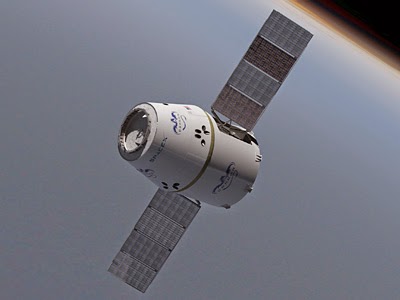
SpaceX Dragon unmanned spacecraft approaches ISS

A contrail is seen behind the SpaceX Falcon 9 rocket carrying a Dragon supply ship as it flies into space after lifting off from Cape Canaveral, Florida, on a resupply mission to the International Space Station, on September 21, 2014

SpaceX's unmanned Dragon spacecraft was nearing the International Space Station on Tuesday with a cargo of supplies, including freeze-dried meals, 20 live lab mice and a 3D printer.

Germany's Alexander Gerst, an astronaut from the European Space Agency (ESA), will operate CanadArm-2, the 57.7-foot (17.6-meter) robotic arm attached to the ISS, to capture the Dragon and bring it in to dock with the space station.

He will be assisted by NASA astronaut Reid Wiseman.

The berthing operation will be complete when the vessel latches fully onto the research outpost about two hours later.

The Dragon capsule is carrying more than 5,000 pounds (2,200 kilograms) of supplies and material for science experiments, including a tool to measure wind speed at the ocean's surface.

The spacecraft launched early Sunday from Cape Canaveral, Florida, and is SpaceX's fourth contracted mission with NASA for supply trips to the ISS and back.

The Rodent Research Hardware System, which will be installed at the International Space Station, includes three modules: the habitat at left, the transporter in the middle and the so-called animal access unit at right. 

Credit: NASA / Dominic Hart

The lab mice are the first live mammals to hitch a ride aboard a commercial cargo ship, and they are enclosed in a NASA-made research cage for studying the effects of weightlessness on their bodies.

This Zero-G Printer is the first 3D printer designed to operate in zero gravity. 

Also on board the SpaceX Dragon capsule is this 3D printer experiment.

The printer was built under a joint partnership between NASA MSFC and Made In Space.

Contracted as the “3D Printing in Zero-G Experiment” this first version of the Zero-G printer will usher in the era of off-world manufacturing.

This initial version of the Zero-G Printer will serve as a test bed for understanding the long-term effects of microgravity on 3D printing, and how it can enable the future of space exploration.

Wednesday, April 9, 2014

Russian Soyuz Launch unmanned cargo spacecraft Progress M-22M

A Russian Soyuz-U booster carrying an unmanned cargo spacecraft Progress M-22M is transported to a launch pad at the Russian leased Kazakhstan's Baikonur cosmodrome early on February 3, 2012

Russia successfully launched an unmanned cargo ship to the International Space Station on Wednesday evening after a spaceship carrying three astronauts experienced a technical glitch last month.

"At 19:35 Moscow time (15:35 GMT), the cargo ship separated from the third-stage booster rockets on schedule," the Russian space agency said in a statement on its website after the Progress M-23M ship blasted off from the Baikonur cosmodrome in Kazakhstan.
The ship carrying 2.5 tonnes of supplies including oxygen, containers of food and water and parcels for the crew is due to dock with the ISS at 01:16 am Thursday (21:16 GMT Wednesday).

The spaceship is following a fast-track route to the international space laboratory that takes just six hours.

Last month, a Soyuz spaceship carrying two Russian cosmonauts and a NASA astronaut, was unable to follow the fast-track route to the ISS after a technical glitch in approach.

The astronauts were forced to spend two days en route to the ISS.

Russia insisted that the glitch was minor and would not prevent future missions from using the fast-track route to the ISS.

NASA has been wholly reliant on Russia for delivering astronauts to the space station since the US retired its space shuttles.

Friday, May 31, 2013

NASA 'Mighty Eagle' Test Flight - Video

The Mighty Eagle, NASA's robotic prototype lander managed out of NASA"s Marshall Space Flight Center, recently completed a test series to monitor its systems functionality after coming out of winter storage.

This latest series included a test flight that was recorded by the Quad-Copter—a small vehicle also developed at Marshall that was equipped with a video camera allowing for never-before-seen footage of the Mighty Eagle.

The Mighty Eagle, nicknamed after one of the characters in the popular Angry Birds game, is a three-legged prototype vehicle.

It is 4 feet tall, 8 feet in diameter and weighs about 700 pounds when fueled. It is a green vehicle, fueled by 90 percent pure hydrogen peroxide, and is guided by an onboard computer that activates the thrusters to power the craft's movements.

"We were approached by the Mighty Eagle team to film the vehicle in flight, and we thought it would be a great collaboration," said Garrick Merrill, a member of the Aero-M team and a computer engineer in the Space Systems Department at Marshall.

"It gave us an opportunity to test the copter in a flight situation, and we were really pleased with the results. It really was a win-win situation for both teams—giving us both important data we can use on future flights." 

The Quad-Copter is an achievement in itself. The vehicle was designed and built by the Aero-M team at Marshall as part of the 2012 Unmanned Aerial Systems, or UAS, competition between various NASA centers.

The Marshall team was made up of young engineers from across the center who were tasked with designing a vehicle that could perform an autonomous search and rescue mission to locate people after a small plane crash.

The Quad-Copter is built with off-the-shelf, hobbyist-grade parts and uses an open-source flight computer.

The initial design of the vehicle uses a two-megapixel IP camera, but for the Mighty Eagle flights the IP camera was removed and a GoPro video camera was attached to provide high-definition video.

Read the full article here

For more information on NASA's robotic landers, visit here.