Showing posts with label test flight. Show all posts

Tuesday, November 11, 2014

NASA Orion's rocket ready for critical December test flight

The high fidelity rehearsal included fully powering up the booster and loading the tanks with cryogenic fuel and oxidizer, liquid oxygen and liquid hydrogen

The huge rocket that will blast NASA's first Orion spacecraft into orbit is ready to Rock 'n' Roll on a critical two orbit test flight scheduled for December.

In addition, Orion is so big and heavy that she's not launching on just any old standard rocket.

To blast the uncrewed Orion to orbit on its maiden mission requires the most powerful booster on Planet Earth, namely the United Launch Alliance Delta IV Heavy rocket.

Liftoff of the state-of-the-art Orion spacecraft on the unmanned Exploration Flight Test-1 (EFT-1) mission is slated for December 4, 2014 from Space Launch Complex 37 (SLC-37) at Cape Canaveral Air Force Station in Florida.

Just days ago, the launch team successfully completed a countdown and wet dress rehearsal fueling test on the rocket itself – minus Orion – at launch complex 37.

The high fidelity rehearsal included fully powering up the booster and loading the tanks with cryogenic fuel and oxidizer, liquid oxygen and liquid hydrogen.

ULA technicians and engineers practiced the countdown on Nov. 5 which included fueling the core stages of the Delta IV Heavy rocket.

"Working in control rooms at Cape Canaveral Air Force Station in Florida, countdown operators followed the same steps they will take on launch day. The simulation also allowed controllers to evaluate the fuel loading and draining systems on the complex rocket before the Orion spacecraft is placed atop the launcher," said NASA.

The next key mission milestone is attachment of the completed Orion vehicle stack on top of the rocket.

Today's scheduled rollout of Orion to the launch pad for hoisting atop the rocket was scrubbed due to poor weather.

The triple barreled Delta IV Heavy booster became the world's (US) most powerful rocket upon the retirement of NASA's Space Shuttle program in 2011 and is the only rocket sufficiently powerful to launch the Orion EFT-1 spacecraft.

The first stage of the mammoth Delta IV Heavy generates some 2 million pounds of liftoff thrust.

"The team has worked extremely hard to ensure this vehicle is processed with the utmost attention to detail and focus on mission success," according to Tony Taliancich, ULA's director of East Coast Launch Operations.


Friday, October 31, 2014

Virgin Galactic's SpaceShipTwo craft suffered an "anomaly" and crashes during a test flight - video

Virgin Galactic's SpaceShipTwo craft crashed Friday after getting into difficulties during a test flight over California.

US press helicopter crew record one person being carried on a stretcher to a waiting helicopter.

The fate of two pilots is unknown, the company said but reports are coming out that 1 has been killed and another seriously injured.


"During the test, the vehicle suffered a serious anomaly resulting in the loss of SpaceShipTwo. Our first concern is the status of the pilots, which is unknown at this time," the firm said in a tweet.

Virgin Galactic's SpaceShipTwo craft suffered an "anomaly" during a test flight over California on Friday, the commercial space flight operator announced on its Twitter feed.

The craft, which is still in its test phase and which normally carries two pilots, had been carried aloft on a bigger aircraft known as WhiteKnightTwo and then released for a test of its rocket engine.
The fate of the crew was not immediately known.

"SpaceShipTwo has experienced an in-flight anomaly. Additional info and statement forthcoming," Virgin said, giving no further details.

WhiteKnightTwo had taken off normally from California's Mojave desert, and been released normally, in what was the 35th such flight.

"SpaceShipTwo has been released by WhiteKnightTwo, and is now flying freely," the firm wrote in a blow-by-blow account of the flight, adding: "Ignition! SpaceShipTwo is flying under rocket power again."

The next tweet announced the "anomaly."

More than 500 people have already reserved seats—and paid a deposit on the $200,000 ticket price—for a minutes-long suborbital flight on SS2.


SpaceShipTwo can carry six passengers.

It is the commercial version of SpaceShipOne, the first private spacecraft to reach the edge of space in 2004, and which is now on displace at the National Air and Space Museum in Washington.

Private companies are rushing to fill the gap left by NASA, which ended its 30-year shuttle program in July with the completion of the final Atlantis mission to the International Space Station (ISS).

Friday's incident is the second involving a space craft this week, after an unmanned Orbital Science rocket exploded on Tuesday six seconds after launch on a resupply mission to the ISS.

Tuesday, May 6, 2014

University of Alaska Fairbanks unmanned aircraft site conducts first test flight

Pilots Mike Cook, left, and Jennifer Haney, present a briefing for those assembled before the Aeryon Scout, similar to the one pictured here in front of them, took off on today's historic flight. 

Credit: University of Alaska Fairbanks (UAF) 

The birds were noisier than the Aeryon Scout as the mini quadcopter whirred over the caribou lounging in the field at the Robert G. White Large Animal Research Station this morning.

The Scout climbed to 200 feet as a crowd of about 50 people silently watched its inaugural flight under the gray overcast sky at Fairbanks, Alaska.

It was a historic first for the University of Alaska Fairbanks (UAF), the Federal Aviation Administration (FAA) and unmanned aircraft operations.

Michael Huerta, FAA administrator, announced this morning in Anchorage that FAA had granted operational status to the Pan-Pacific Unmanned Aircraft Systems Test Range Complex.

Minutes after the announcement, Scout operator Mike Cook took the aircraft to the sky in Fairbanks, the first test mission flight among the six FAA-chosen test sites.

Cook's flight over the caribou was part of a research project to see if the aircraft can be used to observe and collect data about large animals without disturbing them.

"It was picture perfect," said Jay Skaggs, FAA's safety inspector based in Anchorage. "He made aviation history."

UAF's achievement today capped years of work with federal, state and private entities, said UAF Chancellor Brian Rogers.

"Our presence here illustrates an important point about unmanned aircraft work," Rogers said. "It's not simply about the technology, but rather about the application of that technology to real-world needs."

"The test site program is forging ahead just as we expected," said Huerta during the announcement in Anchorage.

"The University of Alaska Fairbanks program is important because it includes a diverse set of test site range locations in seven climatic zones, so it will give us a wealth of data to help develop appropriate safety regulations and standards."

Monday, April 21, 2014

SpaceX F9R Reusable rocket first test flight: Video


SpaceX's F9R reusable rocket prototype launches on its first test flight, a vertical liftoff and landing test that carried the rocket 250 meters above a test pad in McGregor, Texas.

SpaceX Grasshopper Scares Cows

SpaceX currently uses a non-reusable version of the Falcon 9 to launch its Dragon capsules into low-Earth orbit, on commercial resupply missions to the International Space Station.

Making its Falcon 9 a reusable launch vehicle capable of vertical takeoff/vertical landing will save the company a lot of time, money and resources in the long run, and represents a major step on the company's path to commercial spaceflight supremacy.

Tuesday, March 18, 2014

NASA Orion EFT-1: First Test Flight of Orion Space Capsule delayed until December

Artist's concept of a ULA Delta 4 Heavy rocket standing poised on the pad ready to launch NASA's Exploration Flight Test-1 (EFT-1).

The first flight of Orion is now slated for December 2014.

Credit: NASA

he countdown to the maiden launch of Orion, a NASA space capsule designed to take astronauts out into the solar system, is now three months longer than previously planned.

The space agency on Friday (March 14) announced that it was retargeting the first flight of its Orion spacecraft from autumn to just before winter this year.

"The Orion team continues to work toward completing the spacecraft to be ready for a launch in [the] September [to] October [period]," NASA stated on its website.

"However, the initial timeframe for the launch of the Exploration Flight Test-1 (EFT-1) has shifted ... to early December to support allowing more opportunities for launches this year."


The EFT-1 mission will fly the Orion capsule to an altitude of approximately 3,600 miles (5,800 kilometers) above the Earth's surface, more than 15 times farther out than where the International Space Station (ISS) orbits.

By flying out to those distances, NASA will be able to judge how Orion performs in, and returns from, deep-space journeys.

Flying atop a United Launch Alliance (ULA) Delta 4 Heavy rocket, EFT-1 precedes the first flight of the Orion capsule on its intended launch vehicle, NASA's new Space Launch System (SLS), targeted for 2017.

By 2021, NASA plans to send astronauts aboard the Orion spacecraft on a mission to the vicinity of the moon to rendezvous with a redirected asteroid, before ultimately launching a crew to Mars in the 2030s.

Tuesday, September 17, 2013

Boeing's stretched Dreamliner (787-9) completes successful test flight

Boeing's stretched Dreamliner, the 787-9, embarks on its first test flight. Photograph: Elaine Thompson/AP

Boeing has successfully test-flown the stretched version of its 787 Dreamliner as the planemaker tries to move forward from battery fires that culminated in worldwide grounding.

The 787-9 jet landed at 4.18pm at Boeing Field in Seattle. It has room for 290 passengers, 40 more than the original 787-8 jetliner, and about 300 more nautical miles of range.


Boeing hopes it will be more profitable to sell, and for its customers to operate, than the current production model.

In its maiden voyage the 787-9 was scheduled to run detailed tests of its flight controls, part of a nine-month programme. The aircraft used for the tests would eventually be delivered to Air New Zealand in mid-2014, Boeing said.

The jet flew at a speed of up to 366 knots (421mph) and altitude of 20,000ft (6,096 metres), according to flight tracking website Flightaware.com. The trip took it over Puget Sound and then the eastern part of Washington state.


Boeing has unfilled orders for 936 Dreamliners, worth about US$217bn at list prices, or nearly eight years' worth of production at its target construction rate of 10 per month, which it aims to hit by the end of 2013.

About 41% of the orders, or 388 planes, are for the 787-9. Boeing began selling an even longer version of the jet, the 787-10, in June, and has orders for 50 of them. The rest are for the 787-8.

The 787 series has been dogged by problems – overheating and fires related to its next-generation lithium ion battery system caused several emergencies and led to grounding of the jets worldwide.

After they were allowed back into the air, another of the planes was at the centre of drama when a fire broke out near its emergency beacon system, prompting American authorities to issue an airworthiness directive requiring checks on the electrical wiring.

Bombadier CS100
A day before the stretched Dreamliner flight, Bombardier successfully flew its CSeries jetliner, kicking off a renewed effort to sell the all-new narrow-body plane amid questions about its development cost.

The plane brings the Canadian-based company into direct competition for the firist time with the smallest airliners of Boeing and Airbus.

The CS100 test aircraft gently touched down in clear, chilly weather beside the Bombardier plant in Mirabel, Quebec, at 12.23pm on Monday. "It flew very well," said Bombardier chief test pilot Chuck Ellis. "It's a very, very nice airplane."

At a press conference Bombardier said an alert had gone off for one of the subsystems during the flight, without providing details.

The "advisory message" did not affect the plane and would not have required the pilot to land even if the plane had commercial passengers aboard, Ellis said.

The Bombardier CSeries airliner returns from its maiden test flight.

Photograph: Christinne Muschi/Reuters

Montreal-based Bombardier, which also makes trains, is staking a claim in a niche: the single-aisle, 100- to 149-seat class that is midway between the size of so-called "regional" planes and the larger commercial jetliners of Boeing and Airbus.

Bombardier says it can corner half of that market over the next 20 years. Brazil's Embraer SA, the world's number three planemaker, leads in sales of smaller, regional jets.

CSeries sales are at 177 firm orders, far short of Bombardier's goal of 300 by the time the plane enters service in 2014.

Critics say the Canadian design for the medium-haul jet made of lightweight composite materials ignores a trend towards larger aircraft seating 150 people or more as air traffic expands and carriers offer more seats.

Bombardier says its plane will have a 15% cash operating cost advantage, 20% fuel consumption advantage and will be the world's quietest commercial aircraft.

The new jet faces an ambitious 12-month deadline to enter commercial service, and tough sales competition from Boeing's Dreamliner as well as Airbus's A319neo and A320neo models, according to analysts.

The first flight was delayed three times over the last nine months and the plane still faces considerable work in testing, certification and setting up production.

Thursday, June 13, 2013

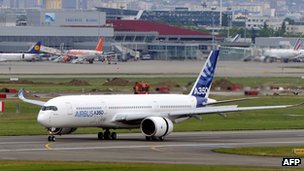
EADS: Airbus A350 set for maiden flight

The A350 is seen as vital to the future of Airbus in its battle with US rival Boeing

The newest aircraft from European planemaker EADS Airbus is due to take off on its maiden flight later.

The Airbus A350 is designed to be more fuel-efficient, and a direct competitor to US rival Boeing's 787 Dreamliner.

It is seen as vital to the future of Airbus, which competes with Boeing to supply the majority of the world's airlines with new planes.

It is due to take off from the French city of Toulouse, where the A350 is assembled, on Friday morning.

The plane will take a short trip to carry out tests, and then land back at Toulouse again.

Boeing's Dreamliner has proved popular since its first flight in 2009, despite recently being grounded by regulators over safety fears relating to its batteries.

Major milestone
Airlines are being squeezed by high fuel costs and falling passenger numbers, and are looking for more fuel-efficient aircraft.

Like the Dreamliner, the A350 is made largely of advanced materials, particularly carbon composites, in order to save weight.

Airbus has already taken more than 600 orders for the new plane. But that still puts it behind the Dreamliner, which has 890 orders so far.

The company hopes to start delivering the first A350s to customers by the end of 2014.

Analysts say a successful test flight would be a major milestone for Airbus in the A350 project, with major aircraft manufacturing projects frequently beset by delays.

Friday, May 31, 2013

NASA 'Mighty Eagle' Test Flight - Video

The Mighty Eagle, NASA's robotic prototype lander managed out of NASA"s Marshall Space Flight Center, recently completed a test series to monitor its systems functionality after coming out of winter storage.

This latest series included a test flight that was recorded by the Quad-Copter—a small vehicle also developed at Marshall that was equipped with a video camera allowing for never-before-seen footage of the Mighty Eagle.

The Mighty Eagle, nicknamed after one of the characters in the popular Angry Birds game, is a three-legged prototype vehicle.

It is 4 feet tall, 8 feet in diameter and weighs about 700 pounds when fueled. It is a green vehicle, fueled by 90 percent pure hydrogen peroxide, and is guided by an onboard computer that activates the thrusters to power the craft's movements.

"We were approached by the Mighty Eagle team to film the vehicle in flight, and we thought it would be a great collaboration," said Garrick Merrill, a member of the Aero-M team and a computer engineer in the Space Systems Department at Marshall.

"It gave us an opportunity to test the copter in a flight situation, and we were really pleased with the results. It really was a win-win situation for both teams—giving us both important data we can use on future flights." 

The Quad-Copter is an achievement in itself. The vehicle was designed and built by the Aero-M team at Marshall as part of the 2012 Unmanned Aerial Systems, or UAS, competition between various NASA centers.

The Marshall team was made up of young engineers from across the center who were tasked with designing a vehicle that could perform an autonomous search and rescue mission to locate people after a small plane crash.

The Quad-Copter is built with off-the-shelf, hobbyist-grade parts and uses an open-source flight computer.

The initial design of the vehicle uses a two-megapixel IP camera, but for the Mighty Eagle flights the IP camera was removed and a GoPro video camera was attached to provide high-definition video.

Read the full article here

For more information on NASA's robotic landers, visit here.

Tuesday, March 26, 2013

Boeing 787 Dreamliner Test Flight 'went to plan'

Boeing has said that a test flight to check the 787 Dreamliner's new battery system "went according to plan".

Boeing redesigned its battery after malfunctions on some planes led to the grounding of the entire 787 fleet.

The firm said it would analyse the data and prepare for another test flight aimed at demonstrating the system to regulators in "coming days".

According to some estimates, Boeing is losing $50m (£33m) per week because of the grounding of the 787 planes.

The grounding has also led to Boeing being prevented from delivering new Dreamliners to customers.

Battery redesign
The Dreamliner 787 is the first plane in the world to use the lithium-ion batteries, which are lighter, hold more power and recharge more quickly.

But incidents relating to battery malfunction earlier this year raised some concerns over its safety and led to the grounding of the fleet.

Nippon Airways Incident
In January, a fire started in a battery pack in a Japan Airlines 787 in Boston. Meanwhile, an All Nippon Airways flight was forced to make an emergency landing because of a battery malfunction.

Boeing has since submitted a plan to the authorities to redesign the battery to ensure its safety.

Its plan includes improving the battery design to stop faults from occurring as well as enhancing the production, operating and testing processes.

At the same time, Boeing said the plan included a new battery enclosure system to prevent any possible overheating from affecting the plane.

Some analysts said that the redesign was likely to help address the concerns surrounding the battery.

"I will give the Boeing engineers the benefit of the doubt that they have designed a box that will handle what the battery can give it," said John Goglia, a former board member of the US National Transport Safety Board (NTSB).

No quick fix
The battery redesign plan was approved by the US Federal Aviation Administration (FAA) earlier this month.

But the regulator had told Boeing to "conduct extensive testing and analysis".

Tuesday, August 14, 2012

NASA Mighty Eagle Takes Flight - Video Gallery


The "Mighty Eagle," a NASA robotic prototype lander, had a successful first untethered flight Aug. 8 at the Marshall Center. During the 34-second flight, the Mighty Eagle soared and hovered at 30 feet, moved sideways, looked for its target and safely landed on the launchpad. 

Credit: NASA/MSFC

The "Mighty Eagle," a NASA robotic prototype lander, is soaring high again for a series of tests being conducted at NASA's Marshall Space Flight Center in Huntsville, Ala.

Since its last round of tests in 2011, the Mighty Eagle team has made significant updates to the guidance controls on the lander's camera, furthering its autonomous capabilities.

The three-legged "green" lander is fueled by 90 percent pure hydrogen peroxide and receives its commands from an onboard computer that activates its onboard thrusters to carry it to a controlled landing using a pre-programmed flight profile.

It is 4 feet tall and 8 feet in diameter and, when fueled, weighs 700 pounds. In this series of tests, which will continue through September, the lander prototype will autonomously fly and hover at 30 feet for two tests, and up to 100 feet for another two tests, and then move sideways, to safely land 30 feet away from the launch pad.

The test demonstrates what it will take to perform the final descent of an autonomous controlled landing on the moon, asteroids or other airless bodies.

"These lander tests provide the data necessary to expand our capabilities to go to other destinations," said Dr. Greg Chavers, engineering manager and warm gas test article lead at the Marshall Center.

"It also furthers our knowledge of the engineering components needed for future human and robotic missions."

NASA will use the Mighty Eagle to mature the technology needed to develop a new generation of small, smart, versatile robotic landers capable of achieving scientific and exploration goals throughout the solar system.

The Mighty Eagle prototype lander was developed by the Marshall Center and Johns Hopkins University Applied Physics Laboratory in Laurel, Md., for NASA’s Planetary Sciences Division, Headquarters Science Mission Directorate.

For more information visit NASA's robotic landers

Monday, March 19, 2012

NASA ER-2 to Check Out MABEL Laser Altimeter

NASA's ER-2 Earth Resources aircraft No. 806 will be flying high-altitude missions over Greenland this spring to validate the accuracy of the newly developed Multiple Altimeter Beam Experiment Lidar. (NASA / Tony Landis)

A NASA ER-2 Earth Resources aircraft based at NASA's Dryden Aircraft Operations Facility in Palmdale, Calif., will be flying a number of high-altitude missions over five weeks this spring to validate the accuracy of a new laser altimeter.

The large air intakes for its powerful engine are obvious as NASA's high-flying ER-2 #806 Earth resources aircraft taxies out for another science mission.
The high-flying ER-2 is scheduled to depart Palmdale on March 22 for a deployment base in Keflavik, Iceland, to test Goddard's Multiple Altimeter Beam Experiment Lidar, or MABEL, that simulates a similar instrument planned for NASA's IceSat-2 environmental satellite scheduled for launch in 2016.

Although not directly connected to the Spring 2012 Operation IceBridge Arctic polar ice survey, the ER-2 flights will be conducted concurrently with many of the same flight tracks being flown by IceBridge mission aircraft.

Operation IceBridge, conducted in the Arctic in March and April and the Antarctic during October and November, is the largest survey of Earth's polar ice ever flown. Although not participating in the Arctic study this spring, NASA's DC-8 flying science laboratory, also based in Palmdale, participates annually in the Antarctic study and has participated in the Arctic study in past years.

Learn more about the 2012 Operation IceBridge Arctic campaign at: http://www.nasa.gov/mission_pages/

Monday, January 9, 2012

NASA Astronaut Douglas Wheeler: Test Flight

Successful test flight today…calm winds and blue sky.

Saturday, November 19, 2011

Video - Blue Origin's Spacecraft test flight


See private spaceship builder Jeff Bezos’s vertical rocket take a short hop during a 2011 test flight by his company Blue Origin.
Credit: Blue Origin

Sunday, September 11, 2011

NASA Orion: Construction begins

Start made on Space Bound Orion

Construction on the first space-bound Orion Multi-Purpose Crew Module began with the first weld at the Michoud Assembly Facility on Sept. 9. 2011.

This capsule will be used during Orion's first test flight in space.

After welding is completed at Michoud, the Orion spacecraft orbital test article will be shipped to NASA’s Kennedy Space Center, where the heat shield will be installed. At Kennedy, it will undergo final assembly and checkout operations for eventual flight.

Credit: NASA

Saturday, September 3, 2011

Amazon Spaceship fails on test flight

An unmanned spacecraft bankrolled by Amazon.com supremo Jeff Bezos has failed during a test flight.

The vehicle became unstable at 45,000 feet and ground controllers had to terminate it as a precaution. Additional details about what went wrong were not released.

"Not the outcome any of us wanted, but we're signed up for this to be hard," Amazon chief executive Mr Bezos wrote in a blog post.

Mr Bezos founded Blue Origin to develop a vertical take-off and landing rocketship that would fly passengers to suborbital space. It recently won money from Nasa to compete to go into orbit as a space taxi now that the space shuttle fleet is retired.

The mishap occurred during a test flight last week from Blue Origin's West Texas spaceport. The ultra-secretive company notified the Federal Aviation Administration about the launch and only acknowledged the accident publicly yesterday.

The Wall Street Journal, which first reported the failure, said the test did not use government funds and was not part of the development agreement with Nasa.

Blue Origin's failure shines a spotlight on the risks of commercial space ventures.

SpaceX, which has a Nasa contract to develop a commercial vehicle to haul supplies and astronauts, suffered three rocket failures before it found success. Later this year, the company, run by PayPal founder Elon Musk, will launch a capsule on a cargo test run to the International Space Station.

Virgin Galactic, founded by the UK hedonist Richard Branson, lost three workers in 2007 after an explosion rocked a California airport during testing of a propellant system for its space tourism vehicle.

The company is currently conducting flight tests in the Mojave Desert and has not yet been able to set a potential date for the first passenger flights.

Friday, August 26, 2011

NASA's Next Generation Robotic Lander Gets Sideways During Test

During a recent test at NASA's Marshall Space Flight Center in Huntsville, Ala., the robotic lander prototype, known as Mighty Eagle, performed a hover test flying up to three feet and then translated, or moved itself sideways, to perform a controlled, safe landing 13 feet from the launch pad.

This is a complex manoeuvre for the lander to perform accurately since a robotic lander may need to right itself autonomously when it comes in for landing on an airless body or planet with no atmosphere.

The robotic lander team cancels out the Earth's gravity, which is six times the gravity a vehicle will experience on the moon, simulating a lunar environment by using a gravity cancelling thruster during test.

To initiate a test, the lander receives a command to activate its onboard thrusters and then follows a pre-programmed flight profile to carry it to a controlled landing.

This test demonstrated the robotic lander prototype's capability to autonomously translate sideways and then land while staying under control, and soon will be used to checkout landing control algorithms for the next generation of lander missions to the moon or other airless planetary bodies.

The Robotic Lander Development Project is a team of industry, government and not-for-profit collaborators, including the Marshall Center, Johns Hopkins University Applied Physics Laboratory in Laurel, Md., and the Von Braun Center for Science and Innovation in Huntsville.

This team is designing and building the next generation of robotic landers that can carry a broad range of science payloads and devices, including geophysical measurement instruments, volatile measurement instruments or possibly lunar sample returns.

Friday, June 17, 2011

NASA - ACAT F-16D Flight Test

In this image from November 2010, the U.S. Air Force's ACAT F-16D flew through Sierra Nevada canyons and past peaks during ground collision avoidance test flights.

The ACAT, which stands for Automatic Collision Avoidance Technology, aircraft took off from Edwards Air Force Base on a flight originating from NASA’s Dryden Flight Research Center.

Researchers at Dryden are working with the Air Force Research Laboratory in the ACAT Fighter Risk Reduction Project to develop collision avoidance technologies for fighter/attack aircraft that would reduce the risk of ground and mid-air collisions.

Image Credit: NASA/Carla Thomas

Monday, March 21, 2011

Boeing's new 747 completes first test flight - Business - U.S. business - Aviation - msnbc.com

The Boeing 747-8 Intercontinental is followed by a chase plane after taking off on its maiden flight from Paine Field, in Everett, Washington
Credit Robert Sorbo

The Boeing 747-8 Intercontinental is followed by a chase plane after taking off on its maiden flight from Paine Field, in Everett, Washington.


Boeing Co's 747-8 Intercontinental, the new passenger version of its legendary jumbo jet, completed its maiden flight without a hitch on Sunday, marking a key milestone for the aircraft model more closely associated with Boeing than any other plane.

The behemoth began its first test flight from Boeing's Paine Field north of Seattle into clear blue skies at 9:58 a.m. local time. The take-off, witnessed by thousands of Boeing employees and aviation enthusiasts, occurred almost 42 years after the first flight of the original 747, which later became one of the most recognized planes in the world.

After almost four and half hours in the air, the red and white plane landed safely at Boeing Field just south of central Seattle.

The 747-8 Intercontinental will seat 467 passengers, 51 more than the current version of the 747. It promises to burn less fuel and offer more passenger comforts. The plane also boasts new wings, a new tail, state-of-the-art engines and a new cockpit.

The 747 was the world's largest airplane until 2005, when Airbus unveiled its 525-seat A380.

Boeing has taken orders for 33 747-8 passenger planes, according to the company website on Friday. The plane lists at $317.5 million.

Germany's Lufthansa has ordered 20 of the planes, and is set to be the first airline to bring the new jumbo into service early next year.

Production of the new 747 has been delayed as has the mid-sized 787 Dreamliner, a carbon-composite plane, which represents a bigger leap in technology than the revamped 747-8.

The stronger-selling freighter version of the 747 has already flown and is due to be delivered in mid-2011 -- 18 months later than first planned. Boeing has sold more than 70 747-8 freighters.

Tuesday, December 1, 2009

Airbus A400M Military transport plane test flight imminent

Airbus' long-delayed A400M military transport will make its first test flight during the week beginning December 7, "weather permitting", the European planemaker said Friday.

The A400M was to replace ageing military cargo carriers in several European air forces but its development has been dogged by a series of serious technical problems and its in service date has been pushed from 2009 to 2013.

Some governments have begun to tire of waiting for Airbus to resolve the issues, and French and German officials have given the firm until the end of the year to prove that the project remains viable.

"Ground tests of the first A400M are progressing satisfactorily at our facility. This allows us to anticipate a first flight in the week 50, weather permitting," said Airbus military chairman and managing director Domingo Urena.

When the 20-billion-euro (28-billion-dollar) A400M project began it was hoped that a first test flight would be held in 2008 and that air forces would have had the airframe in service by the end of this year.

There is now little hope that the first production models will be delivered by 2012 and none is expected on the world's battlefield airstrips until 2013.

The delays have cost millions and forced Airbus to renegotiate its contracts with several customers. South Africa has dropped its order entirely and Britain has mulled switching is business to US manufacturers.

Seven European countries -- Belgium, Britain, France, Germany, Luxembourg, Spain and Turkey -- have ordered 180 planes between them, in most cases to replace ageing Transall and C130 Hercules transports.

Friday, July 10, 2009

NASA Test Launch Abort System


The Max Launch Abort System, an astronaut escape ship alternative to NASA's tower-based choice on the Orion vehicles, launched at 6:26 a.m. EDT on July 8, 2009 from the Wallops Flight Facility in Virginia. Credit: NASA/Sean Smith