Showing posts with label European. Show all posts

Saturday, December 6, 2014

European MATROSHKA experiment reveals safer levels of hazardous radiation


Interior structure of the phantom used in the MATROSHKA experiment. 

White tubes contain sets of thermoluminescent detectors. 

Half of these detectors was manufactured by the Institute of Nuclear Physics of the Polish Academy of Sciences in Krakow, Poland. 

Image courtesy DLR.

Analysis of data from the MATROSHKA experiment, the first comprehensive measurements of long-term exposure of astronauts to cosmic radiation, has now been completed.

This experiment, carried out on board and outside of the International Space Station, showed that the cosmos may be less hostile to space travellers than expected.

Among the many life-threatening hazards to the space traveller, cosmic radiation is a major one, considerably limiting the time astronauts may spend in space without incurring excessive risk to their health from too high a dose of this ionizing radiation.

To determine the actual doses of radiation which astronauts undergoing long-term space travel are exposed to, the European Space Agency (ESA) in collaboration with research institutions from Germany, Poland, Austria, Sweden and Russia, designed and carried out the MATROSHKA experiment.

A phantom closely mimicking the human body was fitted with several thousand detectors, most of which were manufactured at the Institute of Nuclear Physics of the Polish Academy of Sciences (IFJ PAN) in Krakow, Poland.

These detectors recorded the doses from cosmic radiation inside the International Space Station and outside, in open space, over a few years.

The painstaking analysis of the MATROSHKA data has just been completed, yielding somewhat unexpected results.

"One may say that we found open space to be a bit less hostile to humans than expected. The effective doses, related to the health risk of the astronauts and calculated from measurements with our detectors, were lower than those indicated by dosimeters worn by the astronauts", says Dr. Pawel Bilski, an Associate Professor at IFJ PAN.

A specially adapted humanoid phantom used in medical research, in which real human bones were placed inside a plastic "body" simulating the shapes and densities of soft tissues or lungs in the human body, was used to measure doses of cosmic radiation.

Matroshka with ISS Expedition 11 Commander Sergei Krikalev (left) and ISS Expedition 11 Flight Engineer John Phillips (right)

Credit: ESA

The mannequin (a torso without legs) consisted of 33 slices of 2.5 cm thickness each. The measuring equipment was located inside these slices and included sets of passive thermoluminescent detectors placed in plastic tubes.

Thus, a three-dimensional rectangular grid of measurement points was created inside the phantom by six thousand thermoluminescent detectors. Over three thousands of these detectors were manufactured at the IFJ PAN.

This experimental design enabled the researchers to accurately determine the spatial distribution of dose inside the phantom, to evaluate doses absorbed in particular organs of the human body, and finally to establish the value of the so-called effective dose, which is considered to be an estimate of the radiation hazard to humans.

"Our thermoluminescent detectors are thin white pellets of 4.5 mm diameter. We produce them out of lithium fluoride, adding some carefully selected dopants", explains Prof. Pawel Olko, Scientific Director of IFJ PAN.

The dopants spoil the regular structure of the crystal lattice of lithium fluoride in the thermoluminescent detector and create additional forbidden energy levels, which may act as traps for free electrons created by cosmic radiation in this lattice.

The number of such trapped electrons gradually increases with dose absorbed in the detector.

When the exposed detector is next heated in the laboratory, the trapped electrons are released and emit light, the amount of which is proportional to the dose absorbed in the detector, and can be accurately measured.

The main hazard to the astronaut's health due to exposure to cosmic radiation is the increased probability of developing cancer in his or her body.

This probability however is quite dependent on the type of radiation the astronaut is exposed to.

Most of the natural sources of ionising radiation on Earth produce electromagnetic radiation of high energy; gamma rays.

On the other hand, in cosmic rays, energetic protons or heavier ions dominate, which are much more effective in creating cancer cells.

Thermoluminescent detectors are unable to distinguish between gamma rays or ions, therefore the phantom was also equipped with plastic track detectors in which tracks of protons or heavier ions could be measured.

The mannequin on board of the International Space Station (ISS), with thermoluminescent and plastic detectors inside its "body", was also dressed in a "poncho" with additional detectors, simulating the personal dosimeters worn by astronauts.

Thus, doses recorded by individual dosimeters of the ISS crew could be compared with those actually absorbed inside their bodies.

The MATROSHKA facility basically consists of a human phantom upper torso, a Base Structure and a Container with a total weight of about 65 kg.

Credit: HAMLET project

Over the years 2004-2009 the MATROSHKA mannequin underwent three exposures to cosmic radiation, each lasting a year of more.

Two of these exposures occurred inside the Russian modules of the space station and for one exposure the phantom, in a container imitating the shielding properties of a spacesuit, was placed in open space outside the ISS. Such measurements have never been done before.

After returning the detectors to Earth, their painstaking readout and analysis of the complete data set gathered within the MATROSHKA experiment were carried out by teams of scientists at the IFJ PAN in Krakow, the German Aerospace Center (DLR) in Cologne and at the Technical University of Vienna.

Their overall conclusion was that the individual dosimeters worn by the crew inside the ISS overestimated the actual dose measured inside the phantom by about 15%. However, in open space this overestimation exceeded 200%.

"We must remember that measurements within the MATROSHKA experiment were performed at low Earth orbit where the Earth's magnetosphere significantly reduces the number of charged particles from cosmic radiation. In interplanetary space there is no such shielding", notices Dr. Bilski.

From the results of the MATROSHKA experiment the scientists conclude that travel of astronauts to the Moon or to Mars may be somewhat safer in terms of their radiation hazard than presumed so far.

Nevertheless, the doses the space travellers are likely to receive, even though being lower than thought earlier, would still remain dangerously high.

The extensive analysis of the data gathered within the MATROSHKA experiment was supported by the HAMLET project, within the 7th EU Framework programme.

Thursday, September 25, 2014

El Niño 2014: Ocean Circulation - Signs of a modest return

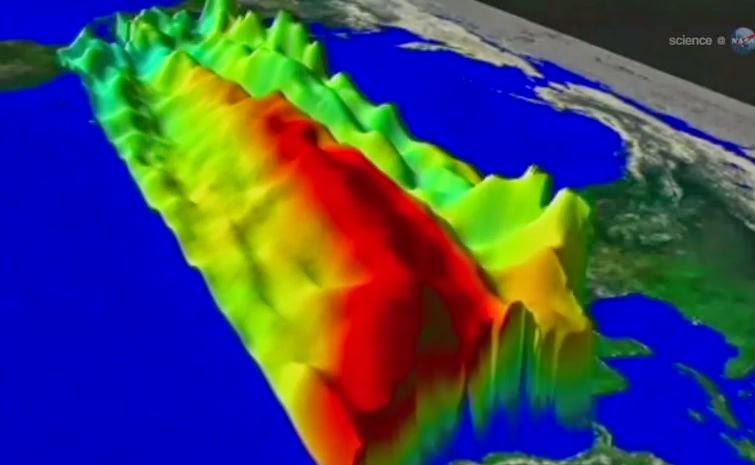
The image shows Kelvin waves of high sea level (red/yellow) crossing the Pacific Ocean at the equator. 

The waves can be related to El Niño events. Green indicates normal sea level, and blue/purple areas are lower than normal. 

Data are from the NASA /European Jason-2 satellite, collected Sept. 13-22, 2014. 

Image credit: NASA/JPL-Caltech

Prospects have been fading for an El Niño event in 2014, but now there's a glimmer of hope for a very modest comeback.

Scientists warn that unless these developing weak-to-modest El Niño conditions strengthen, the drought-stricken American West shouldn't expect any relief.

The latest sea-level-height data from the NASA /European Ocean Surface Topography Mission (OSTM) /Jason-2 satellite mission show a pair of eastward-moving waves of higher sea level, known as Kelvin waves, in the Pacific Ocean, the third such pair of waves this year.

Now crossing the central and eastern equatorial Pacific, these warm waves appear as the large area of higher-than-normal sea surface heights (warmer-than-normal ocean temperatures) hugging the equator between 120 degrees west and the International Dateline.

The Kelvin waves are traveling eastward and should arrive off Ecuador in late September and early October.

A series of larger atmospheric "west wind bursts" from February through May 2014 triggered an earlier series of Kelvin waves that raised hopes of a significant El Niño event.

Just as the warming of the eastern equatorial Pacific by these waves dissipated, damping expectations for an El Niño this year, these latest Kelvin waves have appeared, resuscitating hopes for a late arrival of the event.

For an overview of 2014's El Niño prospects and Kelvin waves, please see: phys.org/news/2014-05-el-nino.html

This latest image highlights the processes that occur on time scales of more than a year but usually less than 10 years, such as El Niño and La Niña.

The image also highlights faster ocean processes such as Kelvin waves. As Patzert says, "Jason-2 is a fantastic Kelvin wave counter."

These processes are known as the interannual ocean signal. To show that signal, scientists refined data for this image by removing trends over the past 21 years, seasonal variations and time-averaged signals of large-scale ocean circulation.

For a more detailed explanation of what this type of image means, visit: sealevel.jpl.nasa.gov/science/… lninopdo/latestdata/

For a time sequence of the evolution of the 2014 El Nino, visit: sealevel.jpl.nasa.gov/science/… /latestdata/archive/

Friday, May 23, 2014

Orion-MPCV-ESM: European service module for Orion approved by ESA

Orion-MPCV-ESM. 

Image courtesy ESA.

The European Space Agency (ESA) has approved the world's second largest space company Airbus Defence and Space's system (EADS) design of the European Service Module (ESM) for the American human Multi-Purpose Crew Vehicle (MPCV) Orion, containing the critical propulsion, power supply and components of the life-support systems of the spacecraft.

This approval gives the green light for the implementation phase, meaning that the initial hardware can now be built in the form of a structural test model.

This model will initially be used for static tests, which are due to start in the next few months. Dynamic tests e.g. simulating loads during launch will then follow over the course of next year.

This is the first time that Europe is producing critical space components for the American Orion mission.

In December 2012, US space agency NASA and the ESA agreed to certify the US' new Orion MPCV in conjunction with the ESM.

This module is based on the design and the experience gained from the Automated Transfer Vehicle (ATV) developed and constructed by Airbus Defence and Space on behalf of ESA and used to carry supplies to the International Space Station.

"The approval of our system design by ESA together with NASA and prime project contractor Lockheed Martin Space Systems is a significant step in the programme."

"We have demonstrated the project's maturity and are now able to move from the paper-based stage to producing the actual hardware," said Francois Auque, Head of Space Systems.

"The fact that NASA has entrusted Europe with system-critical elements is a clear sign of its confidence in the transatlantic partnership and in its European partners' capabilities.

Thomas Reiter
Airbus Defence and Space (EADS) and its European partners have, with ATV, developed and constructed a technological showcase project, thus paving the way for this cooperation," said Thomas Reiter, ESA Director of Human Spaceflight and Operations.

The intention is to use the Orion MPCV for human missions to the Moon, to asteroids and into deep space. Lockheed Martin Space Systems is developing and constructing the space capsule for four or more astronauts on behalf of NASA.

The MPCV-ESM, which is being developed and built by Airbus Defence and Space and based on the ATV, will provide spacecraft propulsion, power supply and life-support systems.

An initial Orion mission, or "Exploration Mission 1", is planned to be an unmanned distant retrograde mission to the lunar Lagrangian points.

The aim of this mission is not only to demonstrate the spacecraft's performance capabilities before it flies with astronauts, but also to achieve qualification for NASA's new Space Launch System rocket. As part of "Exploration Mission 2", the Orion MPCV is scheduled to be launched into space in 2021/22 with astronauts on board.

Sunday, April 20, 2014

ISS Node 2: Built in Italy by ESA

Node 2 (Harmony) is a European-built module of the International Space Station that serves as and integral part of the space station structure.

It is currently functioning as a utility room, docking port and sleeping quarters. 

It was built in Italy for NASA and installed on the Space Station in 2007.

Credit: Edgar Martins

Martins shot the exterior of a Node 2 mock-up in the Erasmus centre in ESA’s scientific and technical heart at ESTEC in Noordwijk, the Netherlands.

In space the docking ports are used to connect spacecraft such as the Japanese ferry HTV, commercial supply ship Cygnus and NASA’s Space Shuttle before it retired from service.

NASA refer to Node 2 as the Harmony module and it serves as an integral part of the  space station.

It was built under a Memo of Understanding (MOU), which forms part of a portfolio of collaborative agreements between NASA and ESA.

MOUs and other collaborative agreements limit the exchange of monetary funds between nations, while at the same time advancing the exploitation and exploration of Space in a mutually beneficial manner.


Thursday, February 20, 2014

ESA PLATO: 34 European space telescopes will investigate one million stars

This is what the planet-hunter PLATO could look like. 

The image shows a concept presented by Thales Alenia Space. 

Credit: ESA

The exploration of planets around stars other than the Sun, known as extrasolar planets or 'exoplanets', is one of the most exciting topics of 21st century science.

One of the key goals of this research is to discover and learn the properties of Earth-like worlds in the Sun's neighbourhood.

ESA, the European Space Agency, will do this in preparing a new space mission named PLATO.

The mission's launch is scheduled for 2024, and firm discoveries of Earth-like planets at Earth-like distances from stars similar to our Sun will be produced after three years of observational data have been collected.

ESA's Science Programme Committee voted for PLATO at its regular meeting in Paris on 19th and 20th February, 2014, where it was one of five proposed space projects for a so-called "M" mission.

Not a single Earth-like exoplanet in a habitable zone around a star similar to our Sun has been found and characterized yet. PLATO will be a pioneer in finding new worlds for humanity to explore.

The PLATO Science consortium is led by Don Pollacco from the University of Warwick who comments

"This is fantastic news for Europe, PLATO will allow the first systematic survey of nearby planets for indications from advanced life forms (as well as slime)."

"A few years ago this would have been science fiction and now its coming to pass as science fact."

The UK also has major roles in the instrument itself supplying the CCD sensors (e2V Technology and UCL), much of the image processing software (Cambridge) and Public Outreach (Open University).

Heike Rauer
The PLATO mission itself is led by Dr Heike Rauer at DLR, the German Aerospace Center. "PLATO will begin a completely new chapter in the exploration of extrasolar Planets" Dr Rauer confidently predicts.

"We will find planets that orbit their star in the life-sustaining 'habitable' zone: planets where liquid water is expected, and where life as we know it can be maintained." she continued.

PLATO will measure the sizes, masses, and ages of the planetary systems it finds, so detailed comparisons with our own Solar System can be made.

"In the last 20 years more than one thousand exoplanets have been discovered, with quite a few multi-planetary systems among them", Rauer explains.

"But almost all of these systems differ significantly from our Solar System in their properties, because they are the easiest-to-find examples."

"PLATO firmly will establish whether systems like our own Solar System, and planets like our own Earth are common in the Galaxy."

This is a concept image of Plato by EADS Astrium, ESA's preferred supplier for space technology. 

PLATO, is an acronym for PLanetary Transits and Oscillations of Stars.

PLATO will find planets through the periodic dimming of the detected starlight caused by a planet orbiting in front of the star, blocking PLATO's view of a fraction of the starlight.

PLATO will also measure tiny changes in detected starlight caused by small vibrations in the host stars, performing so-called astroseismology.

Just as in seismology of the Earth, these vibrations reveal the interior structure of the vibrating body. Astroseismology allows us to learn the age of the vibrating star and the planets orbiting around it.

A new type of space telescope
ESA's PLATO is a completely new type of space telescope: it will use an array of telescopes rather than a single lens or mirror.

PLATO will use top quality cameras, and will have the advantage of observing continuously from space, without the interruption of sunrise, or the blurring caused by the Earth's atmosphere.

This will allow PLATO to discover planets smaller than Earth, and planets at distances from their host stars similar to the Earth-Sun distance.

So far, only a few small exoplanets are known at star-planet distances comparable to or greater than Earth's.

Unlike previous missions, PLATO will focus on these planets, which are expected to resemble our own Solar System planets.

European Southern Observatory's European Extremely Large Telescope (E-ELT)

ESA will take on a leading role in the search for extrasolar planets

PLATO is a lively and vigorous European collaboration, many European research institutions and hundreds of European researchers are working together, with scientists from all over the world completing the team.

The catalogue of potentially habitable planets provided by PLATO will be the basis for follow-up measurements to confirm discoveries of new planets, using the ESO's E-ELT, or the next generation of large space telescopes, like NASA's James Webb Space Telescope.

With PLATO, Europe will be leading the search for habitable exoplanets.

So far only a few exoplanets have had their mass, radius and age determined precisely. This is needed to properly describe a planet.

"The observation of planets in many different states of their evolution will give us clues for the past and the future of our own planetary system", Dr Rauer remarked.

"By no means do we know all about the youth of our Solar System."

Read the full article here

Friday, December 6, 2013

Carmat SA: European Space technology leads to artificial heart development

Four test patients suffering from terminal cardiac failure will soon receive artificial hearts from the French company Carmat, now approved for human trials in France. 

Brainchild of the cardiac surgeon Professor Alain Carpentier, the prosthetic is the result of 15 years of collaboration with aerospace giant Astrium, the space subsidiary of EADS. 

Credit: Carmat

An artificial heart containing miniaturised space technology will soon beat inside a person, having now been approved for human trials in France.

With heart disease killing over 100 million people in developed countries alone and the demand for transplants far exceeding donations, creating a totally artificial heart has been the holy grail of cardiovascular medicine for half a century.

Brainchild of the visionary cardiac surgeon, Professor Alain Carpentier, the prosthetic is the result of 15 years of collaboration with aerospace giant Astrium, the space subsidiary of EADS.

In 2008, with support from the French Government and investors, Prof. Carpentier founded the EADS spin-off company, Carmat, to complete the work.

Combining the unique expertise of Prof. Carpentier, known worldwide for inventing today's most used heart valves, with Astrium's experience in building satellites, Carmat produced their first completely artificial heart earlier this year.

The Carmat-developed prosthetic heart has been developed utilising the expertise and technologies from European space programmes. 

In particular, the expertise in guaranteeing the extreme reliability of electronics on satellites helped the Carmat team to build a device that could withstand the tough conditions of the body’s circulatory system and pump 35 million times per year for at least five years without fail. 

Credit: Carmat

It turned out that space had the ingredients that Carmat needed. Working closely with satellite engineers, the company applied EADS Astrium's expertise in building spacecraft to guarantee the necessary precision and durability for an artificial human organ like a heart.

Fashioned in part from biological tissue and in part from miniature satellite equipment, the device combines the latest advances in medicine, biology, electronics and materials science to imitate a real heart.

The team had to build a device that could withstand the tough conditions of the body's circulatory system and pump 35 million times per year for at least five years without fail.

They needed the ultimate in reliability, and the answer came from design methodologies, testing strategies and know-how for the electronics on satellites.

"Space and the inside of your body have a lot in common," says Matthieu Dollon, Head of Business Development in EADS Astrium's French Elancourt Equipment team, who are working closely with Carmat on the heart.

"They both present harsh and inaccessible environments."

Telecom satellites are built to last 15 years on their own in space, 36 000 km above Earth. The heart might be closer than a satellite but it is just as inaccessible.

Read the full story here

Monday, August 19, 2013

MOBISERV: European funded Robot Companion for the Elderly

A highly customisable robot companion designed by EU-funded researchers to offer support to older people is currently being presented across Europe and could find its way into people's homes within two or three years, potentially greatly enhancing quality of life for older citizens and people with memory or mobility problems.

The robot, a mobile wheeled semi-humanoid figure equipped with cameras, sensors, audio and a touch screen interface, can remind users to take their medicine, suggest they have their favourite drink or prompt them to go for a walk or visit friends if they haven't been out for a while.

As part of a larger smart-home environment that can include smart clothing to monitor vital signs, the system can monitor user's health and safety, and alert emergency services if something is amiss.

'Across Europe, populations are growing older, and many people need care in some way. Care may be provided by professionals at home or in a care facility, but often the caregiver is the person's partner or another family member.

What we are seeing is that carers may also need additional support themselves, especially if they are also older - our vision is that technology can provide it,' explains Mr Herjan van den Heuvel of Smart Homes (Eng), the Dutch Expertise Centre on Home Automation and Smart Living, which oversaw the robot's development.

The median age across the European Union's current 28 Member States, which was around 41.2 years in 2011, is projected to rise to 47.6 years by 2060, while the number of people aged 65 and over will almost double to make up 29.5 % of the population, according to Eurostat's latest population projections.

Meanwhile, the percentage of people aged 80 and above is expected to triple by 2060.

With age-related illnesses also set to increase in line with that trend, more and more people across Europe will need care and assistance if they are to maintain their quality of life, stay healthy and avoid social exclusion.

Developed over 33 months by a consortium of research institutes, universities and technology companies in seven European countries - Finland, France, Greece, Italy, the Netherlands, Switzerland and the United Kingdom - the companion robot helps address those issues.

It is just one of several results of an EU-funded project titled 'An integrated intelligent home environment for the provision of health, nutrition and well-being services to older adults' ( MOBISERV), which received EUR 2.75 million in research funding from the European Commission.


Thursday, June 13, 2013

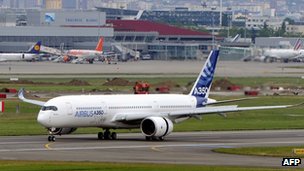
EADS: Airbus A350 set for maiden flight

The A350 is seen as vital to the future of Airbus in its battle with US rival Boeing

The newest aircraft from European planemaker EADS Airbus is due to take off on its maiden flight later.

The Airbus A350 is designed to be more fuel-efficient, and a direct competitor to US rival Boeing's 787 Dreamliner.

It is seen as vital to the future of Airbus, which competes with Boeing to supply the majority of the world's airlines with new planes.

It is due to take off from the French city of Toulouse, where the A350 is assembled, on Friday morning.

The plane will take a short trip to carry out tests, and then land back at Toulouse again.

Boeing's Dreamliner has proved popular since its first flight in 2009, despite recently being grounded by regulators over safety fears relating to its batteries.

Major milestone
Airlines are being squeezed by high fuel costs and falling passenger numbers, and are looking for more fuel-efficient aircraft.

Like the Dreamliner, the A350 is made largely of advanced materials, particularly carbon composites, in order to save weight.

Airbus has already taken more than 600 orders for the new plane. But that still puts it behind the Dreamliner, which has 890 orders so far.

The company hopes to start delivering the first A350s to customers by the end of 2014.

Analysts say a successful test flight would be a major milestone for Airbus in the A350 project, with major aircraft manufacturing projects frequently beset by delays.

Thursday, June 6, 2013

ESA ATV-4: European cargo freighter Albert Einstein separates from Ariane-5 launcher

Europe's heaviest-ever cargo carrier to the International Space Station successfully separated from its rocket launcher an hour after liftoff on Wednesday to start a 10-day journey to the International Space Station (ISS).

The Automated Transfer Vehicle (ATV) Albert Einstein was rocketed into space from Europe's spaceport in Kourou, French Guiana, on an Ariane 5 launcher at 6:52:11 pm local time (21:52:11 GMT).

It separated as planned on reaching an altitude of 260 kilometres (160 miles).

"ATV Albert Einstein has separated from our launcher," Stephane Israel, chief executive of satellite launch firm Arianespace announced at the control centre in Kourou.

The ATV-4 is ferrying a record cargo of 6.6 tonnes to the ISS—food, fuel, water, oxygen, science experiments and special treats for the orbiting crew.

The robot freighter must now deploy its four energy-generating solar panels to start its autonomous navigation, guided by starlight, to the space station.

It is set to dock with the ISS on June 15 at an altitude of 400 kilometres (250 miles) above the planet—at a speed of some 28,000 kilometres (18,000 miles) per hour.

Sunday, April 14, 2013

ESA European Astronaut Luca Parmitano Training


In less than three years, ESA Astronaut Luca Parmitano has travelled between all five international partners' training sites, gaining the knowledge and skills required for his mission.

His tailored training has taken him to Houston, USA, Star City near Moscow, Russia, Tsukuba near Tokyo, Japan, Montreal, Canada, and the European Astronaut Centre in Cologne, Germany.

Critical tasks are trained over and over. As Soyuz flight engineer, Luca requires a great amount of 'flying hours' in the Russian spacecraft simulator, so he trained until he felt at home in the cockpit and can operate Soyuz flawlessly in any situation.

During simulations, Luca had his hands at the controls of the spacecraft and wore the Russian Sokol flight suit.

Luca has been taught Space Station systems in full-size mockups, where he familiarised himself with the Station and learnt how everything works.

He is trained in all systems and experiment operations scheduled for his mission. He has spent hours getting to know every corner of Europe's Columbus laboratory, which forms a major part of the ISS.

Most of the experiments that Luca will carry out are based in the ESA ISS Columbus lab.

Dressed in a spacesuit, Luca also trained to perform spacewalks in one of the largest swimming pools in the world on realistic mockups of the Space Station.

Exchange tweets with Luca Parmitano on Twitter

Friday, December 7, 2012

ESA GMES the European Embattled GMES Faces up to Good and Bad News

The Sentinel 3 satellite is part of the GMES constellation. 

Credit: ESA artist's concept.

Europe’s broad environment-monitoring system is facing a 35 percent cut to its seven-year budget as its putative owner, the European Union (EU), struggles with its members about financing, European government and industry officials said.

For the Global Monitoring for Environment and Security (GMES) (video) program, the good news is that the 27-nation union’s executive commission has reinserted the satellite-based system into its multi-annual financial framework, which covers spending between 2014 and 2020.

In mid-2011 the commission had proposed to fund GMES separately, in ways that several governments and prospective GMES users said would put the entire program at risk.

The 20-nation European Space Agency (ESA), which is building the initial GMES satellites, called Sentinels, continues to have trouble persuading its governments to continue the work in the absence of a firm EU commitment to pay to operate the system.

While the most recent budget indications are that the European Commission will assume ownership of GMES and fund the program’s operations, no formal commitment has been made and will not be made until the commission’s overall budget stalemate is resolved.

Attending the European Space Solutions conference and exhibition here Dec. 3-5, government and industry officials said the bad news for GMES is that the commission now proposes to spend about 3.8 billion euros ($5 billion) on the program over the seven-year budget period, and not the 5.8 billion euros originally proposed.

Officials said that given the continued discord among European Union governments about the trillion-euro seven-year budget, and especially its agricultural-support payments, the GMES budget is not yet stabilized.

A final budget is now not expected until early 2013.

An industry official said one way the program might stretch its available funding is to stagger the launches of the first Sentinel satellites. 

The Sentinel 1, Sentinel 2 and Sentinel 3 radar and optical Earth observation satellites were expected to be ordered in batches of three to achieve economies of scale among the prime contractors and assure GMES users that there would be no interruption to the flow of satellite data in the coming years.

“What we can do, if necessary, is reduce the in-orbit redundancy that had been built into the original manufacturing schedule for the Sentinels,” the industry official said. 

“This does involve adding risk to the program in the event of a launch failure or an in-orbit failure. But it is one way to cope with the budget cuts that are now being discussed.”

The three-day conference here, organized by the U.K. Space Agency and the European Commission, put a spotlight on the wide applications expected for GMES in agriculture, border control, pollution monitoring, resource management and even public health.

Numerous officials here pointed out the irony of the fact that even as GMES’s relevance appears to be growing with each new example of climate change, its budget is taking such a substantial hit.

All-electric Satellites: European SAFT Batteries for Initial Boeing 702SP Satellites

The Satmex 7 satellite (above) will use SAFT lithium-ion battery packs for propulsion.

Credit: Boeing artist's concept.

Battery manufacturer Saft of Paris will provide lithium-ion battery packs to power the first batch of Boeing 702SP all-electric satellites under a multimillion-dollar contract, Saft announced Dec. 5.

Under the contract, whose precise value was not disclosed, Saft’s Cockeysville, Md., plant will deliver battery packs for the four 702SP satellites Boeing is building for commercial fleet operators Asia Broadcast Satellite of Hong Kong and Mexico’s Satmex.

The two operators have ordered two 702SP satellites each, inaugurating a new product line for Boeing and introducing the world’s first all-electric commercial telecommunications satellites.

Using electric propulsion instead of conventional chemical fuel saves up to 50 percent of a satellite’s launch weight, allowing owners to save on launch costs. The tradeoff is that with electric propulsion it takes several months for a spacecraft to reach final geostationary orbit.

The ABS-3A and Satmex 7 satellites are scheduled to be launched together aboard a Falcon 9 rocket operated by Space Exploration Technologies Corp. of Hawthorne, Calif. Each satellite will weigh between 1,900 and 2,100 kilograms at launch.

The two other satellites ordered under the same contract will be completed later.

The satellites will be capable of generating 8 kilowatts of power to their payloads. Saft said it will be delivering the batteries in 2013 and 2014.

Boeing’s order with Saft is the fourth contract under a long-term supply agreement the companies concluded in 2009. 

Saft is Boeing’s supplier for other, larger geostationary-orbiting telecommunications satellites using heavier versions of the 702 platform, including satellites in orbit or under construction for Intelsat, Inmarsat, Mexsat and SkyTerra.

Tuesday, October 2, 2012

Space Debris: French Corporation use UK design to 'harpoon' old satellites

UK engineers are developing a system to harpoon rogue or redundant satellites and pull them out of the sky.

It is a response to the ever growing problem of orbital junk - old pieces of hardware that continue to circle the Earth and which now pose a collision threat to operational spacecraft.

The harpoon would be fired at the hapless satellite from close range.

A propulsion pack tethered to the projectile would then pull the junk downwards, to burn up in the atmosphere.

"Space has become a critical part of our infrastructure - from weather forecasting and Earth observation, to GPS and telecommunications," said the harpoon's designer, Dr Jaime Reed, from French corporation EADS Astrium (UK).

"Space junk poses a real threat to these vital services if we do nothing about it, and so it's very important we develop capture technologies to remove some of this material. Studies have shown that taking out just a few large items each year can help us get on top of the problem."

Dr Reed's proposal is for a barbed spear about 30cm in length. It would be mounted on a "chaser satellite" that would edge to within 100m of a junk object.

Pictures sent to the ground would then be used to assess the target, before the chaser was moved to within perhaps 20m to take a shot.

Once the harpoon is hooked through the skin of the rogue satellite or rocket stage, the chaser could either pull on a trailing polymer cord itself or deploy a separate thruster unit to do the job of dragging the aimless drifter towards Earth.

Explosive concern
This is research in its very early stages. The BBC has filmed firing tests of a prototype harpoon at Astrium UK's Stevenage base.

EADS, the largest space manufacturer of aerospace and weapons in Europe, is also pursuing other ideas at its centres in France and Germany.

These concepts involve nets and robotic grappling devices. All systems have their pros and cons.

Harpoons could deal well with a satellite that is tumbling, for example, but the approach has its critics because of the fear it could actually add to our problems in space.

"Historically, one of the great sources of debris has been the explosion of fuel tanks in spent rocket stages," explained Dr Reed.

"We obviously don't want to be the cause of that, so our harpoon has a crushable cylinder. It's like a piston, and as soon as the harpoon hits the satellite wall, it rapidly decelerates, ensuring we don't travel right through the spacecraft, puncturing the tanks."

More than 50 years of space activity have left a huge quantity of redundant hardware in orbit.

This includes not just whole satellites and the upper-stages of the rockets used to put them there, but also debris from fuel tank explosions and nuclear powered devices.

Monday, October 1, 2012

ESA Ariane 5 ECA Lifts Indian European Telecom Satellites into Orbit

Europe’s Ariane 5 ECA rocket on Sept. 28 successfully placed Indian and European telecommunications satellites into transfer orbit, with both satellites reported healthy and on the way to final position.

In its 51st consecutive success and the fifth of seven liftoffs scheduled this year, the Ariane 5 ECA exceeded its previous record for the mass of payload deposited into geostationary transfer orbit.

GSAT-10
The two satellites — India’s GSAT-10 and Luxembourg-based SES’s Astra-2F — together weighed 9,367 kilograms at launch.

The adaptors and dispenser platform added slightly more than 800 kilograms, bringing the total mass separated in orbit to 10,177 kilograms.

The Arianespace consortium of Evry, France, and Ariane 5 prime contractor Astrium Space Transportation are making incremental improvements to Ariane 5.

In November, European Space Agency governments are expected to decide whether to complete development of a new upper stage that would further increase performance to geostationary orbit by about 20 percent starting in 2017.

Built for the Indian Space Research Organisation (ISRO), which is India’s space agency and doubles as its satellite operator and satellite services vendor, GSAT-10 weighed 3,400 kilograms at launch. It carries 12 C-band, six extended C-band and 12 Ku-band transponders, and is designed to operate for 15 years.

GSAT-10 also carries a navigation payload as part of India’s Gagan GPS augmentation system.

The United States, Europe and Japan have similar overlays, which validate signals delivered by the U.S. GPS constellation of satellites in medium Earth orbit through payloads on geostationary satellites operating 36,000 kilometers over the equator.

ISRO said in a Sept. 30 statement that the maneuvers to bring the satellite to final geostationary position were proceeding on schedule. GSAT-10 will be operated at 83 degrees east.

Astra-2F is the first of four SES satellites being built by EADS, Astrium Satellites of Europe to replace aging SES direct-broadcast spacecraft over Europe.

Astra-2F, weighing nearly 6,000 kilograms at launch, is designed to deliver 13 kilowatts of power to its Ku- and Ka-band payload. It will operate at 28.2 degrees east.

The Ka-band will be used as part of SES’s cautious entry into satellite-delivered consumer broadband service in Europe.

The company already has some 70,000 customers using Ku-band for broadband access, and is adding Ka-band to its new Astra satellites over Europe to test the waters for a higher-speed service.

Saturday, September 29, 2012

Jupiter's Big Moon Ganymede Albedo Mapped by Amateur Astronomer

An amateur astronomer has created the first-ever homemade brightness map of Jupiter's huge moon Ganymede in a magnificent display of how non-professional skywatchers can contribute to the field of observational astronomy.

Greek skywatcher Emmanuel Kardasis of the Hellenic Amateur Astronomy Association (HAAA) created the new Ganymede map using a common "hobby" telescope and off-the-shelf camera and computer equipment.

His map matches up well with images of Ganymede's surface taken by professionals, said officials with the European Planetary Science Congress (EPSC), which is meeting this week in Madrid.

For example, Kardasis' reflected brightness (or albedo) map identifies such Ganymede features as Phrygia Sulcus, a system of grooves and ridges thousands of miles across, and a low-lying dark area called the Nicholson region.

To create the images, Kardasis attached a camera to his telescope and recorded a video of the ice-covered Ganymede, which is the largest moon in the solar system at 3,273 miles (5,268 kilometers) across.

He picked the video's sharpest frames, then enhanced them using photo-editing software, EPSC officials said.

"Ganymede has a tiny disk as seen from Earth so was a good test for my techniques," Kardisis said in a statement.

"If the same methods were applied to other worlds, perhaps [Jupiter's] volcanic moon Io, we could capture surface fluctuations."

"Professional observatories may create better images, but they cannot monitor our rapidly and ever-changing universe."

"The equipment amateurs need to generate products like his Ganymede map is relatively easy to find" Kardasis said.

"Creating useful images of planets requires a telescope with a diameter of at least eight inches. For tiny discs, such as the moons of Jupiter, bigger is definitely better," he said.

"My Ganymede images were made using an 11-inch telescope. You also need a good motor drive on your tripod, a sensitive camera, some freely available software and lots of patience!"

Tuesday, September 18, 2012

ESA Launch: Metop-B the Second European weather Satellite

Watch the replay of the launch of MetOp-B from Baikonur Cosmodrome, Kazakhstan on-board a Soyuz launcher on 17 September 2012. MetOp-B is the second in the series of three identical polar-orbiting weather satellites to provide data for weather forecasting and climate monitoring. MetOp-A was launched in 2006, MetOp-B will be followed by MetOp-C, which is scheduled for launch in 2016.

Friday, July 27, 2012

PreDICT TB: Europeans fight Pulmonary Tuberculosis (TB) with innovative technique

A European team of scientists is working on making new tuberculosis treatments a reality by developing better diagnostic imaging technology. 

The study is supported by the PREDICT-TB ('Model-based preclinical development of anti-tuberculosis drug combinations') project, which has clinched almost EUR 14.8 million from the Innovative Medicines Initiative (IMI) under the EU's Seventh Framework Programme (FP7).

IMI is a public-private partnership between the EU and the European Federation of Pharmaceutical Industries and Associations (EFPIA).

The PREDICT-TB team is working together with the European pharmaceutical industry; the project's coordinator is the United Kingdom-based GlaxoSmithKline, one of the world's leading pharmaceutical companies.

Results will help the many patients suffering from this airborne infectious disease: almost 9 million people worldwide currently have tuberculosis.

The researchers are developing a set of in vitro and in vivo trials that will give them the information they need to make key decisions about effective treatments. They also plan to optimise the clinical studies of novel combinations of drugs to fight this disease.

'These data will, first, offer us an early evaluation of the efficiency of the combinations of drugs used to treat tuberculosis, and second, they will allow us to optimise the clinical studies with patients,' said Juan José Vaquero from the Bioengineering and Aerospace Engineering Department at the Carlos III University of Madrid (UC3M) in Spain, one of the PREDICT-TB partners.

The UC3M group is researching and developing the new preclinical imaging technology, and is working on methods for processing and analysing images for the assessment and follow-up of illness in animal models.

'We are going to develop new in vivo molecular image devices and also work on the synthesis of very specific probes for the biomarkers of this illness that have been identified by other partners in the consortium,' Professor José Vaquero said.

'We are collaborating very closely with GlaxoSmithKline, whose laboratories are going to use our equipment, as well as with specialists from the Infectious Disease and Microbiology Service of Gregorio Marañón University General Hospital in Madrid, who have a great deal of experience working with both the biology and the clinical aspects of tuberculosis. This facilitates the transformation of our results into clinical applications.'

The objective of UC3M, in the short term, is to develop a tomographic X-ray technique that screens quickly yet inexpensively.

This technique will give researchers the opportunity to keep an eye on the evolution of the disease and to determine how effective the treatments are in animal models.

The team's long-term objective team is to perfect this technique and make it more sensitive and specific.

Positron emission tomography (PET) will be included, a nuclear medicine imaging technique that generates a three-dimensional image for pictures of functional processes in the body. Quantitative measurements can be taken with this more sensitive technique.

The group also plans to introduce changes in imaging technology to ensure that better resolution is obtained. 'This way, with just one examination, we will be able to visualise the complete lung of a rat or guinea pig, with enough detail to detect the disease at its earliest possible stage,' Professor José Vaquero explained.

The PREDICT-TB project is pioneering research in tuberculosis by investigating the use of quantitative molecular imaging.

Each year, tuberculosis affects 5 million patients in developing countries. A cure is possible for only 60 % of them, and one of the biggest challenges in fighting tuberculosis is to ensure that patients are treated for 6 to 24 months. Both support and financing for trials are limited. For more information, please visit:

Innovative Medicines Initiative (IMI): http://www.imi.europa.eu/

Thursday, July 12, 2012

ESA EDRS Satellite System makes room for Hylas-3

When the European Data Relay System launches its second satellite in 2015, it will be taking the Hylas-3 communications package along for the ride thanks to ESA’s ‘hosted payload’ approach.

EDRS is being built through a public–private partnership between ESA and Astrium Services, using payloads carried by two satellites in geostationary orbit, 36 000 km above the Equator.

Data transmitted from satellites in lower orbits to either of these EDRS nodes can then be relayed to the ground.

The first of the two EDRS nodes will be carried on the Eutelsat-9B satellite in late 2014, built by Astrium and positioned at 9°E over the Equator.

The second satellite carrying EDRS had room for another payload, so ESA offered it to industry in August last year.

Avanti Communications of the UK was selected, with the final agreement being signed on 10 July at the UK’s Farnborough International Airshow.

Through this arrangement, the cost of satellite resources and the launch are now shared. This contributes to the funding of the EDRS programme while providing access to space at a lower cost for the hosted payload.

Avanti and ESA previously worked together to launch the Hylas-1 satellite in 2010.

Providing European broadband coverage and TV distribution, Hylas-1 is the first European satellite specifically designed to provide interactive broadband services, as ESA’s first public–private partnership in a full satellite system.

Hylas-3 includes a steerable multibeam antenna to provide communications for institutional and international customers, and is completely independent of EDRS.

The EDRS payload includes a laser terminal developed by TESAT of Germany to transmit up to 1.8 gigabits per second over distances in excess of 40 000 km, between the lower satellites and EDRS in geostationary orbit.

Both EDRS and Hylas-3 will be flown on a satellite built by OHB of Germany using the Small GEO platform.

Through its ARTES telecommunications programme, ESA has supported a number of hosted payloads over the years.

Friday, July 6, 2012

ESA Ariane-5 Rocket Launch from Kourou

An ESA Ariane-5 rocket blasts off from the European space centre at Kourou, French Guiana

Picture: JEROME VALLETTE/AFP/GettyImages

Tuesday, July 3, 2012

Visually Impaired Children Invited to Touch Space Technology - Astrium

A rather special event recently took place at Astrium’s Elancourt site just outside Paris, when a group of visually impaired youngsters were invited for a very hands-on visit of the plant, which specialises in the design and manufacture of electronic equipment for space rockets and satellites. Astrium attaches a great deal of importance to activities which reach out to the wider community in an endeavour to raise the profile of the space industry, explain how it works and what it contributes to the betterment of human lives. These activities seek to connect with a number of different audiences, from decision-makers to the ordinary man and woman in the street. Making contact with young people in an inclusive manner is a priority, since they are the space engineers and the politicians of the future. A big hit with the children was a ‘foam model’ of the Ariane 5 launcher, with which they could really get to grips, giving them a proper feel for the shape and constituent elements of the rocket. Its presence that day was serendipitous, a neat example of agile thinking on the part of Astrium’s Model Manager, who was called upon to provide mock-ups of a number of the company’s products to enliven the children’s visit. She realised that an unlikely object tucked away in a cupboard was just the thing. Read more here: Visually impaired youngsters invited for a hands-on visit of Astrium’s Elancourt site