Showing posts with label Boeing. Show all posts

Thursday, December 11, 2014

Boeing short film: The Path to Mars


Can the recently flown and tested, Orion spacecraft truly get us to Mars?

NASA has been portraying the mission as part of the roadmap to the Red Planet, but there are observers who say a human landing mission is an unrealistic goal given the budget just isn't there right now in Congress.

That doesn't stop Boeing from dreaming, though. In this new video, the prime contractor for the future Space Launch System rocket suggests that going to Mars will take six spacecraft elements.

Two are in the works right now, Orion and SLS, while a Mars lander and other bits are just ideas right now, but shown in the video.

According to Boeing, the missing elements include a deep-space tug, a habitat, a lander and a rocket designed to get up out of the Mars gravity well.

They also suggest it will take several SLS launches to assemble all the pieces to bring humans to the Red Planet.

"I think we'll be able to colonize Mars someday," said Mike Raftery, director of Boeing Space Exploration Systems, in the video. "It'll take time."

"It may take hundreds of years. But that's not unusual for humans. It's really about establishing a human foothold on the planet. It's a natural evolution of humanity to take this challenge on."

That said, the video does hold to the old joke that a Mars landing is always 20 years in the future; the opening sequence suggests that the landing would take place in the 2030s and that those first astronauts are between the ages of 10 to 20 right now.

Sunday, November 23, 2014

Boeing Stacks Two Satellites to Launch all-electric propulsion satellites as a Pair

Boeing has successfully mated two 702SP (small platform) satellites in a stacked configuration in preparation for the first-ever conjoined satellite launch. 

The milestone is a significant step towards the early 2015 launch of the satellites ABS-3A and Eutelsat 115 West B, the first-ever all-electric propulsion satellites scheduled to enter service.

The 702SP, designed by Boeing Network & Space Systems satellite businesses and Phantom Works, features an all-electric propulsion system and a joint configuration for a dual-manifest launch. 

By eliminating chemical propulsion and using only electric propulsion, the 702SP platform offers a significant mass advantage that translates to increased revenue-generating payload performance and launch vehicle savings to customers.

Photo credit: Boeing

Tuesday, October 7, 2014

Boeing and EADS Airbus at odds over black boxes

The world's two largest commercial aircraft manufacturers are at odds over equipping planes with black boxes that eject from planes, making them easier to find in the event of an ocean crash.

Airbus is nearly ready to equip airliners with data and cockpit voice recorders that eject so that they can float to the ocean's surface instead of becoming trapped in wreckage, Pascal Andrei, the French aircraft maker's chief product security officer, told a forum of the U.S. National Transportation Safety Board on Tuesday.

Boeing, Airbus' chief rival, has no plans to include such recorders in its planes, Mark Smith, an accident investigator for the aircraft maker, told the safety board.

Such recorders are prone to ejecting accidentally and creating a safety risk, he warned.

Black boxes are equipped with an emergency locator transmitter that would be easier to detect if they are floating on the water's surface.

Questions about whether airliners should be equipped with deployable black boxes arose after Malaysia Airlines Flight 370 disappeared in March.

The Boeing 777 with 239 people on board still has not been found.

"We can say today that we are quite confident on this solution," Andrei said Tuesday. Airbus is working with its suppliers, he said.

"Something would come very soon after some more studies and assessments," he said.

A slide presentation provided by Andrei indicated Airbus plans to include the deployable recorders in its A350 and A380 airliners, which are designed for long-haul flights over ocean.

Based on previous searchers for planes missing in the ocean, Smith estimated there will be only one accident every 10 years involving a commercial airliner in which black boxes that eject would be useful.

On the other hand, five or six accidental ejections are likely each year, he said.

Sunday, September 28, 2014

Sierra Nevada Corp (SNC) challenges Boeing and SpaceX spacecraft contract

An interior view of Boeing's CST-100 spacecraft.

Credit: Boeing

Sierra Nevada Corp (SNC) said it had filed a legal challenge to NASA’s award of contracts totaling $6.8 billion to Boeing and SpaceX to build commercially owned and operated “space taxis” to fly astronauts to the International Space Station.

NASA had considered a bid by privately owned Sierra Nevada, but U.S. officials said on Tuesday the U.S. space agency had opted to award long-time aerospace contractor Boeing and SpaceX with contracts to develop, certify and fly their seven-person capsules.

SNC said its bid could have saved up to $900 million and that NASA’s statements “indicate that there are serious questions and inconsistencies in the source selection process.”

SNC, therefore, feels that there is no alternative but to institute a legal challenge,” it added in a statement on Friday.

Boeing was awarded $4.2 billion and SpaceX $2.6 billion. SpaceX is run by technology entrepreneur Elon Musk, also chief executive of electric car manufacturer Tesla Motors Inc.

“With the current awards, the U.S. government would spend up to $900 million more at the publicly announced contracted level for a space program equivalent to the program that SNC proposed,” Sierra Nevada said.

It said a “thorough review must be conducted of the award decision.”

The space taxis would end U.S. dependence on Russia for rides to the space station.

The contract has taken on new urgency given rising tensions over Russia’s annexation of the Crimea region of Ukraine and support for rebels in eastern Ukraine.

Thursday, September 18, 2014

Blue Origin to Build New BE-4 liquid rocket engine for US Launch Provider

Jeff Bezos looks on as a new model of Blue Origin's BE-4 liquid rocket engine is revealed during a press event on Sept. 17, 2014.

Credit: United Launch Alliance Instagram

Blue Origin, the secretive private spaceflight company led by billionaire Jeff Bezos, has teamed up with a veteran space launch provider to build a new rocket engine designed to reduce U.S. dependence on Russian hardware.

In an announcement today (Sept. 17), Bezos and the launch provider United Launch Alliance unveiled plans to develop Blue Origin's new BE-4 liquid rocket engine.

The new partnership will allow ULA's next-generation rockets to come equipped with engines that are built in America. At the moment, ULA uses Russian-made RD-180 engines to power its Atlas 5 rockets.

"ULA has put a satellite into orbit almost every month for the past eight years – they're the most reliable launch provider in history and their record of success is astonishing," Bezos, founder of Blue Origin and Amazon.com, said in a statement.

"The team at Blue Origin is methodically developing technologies to enable human access to space at dramatically lower cost and increased reliability, and the BE-4 is a big step forward. With the new ULA partnership, we're accelerating commercial development of the next great US-made rocket engine."

A model of Blue Origin's BE-4 rocket engine on display on Sept. 17, 2014.

Credit: United Launch Alliance Instagram

The United Launch Alliance is currently launches most U.S. government and military satellites using its Atlas 5 rockets, as well as Delta 4 booster variants.

The company is a cooperative venture by Boeing and Lockheed Martin.

Blue Origin's partnership with ULA states that full-scale BE-4 engine testing should begin in 2016, with the first flight due for launch in 2019, according to representatives.

Although ULA and Blue Origin did not release the cost of development for the BE-4 engine, it will be privately funded.

Blue Origin and ULA have committed to funding it 100 percent for the next five years. Blue Origin began testing its BE-3 rocket engine in 2013.

"This agreement ensures ULA will remain the most cost-efficient, innovative and reliable company launching the nation's most important national security, civil, human and commercial missions," Tory Bruno, president and CEO of ULA, said in today's statement.

"Blue Origin has demonstrated its ability to develop high-performance rocket engines and we are excited to bring together the best minds in engineering, supply chain management and commercial business practices to create an all-new affordable, reliable, American rocket engine that will create endless possibilities for the future of space launch."


Tensions between the United States and Russia have been heightened due to Russia's involvement with the conflict in the Ukraine. Because of that political situation, ULA has come under fire for its use of the Russian rocket engines.

Today's Blue Origin-ULA rocket engine news is the second time in two days that a commercial spaceflight vernture including Boeing has made headlines.

On Tuesday (Sept. 16), NASA announced that Boeing's manned CST-100 spacecraft, which is slated to launch on Atlas 5 rockets, was one of two vehicles picked to fly American astronauts as part of the agency's Commercial Crew Transportation Capability program.

Blue Origin's BE-4 engine won't serve as a direct replacement for RD-180s that power Atlas 5 rockets.

Instead, Blue Origin's new engine will outfit ULA's next generation of rockets, according to Blue origin representatives.

NASA also picked the Dragon spacecraft developed by California-based SpaceX, led by billionaire Elon Musk, as its second commercial space taxi for astronauts.

The announcement Tuesday came after a four-year competition of aerospace companies that included Blue Origin's Space Vehicle and the Dream Chaser space plane developed by Sierra Nevada among the spacecraft contenders.

Monday, May 5, 2014

New US Spacecraft: First US Space Lifeboat in 40 Years

The next generation of American spacecraft designed to carry people into low-Earth orbit will be required to function as a lifeboat for the International Space Station for up to seven months.

This service has not been provided by an American spacecraft since an Apollo command module remained docked to Skylab for about three months from 1973 to '74.

Like a lifeboat on a cruise ship, the spacecraft is not expected to be called into service to quickly evacuate people but it has to be ready for that job just in case.

Right now, the lifeboat function on the space station is served by requiring a pair of Russian Soyuz Zvezda spacecraft to be docked at all times.

Sierra Nevada Dream Chaser
Each Soyuz Zvezda module holds three people. So with two docked, there can be six people working on the station at any one time.

The crew drops to three when one Soyuz spacecraft leaves and before another arrives during a procedure called an indirect handover.

The situations when the craft will be needed are not only hypothetical.

There have been occasions on the International Space Station when the crew members took refuge in the Soyuz Zvezda module because space debris was passing near the station.

Space Station with Shuttle and ATV Docked
CCP gave aerospace companies a list of requirements their spacecraft need to meet during NASA's certification process for use as in-orbit lifeboats, Scott Thurston, deputy manager of CCP's Spacecraft Office said.

Boeing, Sierra Nevada Corporation and SpaceX are working in partnership with NASA on spacecraft designs that meet these criteria under their Commercial Crew Integrated Capability agreements.

Thurston said each company is coming up with its own novel solutions for the best way to meet the needs of a spacecraft that docks with the station and then stays in orbit for seven months.

"There's no rock left unturned," Thurston said. "Some have started out with very extravagant environmental control and life support systems and as they're doing their studies, they're slowly figuring out exactly what they need and what they don't need."

With a new American spacecraft also offering another four to seven seats, the station can host more astronauts than its current complement of six. That means more science on the station since more people would be available for research duties.

Thursday, May 1, 2014

US Court awards Injunction to Elon Musk, stopping import of Russian rocket engines

A US court has blocked a joint venture of Lockheed Martin and Boeing from buying Russian-made rocket engines, after private rocket operator SpaceX filed a lawsuit protesting the contract.

The preliminary injunction against the deal between the US Air Force and United Launch Systems (ULS) was issued late Wednesday by Judge Susan Braden of the US Court of Federal Claims.

The ruling blocks ULS, its parent company United Launch Alliance, and the Air Force from making payments to any entity subject to the control of Russian Deputy Prime Minister Dmitry Rogozin.

That includes NPO Energomash, the Russian state-owned company that makes the rocket engines that power ULA launches of US government and national security satellites.

Rogozin heads Russia's defense industry and space program, and is on a US sanctions list over the crisis in Ukraine.

SpaceX on April 28 filed a legal protest against the contract, which guaranteed the purchase of 36 rocket cores from ULA to be used in national security launches, on the basis that it was struck without any competition from other companies.

The deal was part of the Air Force's Evolved Expendable Launch Vehicle Program, which is the fourth largest program in the defense budget at a cost of $70 billion, according to court documents.

However, it was unclear how much money was at stake in the ruling. The injunction would not apply to any purchase orders placed or money paid prior to April 30, the court documents said.

SpaceX CEO Elon Musk told reporters last week that the Air Force's awarding of a contract without allowing other companies to compete was "not right" and raised the possibility that the deal could be a violation of sanctions.

The injunction did not address the issue Musk raised of fair competition, and could be lifted if the US Treasury, Commerce Department or State Department reviews the deal and finds it does not violate sanctions.

Sunday, April 20, 2014

DARPA Airborne Satellite Launch Vehicle under an F-15E aircraft

Artist's concept of the DARPA Airborne Satellite Launch Vehicle under an F-15E aircraft.

Credit: Boeing

The next generation of small satellites may blast into orbit from the belly of a fighter jet.

The United States military's Defense Advanced Research Projects Agency (DARPA) gave Boeing a $30.6 million contract last month to develop a 24-foot (7.3-meter) launch vehicle that would attach to the bottom of an F-15E Strike Eagle.

The concept calls for the jet to drop this vehicle when it reaches an altitude of 40,000 feet (12,192 meters), at which point the craft's rocket engines would kick on, carrying onboard satellites into orbit.

This launch system could slash the cost of launching small satellites, those weighing up to 100 pounds (45 kilograms), by 66 percent if all goes well, Boeing officials said.

The fighter-jet system would not only be a cheaper approach than the usual throwaway rocket stages, officials added, but also would be a quicker way to send satellites into orbit.

The United States military would not need to wait around for a launch vehicle to be available or a launch window to open.

"We developed a cost-effective design by moving the engines forward on the launch vehicle," Steve Johnston, Boeing's director of advanced space exploration, said in a statement.

"With our design, the first and second stages are powered by the same engines, reducing weight and complexity."

Artist's concept of the DARPA Airborne Satellite Launch Vehicle under an F-15E aircraft.

Credit: Boeing

Thursday, April 10, 2014

NASA Engineers Prepare Game Changing Cryotank for Testing

Image Credit: NASA/MSFC/Fred Deaton

NASA and Boeing engineers are inspecting and preparing one of the largest composite rocket propellant tanks ever manufactured for testing.

The composite cryotank is part of NASA’s Game Changing Development Program and Space Technology Mission Directorate, which is innovating, developing, testing and flying hardware for use in NASA's future missions.

NASA focused on this technology because composite tanks promise a 30 percent weight reduction and a 25 percent cost savings over the best metal tanks used today.

The outer shell of the 18-foot-diameter (5.5-meter) cryotank is the same size as propellant tanks used on today’s full-size rockets.

The tank was manufactured at the Boeing Developmental Center in Tukwila, Wash., and like artists, the team demonstrated their passion and commitment by signing their work.

The silver signatures of the NASA and Boeing team members are visible on the black dome end of the tank. 

NASA’s Super Guppy delivered the tank in March 2014 to NASA’s Marshall Space Flight Center in Huntsville, Ala., and the Kmag, a 96-wheeled cargo truck, transported the tank to a Marshall Center test area.

The 28,000-gallons (105.992- liter) tank will be insulated and placed in a test stand where it will be loaded with liquid hydrogen cooled to extremely cold, or cryogenic temperatures.

The orange ends of the tank are made of metal and will attach to the test stand so that structural loads can be applied similar to those the tank would experience during a rocket launch.

This artist rendering shows a wide-angle view of the liftoff of the 70-metric-ton (77-ton) crew vehicle configuration SLS from the launchpad. 

This advanced composite cryotank could benefit many of NASA’s deep space exploration spacecraft including NASA's Space Launch System (SLS), the largest most powerful rocket ever built.

Tuesday, April 1, 2014

US Air Force's X37B in orbit for more than 469 days

One of the US Air Force's most mysterious projects - an unmanned space-faring plane - has broken its own longevity record by staying in orbit for more than 469 days.

There aren't many details floating around in public regarding the X-37B - a classified project that's seen three launches into space thus far - but a new report by the IDG News Service suggests the plane is being used to test out the Air Force's new space capabilities while also boosting the intelligence community's surveillance capacity.

Launched back in December 2012, the Boeing-designed X-37B has been floating above the Earth ever since.

The plane is only 8.8m long and looks like a smaller cousin to NASA's past space shuttle models, It has been designed with quick turn-around times in mind, so that it can easily be re-launched after landing.

Although few people know exactly what the vehicle is intended for, astrophysicist Jonathan McDowell told IDG it seems clear one of the big features is the plane's ability to stay in space for extended periods of time.

The US Air Force has two of the Boeing-built robotic vehicles. One of them was launched into space on top of an Atlas 5 rocket on December 11, 2012. It's been up there ever since - but exactly where or why is unknown.

The space plane is able to sustain itself on such a long flight through the solar cells built into its wings which charge internal banks of lithium-ion batteries.

It's only the second time such a craft has been sent into space.

What the reusable space plane carries in its 2.1m by 1.2m cargo bay is classified. So is its mission. So is its course.

This is because it falls under the command of the US Air Force Rapid Capabilities Office - an organisation which, among other things, tests experimental equipment on real operational deployments.

"The Air Force now has a policy of acquiring capabilities rather than missions, so some general somewhere probably thinks it would be spiffy to have a space plane that can launch at short notice," he said.

"It's worthwhile learning lessons from the shuttle and how to do turn-arounds cheaper."

The fact that the project is clouded in secrecy hasn't stopped people from speculating on its goals, however.

Before the X-37B's first launch, officials told the Christian Science Monitor that it would conduct various experiments" involving the transport of "satellite sensors, subsystems, components, and associated technology" into space and back to Earth.

"I believe it's testing some kind of experimental sensor for the National Reconnaissance Office; for example, a hyperspectral imager, or some new kind of signals intelligence package,"McDowell said to IDG.

"The sensor was more successful than expected, so the payload customer asked the X-37 folks to keep the spacecraft in orbit longer."

Friday, March 14, 2014

Boeing Electric Satellite Backlog Poised To Grow

The L-3 Comms xenon-ion propulsion system (XIPS) used aboard the Boeing 702SP is said to be one of the lighter electric-propulsion technologies on the market, maximizing the weight savings but at a price of lower thrust. 

Credit: Boeing

Boeing Space and Intelligence Systems, which booked a headline-grabbing four-satellite order for its new all-electric 702SP satellite design in March 2012 and has gone two years without another commercial order, on March 11 said it would sign a new customer within weeks.

At Satellite 2014, Boeing officials also said they had sold three 702SP satellites to an unidentified U.S. government customer in 2013, an order that presumably allowed the government buyer to profit from scale economies by piggybacking on the original four-satellite contract.

One industry official said Calif.-based Boeing has already signed an authorisation to proceed with the unidentified commercial customer, and that the coming contract was all but certain.


Boeing’s first 702SP order was with Satmex of Mexico, now part of Eutelsat Americas following its January acquisition by Eutelsat of Paris, and ABS of Hong Kong. Each operator agreed to purchase two satellites.

Jim Simpson
Jim Simpson, president of Boeing Satellite Systems International, said the four options that were purchased along with the four firm orders expire at the end of this year.

Patricio Northland, chief executive of Eutelsat Americas, said the company is negotiating with Boeing to extend the option deadline to permit his company to validate the 702SP’s performance, or at least its orbit-raising ability, before purchasing more spacecraft.

The first two 702SP satellites, one for Eutelsat Americas and one for ABS, are scheduled for launch aboard a SpaceX Falcon 9 rocket in early 2015.

Simpson said that while this represents a slight delay from the original planning, it is within the contract terms calling for delivery between December 2014 and March 2015.

The xenon-ion propulsion system used aboard the 702SP is said to be one of the lighter electric-propulsion technologies on the market, maximizing the weight savings but at a price of lower thrust.

The satellites will require between six and eight months to travel from where they are dropped off by the Falcon 9 to final geostationary position.

Russian satellites have been using electric propulsion for decades. It is used to effectively maintain their satellites in a stable geostationary orbit.

They are generally smaller than Western satellites and are usually launched aboard the heavy-lift Proton rocket, which can carry them directly to their final geostationary position.

But the Russian Satellite Communications Co. of Moscow recently experimented with using electric propulsion to perform the full orbit-raising task.

RSCC’s Express-AM5, launched aboard a Proton in December, reached its final operating position only in March as it used its electric propulsion thrusters to perform the orbit-raising maneuver.

Andrey Kirillovich, RSCC’s director for integration services and turnkey projects, said March 13 that the satellite’s thrusters performed as designed.

He said Express-AM5, whose payload was provided by MDA Corp. of Canada with a platform built by ISS Reshetnev of Russia, is in good health at its operation location at 140 degrees east.

Thursday, December 5, 2013

USAF Mysterious X-37B Space Plane Nears One Year In Orbit

This NASA Marshall Space Flight Centre image shows on-orbit functions for the reusable X-37 space plane, now under the wing of the U.S. Air Force. 

Credit: NASA/MSFC

The U.S. Air Force's mysterious X-37B space plane is nearing a major milestone — one year of travel in Earth orbit, performing duties in support of long-term space objectives.

The unmanned X-37B spacecraft — flying a mission known as Orbital Test Vehicle 3 (OTV-3) — launched into space atop an Atlas 5 rocket from Florida’s Cape Canaveral Air Force Station on Dec. 11, 2012.

What payloads the space plane is toting and the overall mission goals on its confidential cruise are classified.

But it is known that the OTV-3 mission signals a milestone for the X-37B program.

This same vehicle was flown on the X-37B program's inaugural flight back in 2010.

That OTV-1 mission lasted nearly 225 days in orbit, gliding back to Earth on autopilot over the Pacific Ocean and touching down at Vandenberg Air Force Base in California.

An OTV-2 mission, which used a different X-37B space plane, was lofted in 2011. That vehicle flew for 469 days, more than doubling its sister ship’s space stay, concluding its mission by also making a Vandenberg landing.


Next-generation technology
According to a Boeing fact sheet, each space plane is built with lightweight composite structures, rather than traditional aluminum.

A new generation of high-temperature leading-edge tiles for the wings is utilized, distinct from the space shuttle’s carbon leading-edge segments.

The X-37B is outfitted with toughened uni-piece fibrous insulation impregnated silica tiles, which are significantly more durable than the first-generation tiles used by the space shuttle.

Advanced conformal reusable insulation blankets are used for the first time on the X-37B.

The Boeing fact sheet also points out that avionics on an X-37B are designed to automate all de-orbit and landing functions.

Additionally, there are no hydraulics onboard the winged vehicle; flight controls and brakes use electromechanical actuation.

Tuesday, September 24, 2013

Pilotless F-16 jet tested as Drone by Boeing and US Air Force

The pilotless jet flew over the Gulf of Mexico on the test carried out on 19 September

Boeing has revealed that it has retrofitted retired fighter jets to turn them into drones. (Watch the video)

It said that one of the Lockheed Martin F-16 made a first flight with an empty cockpit last week.

Two US Air Force pilots controlled the plane from the ground as it flew from a Florida base to the Gulf of Mexico.

Boeing suggested that the innovation could ultimately be used to help train pilots, providing an adversary they could practise firing on.


The jet - which had previously sat mothballed at an Arizona site for 15 years - flew at an altitude of 40,000ft (12.2km) and a speed of Mach 1.47 (1,119mph/1,800km/h).

It carried out a series of manoeuvres including a barrel roll and a "split S" - a move in which the aircraft turns upside down before making a half loop so that it flies the right-way-up in the opposite direction. This can be used in combat to evade missile lock-ons.

Boeing said the unmanned F16 was followed by two chase planes to ensure it stayed in sight, and also contained equipment that would have allowed it to self-destruct if necessary.

The firm added that the flight attained 7Gs of acceleration but was capable of carrying out manoeuvres at 9Gs - something that might cause physical problems for a pilot.

"It flew great, everything worked great, [it] made a beautiful landing - probably one of the best landings I've ever seen," said Paul Cejas, the project's chief engineer.

Lt Col Ryan Inman, Commander of the US Air Force's 82nd Aerial Targets Squadron, also had praise for how the test had gone.

Boeing said that this was the first time an F-16 jet had been flown without a pilot

"It was a little different to see it without anyone in it, but it was a great flight all the way around," he said.

Boeing said that it had a total of six modified F-16s, which have been renamed QF-16s, and that the US military now planned to use some of them in live fire tests.

However, a spokesman for the Campaign to Stop Killer Robots warned of the temptation to use them in warfare.

"I'm very concerned these could be used to target people on the ground," said Prof Noel Sharkey.

"I'm particularly worried about the high speed at which they can travel because they might not be able to distinguish their targets very clearly.

"There is every reason to believe that these so-called 'targets' could become a test bed for drone warfare, moving us closer and closer to automated killing."

Monday, August 19, 2013

NASA accepts third generation TDRS into network

This is TDRS-k, ready for launch. 

Credit: Boeing

NASA has accepted ownership of its newest Tracking and Data Relay Satellite (TDRS) from Boeing after successfully completing in orbit testing. TDRS-K, will be renamed TDRS-11 upon entry into service.

"This is a major step in replenishing an aging TDRS fleet which is essential in providing communications to support space exploration," said Badri Younes, deputy associate administrator for Space Communications and Navigation at NASA Headquarters.

"We look forward to the launch of two additional satellites in the next few years to complete the replenishment program."

The TDRS fleet provides communications support to an array of science missions, as well as several launch vehicles.

The network has provided critical real-time communication with NASA's human spaceflights since early in the Space Shuttle Program. TDRS network operations continue to provide support for International Space Station activities.

"The acceptance of this spacecraft is the result of many years of hard work by dedicated team members at NASA and Boeing," said Jeffrey Gramling, TDRS project manager at NASA's Goddard Space Flight Center in Greenbelt, Md.

"This next generation of spacecraft ensure network continuity for at least another decade."

Goddard is home to the TDRS Project Office, which is responsible for the development and launch of the communication satellites.

The Boeing Company headquartered in Chicago, Ill., is the private contractor for the TDRS K, L and M satellites.

TDRS is the space element of NASA's Space Network, providing the critical communication lifeline for NASA missions.

NASA's Space Communications and Navigation Program, part of the Human Exploration and Operations Mission Directorate at the agency's Headquarters in Washington, is responsible for NASA's Space Network.

The TDRS fleet now consists of eight satellites with ground stations at White Sands, N.M. and Guam. NASA's upgrade to the network includes modifications to those ground terminals.

The TDRS Project was established in 1973 to provide continuous communications to NASA's critical low Earth-orbiting science and human spaceflight missions.

When TDRS-1 was launched from space shuttle Challenger in 1983, TDRS spacecraft were the largest, most sophisticated communication satellites ever built.

TDRS-1 provided NASA an exponential increase in data rates and contact time communicating with spacecraft.

NASA continued adding TDRS spacecraft (the first seven were built by TRW, later to become Northrop Grumman) until 1995.

TDRS-2 was lost during the Challenger accident in 1986. From 2000 to 2002, NASA added three spacecraft to the fleet, establishing the second generation.

The H, I, and J, satellites were built by Hughes (later to become Boeing) and continue to operate along with members of the now aging first generation. TDRS-1 was retired in 2010 and TDRS-4 in 2011.

On Jan. 30, TDRS-K was launched aboard an Atlas V rocket from Cape Canaveral Air Force Station in Florida. Before this year's launch it had been 10 years since NASA last added a TDRS to the network.

These next-generation satellites are being built at Boeing's Space & Intelligence Systems in El Segundo, Calif.

TDRS-K, L, M, together with the other spacecraft that continue to operate well beyond their design life, will ensure NASA's critical missions will be supported into the 2020's.

The launch of TDRS-L is slated for January 2014 and TDRS-M will be ready for launch in December of 2015.

Sunday, June 16, 2013

Paris Air Show peek: EADS Airbus and Boeing Wide-bodies battle it out

The EADS Airbus A350 makes a pass over the airport during its maiden flight from Blagnac airport near Toulouse, southwestern France, Friday, June 14, 2013. 

The EADS Airbus A350 has taken off on its maiden flight, setting the stage for intensifying competition with U.S. rival Boeing in the long-haul wide-body aircraft market. 

Credit: AP Photo /Bob Edme

The Paris Air Show, which opens for business on Monday Jun. 17, brings hundreds of aircraft to the skies around the French capital, the usual tense competition between aircraft manufacturers Boeing and Airbus, and a slew of innovations large and small.

BATTLE OF THE WIDE-BODIES
The much-anticipated Airbus A350 flew for the first time on Friday, launching a new air race between the European plane maker and Boeing for long-haul wide-body aircraft.

Boeing has dominated the market so far, but troubles with the lithium ion batteries in its 787 Dreamliner are giving customers a reason to give a close look at Airbus' first all-new plane in eight years.

The CEO of Airbus parent EADS, Tom Enders, has said he expects a "few hundred" new orders.

Boeing executives, meanwhile, downplayed the air show's importance for orders, noting that the two companies have historically split the commercial aircraft market.

A year ago, at the Paris Air Show's sister event in Britain, Boeing beat Airbus for the number of orders announced.

The U.S. company took in $37 billion in orders and commitments, well above EADS Airbus' $16.9 billion.

But the announcements during the air shows are not always a reliable indicator of business since prices are often negotiated down heavily and big orders don't always coincide with the event.

The race for the title of biggest plane maker is as tight as ever. Over the whole of 2012, Airbus delivered 588 planes. That was a record, but one Boeing beat with 601 deliveries, the first time since 2003 it came out on top.

UAV - DRONES
They have swooped into wildfires to take temperatures and tracked animals across Africa. They have guided a fuel tanker to safety through icy waters.

Drones are increasingly being used for non-military purposes and are expected to feature prominently at the Paris Air Show.

There are still tough restrictions on their flight for safety reasons, but while the Federal Aviation Authority works on new rules, the makers of drones will aim to show off innovation and technical prowess at the show.

Eurocopter, a company based in France, will showcase new technology that can transform a manned helicopter into one that flies without a pilot.

US SEQUESTRATION TAKES TOLL
American fighter jets aren't taking to the skies above Paris, nor will they be seen on the ground, for the first time in more than two decades thanks to the U.S. government's spending cuts—the infamous 'sequestration'.

The U.S. pavilion remains the largest, but the event will be less of a sales showcase for latest military hardware and more a place for suppliers to meet up with potential customers.

Russia, on the other hand, is looking to make a splash by presenting fighter jets and military helicopters at the show for the first time since 2001.

The Sukhoi manufacturer will showcase its Su-35, a twin-engine multipurpose fighter, for the first time outside Russia. Britain and France also will have fighter jets on display.


EVERY LITTLE BCOUNTS
Less flashy but just as important for the industry will be the myriad technological innovations that parts suppliers will come to Paris to present. The biggest issue? The cost of fuel.

The price of jet fuel has more than tripled worldwide since 2003—a trend both jet manufacturers and airlines expect to continue. Electric- or solar-powered commercial flights are wildly improbable and biofuels aren't yet economically viable, so airlines are looking to improve mileage any way possible.

For long-haul flights, that means more carbon-fiber in airplane bodies and other design tweaks, such as electric motors for taxiing. For passengers, it means no end in sight on extra baggage fees.

Thursday, May 16, 2013

Japan Defense takes delivery of ScanEagle UAS from Boeing's Insitu Pacific

A ScanEagle unmanned aircraft system has been delivered to Japan by Australia's Insitu Pacific.

The country's land self-defense force will use it to monitor aggressive acts by neighbouring China.

Insitu Pacific, a subsidiary of Boeing's Insitu Inc. of the United States, said the aircraft was delivered to its partner Mitsubishi Heavy Industries.
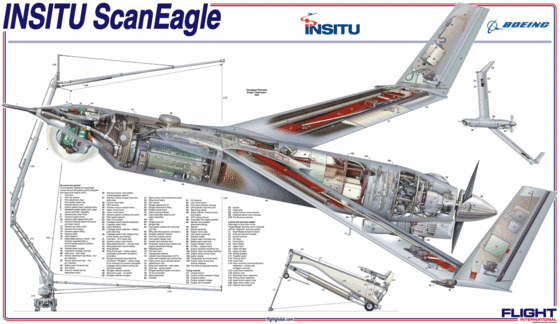
"The benefits ScanEagle brings to Japan are substantial and this well-proven UAS could help save many lives in the future by getting information into the right hands quickly," said Insitu Pacific Director of Business Development Dale McDowall.

Add caption
Image Credit: Flight Global

"The ScanEagle will enhance Japan's immediate response capability and we are very pleased to have developed such a great partnership with Sojitz Corp. and Mitsubishi Heavy Industries of Japan."

Insiti Pacific said the Japanese military identified the need for a UAS to assess damage and provide real-time information for first responders to natural and man-made disasters following the country's 2011 earthquake and tsunami.

The order for ScanEagle was made last year. The vehicle will undergo operational testing and evaluation by the Japan Ground Self Defense Force (JGSDF) for 12 months before entering service.

Saturday, May 4, 2013

US Air Force's Experimental Waverider Scramjet hits Mach 5.1 (3,880 mph)


The final flight of the X-51A Waverider test program saw the Scramjet aircraft reach Mach 5.1 over the Pacific Ocean, the U.S. Air Force said Friday.

The unmanned hypersonic researcher craft traveled more than 230 nautical miles in just over 6 minutes Wednesday over the Point Mugu Naval Air Warfare Center Sea Range off California before crashing into the ocean as intended, an Air Force release said.

The X-51A took off from Edwards Air Force Base in California under the wing of a B-52H Stratofortress before being released at about 50,000 feet.

A solid rocket booster took the X-51A to about Mach 4.8 at which point the craft's scramjet engine ignited and accelerated it to Mach 5.1 - about 3,880 miles per hour - at 60,000 feet.

Scramjet stands for supersonic combustion ram jet, which has no moving parts; fuel is mixed with air rushing into the combustion chamber at supersonic speeds and then ignited.

"It was a full mission success," Charlie Brink, X-51A program manager for the Air Force Research Laboratory
, said in a statement.

"I believe all we have learned from the X-51A Waverider will serve as the bedrock for future hypersonics research and ultimately the practical application of hypersonic flight."

Wednesday, April 17, 2013

Brazil's SGDC: Geostationary Defense and Strategic Communications Satellite

Boeing and Space Systems/Loral of the United States, Astrium Satellites and Thales Alenia Space of Europe and Mitsubishi Electric (Melco) of Japan all submitted separate bids for what Brazil calls SGDC - Geostationary Defense and Strategic Communications Satellite.

The SGDC satellite is expected to weigh no more than 6,000 kilograms at launch and to operate at 75 degrees west in a geostationary orbit. 

It will be operated by Brazil’s Telebras national telecommunications company, with the system managed by Visiona Tecnologica Espacial SA, a joint venture created to manage the project.

Brazilian aircraft manufacturer Embraer’s Embraer Defense owns 51 percent of the Visiona joint venture, with Telebras holding the remaining 49 percent.

Brazilian authorities have assigned Embraer the task of becoming a major satellite prime contractor capable of handling future satellite projects in part as a result of a large technology-transfer package the Brazilian government has inserted into the SGDC bid request.

A second SGDC satellite is part of Brazil’s national space program, which is coordinated by the Brazilian Space Agency (AEB).

Several of the bidders are using the SGDC program to give Brazilian authorities a glimpse of what future technology-transfer agreements might look like, primarily for optical and radar Earth observation, and satellite-based weather forecasting.

If the contest for the telecommunications satellite is placed into a wider context of generalized cooperation with Brazil, the two European bidders may have an edge, they have the most experience in selling Earth observation satellites to nations demanding sizable technology transfers.

Japan’s Melco has also demonstrated its export prowess in both telecommunications and Earth observation satellites and could offer a viable alternative.

U.S. satellite industry officials have said the U.S. government has become more comfortable with the export of U.S. imaging sensors and satellites, and that government regulations are no longer a showstopper for a U.S. satellite builder.

The Latin America Aero and Defense aerospace show, held April 9-12 in Rio de Janeiro, was an occasion for several bidders to show their presence as Brazilian authorities sift through the SGDC bids.

AEB has said the SGDC satellite is budgeted at 716 million Brazilian reais ($362 million) including its launch, which will be the subject of a separate competition.

Satellite Star One C1
The Brazilian Ministry of Defense already leases X-band capacity on the commercial Star One C1 and C2 satellites operated by Brazil’s private-sector satellite operator.

Star One will cost around 23 million reais annually, according to the ministry.

The five X-band transponders to be placed on the first SGDC satellite will cover all of South America and the surrounding maritime routes.

Brazil’s Ministry of Communications leases seven Ku-band transponders on Star One satellites for about 43 million reais per year.

The ministry will use the Ka-band spot-beam capacity on the SGDC satellite to offer broadband to Brazilian villages that do not have broadband access.

Friday, March 22, 2013

Boeing Exec Pressures US DoD To Relax Pilitary Payloads Rules

Boeing Space and Intelligence Systems general manager Craig Cooning. 

Credit: photo by Chuck Bigger

The head of Boeing Space and Intelligence Systems on March 20 urged the U.S. Defense Department to relax its rules on placing military payloads on commercial satellites, saying the current rules are unlikely to result in any hosted-payload efforts being consummated.

El Segundo, Calif.-based Boeing Space and Intelligence Systems has staked part of its pivot toward the commercial market on providing payloads that can be placed alongside a commercial payload on a commercially owned telecommunications satellite.

The company is hoping that as the Defense Department adjusts to sequestration-related budget pressures, it will realize the benefits of hosted payloads and the use of commercial satellites to lower the costs of military access to space.

The Australian Defence Force has been a showcase example of a military user taking advantage of a hosted-payload opportunity, placing a UHF-band payload it purchased from Boeing on the Intelsat 22 satellite, now in orbit, which was manufactured by Boeing under contract to Intelsat.

Australian authorities have said going the hosted-payload route saved it some 40 percent on its UHF-payload program compared to a conventional procurement of a dedicated satellite and launch.

But Intelsat’s attempt to sell a similar Boeing-provided UHF payload met with less success. The company was unable to sell it in advance of its Feb. 1 launch.

The Sea Launch rocket failed shortly after liftoff, destroying the satellite, although Boeing Space and Intelligence Systems general manager Craig Cooning told reporters here March 19 that he believes the payload ultimately would have been sold.

For the U.S. Defense Department, rules setting the terms and conditions under which hosted payloads may be considered were issued in late 2012 and were met with a broadly negative industry reaction.

In his March 20 speech, Cooning said the rules “on the surface appeared too restrictive and too difficult to actually advance the use of hosted payloads. So there’s room for improvement, and I encourage those decision makers to continue to engage with industry in order to adjust this memorandum and enable broader participation.”

Cooning said the U.S. military currently receives 50-70 percent of its satellite bandwidth from commercial sources. Other estimates have shown an even higher dependence on commercial satellites by the military.

Monday, March 18, 2013

Boeing 787 Dreamliner ready for Restart

Boeing has said that it expects commercial flights of its Dreamliner 787 plane to restart within "weeks".

The comments come just days after the US airline regulator approved its plan to redesign the lithium-ion batteries used on the plane.

All 50 Dreamliners in operation were grounded earlier this year after batteries on some planes emitted smoke.

Boeing said it had found a fix for the problem and had been carrying out tests on the proposed solution.

Ray Connor, president of Boeing Commercial Airplanes, said the timing of the start of commercial flight would depend on how fast the firm can "move through the certification process".

"We don't anticipate that being months, we are thinking more along the line of weeks," he said.

'More confident' The Dreamliner 787 is the first plane in the world to use the lithium-ion batteries, which are lighter, hold more power and recharge more quickly.

It is also said to be one of the most advanced and fuel-efficient planes in the industry.

However, concerns have been raised over its safety after a string of incidents earlier this year.

In January, a fire started in a lithium-ion battery pack of a Japan Airlines 787 in Boston. Meanwhile, an All Nippon Airways flight was forced to make an emergency landing because of a battery malfunction.

The incidents led to the entire fleet of Dreamliners being grounded by the authorities.

However, Boeing has since submitted a plan to redesign the batteries to ensure their safety.

Its plan includes improving the battery design to stop faults from occurring, enhancing the production, operating and testing processes, and introducing a new battery enclosure system to prevent any overheating from affecting the plane.

"We may never get to the single root cause, but the process that we've applied to understanding what improvements can be made is the most robust process we have ever followed in improving a part in the history," said Mike Sinnett, the chief project engineer of the Dreamliner.