Showing posts with label delivery. Show all posts

Monday, November 24, 2014

Russian Soyuz Delivers Crew of 3 to International Space Station

A Russian Soyuz TMA-15M spacecraft carrying three new members of the Expedition 42 crew approaches the International Space Station ahead of docking on Nov. 23, 2014.

Credit: NASA

Three new crewmembers arrived at the International Space Station late Sunday (Nov. 23), doubling the orbiting lab's population back up to its full six-person strength.

NASA astronaut Terry Virts, European Space Agency astronaut Samantha Cristoforetti and cosmonaut Anton Shkaplerov blasted off atop a Russian Soyuz rocket from the Baikonur Cosmodrome in Kazakhstan at 4:01 p.m. EST (2101 GMT, 3:01 a.m. local time in Baikonur).

The trio reached the space station about six hours later after a quick trip through space.

Virts, Cristoforetti and Shkaplerov's Soyuz spacecraft linked up with the space station at 9:48 p.m. EST (0248 GMT).

Virts is planning on sharing his experiences in space via social media websites like Twitter. The NASA astronaut is planning to take photos of his views of the planet to help people experience a little bit of what spaceflight is like.

"It's such a unique experience and such a small number of people ever get to leave Earth, so I'm going to be using Twitter and Instagram to share pictures," Virts told reporters before launch.

"@AstroTerry is the call-sign [Twitter handle]. And hopefully I can just share the adventure that I'm going on with as many people as possible around the world."

Russia's Soyuz spacecraft are currently the only spaceflight vehicle that can transport NASA astronauts to the space station.

Wednesday, September 24, 2014

DHL Paketkopter 2.0: Juist Island to get first German drone delivery service

Deutsche Post DHL says it is starting Germany's first drone package delivery service, a test program transporting medicine to a pharmacy on a North Sea island.

The company said the quad-rotor "DHL Paketkopter 2.0" will begin daily flights Friday, bringing a maximum load of 1.2 kilograms (2.65 pounds) of medicine to the German island of Juist.

The island has about 1,500 inhabitants. It's usually served by one ferry per day and an occasional small-aircraft flight, depending on the weather.

DHL said Wednesday it will monitor each 12-kilometer (7.5-mile) flight to the island, but the water, snow and dust-resistant drone will fly on autopilot to deliver the medicine—at no extra cost during the test.

The company says it currently has no concrete plans for full-scale regular drone deliveries.

Together with the two research and development partners, the Institute of Flight System Dynamics, RWTH Aachen and the Microdrones GmbH, went through DHL package one led by the Lower Saxony Ministry for Economic Affairs, Labour and Transport of review and approval process.

The Federal Ministry of Transport and digital infrastructure has set up in coordination with the German Air Traffic Control (DFS) for this research project an exclusive restricted area.

In addition to the island of Juist municipality and the town of Norden, the National Park Administration Wadden Sea has approved the use of the copter.

Wednesday, August 13, 2014

ESA ATV-5 George Lemaître makes its final ISS delivery - video


Highlights from the docking of ATV Georges Lemaître to the International Space Station.

The fifth and final Automated Transfer Vehicle docked with the ISS at 13:30 UTC/15:30 CEST on 12 August 2014.

The vehicle carried 6602 kg of freight, including 2680 kg of dry cargo and 3921 kg of water, propellants and gases.

Tuesday, August 12, 2014

ESA ATV-5 Georges Lemaître last ISS cargo Delivery

ATV-5 Georges Lemaître, the European Space Agency's fifth and last Automated Transfer Vehicle cargo ship, arrives at the International Space Station on Aug. 12, 2014 to deliver more than 7 tons of supplies. 

Europe's ATV spacecraft are one of several unmanned cargo ships keeping the space station stocked with supplies.

Credit: NASA TV

An unmanned European cargo vessel has linked up with the International Space Station for the last time.

The European Space Agency's fifth Automated Transfer Vehicle (ATV-5) joined up with the station at 9:30 a.m. EDT (1330 GMT) on Tuesday (Aug. 12) as both spacecraft sailed high over southern Kazakhstan in Central Asia.

The delivery is the final one by Europe's ATV fleet of spacecraft, which has been resupplying the orbiting lab since 2008.

Tuesday's ATV docking at the aft end of the station's Russian-built Zvezda module was "as flawless as can be," NASA spokesman Rob Navias said during a live broadcast of the orbital meet-up. "A perfect rendezvous and a textbook docking."

Thursday, May 16, 2013

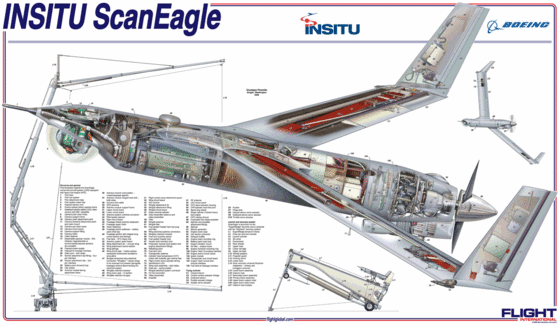
Japan Defense takes delivery of ScanEagle UAS from Boeing's Insitu Pacific

A ScanEagle unmanned aircraft system has been delivered to Japan by Australia's Insitu Pacific.

The country's land self-defense force will use it to monitor aggressive acts by neighbouring China.

Insitu Pacific, a subsidiary of Boeing's Insitu Inc. of the United States, said the aircraft was delivered to its partner Mitsubishi Heavy Industries.

"The benefits ScanEagle brings to Japan are substantial and this well-proven UAS could help save many lives in the future by getting information into the right hands quickly," said Insitu Pacific Director of Business Development Dale McDowall.

Add caption
Image Credit: Flight Global

"The ScanEagle will enhance Japan's immediate response capability and we are very pleased to have developed such a great partnership with Sojitz Corp. and Mitsubishi Heavy Industries of Japan."

Insiti Pacific said the Japanese military identified the need for a UAS to assess damage and provide real-time information for first responders to natural and man-made disasters following the country's 2011 earthquake and tsunami.

The order for ScanEagle was made last year. The vehicle will undergo operational testing and evaluation by the Japan Ground Self Defense Force (JGSDF) for 12 months before entering service.

Thursday, August 5, 2010

Ukraine Postpones Delivery Of Taurus-II Launch Vehicle's First Stage To US


Ukraine's state owned company "Yuzhmash" based in eastern city Dnipropetrovsk postponed the delivery of the basic part of the Taurus-II launch vehicle's first stage to a U.S. company, the Ukranian company said in a statement on Tuesday.

"For some technical reasons, the delivery date has been put off to September-October," the statement said.

The delivery was reportedly scheduled for August.

The two-stage launch vehicle is designed to transport loads of up to five tons into low orbit.

In 2008, Ukraine's companies "Yuzhnoye" and "Yuzhmash" signed a long-term contract with U.S. Orbital Sciences Corp. on cooperation in producing Taurus-II rocket till 2019.

According to the document the Ukrainian side is responsible for designing and producing the first stage of the launch vehicle, the U.S. side for the second stage, ground complex and assembly.

The Taurus-II program is funded by NASA.

Tuesday, November 24, 2009

Re-usable Launch Vehicles: Promised but not Delivered

There is a large up-front investment needed to develop and test any new launch system and companies either cannot raise enough money or are unwilling to take the risks associated with investing the needed funds.

The market for a reusable system is still immature, i.e., demand for launch services is in the embryonic stages, even though we have been launching satellites for over 50 years

Launch vehicle prices are sky high and they have been for a long time. This has presented a very high hurdle to space access for many potential space applications. There are literally tens of thousands of university experiments awaiting flight opportunities, but the cost is too high for students and faculty.

Hundreds of private-sector entrepreneurs have waited years for a chance to try new ideas and applications. Even large, established companies would like to stretch product lines through space experimentation, but have been frustrated by the high cost of launching trial products.

The promise of reusable space launch systems is dramatically lower costs to orbit. An ideal, fully-reusable system would be highly reliable, readily available and could cut costs by a factor of 10 or more. The introduction of such a system would open space access to thousands of denied users. So, why don't we have one?

There are several reasons. Technologies for fully-reusable orbital launch systems still evade the many companies that have attempted to design and build them.

There is a large up-front investment needed to develop and test any new launch system and companies either cannot raise enough money or are unwilling to take the risks associated with investing the needed funds. The market for a reusable system is still immature, i.e., demand for launch services is in the embryonic stages, even though we have been launching satellites for over 50 years.

Elusive technologies include truly reusable cryogenic tanks, low-maintenance thermal shielding, ultra-lightweight structures and advanced avionics. Financing such projects has been problematic, thanks to the many failures and overly-optimistic cost and revenue projections.

However, these hurdles will be overcome as the market matures. The one missing ingredient that would truly make reusable vehicles come to life is a "killer application" that would create a strong market demand for low-Earth-orbit flights.

There seem to be two possible business activities that might generate the needed market demand. One is the eventual human-tourism market that is just getting started with sub-orbital flights.

The other is the creation of a large, distributed space infrastructure of low-orbiting satellites that must be maintained over a long period of time. There is little doubt that the day will come when reusable systems are indeed a reality. The only question is: How soon?

If you want to know more about the design and technologies of launch vehicles register for a special session of the internationally popular course: Launch Vehicle Systems Design and Engineering, to be presented in Cocoa Beach on December 14-16, 2009.