Showing posts with label Build. Show all posts

Tuesday, October 21, 2014

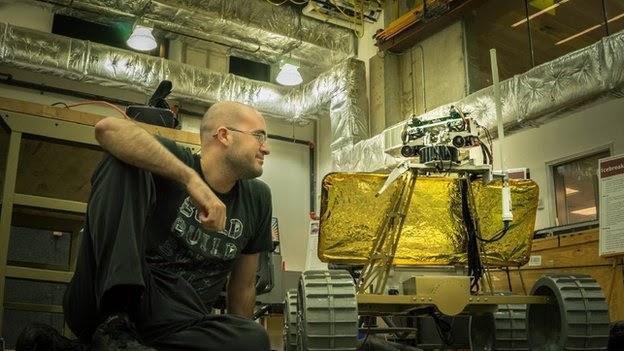
Students build Oculus robot to beam live video from Moon

Daniel Shafrir hopes Andy can transform education about space

Scientists at Carnegie Mellon University have developed a robot which they plan to land on the Moon to act as eyes for Earth-bound space enthusiasts.

The project is part of a $30m prize from Google offered to a team that can send video back from the moon.

The robot has already been shown to potential investors, including Apollo 9 astronaut Rusty Schweickart.

It works in tandem with an Oculus Rift virtual reality headset.

The scientists from Carnegie Mellon have teamed up with space firm Astrobotic to compete for the Google Lunar XPrize, which requires a team to land a robot on the Moon, move it 500m and send back video to Earth.

Astrobotic Technology, which is a spin-off from Carnegie Mellon, has signed a deal with SpaceX - the private space company set up by Elon Musk - to use its Falcon 9 rocket to launch the robot. It is due to take off in 2016.

Non-stop hackathon
"The vision was simple - let anyone on Earth experience the Moon live through the eyes of a robot," explained team leader Daniel Shafrir.

"We weren't just going to go to the Moon. We are going to bring the Moon back," he added.

The telepresence robot, nicknamed Andy after university founder Andrew Carnegie, can be controlled by an operator's head.

Using an Oculus Rift headset, the movements of the user's head are tracked and sent back to Andy's camera so that it will match where the user is looking.

"Imagine the feeling of looking out and seeing rocks and craters billions of years old. Turn your head to the right and you see the dark expanse of space. Turn your head to the left and you see home, Earth," said Mr Shafrir.

To achieve this required complex coding. The team also encountered smaller problems such as the fact that the Oculus software was unable to receive two live video streams at the same time.

"Tackling challenges like that made the project a non-stop, day and night hackathon," explained Mr Shafrir.

Working with games designer Ben Boesel and planetarium director Dan Arnett, the team put Andy through his paces in a demo earlier this month.

The vision is to have "hundreds of the robots on the Moon", said Mr Shafrir.

"With an Oculus headset in every classroom, allowing kids to experience what, to this date, has only been experienced by 12 human beings," he added.

There are currently 18 teams from around the world competing to win the Google-sponsored Lunar X-Prize.

Thursday, October 16, 2014

Scientists build first 3D map of hidden universe

3D map of the cosmic web at a distance of 10.8 billion light years from Earth. 

The map was generated from imprints of hydrogen gas observed in the spectrum of 24 background galaxies, which are located behind the volume being mapped. 

This is the first time that large-scale structures in such a distant part of the Universe have been mapped directly. 

The colouring represents the density of hydrogen gas tracing the cosmic web, with brighter colors representing higher density. 

Credit: Casey Stark (UC Berkeley) and Khee-gan Lee (MPIA)

A team led by astronomers from the Max Planck Institute for Astronomy has created the first three-dimensional map of the 'adolescent' Universe, just 3 billion years after the Big Bang.

This map, built from data collected from the W. M. Keck Observatory, is millions of light-years across and provides a tantalizing glimpse of large structures in the 'cosmic web', the backbone of cosmic structure.

On the largest scales, matter in the Universe is arranged in a vast network of filamentary structures known as the 'cosmic web', its tangled strands spanning hundreds of millions of light-years.

Dark matter, which emits no light, forms the backbone of this web, which is also suffused with primordial hydrogen gas left over from the Big Bang.

Galaxies like our own Milky Way are embedded inside this web, but fill only a tiny fraction of its volume.

Now a team of astronomers led by Khee-gan Lee, a post-doc at the Max Planck Institute for Astronomy, has created a map of hydrogen absorption revealing a three-dimensional section of the universe 11 billions light years away, the first time the cosmic web has been mapped at such a vast distance.

Since observing to such immense distances is also looking back in time, the map reveals the early stages of cosmic structure formation when the Universe was only a quarter of its current age, during an era when the galaxies were undergoing a major 'growth spurt'.

The map was created by using faint background galaxies as light sources, against which gas could be seen by the characteristic absorption features of hydrogen.

The wavelengths of each hydrogen feature showed the presence of gas at a specific distance from us.

Combining all of the measurements across the entire field of view allowed the team a tantalizing glimpse of giant filamentary structures extending across millions of light-years, and paves the way for more extensive studies that will reveal not only the structure of the cosmic web, but also details of its function, the ways that pristine gas is funneled along the web into galaxies, providing the raw material for the formation of galaxies, stars, and planets.

Credit: Casey Stark (UC Berkeley) And Khee-gan Lee (MPIA)

Using the light from faint background galaxies for this purpose had been thought impossible with current telescopes, until Lee carried out calculations that suggested otherwise.

To ensure success, Lee and his colleagues obtained observing time at Keck Observatory, home of the two largest and most scientifically productive telescopes in the world.

Although bad weather limited the astronomers to observing for only 4 hours, the data they collected with the LRIS instrument was completely unprecedented.

"We were pretty disappointed as the weather was terrible and we only managed to collect a few hours of good data, but judging by the data quality as it came off the telescope, it was clear to me that the experiment was going to work," said Max Plank's Joseph Hennawi, who was part of the observing team.

"The data were obtained using the LRIS spectrograph on the Keck I telescope," Lee said.

"With its gargantuan 10m-diameter mirror, this telescope effectively collected enough light from our targeted galaxies that are more than 15 billion times fainter than the faintest stars visible to the naked eye."

"Since we were measuring the dimming of blue light from these distant galaxies caused by the foreground gas, the thin atmosphere at the summit of Mauna Kea allowed more of this blue light to reach the telescope and be measured by the highly sensitive detectors of the LRIS spectrograph."

"The data we collected would have taken at least several times longer to obtain on any other telescope."

Their absorption measurements using 24 faint background galaxies provided sufficient coverage of a small patch of the sky to be combined into a 3D map of the foreground cosmic web.

A crucial element was the computer algorithm used to create the 3D map: due to the large amount of data, a naïve implementation of the map-making procedure would require an inordinate amount of computing time.

Casey Stark
Fortunately, team members Casey Stark and Martin White (UC Berkeley and Lawrence Berkeley National Lab) devised a new fast algorithm that could create the map within minutes.

"We realized we could simplify the computations by tailoring it to this particular problem, and thus use much less memory. A calculation that previously required a supercomputer now runs on a laptop", says Stark.

The resulting map of hydrogen absorption reveals a three-dimensional section of the universe 11 billions light years away, this is first time the cosmic web has been mapped at such a vast distance.

Since observing to such immense distances is also looking back in time, the map reveals the early stages of cosmic structure formation when the Universe was only a quarter of its current age, during an era when the galaxies were undergoing a major 'growth spurt'.

The map provides a tantalizing glimpse of giant filamentary structures extending across millions of light-years, and paves the way for more extensive studies that will reveal not only the structure of the cosmic web, but also details of its function, the ways that pristine gas is funneled along the web into galaxies, providing the raw material for the formation of galaxies, stars, and planets.

Thursday, September 18, 2014

Blue Origin to Build New BE-4 liquid rocket engine for US Launch Provider

Jeff Bezos looks on as a new model of Blue Origin's BE-4 liquid rocket engine is revealed during a press event on Sept. 17, 2014.

Credit: United Launch Alliance Instagram

Blue Origin, the secretive private spaceflight company led by billionaire Jeff Bezos, has teamed up with a veteran space launch provider to build a new rocket engine designed to reduce U.S. dependence on Russian hardware.

In an announcement today (Sept. 17), Bezos and the launch provider United Launch Alliance unveiled plans to develop Blue Origin's new BE-4 liquid rocket engine.

The new partnership will allow ULA's next-generation rockets to come equipped with engines that are built in America. At the moment, ULA uses Russian-made RD-180 engines to power its Atlas 5 rockets.

"ULA has put a satellite into orbit almost every month for the past eight years – they're the most reliable launch provider in history and their record of success is astonishing," Bezos, founder of Blue Origin and Amazon.com, said in a statement.

"The team at Blue Origin is methodically developing technologies to enable human access to space at dramatically lower cost and increased reliability, and the BE-4 is a big step forward. With the new ULA partnership, we're accelerating commercial development of the next great US-made rocket engine."

A model of Blue Origin's BE-4 rocket engine on display on Sept. 17, 2014.

Credit: United Launch Alliance Instagram

The United Launch Alliance is currently launches most U.S. government and military satellites using its Atlas 5 rockets, as well as Delta 4 booster variants.

The company is a cooperative venture by Boeing and Lockheed Martin.

Blue Origin's partnership with ULA states that full-scale BE-4 engine testing should begin in 2016, with the first flight due for launch in 2019, according to representatives.

Although ULA and Blue Origin did not release the cost of development for the BE-4 engine, it will be privately funded.

Blue Origin and ULA have committed to funding it 100 percent for the next five years. Blue Origin began testing its BE-3 rocket engine in 2013.

"This agreement ensures ULA will remain the most cost-efficient, innovative and reliable company launching the nation's most important national security, civil, human and commercial missions," Tory Bruno, president and CEO of ULA, said in today's statement.

"Blue Origin has demonstrated its ability to develop high-performance rocket engines and we are excited to bring together the best minds in engineering, supply chain management and commercial business practices to create an all-new affordable, reliable, American rocket engine that will create endless possibilities for the future of space launch."


Tensions between the United States and Russia have been heightened due to Russia's involvement with the conflict in the Ukraine. Because of that political situation, ULA has come under fire for its use of the Russian rocket engines.

Today's Blue Origin-ULA rocket engine news is the second time in two days that a commercial spaceflight vernture including Boeing has made headlines.

On Tuesday (Sept. 16), NASA announced that Boeing's manned CST-100 spacecraft, which is slated to launch on Atlas 5 rockets, was one of two vehicles picked to fly American astronauts as part of the agency's Commercial Crew Transportation Capability program.

Blue Origin's BE-4 engine won't serve as a direct replacement for RD-180s that power Atlas 5 rockets.

Instead, Blue Origin's new engine will outfit ULA's next generation of rockets, according to Blue origin representatives.

NASA also picked the Dragon spacecraft developed by California-based SpaceX, led by billionaire Elon Musk, as its second commercial space taxi for astronauts.

The announcement Tuesday came after a four-year competition of aerospace companies that included Blue Origin's Space Vehicle and the Dream Chaser space plane developed by Sierra Nevada among the spacecraft contenders.

Thursday, May 8, 2014

Scottish Researchers build acoustic tractor beam

(a) Nonconservative pushing force exerted on an object by a plane wave as a result of strong backscattering. 

(b) Decreasing of the pushing force due to an enhanced forward scattering in a nonparaxial beam. 

(c) The authors used a target designed to maximize the forward scattering of acoustic radiation, leading to a pulling nonconservative force towards the source: an acoustic tractor beam. 

Credit: APS/Alan Stonebraker

A team of researchers with members from the U.K., Scotland and the U.S. has built a functioning acoustic tractor beam in a lab, one that is able to pull objects of centimeter size.

In their paper published in the journal Physical Review Letters, the team describes how they built their device, why it works and to what applications it might be put.

Tractor beams, as we all know are a staple of science fiction, a beam is emitted from a spaceship that can be used to lock on to other objects, such as another space ship, and then used to move that other object in any direction, most interestingly, in the same direction from which the beam is being emitted, pulling it in.

Tractor beams seem counterintuitive as beams of light tend to push objects away, rather than attract them—but, as prior research has shown, optical tractor beams can be created at the nanoparticle level, e.g. optical tweezers.

In this new effort, the research team has extended the abilities of a tractor beam by using one based on acoustics, rather than optics.

Sending a beam (wave) at an object and having it pull the object closer rather than push it can work because of the scattering of the wave that occurs when it collides with the object and if the wave is sent at an angle to the object.

If the scattering and angle are controlled just right, a low pressure zone can be created in front of the object, in effect, pushing it back towards the origin of the beam.

In the lab, the researchers used ultrasonic sound waves in a tank of water.

They put an array of ultrasound emitters at the bottom of the tank and used a hollow isosceles triangular prism as the object to be pulled.

Using an array of emitters allowed for very precisely controlling the wave, which allowed for directing energy onto the outer surface of the object, causing backscattering that led to the frontal low pressure zone, which in turn led to pushing the object back towards the wave source.

An analogy would be squeezing a chocolate chip with your fingers, forcing it to move in whatever direction you choose.

Experimental configuration to demonstrate negative radiation forces with a planar ultrasonic array.

(a) Scaled cross-sectional geometry of the 550 kHz planar matrix array source and hollow, prism-shaped targets suspended above the array. Linear phase gradients applied to the array elements produce wave fronts steered at θ=50.6° towards the array center line.

Active subapertures, forming a hollow core with diameter Δxn, are stepped towards the center line by the array element pitch, with a corresponding lateral (±x) shift in the transmitted local wave fronts and an axial (−z) shift of the intersection with the axis.

(b), (c) Normalised maps of simulated instantaneous pressure field and

(d),(e) measured magnitude of the pressure field produced by the transmitting subapertures illustrated under the field maps. 

Credit: (c) PRL, DOI: 10.1103/PhysRevLett.112.174302

Because of the stipulations required to make it work, applications that could make use of such a tractor beam are clearly limited, though the researchers suggest it might prove useful in some medical situations.

More information: Acoustic Tractor Beam, Phys. Rev. Lett. 112, 174302 – Published 30 April 2014. dx.doi.org/10.1103/PhysRevLett.112.174302

Wednesday, December 18, 2013

NASA engineers crush fuel tank to build better rockets

NASA's Mark Hilburger prepares to buckle an aluminum-lithium cylinder about the size of fuel tank barrels for the largest rockets ever built. 

The black and white dots on the upper portion of the tank helped 20 high-speed cameras record minute changes in the tank as almost a million pounds of force pressed down upon the tank in a test at NASA's Marshall Space Flight Center. 

Credit: NASA/Fred Deaton

NASA completed a series of high-tech can-crushing tests last week as an enormous fuel tank crumbled under the pressure of almost a million pounds of force, all in the name of building lighter, more affordable rockets.

During the testing for the Shell Buckling Knockdown Factor Project, which began Dec. 9 at NASA's Marshall Space Flight Center in Huntsville, Ala., force and pressure were increasingly applied to the top of an empty but pressurized rocket fuel tank to evaluate its structural integrity.

The resulting data will help engineers design, build and test the gigantic fuel tanks for the Space Launch System (SLS) rocket NASA is developing for deep space missions.

"These full-scale tests along with our computer models and subscale tests will help NASA and industry design lighter, more affordable launch vehicles," said Mark Hilburger, senior research engineer in the Structural Mechanics and Concepts Branch at NASA's Langley Research Center in Hampton, Va.

Hilburger is conducting the tests for the NASA Engineering and Safety Center. "We were looking at real-time data from 20 cameras and more than 800 sensors during the final test."

The aluminum-lithium tank was made from unused space shuttle tank hardware and decked out in 70,000 black and white polka dots that helped high-speed cameras focus on any buckles, rips or strains.

"When it buckled it was quite dramatic," Hilburger said. "We heard the bang, almost like the sound of thunder and could see the large buckles in the test article."

Engineers are updating design guidelines that have the potential to reduce launch vehicle weight by 20 percent.

Lighter rockets can carry more equipment into space or travel farther away from Earth for exploration missions to asteroids, Mars or other distant locations.


"In addition to providing data for the Space Launch System design team, these tests are preparing us for upcoming full-scale tests," said Matt Cash, Marshall's lead test engineer for the shell buckling efforts and the SLS forward skirt and liquid oxygen tank structural testing.

"Performing structural tests on hardware that is the same size as SLS hardware is providing tremendous benefit for our future development work for the rocket."

The testing was conducted at Marshall's load test annex, part of the Structural and Dynamics Engineering Test Laboratory previously used to test large structures for the Saturn V rocket, space shuttle and International Space Station.

NASA's Space Launch System will provide an entirely new capability for human exploration beyond Earth orbit.

Designed to be flexible for crew or cargo missions, the SLS will be safe, affordable and sustainable to continue America's journey of discovery from the unique vantage point of space.

SLS will carry the Orion spacecraft's crew to deep space destinations including an asteroid and eventually Mars.

Thursday, March 25, 2010

Consuming Tequila (plants) helps Build Stronger Bones

The plant that gave the world tequila contains a substance that seems ideal for use in a new genre of processed foods -- so-called "functional foods" -- with health benefits over and above serving as a source of nutrients, scientists reported at the 239th National Meeting of the American Chemical Society (ACS) in San Francisco on March 23. Foods spiked with "fructans" from the agave plant may help protect against osteoporosis by boosting the body's absorption of calcium and could have other health benefits, they said.

"Fructans are considered functional food ingredients because they affect body processes in ways that result in better health and reduction in the risk of many diseases," said Mercedes López, Ph.D., who delivered the report. She is with the National Polytechnic Institute, Guanajuato, Mexico. "Experimental studies suggest that fructans may be beneficial in diabetes, obesity, stimulating the immune system of the body, decreasing levels of disease-causing bacteria in the intestine, relieving constipation, and reducing the risk of colon cancer."

Fructans are non-digestible carbohydrates. They consist of molecules of fructose -- the sugar found in honey, grapes, and ripe fruits -- linked together into chains. Rich natural sources include artichokes, Jerusalem artichokes, garlic and onions, and chicory. Fructans do not occur in tequila, however, because they change into alcohol when agave is used to make tequila, López said.

So-called "inulin-type" fructans from chicory find wide use in the United States and other countries in ice cream, breakfast cereals, baked goods, sauces, beverages, and other foods. Small fructans have a sweet taste, while those formed from longer chains of fructose have a neutral taste and give foods a smooth, pleasant texture. Scientific studies have suggested that fructans stimulate the growth of healthful bacteria in the large intestine in a way that increases the body's absorption of minerals, including the calcium and magnesium important for bone growth.

In the new study, López and colleagues set out to determine what effects agave fructans actually have on bone growth. They tested the effects of agave fructans on laboratory mice, used as stand-ins for humans in such research. Mice fed agave fructans absorbed more calcium from food, excreted less calcium in their feces, and showed a 50 percent increase in levels of a protein associated with the build-up of new bone tissue.

"These results suggest that the supplementation of the standard diet with agave fructans prevented bone loss and improved bone formation, indicating the important role of agave fructans on the maintenance of healthy bone," López said. "They can be used in many products for children and infants to help prevent various diseases, and can even be used in ice cream as a sugar substitute."