Showing posts with label students. Show all posts

Tuesday, October 21, 2014

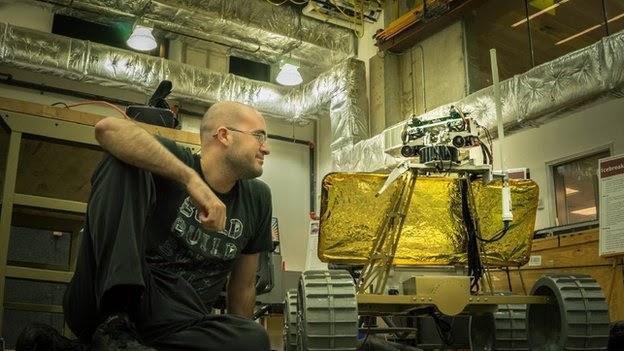
Students build Oculus robot to beam live video from Moon

Daniel Shafrir hopes Andy can transform education about space

Scientists at Carnegie Mellon University have developed a robot which they plan to land on the Moon to act as eyes for Earth-bound space enthusiasts.

The project is part of a $30m prize from Google offered to a team that can send video back from the moon.

The robot has already been shown to potential investors, including Apollo 9 astronaut Rusty Schweickart.

It works in tandem with an Oculus Rift virtual reality headset.

The scientists from Carnegie Mellon have teamed up with space firm Astrobotic to compete for the Google Lunar XPrize, which requires a team to land a robot on the Moon, move it 500m and send back video to Earth.

Astrobotic Technology, which is a spin-off from Carnegie Mellon, has signed a deal with SpaceX - the private space company set up by Elon Musk - to use its Falcon 9 rocket to launch the robot. It is due to take off in 2016.

Non-stop hackathon
"The vision was simple - let anyone on Earth experience the Moon live through the eyes of a robot," explained team leader Daniel Shafrir.

"We weren't just going to go to the Moon. We are going to bring the Moon back," he added.

The telepresence robot, nicknamed Andy after university founder Andrew Carnegie, can be controlled by an operator's head.

Using an Oculus Rift headset, the movements of the user's head are tracked and sent back to Andy's camera so that it will match where the user is looking.

"Imagine the feeling of looking out and seeing rocks and craters billions of years old. Turn your head to the right and you see the dark expanse of space. Turn your head to the left and you see home, Earth," said Mr Shafrir.

To achieve this required complex coding. The team also encountered smaller problems such as the fact that the Oculus software was unable to receive two live video streams at the same time.

"Tackling challenges like that made the project a non-stop, day and night hackathon," explained Mr Shafrir.

Working with games designer Ben Boesel and planetarium director Dan Arnett, the team put Andy through his paces in a demo earlier this month.

The vision is to have "hundreds of the robots on the Moon", said Mr Shafrir.

"With an Oculus headset in every classroom, allowing kids to experience what, to this date, has only been experienced by 12 human beings," he added.

There are currently 18 teams from around the world competing to win the Google-sponsored Lunar X-Prize.

Saturday, August 16, 2014

Sally Ride EarthKAM Mission: Students See World From ISS

A view of the Sally Ride EarthKAM hardware set-up for use in the Lab Window Observation Research Facility (WORF) aboard the International Space Station. 

Image Credit: NASA

NASA is helping students examine their home planet from space without ever leaving the ground, giving them a global perspective by going beyond a map attached to a sphere on a pedestal.

The Sally Ride Earth Knowledge Acquired by Middle School Students (Sally Ride EarthKAM) program provides a unique educational opportunity for thousands of students multiple times a year.

EarthKAM is an international award-winning education program, allowing students to photograph and analyze our planet from the perspective of the International Space Station.

A Canadian student from Good Shepherd School in Peace River, Alberta, studies orbital paths of the International Space Station.

Image Credit: NASA

Using the Internet, students control a special digital camera on the orbiting laboratory to photograph Earth's coastlines, mountain ranges and other interesting geographical topography.

The camera has been aboard the orbiting outpost since the first space station expedition began in November 2000 and supports approximately four missions annually.

Schools around the world are lining up to participate in the program, which is growing by leaps and bounds.

The most recent mission, July 15-19, set summertime records, drawing nearly 36,000 students from 562 schools and summer programs in 34 countries across six continents.

Mission organizers believe they may set more participation records when the fall session begins Sept. 29.

EarthKAM officials have scheduled two new sessions that are set to begin in the next few months. Interested teachers or students can still sign up at the EarthKAM website.

"This program will help our students become more scientifically literate," said Annie Bourque, a teacher with Barnstead Elementary School in New Hampshire, one of the hundreds of schools that signed up for the recent summer mission.

"We want them to understand how new technology can help design tools to improve our ability to measure and observe our world. Real, current photographs of the Earth are powerful learning tools, especially when the students have a hand in creating them."

"The goal of the investigation is to cast the net wide and encourage all students to take advantage of this great opportunity from the space station," said Cindy Evans, Ph.D., International Space Station associate program scientist for Earth Observations at NASA's Johnson Space Center in Houston.

"It is also a great way for future scientists and engineers to explore the many aspects of spaceflight."

The outreach program staff is made up of a group of students attending the University of California, San Diego (UCSD), who have been accepted into the EarthKAM Voluntary Internship Program.

They operate as flight controllers, giving them training and inspiration for the next generation of space engineers.

Saturday, June 1, 2013

ESA CubeSat Space Tethers need to be Snap-proof

Space tethers hold intriguing potential for satellite manoeuvring, attitude control and even power generation. 

Unfortunately, about half of all orbital tether tests have either failed to deploy or snapped, probably due to micrometeoroid impacts.

ESA is developing on a new snap-proof design for their ongoing Satellite program.

Scanning-electron microscope image of the new design of an ultra-thin  snap-proof solar sail tether.

The tether is soon to be operationally tested on Estonia's ESTCube-1, which is being launched into orbit along with ESA's Proba-V satellite on the next Vega rocket.

Harnessing manufacturing techniques from the microelectronics industry, this aluminium tether measures just 50 micrometres across - across half the diameter of the average human hair - with a smaller 25 micrometre wire interweaved onto it.

The University of Helsinki's interweaving technique, with several wires joined together every centimetre, will hopefully keep the tether intact to run an electric charge down it, even if all but one subwires in the tether are cut.

Designed, built and operated by the students of several Estonian universities and led by the University of Tartu with Tartu Observatory, ESTCube-1 is part of ESA's Plan for Cooperating States (PECS) agreement with Estonia.

PECS is a one-year programme of activity taking place as a prelude to the country joining ESA as a Member State.

The electric solar sail, or 'E-sail' being tested by this CubeSat mission, passes electricity through wires such as these to generate electrostatic forces which in turn generate momentum.

In low orbit, E-sails could be used as brakes to deorbit satellites. Beyond Earth's magnetic field, satellites could one day make use of the solar wind to gain a nearly free ride across the Solar System.

ESTCube-1 will unfurl a 10 m-long single-strand E-sail to show its potential as a compact and economical deorbiting method, measuring the resulting force acting on the E-sail as it comes into contact with space plasma.

A 100 m E-sail tether will fly on Finnish student CubeSat Aalto-1 next year. Artist's impression shown below. The thin E-sail tether line is visible in the picture.


Tuesday, January 22, 2013

Nasa Sphere Satellites in the ISS

The International Space Station has 3 small Sphere satellites used to test control algorithms. 

They form part of an MIT Project and are available for students to program.

They are designed to act in unison with each other in a group or swarm.

Nasa


Thursday, September 27, 2012

Phonesat: On-board mobile phone to power low-cost satellite

A University of Queensland staff member is sending a satellite into space more powerful than the Curiosity Rover which recently landed on Mars.

The satellite, which measures 10cm x 10cm, is controlled by an on-board Android mobile phone five times more powerful than its larger space-faring cousin.

It also has a camera four times more powerful.

Michael Kehoe, a UQ staff member with Information Technology Services (ITS) and a final year student of the School of Information Technology and Electrical Engineering (ITEE) recently completed a five-week internship with NASA in California.

He was tasked with designing a satellite that used a mobile phone as its on-board computer, as part of a NASA initiative, PHONESAT.

"This is a proof of concept that will be used for a range of later designs," said Mr Kehoe.

"The satellite uses an attitude determinate control system (ADCS) written by fellow UQ graduate Jasper Wolfe to stop the satellite from spinning and alter its path in orbit," he said.

"Because it uses a common mobile phone as its central processor, I've been able to incorporate some really fun ideas into the satellite.

I'll be able to take temperature, accelerometer and heading readings using the phone's sensors and photos using the phone's camera."

Despite being controlled by a mobile phone, the satellite is not able to phone home.

"Unfortunately there's no reception in space, so we'll be using a high-powered radio link to receive data from the satellite," said Mr Kehoe.

Tracking of the satellite is being set up in America with NASA and in Australia, with the assistance of ITEE.

Tracking equipment on top of the Parnell building will monitor the satellite from launch on November 25 to re-entry 12 days later.

The project provides a proof of concept for low cost, rapid design iteration space craft. Total component costs for the satellite are $7800, opposed to Curiosity's $2.5 billion.

"An example of why this is important can be seen in the Curiosity Rover which landed in August on Mars," said Mr Kehoe.

"Design work started eight years ago and used cutting-edge technology at the time, but by launch date a common mobile phone had more processing power and better camera.

If we can shorten the time it takes to build spacecraft, we can decrease cost and increase the quality of what goes into space."

More information: open.nasa.gov/plan/phonesat/

Tuesday, July 17, 2012

Students Show Off Their Robots - YouTube


Professor Oussama Khatib enthusiastically tossed black T-shirts to class participants crowded in the basement of an engineering building that displayed in bold white letters a mashup of their names and the name of the course. Suited up and ready to play, they were ready for the games to begin.

"I know there's going to be a lot of excitement," Khatib said to the packed room. "You've been working day and night. Thank you."

Gathered in teams of three or four, the students took turns showing off their creations – robots that play games, make art, help land a toy helicopter.

"Every year students come with all of these wonderful ideas," Khatib said. "They are so creative in conceiving a project that's exciting, interactive, dynamic."

Experimental Robotics is a spring quarter class for students who have basic knowledge of robotics. By the end of the course, they are expected to be able to design and build their own 'bot.

The day of final presentations brings friends and classmates together to cheer on the accomplishment of creating a machine that completes a task – or tries to. The game-day vibe is made complete with a table filled with snacks and soda.

Friday, April 27, 2012

MARS: Student discovers new form of lava flow

Cooling lava on Mars can form patterns like snail shells when the lava is pulled in two directions at once. Such patterns, rare on Earth, have never before been seen on Mars. 

This image, with more than a dozen lava coils visible, shows an area in a volcanic region named Cerberus Palus that is about 500 meters (1640 feet) wide.
Photo by: NASA/JPL-Caltech/UA

High-resolution photos of lava flows on Mars reveal coiling spiral patterns that resemble snail or nautilus shells. Such patterns have been found in a few locations on Earth, but never before on Mars.

The discovery, made by Arizona State University graduate student Andrew Ryan, is announced in a paper published April 27, 2012, in the scientific journal Science.

The new result came out of research into possible interactions of lava flows and floods of water in the Elysium volcanic province of Mars.

"I was interested in Martian outflow channels and was particularly intrigued by Athabasca Valles and Cerberus Palus, both part of Elysium," says Ryan, who is in his first year as a graduate student in ASU's School of Earth and Space Exploration, part of the College of Liberal Arts and Sciences.

Philip Christensen, Regents' Professor of Geological Sciences at ASU, is second author on the paper.

"Athabasca Valles has a very interesting history," Ryan says. "There's an extensive literature on the area, as well as an intriguing combination of seemingly fluvial and volcanic features."

Among the features are large slabs or plates that resemble broken floes of pack ice in the Arctic Ocean on Earth. In the past, a few scientists have argued that the plates in Elysium are in fact underlain by water ice.

Thursday, March 22, 2012

NASA Competition: Students To Help Design Deep Space Habitat

College students have until May 2 to help NASA design a deep space habitat, thanks to a new competition.

NASA is hosting the 2013 Exploration Habitat (X-Hab) Academic Innovation Challenge that tests undergraduate and graduate students to design systems for potential use on a deep space habitat prototype.

Interested students can view more information and eligibility requirements here: http://spacegrant.org/xhab.

Winners are expected to receive between $10,000 and $49,000 to produce functional products to be delivered by June 2013.

"Students will play a vital role in our critical early system planning and development," Alvin Drew, NASA astronaut and project manager at Johnson Space Center, said in a statement.

"Their designs could become the basis for the concepts and technologies that will make up the habitat we eventually send to space."

The challenge was first held in 2011 when NASA solicited designs for an inflatable space loft, a place where astronauts can sleep, eat and live while in space.

The University of Wisconsin-Madison beat out two other teams and tested its loft as part of NASA's Desert Research and Technology Studies simulated asteroid mission in August and September.

The 2012 challenge called for designs for plant growth technologies. NASA funded four schools to build their designs, which will be tested in August.

NASA announced the 2013 challenge Tuesday and called for designs on various technologies such as solar arrays, medicine systems and food production.

X-Hab is designed to attract students in science, technology, engineering and mathematics by providing them with real-world challenges, and helps NASA engineers through the development of novel technologies, NASA said in a statement.

"The NASA team is putting a great deal of responsibility on the students, and in turn gives the students a bigger stake in the future development of space technologies that likely will become heritage to actual systems and technologies that will be flown in space in the years and decades to come," NASA says in the challenge description.

Thursday, March 17, 2011

Tricycle powered by power tools

A group of engineers have created a tricycle powered by power tools. The EX is propelled solely by two portable 18V Bosch electric screwdrivers. It was created by former University of Fine Arts Hamburg students Sebastian Auray, Nils Ferber, Ruben Faber and Ludolf von Oldershausen. Weighing 20kg, the vehicle can accelerate up to 30 km/h.
A group of engineers have created a tricycle powered by power tools.

The EX is propelled solely by two portable 18V Bosch electric screwdrivers.

It was created by former University of Fine Arts Hamburg students Sebastian Auray, Nils Ferber, Ruben Faber and Ludolf von Oldershausen.

Weighing 20kg, the vehicle can accelerate up to 30 km/h.

Picture: Oldershausen/Auray/Faber/Ferber / Rex Features

Wednesday, November 11, 2009

ESA: First ‘Fly Your Thesis!’ campaign gives students a taste of space

First ‘Fly Your Thesis!’ campaign gives students a taste of space

ESA’s ‘Fly Your Thesis!’ programme made its successful debut during ESA’s 51st Parabolic Flight Campaign, held 25 October to 5 November. Four student teams from five European countries took advantage of this new educational initiative to conduct microgravity experiments on the Airbus A300 ‘Zero G’ aircraft.

‘Fly Your Thesis!’ was introduced by ESA’s Education Office in close coordination with ESA’s Directorate of Human Spaceflight in 2008. It provides students with a unique opportunity to perform scientific experiments in microgravity as part of their Masters or PhD theses. The first participants were chosen in January 2009, after a rigorous selection process.

The 2009 campaign students and the 'Fly Your Thesis!' team

A group from the University of Münster, Germany, studied the behaviour of tiny particles under different illumination conditions in order to improve understanding of dust storms on Mars. Students from the Open University in the UK and the University of Nice-Sophia Antipolis, France, simulated the loose surface material on asteroids as a precursor to sample-return missions.

A group from the University of Science and Technology in Trondheim, Norway, investigated the flow birefringence of clay nanoparticles in water, research with potential applications such as the prevention of catastrophic landslides.

Another team from the Autonomous University of Barcelona and the Polytechnic University of Catalonia, Spain, recorded the behaviour of enzymes that modify assimilation of drugs by the human body.

The ABC team, from Spain

After months of assembling and testing their experiments, the 15 university students arrived in Bordeaux, France, on 25 October. Over the next few days, they completed the assembly of their experiment racks and, on 28 October, these were loaded onto the Airbus.

With all safety checks completed, the first flight took off from Bordeaux on 3 November. After heading out over the Atlantic Ocean, the students were cleared to switch on their experiments and prepare for the first of 31 parabolas, each providing about 20 seconds of microgravity.