Showing posts with label robotics. Show all posts

Friday, October 17, 2014

KEECKER: The World's First HomePod

A new project on Kickstarter has gotten a lot of attention, it's the KEECKER, billed as The World's First HomePod, a rolling egg-looking robot that moves from room to room in a person's house, bringing personal entertainment functionality with it.

The idea is that instead of having music players, television sets, etc. in multiple rooms, have just one that can be summoned to wherever you want.


KEECKER is white and looks like a giant egg (a little less than knee high) with just a camera, lamp, microphone and a button mounted on it.

It's very plain looking, but offers a wide variety of entertainment options. It receives commands via smartphone (iOS or Android). It also comes with some smarts.

When brought home it moves around the house creating a map (with assistance from the new owner) learning which room is which by name so that when summoned, it knows which room to come to.

Pierre Lebeau
Once it arrives, KEECKER can play music or broadcast a video (or artistic renderings such as the moving galaxy) on a wall, browse the web or serve as a gaming unit.

It can also be used for video conferencing courtesy of a built in 360° camera and microphone, and because it runs on Android, it can run any Android app.

As if that weren't' enough, it can also be used as a sentry (or pet sitter) constantly monitoring the home (movement, temperature, CO2 and noise levels) while everyone is away.

KEECKER has motion sensors, WiFi, audio/video, an adjustable projection lamp, a processor (a quadcore mobile chip),

1 terabyte of local storage and a battery that can go for several days between recharging. Its makers promise that it's also quiet and doesn't get hot.

They also plan to release both an SDK and API in the near future and promise that it won't operate like Roomba, constantly running into walls to learn of its limitations. Instead, the robot will lean more the longer it "lives" in a home, and has software that prevents it from running into things.

It's not difficult to see the usefulness of KEECKER, if you're working in the kitchen, you could call your little robot to offer up a recipe, or provide music as you cook.

Likewise, it could be summoned to other areas, such as the bathroom or other parts of the house where traditional electronic devices don't exist.

On the down side, it clearly wouldn't work if there are stairs and may have trouble navigating cluttered environments.

Initial prices for KEECKER range from $3000 to $4000, depending on configuration.

Thursday, October 9, 2014

SHERPA: A Life Saving UAV Quadcopter Project in the Alps


Scientists at the University of Twente are working on robots that are expected to save lives in calamity situations in the Alps.

The emphasis within this SHERPA project is on cooperation between human rescue workers, the ground robot ('ground rover') with a robotic arm and flying robots.

This week all the members of the SHERPA consortium will meet in Twente in order to harmonize their results and to experiment with the various parts of the robot platform.

It is because of scientific innovations that robots are increasingly being relocated from predictable environments such as factories, to locations where calamities can occur, such as the Alps.

The robots of the SHERPA project provide rescue workers with support during their tasks, for instance, after an avalanche.

In extreme, dangerous cases, these robots can even take over some aspects of the work of their human team-members by locating victims. SHERPA will greatly increase the chance of saving victims.

Humans and robots working together
What is unique about SHERPA is the cooperation between humans and robots, each with their own qualities, in order to achieve a common goal: saving lives.

The emphasis with robots is on their autonomy, cognitive capacities, strategy for cooperation and in the interaction with their human colleagues.'

Together, humans and robots will form rescue teams that the Italian organization of rescue workers has stationed in the Alps.

On behalf of the University of Twente (UT), Raffaella Carloni and other members of the Robotics and Mechatronics group (CTIT institute) and the LEO Centre for Service Robotics are working on the mechanical design, the control mechanism and realizing the robotic arm.

This arm is being developed and constructed in Twente and will be mounted onto the ground robot.

Furthermore, the UT is focussing on technological support of the interaction between humans and robots.

The robotic arm is capable of grasping the Unmanned Aerial Vehicle (UAV), i.e., the flying robot, while it is airborne and placing it on the charger for the ground robot.

This innovative robotic arm is unique because it rigidity can be adjusted to a task. In addition, the arm is more resilient to shocks and vibrations than the current generation of robotic arms.

To provide a rescue worker who is operating the airborne robot with the best possible technological support, he or she will be equipped with sensors and portable technology. This too is, in part, a 'task of ' the UT.

The enormous advantage of this approach is that a rescue worker has optimum perception and can respond adequately to a possible calamity situation without actually having to be present at the site of the calamity.

The Sensors measure the robot's dynamic movements, such as position, speed and resistance. Because of the robot's cognitive algorithms, the robot and human can jointly seek victims and determine their actions in order to save human lives.

Monday, September 22, 2014

New RFID technology helps PR2 robots find household objects


A Georgia Tech research team has developed a new search algorithm that improves a robot’s ability to find and navigate to tagged objects.

Mobile robots could be much more useful in homes, if they could locate people, places and objects.

Today's robots usually see the world with cameras and lasers, which have difficulty reliably recognizing things and can miss objects that are hidden in clutter.

A complementary way robots can "sense" what is around them is through the use of small ultra-high frequency radio-frequency identification (UHF RFID) tags.

Inexpensive self-adhesive tags can be stuck on objects, allowing an RFID-equipped robot to search a room for the correct tag's signal, even when the object is hidden out of sight.

Once the tag is detected, the robot knows the object it's trying to find isn't far away.

"But RFID doesn't tell the robot where it is," said Charlie Kemp, an associate professor in Georgia Tech's Wallace H. Coulter Department of Biomedical Engineering.

"To actually find the object and get close to it, the robot has to be more clever."

A PR2 robot successfully navigates to a medication bottle. 

Credit: Georgia Tech/Travis Deyle

That's why Kemp, former Georgia Tech student Travis Deyle and University of Washington Professor Matthew Reynolds developed a new search algorithm that improves a robot's ability to find and navigate to tagged objects.

The team has implemented their system in a PR2 robot, allowing it to travel through a home and correctly locate different types of tagged household objects, including a medication bottle, TV remote, phone and hair brush.

The research was presented September 14-18 in Chicago at the IEEE/RSJ International Conference on Intelligent Robots and Systems (IROS).

The researchers have equipped a PR2 robot with articulated, directionally sensitive antennas and a new algorithm that allows the robot to successfully find and navigate to the intended object.

Due to the physics of radio-frequency propagation, these antennas tend to receive stronger signals from a tag when they are closer to it and pointed more directly at it.

By moving around the antennas on its shoulders and driving around the room, the PR2 can figure out the direction it should move to get a stronger signal from a tag and thus become closer to a tagged object.

In essence, the robot plays the classic childhood game of "Hotter/Colder" with the tag telling the PR2 when it's getting closer to the target object.

Charlie Kemp is an associate professor in the Wallace H. Coulter Department of Biomedical Engineering. Credit: Georgia Tech

In contrast to other approaches, the robot doesn't explicitly estimate the 3D location of the target object, which significantly reduces the complexity of the algorithm.

"Instead the robot can use its mobility and our special behaviors to get close to a tag and oriented toward it," said Deyle, who conducted the study in Kemp's lab while earning his doctoral degree in Electrical and Computer Engineering from Georgia Tech.

Deyle, who currently works at Google, says the research has implications for future home robots and is particularly compelling for applications such as helping people with medicine, as RFID is able to provide precise identification information about an object or a person.

"This could allow a robot to search for, grasp and deliver the right medication to the right person at the right time," he added.

"RFID provides precise identification, so the risk of delivering the wrong medication is dramatically reduced. Creating a system that allows robots to accurately locate the correct tag is an important first step."

More information: 
Travis Deyle, Matt Reynolds and Charles C. Kemp, "Finding and Navigating to Household Objects with UHF RFID Tags by Optimizing RF Signal Strength." IEEE/RSJ International Conference on Intelligent Robots and Systems (IROS), 2014. www.hsi.gatech.edu/hrl/pdf/iro… le_reynolds_kemp.pdf

Saturday, August 9, 2014

Robot folds itself up and walks away

A team from Harvard's Wyss Institute, Harvard's SEAS, and MIT built an autonomous robot that starts out as a single composite sheet programmed to fold itself into a complex shape and crawl away without any human intervention.

Credit: Harvard's Wyss Institute

A team of engineers used little more than paper and Shrinky dinks, the classic children's toy that shrinks when heated, to build a robot that assembles itself into a complex shape in four minutes flat, and crawls away without any human intervention.

The advance, described in Science, demonstrates the potential to quickly and cheaply build sophisticated machines that interact with the environment, and to automate much of the design and assembly process.

The method draws inspiration from self-assembly in nature, such as the way linear sequences of amino acids fold into complex proteins with sophisticated functions.

"Getting a robot to assemble itself autonomously and actually perform a function has been a milestone we've been chasing for many years," said senior author Rob Wood, Ph.D., a Core Faculty member at the Wyss Institute for Biologically Inspired Engineering at Harvard University and the Charles River Professor of Engineering and Applied Sciences at Harvard's School of Engineering and Applied Sciences (SEAS).

The team included engineers and computer scientists from the Wyss Institute, SEAS, and the Massachusetts Institute of Technology (MIT).

In addition to expanding the scope of ways one can manufacture robots in general, the advance harbors potential for rather exotic applications as well.

"Imagine a ream of dozens of robotic satellites sandwiched together so that they could be sent up to space and then assemble themselves remotely once they get there-they could take images, collect data, and more," said lead author Sam Felton, who is pursuing his Ph.D. at SEAS.

The robots are the culmination of a series of advances made by the team over the last few years, including development of a printed robotic inchworm -- which still required human involvement while folding itself, and a self-folding lamp that had to be turned on by a person after it self-assembled.

The new robot is the first that builds itself and performs a function without human intervention.

"Here we created a full electromechanical system that was embedded into one flat sheet," Felton said.

The team used computer design tools to inform the optimal design and fold pattern, and after about 40 prototypes, Felton honed in on the one that could fold itself up and walk away. He fabricated the sheet using a solid ink printer, a laser machine, and his hands.

The refined design only took about two hours to assemble using a method that relies upon the power of origami, the ancient Japanese art whereby a single sheet of paper can be folded into complex structures. The origami-inspired approach enabled the team to avoid the traditional "nuts and bolts" approach to assembling complex machines.

They started with a flat sheet, to which they added two motors, two batteries, and a microcontroller -- which acts like the robot's "brain," Felton said.

The sheet was a composite of paper and Shrinky dinks™, which is also called polystyrene, and a single flexible circuit board in the middle. It also included hinges that were programmed to fold at specific angles. Each hinge contained embedded circuits that produce heat on command from the microcontroller. The heat triggers the composite to self-fold in a series of steps.

When the hinges cool after about four minutes, the polystyrene hardens -- making the robot stiff -- and the microncontroller then signals the robot to crawl away at a speed of about one-tenth of a mile per hour. The entire event consumed about the same amount of energy in one AA alkaline battery.

The current robot operates on a timer, waiting about ten seconds after the batteries are installed to begin folding. However, "we could easily modify this such that the folding is triggered by an environmental sensor, such as temperature or pressure," Felton said.

One of the primary challenges in the process, Felton said, was the propensity for the robots to burn up before they folded up properly; each one runs on about ten times the current that typically runs through a light bulb.

"There is a great deal that we can improve based on this foundational step," said Felton, who plans to experiment with different kinds of shape memory polymers, materials like the polystyrene -- that are stronger and require less heat to activate, for example.

Journal Reference: S. Felton, M. Tolley, E. Demaine, D. Rus, R. Wood. A method for building self-folding machines. Science, 2014; 345 (6197): 644 DOI: 10.1126/science.1252610

Sunday, February 16, 2014

Amazon Electric Ghost Knifefish inspire underwater robotics research

Northwestern has developed a number of robotic prototypes based on the Ghost Knifefish.

Electric Ghost Knifefish from South America are opening up new ideas in robotics.

Knifefish put a small current through the water to sense their environment, and undulate a long fin to move around.

Scientists at the Neuroscience and Robotics Lab in Northwestern University, US, believe both features could be harnessed in a new class of autonomous underwater vehicles.

They are developing robots that will be able to swim around debris in total darkness, such as inside a sunken ship.


"Today, we don't really have underwater robots that work well in really cluttered conditions or in conditions where vision isn't useful," said Prof Malcolm MacIver.

"Just consider the sunken cruise ship. It is very dangerous to send divers into such situations where the water can be very cloudy.

"But we can learn from the electric fish. They don't use vision to hunt at night in the rivers of the Amazon basin, and their movement through the cluttered root masses and flooded forests requires incredible precision. They fit a big hole in terms of our capabilities in underwater robots."

Prof MacIver was explaining his work here at the annual meeting of the American Association for the Advancement of Science (AAAS).

He has studied knifefish for years, deciphering their sensory and locomotion systems.

The animals generate an electric field from modified neurons running along their spinal cord. When prey, such as aquatic insects, enter this field the fish measure a tiny change in voltage at the surface of their skin.

The perturbation is only one-tenth to one-hundredth of a millionth of a volt, but sufficient for the receptors to detect it.

Knifefish hunt in darkess

"The fish have evolved an amazing system," said Prof MacIver.

"Imagine your retina stretched over your entire body and what that would be like. That's the situation that knifefish find themselves in.

"They perceive in all directions. They emit a kind of radar, but it's an electric field; and the sensory receptors scattered over their entire body surface mean they can detect things coming from all directions."

The technology in Prof MacIver's lab is now simulating this enabling a robot in a tank to react to what is around it and move accordingly.

But it is the special propulsion technique employed by knifefish that the Northwestern researcher also wants to copy.


"The knifefish inspired GhostBot. We've built one of the most advanced fish robots in the world, with 34 degrees of freedom (the humanoid robot ASIMO has 26; the Roomba floor vacuum robot has 2), to better understand knifefish mechanics and sensorimotor coupling. "

"The video is the first where we discovered that inward counter-propagating waves generate a strong downward jet, producing vertical thrust. "

"This is a key element of knifefish maneuverability. The water is seeded with reflective particles for subsequent particle imaging velocimetry. "

You will see that the ripples sent through the long fin on the belly undulate one way, and the fish will move forward; undulate the other way, and the direction of travel is reversed.

Use counter-propagating waves that meet in the middle, and the fish will move up.

"From all our simulations, we now have mathematical relationships between things like the frequency and amplitude of the travelling wave and how much propulsion you get," said Prof MacIver.

"So now we can put that into technology and get it to work properly."

Currently, the Northwestern lab is demonstrating artificial sensory and locomotion capabilities on two separate robotic platforms. The aim now is to bring them together into a single working device.

Tuesday, February 11, 2014

TeleBot: The Real- life RoboCop to be tested


Researchers and students in FIU's Discovery Lab have developed the initial prototype of a TeleBot—which combines telepresence and robotics—to allow disabled police and military personnel to serve as patrol officers.

A demonstration of the prototype will take place at 10 a.m. on Wednesday, Feb. 12, 2014 at the Graham Center pit on FIU's Modesto A. Maidique Campus.

Unlike the RoboCop of the movie that premieres this week, the FIU TeleBot is not expected to cause damage to life or property.

Researchers and students have worked for more than 18 months to refine technology that will allow a disabled person to control the robot remotely, see everything the robot "sees" and interact with members of the public.

"This kind of project requires a lot of hard work, technical expertise and resources," said Jong-Hoon Kim, director of the Discovery Lab.

"We had to build everything from scratch. The students are very motivated and feel like they are making a real contribution."

Having overcome multiple challenges, chief among them proper hand functioning, the team has finished work on a prototype that stands six feet tall, weighs about 75 pounds and can be controlled from a remote location.

The TeleBot project began in 2012 when Jeremy Robins, a lieutenant commander in the U.S. Navy Reserves, donated $20,000 to the Discovery Lab to develop an idea he had to bring disabled law enforcement officers, as well as disabled combat veterans, back to the force.

Researcher takes a muscular approach to robotics

An active orthotic device developed by a Carnegie Mellon University roboticist uses soft materials and mimics the leg's structures for controlling the ankle 

Credit: Carnegie Mellon University

During his childhood in Korea, Yong-Lae Park developed a love for robotics, using the nuts, bolts and metal bars from science kits to build mechanical versions of his favourite cartoon characters.

"Robotics is very interesting and attractive because you build it and it moves on its own," Park said.

Today, Park, an associate professor at Carnegie Mellon University's Robotics Institute, retains his childhood passion but directs it toward more mature creations.

He's part of a team that has designed a robotic device to restore movement for sufferers of neuromuscular disorders that affect the foot and ankle, such as cerebral palsy, multiple sclerosis and drop foot.

The device, which looks like a sock made of cybernetic muscle sinews, uses pneumatics to augment the strength of patients' ankles.

While most such devices are bulky, this one eschews a rigid exoskeleton in favor of more nimble materials that could allow more flexibility.

Bor-rong Chen
Park's role in the eight-member team was to create the mechanical design and synchronize it with the muscle motions of the patient, said Bor-rong Chen, who worked on the device with Park while they studied at Harvard.

"He's a brilliant maker in general, with a very strong background in using the right material to solve a mechanical problem and designing the structure of the material," Chen said.

To design the device - a three-year effort funded by Harvard's Wyss Institute for Biologically-Inspired Engineering and the National Science Foundation - Park had to delve outside his robotic comfort zone, educating himself on the biology of the ankle.

Most exoskeletons treat the ankle as if it has only one range of motion, up and down, Park said. But when he studied the joint he realized that its movement was much more complicated. To mimic natural ankle movements, the device would have to account for this complexity.

After this realization, Park set about the formidable task of translating those complex movements into mechanical processes.

"My job is engineering, so I try to simplify those things as much as possible," Park said.

More information: iopscience.iop.org/1748-3190/9/1/016007/article

Wednesday, January 29, 2014

Russia's NORD device may travel to Mars 2020

NORD will help Mars 2020 rover figure out how humans can best use the red planet's resources and which parts of Mars are the most suitable habitats for humans in terms of minerals.

A device created by Russian scientists is bidding for a chance to travel to Mars aboard NASA's Mars 2020 rover.

In about five months or so, it will be clear whether NORD, the brainchild of the Moscow-based Space Research Institute, will participate in the mission.

NASA launched a competition for Mars 2020 research proposals in September. By now, the application submission is already over.

Mars 2020 is due to succeed its elder brother, Curiosity MSL, which has been exploring the red planet since August 2012. The new rover will be based heavily on the design of Curiosity.

The landing system and the chassis will be recreated without any additional engineering. This, NASA says, will reduce technical risks and make the project cheaper.

The main aim of the Curiosity mission was to find traces of past life-supporting environments on Mars. The goal has been achieved. Mars 2020 will look for traces of past life in those once-habitable environments.

Curiosity is equipped with DAN, a Russian-made neutron detector. DAN, or Dynamic Albedo of Neutrons, measures the energy of neutrons leaking from the ground.

It can detect water content as low as one-tenth of one percent as deep as 20 inches.

If water is present, liquid or frozen, hydrogen atoms slow the neutrons down.

These slower neutrons are measured by DAN.

"NORD has no generator. We replaced it with a gamma spectrometer designed to measure natural radiation on Mar's surface and analyze the chemical composition of Martian soil in areas explored by the rover," Igor Mitrofanov, an IKI laboratory chief, told reporters.

NORD will help Mars 2020 rover figure out how humans can best use the red planet's resources and which parts of Mars are the most suitable habitats for humans in terms of minerals.

The rock and soil samples collected by Nord will be stored inside Mars 2020 for several years until a new spacecraft arrives and takes them over.

It will then have to blast off to Earth - a complicated task, much more difficult than even blasting off from Moon, as it requires a rocket powerful enough to escape Mars' gravity.

Wednesday, January 15, 2014

Jellyfish-powered Ornithopter Drone prepares for lift-off - Video


Inspired by nature and by the aviation pioneers of the early 20th century, scientists in the US said Wednesday they had built the world's first jellyfish drone aircraft.

The tiny, ultra-light lab machine, weighing just 2.1 grammes (0.07 ounces), is the first man-made flying object to hover and move with a motion like that of the jellyfish in water, the inventors believe.

Leif Ristroph
"We were interested first of all in making a robotic insect that would be an alternative to the helicopter," said Leif Ristroph, who works alongside Stephen Childress at New York University's Applied Math Lab.

"Our interest ended up being a little bit weird—it was the jellyfish."

The jellyfish has long been admired by engineers for a simple yet efficient motion, sculpted by millions of years of evolution, that requires just a simple muscle and no brain power, just a primitive nervous system.

It has a bell-like translucent skirt that first billows out and then closes tightly, squirting water out from the small opening to provide itself with movement.

In this case, the aircraft uses four petal-shaped wings, each eight centimetres (four inches) long, that when folded together form a downward-facing "cone."

Stephen Childress
A tiny motor, attached to a crankshaft, causes the wings to push outwards and then downwards, 20 times a second, forcing out air through the bottom of the cone.

The result is an "ornithopter," or flying machine that hovers with great stability, without the need for constant, energy-draining correction.

"If it's knocked over, it stabilises by itself," Ristroph said to reporters.

The craft can change direction by making one of the four wings work harder than the others.

Pioneers of flight
The materials to make the machine are all over-the-counter components—light carbon-fibre ribs to hold the motor and provide the frames of the wings, which are covered by transparent Mylar film—bought at ordinary modelling stores.

Ristroph said he and Childress had been intrigued by film footage of aviation pioneers who had tried to mimick insects to build ornithopters, but lacked the knowledge or materials at the time.

More information: Stable hovering of a jellyfish-like flying machine, Journal of the Royal Society Interface, rsif.royalsocietypublishing.org/lookup/doi/10.1098/rsif.2013.0992

Tuesday, November 12, 2013

NASA Robonaut-2 to grow legs

video platformvideo managementvideo solutionsvideo player
NASA has announced its intention to add legs to the Robonaut 2 (R2) robot currently aboard the International Space Station (ISS), sometime next year.

The move is part of a 50 year project (currently in year 17) by NASA to investigate the possibilities of using robots on space missions. Adding legs to R2 will increase its standing height to eight feet and its weight to 500 pounds.

R2 was first delivered to the ISS in 2011 as just a head, torso and arms by the Space Shuttle Discovery and is the first dexterous robot in space (Japan's talking Kirobo robot has arms and legs but they offer virtually no functionality.)

Designed at NASA's Johnson Space center in Houston Texas, R2's purpose is to perform many of the activities that are now carried out by human astronauts.

R2 is actually one of four robonauts that NASA has built, each with a different mission in mind.

Future parts for R2 include interchangeable wheels for rolling around on the surface of a planet or moon (one configuration involves having R2 roll around on four wheels instead of just two for added stability).

NASA also plans to create a line of hands that allow the robot to perform a variety of tasks, one of which would almost certainly be taking part in missions that involve conducting space walks to perform duties or to make repairs to the ISS.

In adding legs to R2, NASA plans to eventually have the robot move autonomously around the ISS—them being long will help with movingly quickly in and out of hatches. But that's part of a long learning process.

R2 will have to start out by taking baby steps as the cramped quarters of the ISS leaves little room for clumsiness—one bump could send a human astronaut careening helplessly through a compartment likely crashing into a wall, or sensitive equipment.

The ultimate goal is have R2 move as gracefully as an antelope both inside the ISS and out while performing tasks that are either mundane or dangerous.

Having the robot perform spacewalks, for example, would also save on costs as it wouldn't require life-support and other back-up systems necessary to keep humans safe when venturing out.

Saturday, February 16, 2013

Scottish Cybraphon Sings - Video


Cybraphon Demo Song (The Balkan Bazaar) from Cybraphon on Vimeo.


Cybraphon is the latest project from Edinburgh-based artist collective FOUND (Ziggy Campbell, Simon Kirby and Tommy Perman).

Inspired by early 19th century mechanical bands such as the nickelodeon, Cybraphon is an interactive version of a mechanical band in a box. Consisting of a series of robotic instruments housed in a large display case, Cybraphon behaves like a real band.

Image conscious and emotional, the band’s performance is affected by online community opinion as it searches the web for reviews and comments about itself 24 hours a day.

This website documents the progress of the project as Cybraphon is comes to life at the Edinburgh Sculpture Workshop (ESW).

Cybraphon is funded by the Alt-w Production Award administered by New Media Scotland and will be unveiled at the Edinburgh Arts Festival on 5 August 2009 in InSpace Gallery.

Sunday, September 23, 2012

Astronaut Mike Hopkins working Robonaut2

Astronaut Mike Hopkins working with robonaut. He is controlling the robot by having him follow my motions.

Wednesday, August 22, 2012

Health Care "Telepresence Robot" to aid high dependency care at Northern Ireland Hospital

A Northern Ireland Health Trust is the first in the UK to use a robot which allows intensive care specialists from one hospital to remotely assess patients in another.

The 'telepresence' robot enables doctors to examine and interact with patients in different locations.

It will be used at Daisy Hill Hospital in County Down.

Stormont Health Minister Edwin Poots said the new technology would create an "effective hospital network".

The robot has the ability to transmit heart and breath sounds and it is hoped it will prevent the need to transfer patients to intensive care in some cases.

It enables Dr Charles McAllister, based at Craigavon Area Hospital in County Armagh, to speak to staff and patients at a bedside in the Southern Trust in Newry more than 20 miles away.

"It means that although there are no intensivists on site in Daisy Hill Hospital, it means there will be 24/7 access to the intensivists on the Craigavon site to give advice and support on any patients in a high dependency unit or throughout the hospital," he said.

"You can get a huge amount of information via the robot.

"You can get real time information from the monitor, you can see the patient up close in high definition and look at all the charts and observations.

"There is also a facility for listening to the patient's lungs and heart through a stethoscope at the back of the robot."

More about "Telepresence" and robots, here.

Thursday, August 2, 2012

A Robot that can walk and jump on water

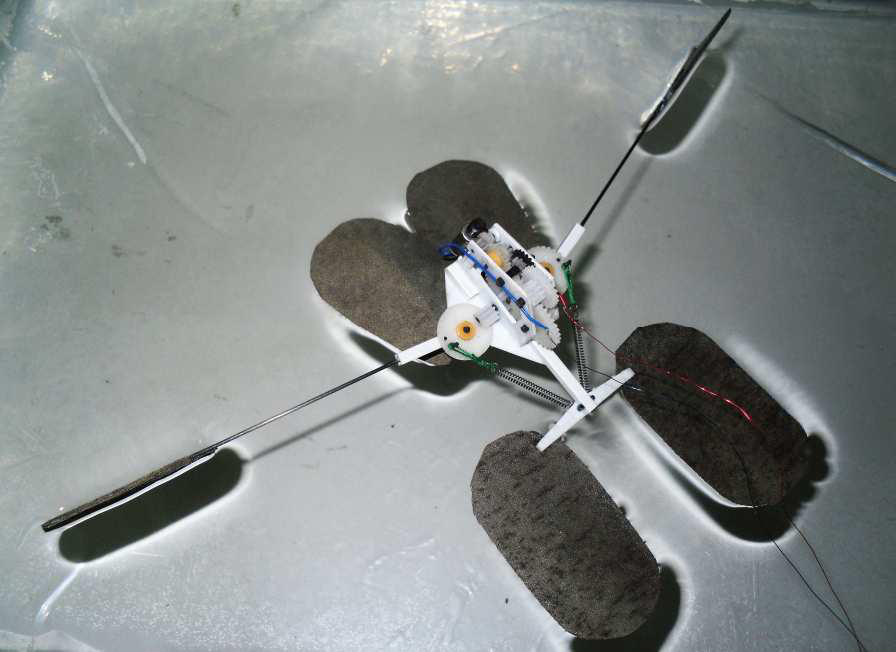
This microrobot was developed by Qinmin Pan and colleagues at Harbin Institute of Technology in China.

In their paper, published in ACS Applied Materials & Interfaces, they described other tiny robots that can walk on water (including a design that Pan created last year).

But, they pointed out, robots that walk on water don’t really mimic the behavior of water striders which actually jump up and down on water.

Their new microrobot does just that, overcoming what until now has been a major challenge: keeping the legs of the bot from breaking through the water’s surface as it leaps up.

In tests , the robot could leap 5.5 inches into the air and almost 14 inches forward (a distance more than twice its own length) at a speed of 3.6 miles per hour.

Pan accomplished this feat by using porous, extra water-repellant nickel foam for the legs.

Before you think that this is just a nifty side project for a mad scientist, such robotic water striders could be used to monitor lake water quality or in espionage.

Robots that have the ability to jump on water are going to be able to avoid obstacles they encounter, making them even better at their jobs.

Wednesday, August 1, 2012

Prototype Upper Body for a Child Robot "Affetto" - YouTube


Affetto moves flexibly thanks to 22 pneumatic actuators in its body (3 for neck, 7 for each arm, 1 for chest, and 4 for waist).

Researchers at Osaka University in Japan have built a prototype of a robotic baby, named Affetto.

The researchers aim to learn more about higher cognitive functions in humans by studying people’s interactions with their infantile android.

Visit http://www.youtube.com/ to see how its realistic face moves and also http://www.er.ams.eng.osaka-u.ac.jp/ to know about our project (JSPS grant-in-aid for specially promoted research).

Wednesday, July 25, 2012

The Mantabot - YouTube


Batoid rays, such as stingrays and manta rays, are among nature’s most elegant swimmers. They are fast, highly maneuverable, graceful, energy-efficient, and can cruise, bird-like, for long distances in the deep, open ocean, and rest on the sea bottom.

“They are wonderful examples of optimal engineering by nature,” says Hilary Bart-Smith, an associate professor of mechanical and aerospace engineering in the University of Virginia‘s School of Engineering and Applied Science.

They are designing an “autonomous underwater vehicle” that someday may surpass what nature has provided as a model. The vehicle has potential commercial and military applications, and could be used for undersea exploration and scientific research.

Tuesday, July 17, 2012

Students Show Off Their Robots - YouTube


Professor Oussama Khatib enthusiastically tossed black T-shirts to class participants crowded in the basement of an engineering building that displayed in bold white letters a mashup of their names and the name of the course. Suited up and ready to play, they were ready for the games to begin.

"I know there's going to be a lot of excitement," Khatib said to the packed room. "You've been working day and night. Thank you."

Gathered in teams of three or four, the students took turns showing off their creations – robots that play games, make art, help land a toy helicopter.

"Every year students come with all of these wonderful ideas," Khatib said. "They are so creative in conceiving a project that's exciting, interactive, dynamic."

Experimental Robotics is a spring quarter class for students who have basic knowledge of robotics. By the end of the course, they are expected to be able to design and build their own 'bot.

The day of final presentations brings friends and classmates together to cheer on the accomplishment of creating a machine that completes a task – or tries to. The game-day vibe is made complete with a table filled with snacks and soda.

Sunday, July 8, 2012

Sc-Fi RoboCop (2013) "Omnicorp Product Line" - YouTube


The video were revealed today as part of the early viral marketing campaign for Jose Padilha‘s new RoboCop, which will star Joel Kinnaman, Gary Oldman, Samuel L. Jackson and Hugh Laurie.

The film is set for release in August 9, 2013, but you can see the new ED, and seemingly a tease of RoboCop in the video.

Those with a keen memory for the original film will note that the video below seems to position ED and RoboCop as complimentary technology, rather than competing interests. So that’s a bit different than what we saw in the Paul Verhoeven movie. Wonder how that factors in to the new take?

That image above is a shot of the redesigned ED-209 automated security sentry drone from OmniCorp — you may remember the original ED-209 as the roaring, bullet-spitting hulk that went haywire in a boardroom demonstration and lead to the fictional funding of Sci-Fi hero RoboCop.

Tuesday, May 22, 2012

Robotic fish Shoal: Sniffing out pollution in harbours

There is something unnatural lurking in the waters of the port of Gijon, Spain, and researchers are tracking its every move. 

 It is not some bizarre new form of marine life, but an autonomous robotic fish designed to sense marine pollution, taking to the open waves for the first time.

"With these fish we can find exactly what is causing the pollution and put a stop to it right away," explains Luke Speller, a scientist at the British technology firm BMT and the leader of SHOAL, a European project involving universities, businesses and the port of Gijon, which have joined forces to create the fish.

Currently the port relies on divers to monitor water quality, which is a lengthy process costing €100,000 per year. The divers take water samples from hundreds of points in the port, then send them off for analysis, with the results taking weeks to return.

By contrast, the SHOAL robots would continuously monitor the water, letting the port respond immediately to the causes of pollution, such as a leaking boat or industrial spillage, and work to mitigate its effectsMovie Camera.

The SHOAL fish are one and a half metres long, comparable to the size and shape of a tuna, but their neon-yellow plastic shell means they are unlikely to be mistaken for the real thing. 

A range of onboard chemical sensors detect lead, copper and other pollutants, along with measuring water salinity.

They are driven by a dual-hinged tail capable of making tight turns that would be impossible with a propeller-driven robot.

They are also less noisy, reducing the impact on marine life. The robots are battery powered and capable of running for 8 hours between charges. At the moment the researchers have to recover them by boat, but their plan is that the fish will return to a charging station by themselves.

Working in a group, the fish can cover a 1 kilometre-square region of water, down to a depth of 30 metres.

They communicate with each other and a nearby base-station using very low-frequency sound waves, which can penetrate the water more easily than radio waves.

However, this means the fish have a low data transmission rate and can only send short, predefined messages. "It's a good solution, but it requires thinking carefully about what data to transmit and how to use that data," says Kristi Morgansen, a roboticist at the University of Washington, who was not involved in the research.

Navigation relies on a related system that communicates with four "pingers" at the corners of the port, which act much like GPS satellites for the fish. If one fish senses pollution in an area it can call the others to create a detailed map of high and low concentrations around it, helping port authorities to locate the exact source of the pollutant.

Wednesday, April 25, 2012

Paralysed Claire Lomas walks London marathon in Robotic Suit

Claire Lomas, paralysed in a horse riding accident, had some dashing male company as she continued her quest to complete the 2012 London Marathon yesterday.

Claire, 32, of Eye Kettleby, near Melton, is almost six miles into the 26-mile course, which she is walking in a Cyclone robotic suit, called ReWalk.

She was joined for the last mile of yesterday's leg, in south London, by former tennis ace Tim Henman and his wife, Lucy.

"I couldn't believe I was actually there with Tim Henman," said Claire.

"He was my favourite tennis player of them all and it was so strange to see him there in front of me. He's exactly like he is on the telly. I told him he used to put me through hell watching him play."

Claire, who was paralysed from the chest down in a riding accident five years ago, is aiming to complete the route in two weeks to raise thousands of pounds for Spinal Research.

She said: "It was a tiring day and I felt a little sore but having Matt and Tim walk with me really spurred me on – they are both lovely blokes."

Claire is walking in a pioneering suit using motion sensors, electronics and computers to help paraplegics walk again.

Tomorrow's leg will see her pass the Cutty Sark on her way through Greenwich.

More information can be found on her website www.get-claire-walking.co.uk

Below is a short video showing Claire training before the marathon. Other Videos uploaded by Claire can be found here: www.youtube.com/user/clairelom