Showing posts with label underwater. Show all posts

Monday, August 4, 2014

NASA NEEMO 18 Expedition: Astronauts complete underwater mission

Astronaut Jeanette Epps on an undersea exploration traverse EVA during NEEMO 18.

Four astronauts splashed up from the depths of the Atlantic Ocean on July 29, bringing to a successful close the 18th NASA Extreme Environment Mission Operations (NEEMO) expedition.

"Splashup" took place at 11:40 a.m. EDT Tuesday.

Accompanied by two lab technicians, the crew, commander Akihiko Hoshide of the Japan Aerospace Exploration Agency, NASA's Jeanette Epps and Mark Vande Hei, and Thomas Pesquet from the European Space Agency, spent nine days living and conducting research 62 feet below the surface in Florida International University's Aquarius Reef Base undersea research habitat off the coast of Key Largo, Fla.

They investigated tools, techniques and technologies that will benefit space-voyagers aboard future International Space Station (ISS) and long-duration exploration missions.

The mission's scientific investigations focused on a suite of studies from NASA's Human Research Program covering behavioural health and performance, human health and countermeasures, and human factors and habitability.

These studies examined such issues as team cohesion and the ability of crew members to perform tasks while working under constraining factors including isolation, confinement, remoteness, circadian rhythm disruption, communication delays and work overload.

Akihiko Hoshide
"NEEMO is about working and living together," Hoshide said.

"Not just the six aquanauts inside the habitat, but also with the entire team on the surface, the support divers, and the researchers. It is a great spaceflight analog in that aspect, too."

"Teamwork is the key to success, and we worked well. I am grateful to have worked with such professionals, who made my work as the NEEMO 18 commander easy and enjoyable."

NEEMO 18 extravehicular activities evaluated tools and techniques for exploration tasks across gravity fields ranging from asteroids, to the moons of Mars and Mars surface.

Techniques to address re-planning of exploration operations to account for varying time delays in communications were addressed.

Mark Vande Hei
"NEEMO 18 was a fantastic opportunity for me to participate in the development of technologies and techniques for future exploration," said Vande Hei.

"That by itself would have been plenty, but on top of that I got to experience life in an environment that most of us don't get to experience as well as enjoy the company of some fantastic teammates, both on the crew and in the ground control and support team."

NEEMO 18 engineering studies included evaluating the use of Bluetooth technology to monitor each crew member's heart rate.

The successful outcome of this analysis will help address future upgrades to the existing suite of heart rate monitoring equipment aboard the space station.

The mission's scientific and exploration objectives were completed.

The extreme environment of life undersea is as close to being in space as possible, thus making such missions excellent analogs for spaceflight. Parallels between life underwater and in space were drawn throughout the mission.

Thomas Pesquet
"I consider myself extremely lucky to have 'flown' this mission with such professional and talented crewmembers," Pesquet said.

"I learned so much by just watching them go about their busy schedule, solve complex tasks, think out-of-the-box."

"Our commander Aki also made a point of always linking what happened down here to what he experienced up there in space, and the parallels were constantly made, with invaluable knowledge passed on to the rest of the crew."

For the crew members, the experience of living beneath the waves is something they will not soon forget.

In Vande Hei's words, "Personally, I'll never forget the womb-like peace of being out of the habitat, diving, at night, lights off."

"The sparks of luminescence that occurred when I clapped my hands or the puffs of that luminescence that spontaneously occurred made it seem like I was on another planet."

ESA Herve Stevenin at Aquarius base
Future  Mission: NEEMO 19
NASA will return to Aquarius on Sept. 7 for NEEMO 19, a seven-day mission.

NASA astronaut Randy Bresnik will command the second 2014 mission. He will be joined by Canadian Space Agency astronaut Jeremy Hansen, ESA astronaut Andreas Mogensen, and Herve Stevenin, ESA's Head of Extravehicular Activity (EVA) Training at the European Astronaut Center in Cologne, Germany.

NEEMO 19 will focus on the evaluation of tele-mentoring operations for ESA.

Telementoring is when a crew member is given instruction for a task by an expert who is located remotely but is virtually present via a video and voice connection.

Sunday, March 9, 2014

HOT Super Falcon: the ultimate submarine experience - Video


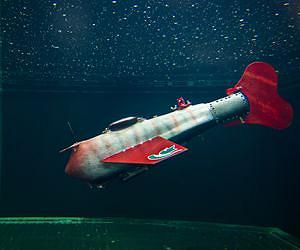
Hawkes Ocean Technologies (HOT), maker of the DeepFlight submersibles, has made the Super Falcon to be always positively buoyant — that means if everything suddenly cuts out, you'll rise to the surface rather than sink to the depths (as a conventional submarine would).


A low frontal area and a lightweight proprietary pressure hull help make the craft easy to operate for the pilot, who has a great deal of control over the Super Falcon when it comes to moving through the water: it can perform deep sea barrel rolls if you want it to, such is its nimbleness.

The Super Falcon has a cruising speed of 2-6 knots (2.3-6.9mph).

With a thrust of 230kg and an operating depth of up to 120m.

Weighing 1,800kg in total, the sub has two life support systems installed that can keep a pair of passengers alive for 12 hours should something go drastically wrong.

It uses a fly-by-wire (partly computerised) control system for smooth operation, and a marine-grade VHF radio is included so you can keep in touch with the surface while you're underwater.

The Super Falcon is 1.6m (5' 2') tall and measures 6.4m from tip to tail, so it's about one-and-a-half times the length of an average family car.

If you want a DeepFlight Super Falcon to call your own, you're going to need to part with $1.7 million (about £1 million) — they are manufactured in Richmond, California, overlooking San Francisco bay.

Here's a closer look at one of the cockpits: each passenger gets an adjustable carbon fibre seat with an integrated 5-point harness, forward and rear footrests and a bank of digital control consoles.

The craft is fitted with an on-board air conditioning system and a built-in heads-up display to help you find your way through the murkiest waters successfully.

An on-board radio system enables both passengers to communicate with each other.

Graham Hawkes is the founder and Chief Technical Officer of Hawkes Ocean Technologies.

He has more than 45 years' worth of experience in underwater engineering.

Hawkes has taken the Super Falcon around the United States, Mexico and the Middle East, and has said that the vessel's target market is wealthy executives such as Hedonist Billionaire Branson.

Sunday, February 16, 2014

Amazon Electric Ghost Knifefish inspire underwater robotics research

Northwestern has developed a number of robotic prototypes based on the Ghost Knifefish.

Electric Ghost Knifefish from South America are opening up new ideas in robotics.

Knifefish put a small current through the water to sense their environment, and undulate a long fin to move around.

Scientists at the Neuroscience and Robotics Lab in Northwestern University, US, believe both features could be harnessed in a new class of autonomous underwater vehicles.

They are developing robots that will be able to swim around debris in total darkness, such as inside a sunken ship.


"Today, we don't really have underwater robots that work well in really cluttered conditions or in conditions where vision isn't useful," said Prof Malcolm MacIver.

"Just consider the sunken cruise ship. It is very dangerous to send divers into such situations where the water can be very cloudy.

"But we can learn from the electric fish. They don't use vision to hunt at night in the rivers of the Amazon basin, and their movement through the cluttered root masses and flooded forests requires incredible precision. They fit a big hole in terms of our capabilities in underwater robots."

Prof MacIver was explaining his work here at the annual meeting of the American Association for the Advancement of Science (AAAS).

He has studied knifefish for years, deciphering their sensory and locomotion systems.

The animals generate an electric field from modified neurons running along their spinal cord. When prey, such as aquatic insects, enter this field the fish measure a tiny change in voltage at the surface of their skin.

The perturbation is only one-tenth to one-hundredth of a millionth of a volt, but sufficient for the receptors to detect it.

Knifefish hunt in darkess

"The fish have evolved an amazing system," said Prof MacIver.

"Imagine your retina stretched over your entire body and what that would be like. That's the situation that knifefish find themselves in.

"They perceive in all directions. They emit a kind of radar, but it's an electric field; and the sensory receptors scattered over their entire body surface mean they can detect things coming from all directions."

The technology in Prof MacIver's lab is now simulating this enabling a robot in a tank to react to what is around it and move accordingly.

But it is the special propulsion technique employed by knifefish that the Northwestern researcher also wants to copy.


"The knifefish inspired GhostBot. We've built one of the most advanced fish robots in the world, with 34 degrees of freedom (the humanoid robot ASIMO has 26; the Roomba floor vacuum robot has 2), to better understand knifefish mechanics and sensorimotor coupling. "

"The video is the first where we discovered that inward counter-propagating waves generate a strong downward jet, producing vertical thrust. "

"This is a key element of knifefish maneuverability. The water is seeded with reflective particles for subsequent particle imaging velocimetry. "

You will see that the ripples sent through the long fin on the belly undulate one way, and the fish will move forward; undulate the other way, and the direction of travel is reversed.

Use counter-propagating waves that meet in the middle, and the fish will move up.

"From all our simulations, we now have mathematical relationships between things like the frequency and amplitude of the travelling wave and how much propulsion you get," said Prof MacIver.

"So now we can put that into technology and get it to work properly."

Currently, the Northwestern lab is demonstrating artificial sensory and locomotion capabilities on two separate robotic platforms. The aim now is to bring them together into a single working device.

Wednesday, January 29, 2014

Satellite images detect underwater volcanic eruptions

Degassing lava erupts onto the seafloor at NW Rota-1 volcano, creating a billowing cloudy plume that is extremely acidic, and is full of carbon dioxide and sulfur. 

Credit: Woods Hole Oceanographic Institution (WHOI)

Oregon State University scientists have discovered how to pinpoint the time and place of underwater volcanic eruptions using satellite images.

Volcanic eruptions on the ocean floor can spew large amounts of pumice and fine particles, as well as hot water that brings nutrients to the surface, resulting in plumes of algae.

The plumes are picked up as shades of green in satellite images.

Robert O'Malley
"Some volcanic eruptions take place hundreds of feet below water and show no changes to the sea surface to the naked eye," said Robert O'Malley, an OSU research assistant in botany and plant pathology in OSU's College of Agricultural Sciences.

"It's amazing an orbiting satellite can detect color changes that indicate an eruption has taken place. Many times you can't spot an eruption if you were floating over it in a boat."

Underwater volcanic eruptions are rarely detected, so little is known about them, according to Mike Behrenfeld, an OSU expert in marine algae and and one of the researchers on the project.

"Satellite measurements of the planet are made every day," Behrenfeld said, "so this new method provides another tool for spotting these dramatic events that affect life in the oceans."

O'Malley and Behrenfeld developed a process for analyzing low-resolution images to show evidence of eruptions, which can extend over thousands of square miles, by matching five known eruptions with data from NASA satellites.

"We measured sunlight going into the ocean interacting with particles consistent with underwater volcanic eruptions," said O'Malley.

"From there, we found we could connect color data with documented eruptions. Now we have a better idea of what to look for in the data when we don't know about the eruption first."

Next, the researchers plan to test how well their method works as eruptions are happening. Further study will also focus on the depth at which eruptions can be detected.

The study was published in the journal Remote Sensing of the Environment.

More information: Read the study here: ir.library.oregonstate.edu/xmlui/handle/1957/45229

Tuesday, November 26, 2013

U-Cat Robot Turtle: Underwater archaeologists to inspect shipwrecks


The Robot Safari in London Science Museum will see the world premiere of the underwater robot U-CAT, a highly maneuverable robot turtle, designed to penetrate shipwrecks.

U-CAT's locomotion principle is similar to sea turtles. Independently driven four flippers make the robot highly maneuverable; it can swim forward and backward, up and down and turn on spot in all directions.

Maneuverability is a desirable feature when inspecting confined spaces such as shipwrecks. The robot carries an onboard camera and the video footage can be later used to reconstruct the underwater site.

"U-CAT is specifically designed to meet the end-user requirements. Conventional underwater robots use propellers for locomotion. Fin propulsors of U-CAT can drive the robot in all directions without disturbing water and beating up silt from the bottom, which would decrease visibility inside the shipwreck", says Taavi Salumäe, the designer of the U-CAT concept and researcher in Centre for Biorobotics, Tallinn University of Technology.

"The so called biomimetic robots, robots based on animals and plants, is an increasing trend in robotics where we try to overcome the technological bottlenecks by looking at alternative technical solutions provided by nature ", explains Prof. Maarja Kruusmaa, a Head of Centre for Biorobotics.

Credit: Centre for Biorobotics, Tallinn University of Technology

Tuesday, October 1, 2013

ESA Astronauts in underwater NASA Seatest adventure - video

ESA astronaut Andreas Mogensen gives the ‘all-ok’ while spacewalk training during NASA’s Seatest underwater simulation for working in space.

ESA astronauts Andreas Mogensen and Thomas Pesquet returned from Florida last week after taking part in Seatest – NASA's underwater testbed for working in space.

Andreas stayed 20 m underwater for four nights in the Aquarius habitat with NASA astronauts Joa Acaba and Kate Rubins and Japanese astronaut Soichi Noguchi.

 Andreas Mogensen
The mission was divided into testing crew procedures that might be used on the International Space Station and practising spacewalks underwater.

Each day, half of the crew ventured outside for a three-hour 'waterwalk' as the other two monitored it from inside. In the afternoon the roles were reversed.

During sorties, the astronauts practised moving across different terrains and deploying sensor arrays. At different points along their way they ran through ways of sampling the seabed.

Techniques included a simple inverted bag, a modified 'pooper-scooper' and an advanced pneumatic drill that chips away at a rock while making sure that the pieces do not fly away.

Thomas Pesquet
On the third day the astronauts changed their weights to recreate lunar gravity. "The lunar spacewalks were the best," says Andreas. "It is a fantastic feeling to bounce around on the surface."

In the underwater 'space station' Andreas and colleagues tested hardware that can deliver just-in-time-training on heads-up displays. Andreas used the hardware to assemble and install a miniature exercise device.

Astronauts on space missions must exercise up to two hours a day to stay fit and counteract the negative effects of living in space on the body.

Exercise machines on the International Space Station work well but are too large to be practical for smaller spacecraft.

The new 'gymnasium-in-a-box' was put through its paces during Seatest. The miniature exercise device is computer-controlled to vary resistance, offering a complete workout.

Meanwhile, above ground, Thomas took on the role of flight director and crew communicator. With a 20-minute delay imposed on all communications between the astronauts and mission control, it was almost like not having direct communication at all.

A simulated spacewalk during NASA's Seatest to test and practice moving across different terrains and deploying sensor arrays. At different points along their way the astronauts ran through ways of sampling the seabed. 

Techniques included a simple inverted bag, a modified ‘pooper-scooper’ and an advanced pneumatic drill that chips away at a rock while making sure that the pieces do not fly away.

Thomas, who is a qualified Space Station crew communicator, recounts, "Our communication became more formal – there was less time for chatter.

We had to anticipate possible questions and provide the answers before they were asked."

Thursday, September 12, 2013

ESA: Underwater astronaut on the Moon

ESA astronaut Jean-François Clervoy standing in the Comex-designed Gandolfi spacewalk off the coast of Marseille, France. 

Training astronauts underwater is an effective way of getting used to the sensations of working in weightlessness for long periods. 

Credit: Alexis Rosenfeld

ESA astronaut Jean-François Clervoy and ESA astronaut instructor Hervé Stevenin slipped into the roles of Neil Armstrong and Buzz Aldrin last week for an underwater simulation of the historic mission to the Moon.

Training astronauts underwater is an effective way of getting used to the sensations of working in weightlessness for long periods.

Last week the underwater training concept was extended by French deep-diving specialists Comex to simulate gravity on the Moon.

Lunar gravity can be simulated by adjusting the astronaut's buoyancy – our Moon has a sixth of the gravity we feel on Earth.

The Apollo 11 Under The Sea mission repeated Armstrong and Aldrin's efforts on the Moon 44 years ago – underwater.

Initial tests were performed in one of Comex's pools in Marseille, France before the two moonwalk simulations in the Mediterranean Sea off Marseille on 4 September.

Jean-François and Hervé wore a Comex-designed Gandolfi spacewalk training suit based on the Russian Orlan spacesuit.

During the mission, several soil samples were collected by the aquanauts with similar tools used on the Moon by the Apollo 11 crew.

Jean-Francois is an experienced astronaut who has flown on three space missions on the Space Shuttle, including travelling to Russia's Mir space station and repairing the Hubble space telescope.

ESA astronaut Jean-François Clervoy collecting a rock sample underwater off the coast of Marseille, France. 

During the mission, several soil samples were collected by the aquanauts with similar tools used on the Moon by the Apollo 11 crew. 

Credit: Alexis Rosenfeld

Their expertise offered valuable feedback for the engineers, operators, test conductors and support divers on the simulation programme.

Hervé, spacewalk training lead at the European Astronaut Centre in Germany, is an experienced instructor for ESA astronauts and was trained by NASA on their spacesuit in Houston as well as by the Russians at the Gagarin Cosmonaut Training Centre on the Orlan spacesuit.

Thursday, August 1, 2013

MORPH International Exercise: Underwater UAV drones explore the Med

MORPH, the world's first fleet of "marine drones" is being put through its paces in the Mediterranean port of Toulon.

Five European countries -- France, Germany, Italy, Spain and Portugal -- have sent prototypes here under a four-year, four-million-euro ($5.32-million) programme to build a squad of unmanned underwater rovers.

The MEDUSAS, first launched in 2010, has been thoroughly tested at sea and its autonomy and reliability have been instrumental in other projects. 

In previous missions, equipped with one acoustic modem, it collected data sets that are currently being used to test the efficacy of single beacon navigation algorithms. 

Deployed from a surface vessel, but communicating among themselves and using artificial intelligence, the wireless scouts would spread out in a surveillance network.

Using video cameras and echosounders, the explorers would help to create 3D maps of underwater terrain, benefitting oceanographers, archaeologists, offshore oil and gas drillers, pollution monitors, marine biologists and other civilian users.

But there is an obvious naval use too, for a flexible network of small, hard-to-detect drones would multiply the surveillance capacity against mines and other threats.

Vincent Rigaud
"Underwater robots are not new -- we've been involved in them for years," said Vincent Rigaud, director of underwater systems at the French Institute for Research for Exploitation of the Sea (Ifremer), one of the world's top names in oceanography.

"What is new, though, is creating a fleet of them, with autonomous capacity."

Achieving this means overcoming two major hurdles, Rigaud explained.

One is software: creating artificial intelligence programmes that give the options for cooperating in a group and coping with the uncertainties of the marine environment, with its tides and currents.

The other is communications. Airborne drones can talk to each other, and to their controller, by the instant means of radio.

But radio waves do not penetrate underwater, which leaves sound the only option for communication among the marine drones.

Rather like a school of dolphins chirping to each other, the robots use acoustic signals to swap information and instructions -- and as experiments have shown, this is not an easy thing.

The communication is frustratingly long because the data flow is so slow, and the tenuous sound link is easily disrupted by other sources of noise, such as a passing vessel.

Pere Ridao
"It's like going back to modems in the dawn of the computer age," said Pere Ridao of the University of Girona in Spain.

"The maximum flow rate is about 100,000 times slower than a typical ADSL connection. It takes several minutes to send a picture."

On a mission, the robots would share a rough map of the underwater terrain, showing major obstacles to avoid, but would then work by themselves within designated parameters.

What they see and monitor would be stored in onboard memories which would then be downloaded after they are recovered.

Powerful computers would crunch the raw data into useable applications.

Antonio Pascoal
"The vehicles are not physically connected but virtually connected," explained Antonio Pascoal, a professor at Portugal's Superior Technical Institute (IST).

"The idea is for them to dialogue and adapt to marine geometry without human intervention."

The programme, called MORPH (Marine Robotic System of Self-Organising, Logically Linked Physical Nodes), was launched in February 2012 with the help of the European Commission. Thirty-two scientists are taking part.

Sunday, January 20, 2013

GRACE the Robot Fish: Data Gathering ROV from MSU

A team of MSU researchers has developed a robotic fish that can swim and glide long distances while gathering data such as water quality and temperature. 

Photo by G.L. Kohuth.

A high-tech robotic fish hatched at Michigan State University has a new look. A new skill and a new name.

MSU scientists have made a number of improvements on the fish, including the ability to glide long distances, which is the most important change to date.

The fish now has the ability to glide through the water practically indefinitely, using little to no energy, while gathering valuable data that can aid in the cleaning of our lakes and rivers.

Designed and built by Xiaobo Tan, MSU associate professor of electrical and computer engineering, and his team, the fish is equipped with an array of sensors that not only allow it to travel autonomously, but also measure water temperature, quality and other pertinent facts.


"Swimming requires constant flapping of the tail," Tan said, "which means the battery is constantly being discharged and typically wouldn't last more than a few hours."

The disadvantage to gliding, he said, is that it is slower and less maneuverable.

"This is why we integrated both locomotion modes - gliding and swimming - in our robot," Tan said. "Such integration also allows the robot to adapt to different environments, from shallow streams to deep lakes, from calm ponds to rivers, with rapid currents."

The robot's ability to glide is achieved through a newly installed pump that pushes water in and out of the fish, depending on whether the scientists want the robot to ascend or descend.

Also, the robot's battery pack sits on a kind of rail that moves backward and forward, in sync with the pumping action, to allow the robot to glide through water on a desired path.

The robotic fish now has a name: Grace, which stands for "Gliding Robot ACE."

Late last year Tan and his team took Grace for a test drive on the Kalamazoo River, where it exceeded all expectations.

"She swam at three sites along the river and wirelessly sent back sensor readings," Tan said.

"I'm not sure, but we may have set a world record - demonstrating robotic fish-based sampling with commercial water-quality sensors in a real-world environment."

Sunday, August 19, 2012

Japan's Yonaguni-Jima – Mysterious Underwater Pyramid

Yonaguni Island is part of a chain of islands known as the Ryūkyū Islands, which stretch south from Japan to mainland China.

Yonaguni is the last of the Ryūkyū Islands and lies just 30 miles from Taiwan.

Ten years ago, while looking for interesting underwater diving sites near the Yonaguni Monument, diving instructor Kihachiro Aratake, a director of the Yonaguni-Cho Tourism Association, discovered an astonishing 20 meters underwater to build under the surface of the water.

The construct is defined as “like a row in the side of a mountain,” like a stand for Sea Gods, or rather like an amphitheater with its huge stone blocks and steps.

The construct’s base is 250 meters 100 meters below the surface of the ocean and rises to a height of 80 meters.

Man-made, or created by nature?

This enigmatic, sunken stone structures off Okinawa, Japan, from 60 to 100 feet below the ocean surface, have the Japanese wondering if their homeland was once part of the lost continent of Mu.


Stone patios, walls and rectangular blocks, and stone circles includes hexagonal columns look intriguingly, if not permanently, man-made.

A few more clues: a way around, what would postholes supported ancient wooden structures, how to cut out steps, and castles with similar architecture nearby and is still located on the land.

Friday, March 23, 2012

Robot Jellyfish: Underwater Robots Allow Researchers To Explore Earth’s Final Frontier

Robot jellyfish, an underwater robot inspired by the animal, can power itself with seawater and could potentially be used for rescue missions, military surveillance and environmental monitoring.

Engineers designed the robot jellyfish to use oxygen and hydrogen gases from the ocean water as a renewable energy source to power the underwater robot, researchers said.

Though the robot jellyfish is still a long way from completion, the creation could become the newest tool in the suite of underwater robots scientists use to explore the deep ocean.

Engineered jellyfish definitely have a gee-whiz factor, but underwater robots have already found plenty of uses in research, exploration and resource management.

One of the biggest barriers to underwater exploration is pressure - the further underwater you travel, the more pressure water exerts. Robots allow researchers to survey the deep sea without having to risk travelling down themselves.

The Titanic sank 12,500 feet under the ocean after it hit an iceberg in 1912, a depth where the pressure is over 350 times greater than the surface pressure. In 2010, researchers used two autonomous underwater robots to chart the Titanic's wreck site for the first time.

The robots moved along the ocean floor and took 130,000 pictures of the Titanic's final resting place. Researchers stitched the photos together into the first comprehensive map of the Titanic site. The map and other expedition findings will be released on April 15, 100 years after the ship sank.

Underwater visibility frequently impedes research. Robots can pierce through the darkness or murkiness of the ocean to see things human divers simply cannot, making robots invaluable for rescue missions.

After the devastating earthquake that shook Japan in March 2011, Japan and the United States teamed up and used four suitcase-sized robots to inspect bridges and pipelines and to search for bodies.

Sediment and debris made visibility nearly impossible, so engineers equipped the robots with sonar. The robots fed video to the controllers so researchers could see what the robot saw in real time.

Rescue workers also used an underwater robot to help find a man missing in Moses Lake, Wash. Deputies from the sheriff's office used a robot to examine a reservoir near where a missing man's truck was found, though to no avail. It was the second time the sheriff's office used the robot.

A few weeks earlier, the department used the robot to investigate a submerged truck. The robot was able to help police determine that the truck was empty without any officers having to venture into the frigid water themselves, according to the Tri-City Herald.

Underwater robots aren't just making discoveries and rescue missions however. They are also being used to get kids and adults more interested in science.

The National Underwater Robotics Challenge, held every year since 2007 in Chandler, Ariz., gives kids an opportunity to build a robot of their own to compete in an underwater obstacle course.

"The mission of the National Underwater Robotics Challenge is to bring science and technology educational opportunities to the students of all ages across the country," according to the competition website. "This event is designed to stimulate the youth of America and to reverse the national 'brain drain.'"

Despite the novel technology available and the massive amount of research conducted, much of the ocean is still an enigma.

"We have better maps of the surface of Mars and the moon than we do the bottom of the ocean," Gene Feldman, an oceanographer with NASA's Goddard Space Flight Center, said in a 2009 statement. "In many ways, it's easier to put a person into space than it is to send a person down to the bottom of the ocean."

However, curiosity, coupled with ever-improving technology, may allow researchers to someday study the hard-to-reach places underwater, he said.

Saturday, March 10, 2012

Titanic Debris Site Mapped by Underwater Robots

Researchers have mapped the entire debris field of the doomed ship, RMS Titanic, using underwater robots and found new clues to learn what happened to the ship 100 years ago, when it hit an iceberg and sank killing more than 1,500 people.

A team of researchers have mapped the entire three-by-five-mile Titanic debris field using sonar imaging and more than 100,000 photos taken from underwater robots.

Explorers have earlier mapped the floor around the wreckage but those old maps were incomplete.

"With the sonar map, it's like suddenly the entire room lit up and you can go from room to room with a magnifying glass and document it," Parks Stephenson, a Titanic historian, was quoted as saying.

"Nothing like this has ever been done for the Titanic site," he added.

The team, which began mapping the debris in 2010, is now planning to air a two-hour documentary on the expedition on 15 April, 100 years after the Titanic sank.

Further info on this story here at ABC News

Tuesday, October 18, 2011

Canary Islands: Calmas Sea, Underwater Volcano eruption

An aerial view of coloured water caused by lava and gas emissions coming from the eruption of an underwater volcano in the waters of the Calmas Sea off the coast of Hierro Island, in the Canary Islands. 

Experts said the gases did not present a danger to the island's 10,000 residents.

Picture: EPA/GELMERT FINOL

Wednesday, October 12, 2011

The wreck of the WM Barkley

A topographic seafloor image shows the partially buried wreck of the WM Barkley lying at a water depth of 56 metres. 

The picture puts to rest a 94-year-old mystery as to the precise location of the vessel, which was torpedoed by a German submarine during the First World War off the coast of Dublin.

Picture: Marine Institute/PA

Monday, October 10, 2011

U‐Boat Worx: mini-submersibles available for private charter

Staff from The Netherlands-based company will confer with clients, to determine which of the submersibles will best meet their needs.

That watercraft can then be transported to a destination of the client's choice, with U-Boat Worx supplying the crew, support/technical equipment, and transport to and from the launch site.

For underwater sight-seers, they can also recommend an itinerary for the cruise.

Although there are plans to add other craft to the charter fleet, there will at first be two models available - the C-Quester 3 and the C-Explorer 2. Seating three and two people respectively (including pilot), the mini-submersibles both feature 360-degree transparent acrylic pressure hulls, air conditioning, and a maximum operating depth of 100 meters (328 feet).

Joining the fleet once it's completed late this year will be the five-passenger C-Explorer 5, which will reportedly be able to descend to 300 meters (984 feet). All three subs are said to have an operational time of up to eight hours.

The charter price of €75,000 for one month (all-inclusive with crew, insurance, parts, etc.) is not going to be an option for most of us, but it does at open up the possibilities for some individuals, and particularly for companies and research institutes.

U-Boat Worx is also currently providing guided dives to tourists in a C-Quester 3, based out of Aruba.

The video below (part-way through) shows one such sub cavorting in the briny deep.


U‐Boat Worx makes its mini-submersibles available for private charter

Thursday, July 14, 2011

Underwater Antarctic volcanoes discovered in the Southern Ocean - British Antarctic Survey

Scientists from British Antarctic Survey (BAS) have discovered previously unknown volcanoes in the ocean waters around the remote South Sandwich Islands. Using ship-borne sea-floor mapping technology during research cruises onboard the RRS James Clark Ross, the scientists found 12 volcanoes beneath the sea surface — some up to 3km high.

They found 5km diameter craters left by collapsing volcanoes and 7 active volcanoes visible above the sea as a chain of islands. The research is important also for understanding what happens when volcanoes erupt or collapse underwater and their potential for creating serious hazards such as tsunamis.

Also this sub-sea landscape, with its waters warmed by volcanic activity creates a rich habitat for many species of wildlife and adds valuable new insight about life on earth. Sea-floor mapping technology reveals volcanoes beneath the sea surface.

Speaking at the International Symposium on Antarctic Earth Sciences in Edinburgh Dr Phil Leat from British Antarctic Survey said,
“There is so much that we don’t understand about volcanic activity beneath the sea — it’s likely that volcanoes are erupting or collapsing all the time. The technologies that scientists can now use from ships not only give us an opportunity to piece together the story of the evolution of our earth, but they also help shed new light on the development of natural events that pose hazards for people living in more populated regions on the planet.”
Underwater Antarctic volcanoes discovered in the Southern Ocean - British Antarctic Survey

Monday, March 7, 2011

HydroBOB Underwater Scooter for non-Divers


For those with no diving experience, or who don’t know how to swim, Andrew Sneath has created an underwater vehicle just for you.

Offering a controlled environment, and the ability to breathe regularly thanks to a bubble around the rider’s head, the HydroBOB underwater scooter is perhaps not the most graceful device to ever descend beneath the waves, but it does look like a somewhat safe method to experience the joys of being underwater.


The HydroBOB is consisted of three parts: the scooter, a viewing bubble that has a 180 degree view, and an oxygen tank. The rider sits on the seat and holds onto the handlebars, where triggers can be used to control the thrust.

As we said above, the ride doesn’t seem to be all that smooth, but we imagine that it could probably be a lot worse. The ride is slow, but for those who can’t swim, that may be a good thing.

The underwater scooter is connected to a support structure above the surface of the water. Considering the large tether that connects the scooter and the support structure above, the HydroBOB probably can’t go very far.

The BOB in HydroBOB stands for Breathing Observation Bubble. If you’re interested in taking a ride on the scooter, you’ll have to head to Ft. Lauderdale, Florida, where you can rent your very own for $25 per hour. Or you can rent one for a private event. Check out the HydroBOB in action!

Wednesday, November 10, 2010

Tiger Shark snatches underwater camera from diver's hands


Karin Brussaard recalls "There were about six or seven tiger sharks down there and we couldn't believe our luck. We were having a great time photographing them all until one diver swam towards one of them trying to get a better shot.

The shark suddenly seemed to get angry and snatched the camera right out of his hands."

Tiger sharks are considered to be one of the most dangerous shark species in the world and are responsible for many recorded attacks on humans, second only to the great white shark.


These remarkable pictures show the moment a tiger shark snatched an expensive camera from the hands of a petrified photographer during an underwater diving expedition in the Bahamas.

After photographer Karin Brussaard took several photos, the shark decided enough was enough and grabbed the equipment in its jaws before swimming off


Brussaard, from the Netherlands, said: "Luckily it did drop it eventually and remarkably the camera only seemed to have a couple of scratches on it"

Monday, November 8, 2010

The beauty of the Sea and the life in it

Stephen Holinski of Canada took the Gold prize Our World Under Water competition and the fourth annual Deep Indonesia International underwater photo competition.

Stephen Holinski was competing in the compact cameras category for his picture of a mantis shrimp with eggs.

Thursday, July 1, 2010

Underwater Ordnance Watch: The search for discarded chemical agents outside Pearl Harbor

What Margo Edwards calls “My Scientific Detective Story” begins with flashbacks.

World War II is over. Mustard agent (a liquid used to produce mustard gas) has been stockpiled for decades from Europe to Asia.

Disposal options: bury, burn or dump the containers at sea.

Years later, Baltic Sea fishermen find unusual nodules in their nets. The polymerised balls contain liquid that burns the skin of people who come in contact with it.

The United States signs a 1975 treaty banning ocean disposal of chemical weapons. One year later, scientists conducting a biological survey for the Department of Defense south of Pearl Harbour find a dozen leaky cylinders; people handling them suffer mustard burns. A follow-up survey observes conventional munitions, but no additional mustard containers.

Further information at University of Hawaii website