Showing posts with label Lakes. Show all posts

Wednesday, March 20, 2013

Saturn Moon Titan: Cyclones May Swirl on Icy Moon

An artist's conception of a lake on Titan. 

Cyclones could form above the Saturn's moon seas if they are mostly made of methane, new research indicates. 

CREDIT: NASA/JPL

Titan, an ocean-covered moon around Saturn that's usually so cold methane falls as rain, actually warms up enough in the summertime for high-speed cyclones to whip across its seas, according to new research.

Sea evaporation could create enough energy to produce winds as high as 44 miles per hour (70 km/h) on Titan, which is the largest of Saturn's dozens of moons.

But whether cyclones form at all depends very much on what Titan's seas are made of. If more than half of an ocean is composed of methane, the chemical recipe would be perfect for a storm.

The next step is getting Cassini, a NASA spacecraft orbiting Saturn and its moons, to look for one.

"In the next few years, we will approach summer in the [northern] polar region and we might have the chance to see a cyclone, if the condition is favorable," said Tetsuya Tokano, a researcher with the Institute for Geophysics and Meteorology at the University of Cologne.

Tokano's research is appearing in the April 2013 issue of the journal Icarus.


Cyclones on Earth happen principally in two ways. The first, which cannot happen on Titan because the temperature range is too small, occurs when cold fronts and warm fronts run into each other. Warm and cold air bend around each other and generate high-speed winds.

The second happens when heat from Earth's water warms the air and makes it rise, creating an energy cycle that produces high-speed winds. As the cycle continues, it fuels a spinning storm. This is what could happen on Titan.

Such winds could occur on Titan only above its mid-latitude seas, where there is the right combination of moisture and temperature to create the rising air. Tokano said the difficulty is that we don't yet know the exact chemical composition of Titan's seas.

"There is big uncertainty, and many possible types of hydrocarbons," he said. However, if the seas are mostly methane, they could transfer enough energy from the surface of the sea into the atmosphere to create cyclones. Methane is the only liquid on Titan that can condense like water vapour on Earth.

"This potentially would be large enough to make a cyclone in favorable conditions," Tokano said.

Sunday, January 20, 2013

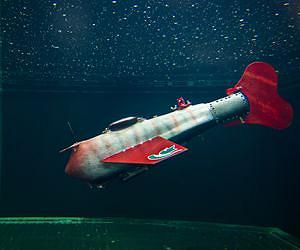
GRACE the Robot Fish: Data Gathering ROV from MSU

A team of MSU researchers has developed a robotic fish that can swim and glide long distances while gathering data such as water quality and temperature. 

Photo by G.L. Kohuth.

A high-tech robotic fish hatched at Michigan State University has a new look. A new skill and a new name.

MSU scientists have made a number of improvements on the fish, including the ability to glide long distances, which is the most important change to date.

The fish now has the ability to glide through the water practically indefinitely, using little to no energy, while gathering valuable data that can aid in the cleaning of our lakes and rivers.

Designed and built by Xiaobo Tan, MSU associate professor of electrical and computer engineering, and his team, the fish is equipped with an array of sensors that not only allow it to travel autonomously, but also measure water temperature, quality and other pertinent facts.


"Swimming requires constant flapping of the tail," Tan said, "which means the battery is constantly being discharged and typically wouldn't last more than a few hours."

The disadvantage to gliding, he said, is that it is slower and less maneuverable.

"This is why we integrated both locomotion modes - gliding and swimming - in our robot," Tan said. "Such integration also allows the robot to adapt to different environments, from shallow streams to deep lakes, from calm ponds to rivers, with rapid currents."

The robot's ability to glide is achieved through a newly installed pump that pushes water in and out of the fish, depending on whether the scientists want the robot to ascend or descend.

Also, the robot's battery pack sits on a kind of rail that moves backward and forward, in sync with the pumping action, to allow the robot to glide through water on a desired path.

The robotic fish now has a name: Grace, which stands for "Gliding Robot ACE."

Late last year Tan and his team took Grace for a test drive on the Kalamazoo River, where it exceeded all expectations.

"She swam at three sites along the river and wirelessly sent back sensor readings," Tan said.

"I'm not sure, but we may have set a world record - demonstrating robotic fish-based sampling with commercial water-quality sensors in a real-world environment."

Saturday, February 4, 2012

Lake Vostok: Russian Scientists Drilling through Ice

It has been five days since anyone has communicated with Russian scientists, who are in a remote Antarctic 'station,' where they are drilling through 13,000 feet of an ice sheet to reach the prehistoric Lake Vostok.

Now the scientific community is anxiously waiting to hear what's become of them.

"Temps are dropping below -40 Celsius and they have only a week or so left before they have to winterize the station," said John Priscu, an Antarctic research expert at Montana State University, in an interview with Fox News.

"I can only imagine what things must be like at Vostok Station this week."

The scientists are presumed to be on the surface of the ice sheet near the Vostok Station, where they were expected to conclude two decades of efforts to drill through to what has been deemed the most "alien lake on Earth," sealed off from the planet's atmosphere for 20 million years.

Geothermal vents are theorized to sustain life beneath the lake, from primordial microbes to monstrous tube worms.

To prevent contamination of the lake, they have attempted to drill only deep enough to let frozen slush on its surface flow up through the borehole, but it is possible that pressurized gas could escape explosively, raising concerns about the scientists' safety.

"If it goes well, a breakthrough opens up a whole new chapter in our understanding of our planet and possibly moons in our solar system and planets far beyond," Priscu told the Washington Post.

"If it doesn't go well, it casts a pall over the whole effort to explore this wet underside of Antarctica."

Monday, December 5, 2011

Grand Traverse Bay of Lake Michigan

This is a "grand" view of Grand Traverse Bay of Lake Michigan, USA

Tuesday, August 23, 2011

Water Evidence for Mars Floods has dried up!

Lava, not water, may have carved the biggest channels on Mars.

Ever since NASA's Mariner 9 spacecraft beamed back the first images of the channels in the 1970s, most people have assumed they were created by massive floods. 

David Leverington of Texas Tech University in Lubbock says flowing water would have left behind much more sediment than is seen. There are also few minerals that form in liquid water present.

Lava, however, is known to have carved big channels on the moon. And Leverington points out that some of the channels on Mars start on the flanks of volcanoes and end in large deposits of solidified lava (Geomorphology, DOI: 10.1016/j.geomorph.2011.05.022).

Kelin Whipple of Arizona State University (ASU) in Tempe agrees that lava probably carved the huge channels, such as Kasei Valles (shown). He says the study calls into question the case for huge volumes of water – and possibly an ocean – on ancient Mars.

Phil Christensen, also at ASU, says clays and fans of sediment still point to the existence of smaller Martian lakes and riversMovie Camera. These would be better places to search for life, he says, because they would have held water for longer periods than the giant channels, where floods – if there ever were any – would have been fleeting. "Lakes and deltas are probably the places people are going to look for life," he says.

Thursday, December 31, 2009

NASA study: California Lakes warming quicker than expected

New U.S. scientific findings suggest that climate change may be affecting aquatic environments faster and sooner than the atmosphere.

Researchers from NASA's Jet Propulsion Laboratory in Pasadena, Calif., came to conclusions after noticing that Lake Tahoe, Clear Lake and four other big lakes in Northern California and Nevada are heating up faster than the surrounding atmosphere, The Sacramento Bee reported Sunday.

The newspaper said the researchers tapped satellite sensor temperature data compiled over 18 years in what is believed to be the first time that long-range lake surface temperatures have been dissected. What the data reportedly showed is that the lakes' water temperature rose two times faster, on average, than the regional air temperatures.

"It was a big surprise to see that," Philipp Schneider, the study's lead author and a post-doctoral research scientist at the NASA lab, told the Bee. "If it turns out they're actually changing faster than the air temperature, then there's a whole new phenomenon going on here.

The lake ecosystems are going to be very much affected, especially because the trend we observed seems to be quite rapid."