Showing posts with label Drones. Show all posts

Wednesday, September 17, 2014

ARCAS: Aerial Robotics Cooperative Assembly System

ARCAS

There are many situations where it's impossible, complicated or too time-consuming for humans to enter and carry out operations.

Think of contaminated areas following a nuclear accident, or the need to erect structures such as antennae on mountain tops.

These are examples of where flying robots could be used.

Robots taught to think and act autonomously

The EU's ARCAS project (Aerial Robotics Cooperative Assembly System) has designed a range of different flying robots with multi-joint manipulator arms to work together on grasping, transporting and depositing parts safely and efficiently.

The autonomy and skills of the robots is being developed to build or disassemble structures for a host of future applications, from rescue missions to inspection and maintenance in the energy and space sectors.

'The idea is that the robots should be able to fly in anywhere where it is impossible or impractical for piloted aircraft or ground robots to operate,' explained ARCAS project manager Professor AnĂ­bal Ollero, of the University of Seville.

'We have helicopters, and multi-rotor systems with eight rotors to give more hovering control, increase the payload and carry arms with greater degrees of freedom.'

Up to 10 mini-prototypes have been demonstrated working together on an indoor test bed at CATEC , the Advanced Aerospace Technologies Centre in Seville, Spain.

Larger outdoor demonstrations using adapted helicopters and bigger multi-rotors have been performed at the facilities of DLR , the German national aerospace research centre, near Munich, and the University of Seville , to grasp bars and transport them over distance before depositing them.

The idea of flying robots is not new, of course. A large range of unmanned aerial vehicles are already in use, not least to take photographs and collect other sensor data.

But ARCAS is pioneering in that the flying robots are being equipped with arms to perform increasingly complicated manipulation tasks autonomously.


They are programmed with briefing information and 3D maps to orient them, equipped with sensors to adapt to mistakes (such as the dropping of a part) or changing circumstances (like weather conditions), and even taught how to land safely in an emergency or fly home automatically when they lose contact with base.

'The robots work very well," said Professor Ollero. 'We still need to improve accuracy and repetitiveness in different conditions, but the results are very promising.'

'We have demonstrated aerial manipulation with six- and seven-joint arms and perception and planning functionalities, and this is a first worldwide.'

Now the aim is to improve the robots' robustness and reactivity, working them together in bigger numbers and increasing the complexity of tasks they perform.

From pipeline inspection to space junk

ARCAS is paving the way for the flying robots to be used in applications as soon as national safety laws allow.

At first, this is likely to be for inspection and maintenance purposes: oil and gas pipelines and electricity networks stretching over thousands of kilometres, for example.

In the medium term, the team believes the robots could cooperate in fast building of structures, such as antennae stations in remote areas or platforms between buildings, say, to rescue people from fires.

In the long term, post-2020, they will be able to dismantle satellites, service space stations or even help remove space junk.

The ARCAS project (Aerial Robotics Cooperative Assembly System), involves eight partners from five countries and is funded to the tune of 6.15 million euros by the European Commission's 7th Framework Programme. It began in 2011 and finishes in November 2015.

Thursday, May 29, 2014

Flocking Drones UAV: Nature inspires future developments - Video

Biologically-inspired flapping-wing robots are shown. 

Image courtesy Pakpong Chirarattananon.

Researchers have been taking tips from nature to build the next generation of flying robots.

Based on the mechanisms adopted by birds, bats, insects and snakes, 14 distinguished research teams have developed solutions to some of the common problems that drones could be faced with when navigating through an urban environment and performing novel tasks for the benefit of society.

Whether this is avoiding obstacles, picking up and delivering items or improving the take-off and landing on tricky surfaces, it is hoped the solutions can lead to the deployment of drones in complex urban environments in a number of different ways, from military surveillance and search and rescue efforts to flying camera phones and reliable courier services. For this, drones need exquisite flight control.

The research teams have presented their work, 23 May, in a special issue of IOP Publishing's journal Bioinspiration and Biomimetics, devoted to bio-inspired flight control.

The first small drones have already been used in search and rescue operations to investigate difficult-to-reach and hazardous areas, such as in Fukushima, Japan.

A video by the COLLMOT Robotic Research Project showing a group of drones flying autonomously across a field.

A research team from Hungary believe these efforts could be improved if robots are able to work in tandem, and have developed an algorithm that allows a number of drones to fly together like a flock of birds.

The effectiveness of the algorithm was demonstrated by using it to direct the movements of a flock of nine individual quadcopters whilst they followed a moving car.

While this collective movement may be helpful when searching vast expanses of land, a group of researchers from Harvard University have developed a millimetre-sized drone with a view to using it to explore extremely cramped and tight spaces.

The microrobot they designed, which was the size of a one cent coin, could take off and land and hover in the air for sustained periods of time.

In their new paper, the researchers have demonstrated the first simple, fly-like manoeuvres. In the future, millimetre-sized drones could also be used in assisted agriculture pollination and reconnaissance, and could aid future studies of insect flight.

Once deployed into the real world, drones will be faced with the extremely tricky task of dealing with the elements, which could be extreme heat, the freezing cold, torrential rain or thunderstorms.

The most challenging problem for airborne robots will be strong winds and whirlwinds, which a research team, from the University of North Caroline at Chapel Hill, University of California and The Johns Hopkins University, have begun to tackle by studying the hawk moth.

In their study, the researchers flew hawk moths through a number of different whirlwind conditions in a vortex chamber, carefully examining the mechanisms that the hawk moths used to successfully regain flight control.

The whole collection of related papers can be downloaded for free from http://iopscience.iop.org/1748-3190/9/2

Tuesday, May 27, 2014

NOAA Hurricane Research Storm Drones

In this April 29, 2014 photo, Joe Cione, who studies how storms interact with the ocean at the (National Oceanic and Atmospheric Administration) NOAA's Hurricane Research Division in Miami, displays a drone he hopes to use this hurricane season for research. 

NOAA researchers plan to test five or six drones in the peak of hurricane season that will be transmitting data that could help forecasters understand what makes some storms fizzle while others strengthen into monsters. AP Photo/J Pat Carter

The point where the roiling ocean meets the fury of a hurricane's winds may hold the key to improving storm intensity forecasts, but it's nearly impossible for scientists to see.

That may change this summer, thanks to post-Hurricane Sandy federal funding and a handful of winged drones that can spend hours spiraling in a hurricane's dark places.

The drones will be transmitting data that could help forecasters understand what makes some storms fizzle while others strengthen into monsters.

Researchers at the NOAA's plan to test five or six drones in the peak of hurricane season.

The $1.25 million project is among a slew of other NOAA hurricane research funded by last year's Sandy supplemental bill that authorised $60 billion for disaster relief agencies.

Monday, February 24, 2014

Thales WK450 Drone: UK Army using French Watchkeeper drones to police the UK skies


The Army's latest "spy in the sky" unmanned aircraft is due to begin flying over British skies this week.

Thales Watchkeeper WK450, a reconnaissance and surveillance unmanned air system (UAS), has a wingspan of 35 feet and can fly at an altitude of up to 16,000 feet.

It has been designed to loiter over areas of interest for "significantly longer" than existing systems, providing clear surveillance pictures to troops on the ground.

The aircraft boasts two sensors - a day and night camera which produces 24-hour high-definition images and a radar sensor, allowing it to see in all conditions.

These images are relayed in real time to a ground control station that acts as the aircraft's cockpit - reducing the need to deploy troops to "potentially dangerous" situations.

Watchkeeper, which has been tested in West Wales since 2010 and is nearing the end of its trials, is expected to take a "significant role" in future military campaigns.

This week, highly-skilled pilots will fly Watchkeeper in restricted airspace over the Ministry of Defence's Salisbury Plain Training Area in Wiltshire, overseen by military air traffic controllers.

The Army is due to begin its own training later this year.

Colonel Mark Thornhill, Commander of 1st Artillery Brigade said: "Watchkeeper is a state-of-the-art system coming in to service now. It can fly for longer, it flies off rough strips, it has better sensors.

"Watchkeeper is designed specifically to support worldwide operations in many different locations.

"Watchkeeper is a fantastic capability because it will allow us to provide real-time imagery back to the ground commander so that he can then take appropriate action depending on what he sees and what he learns from that imagery.

"Therefore, he will be able to perform in a much better fashion and make much better operational decisions based on the imagery we are providing to him."

Watchkeeper, which is being developed by the French corporation Thales in the UK, is unarmed and does not carry any weapons. It has already clocked up 500 hours of flying time in West Wales.

Sunday, December 1, 2013

New Wave Energy UK: Power plants in sky - Wireless Transmission Drones

Here is the idea: flying power plants in the sky as a means of providing clean, renewable energy.

Here is more of the idea: this would be a high-altitude aerial power plant that harvests energy from solar, wind and other sources, and beams it wirelessly to the ground.

Now the idea gets more interesting: The power plant would be using networks of unmanned drones.

The company is New Wave Energy UK, formed in 2012, self-described as "an upcoming energy provider within the UK currently working towards researching and constructing our own novel form of power plant." (New Wave Energy UK is not associated or affiliated with US-based New Wave Energy Corp.)

In a November 15 press release, the company announced that "A new and exciting venture into a whole new form of power plant is currently in incubation within the UK."

The company said the "patent pending technology" is a drone-based power plant for combined solar, wind, heat and emerging new forms of energy generation.

The technology is to incorporate wireless power transmission from the drones (and their wireless network) to the Earth's surface," according to the release.

Details about the drone are in a recent Gizmag article on New Wave Energy UK.

According to the article, the company's ambition is for each drone to have four rotors, multiple wind turbines and a flat base for generating solar power.

With energy harvested, the devices will power themselves and also 50 kW more that can be transmitted wirelessly to the ground.

Rectenna arrays installed inland or on offshore installations would receive electromagnetic waves and convert them into usable power.

According to New Wave Energy, "The technology is tailored to operate at 50,000 ft where wind patterns are more reliable, solar production is greater and there is little or no interference from weather patterns."

In the November 15 press release, the company said it was seeking further investment to advance the project.

New Wave Energy UK is turning to crowdfunding as one such step. "To raise such equity New Wave Energy UK Ltd are hoping to raise £300,000 through crowd funding on Kickstarter.

New Wave Energy UK Ltd also intend to acquire a total of £32 million from private investors during the crucial stages of the project to commercialise the application."

Thursday, August 1, 2013

MORPH International Exercise: Underwater UAV drones explore the Med

MORPH, the world's first fleet of "marine drones" is being put through its paces in the Mediterranean port of Toulon.

Five European countries -- France, Germany, Italy, Spain and Portugal -- have sent prototypes here under a four-year, four-million-euro ($5.32-million) programme to build a squad of unmanned underwater rovers.

The MEDUSAS, first launched in 2010, has been thoroughly tested at sea and its autonomy and reliability have been instrumental in other projects. 

In previous missions, equipped with one acoustic modem, it collected data sets that are currently being used to test the efficacy of single beacon navigation algorithms. 

Deployed from a surface vessel, but communicating among themselves and using artificial intelligence, the wireless scouts would spread out in a surveillance network.

Using video cameras and echosounders, the explorers would help to create 3D maps of underwater terrain, benefitting oceanographers, archaeologists, offshore oil and gas drillers, pollution monitors, marine biologists and other civilian users.

But there is an obvious naval use too, for a flexible network of small, hard-to-detect drones would multiply the surveillance capacity against mines and other threats.

Vincent Rigaud
"Underwater robots are not new -- we've been involved in them for years," said Vincent Rigaud, director of underwater systems at the French Institute for Research for Exploitation of the Sea (Ifremer), one of the world's top names in oceanography.

"What is new, though, is creating a fleet of them, with autonomous capacity."

Achieving this means overcoming two major hurdles, Rigaud explained.

One is software: creating artificial intelligence programmes that give the options for cooperating in a group and coping with the uncertainties of the marine environment, with its tides and currents.

The other is communications. Airborne drones can talk to each other, and to their controller, by the instant means of radio.

But radio waves do not penetrate underwater, which leaves sound the only option for communication among the marine drones.

Rather like a school of dolphins chirping to each other, the robots use acoustic signals to swap information and instructions -- and as experiments have shown, this is not an easy thing.

The communication is frustratingly long because the data flow is so slow, and the tenuous sound link is easily disrupted by other sources of noise, such as a passing vessel.

Pere Ridao
"It's like going back to modems in the dawn of the computer age," said Pere Ridao of the University of Girona in Spain.

"The maximum flow rate is about 100,000 times slower than a typical ADSL connection. It takes several minutes to send a picture."

On a mission, the robots would share a rough map of the underwater terrain, showing major obstacles to avoid, but would then work by themselves within designated parameters.

What they see and monitor would be stored in onboard memories which would then be downloaded after they are recovered.

Powerful computers would crunch the raw data into useable applications.

Antonio Pascoal
"The vehicles are not physically connected but virtually connected," explained Antonio Pascoal, a professor at Portugal's Superior Technical Institute (IST).

"The idea is for them to dialogue and adapt to marine geometry without human intervention."

The programme, called MORPH (Marine Robotic System of Self-Organising, Logically Linked Physical Nodes), was launched in February 2012 with the help of the European Commission. Thirty-two scientists are taking part.

Sunday, June 16, 2013

Paris Air Show peek: EADS Airbus and Boeing Wide-bodies battle it out

The EADS Airbus A350 makes a pass over the airport during its maiden flight from Blagnac airport near Toulouse, southwestern France, Friday, June 14, 2013. 

The EADS Airbus A350 has taken off on its maiden flight, setting the stage for intensifying competition with U.S. rival Boeing in the long-haul wide-body aircraft market. 

Credit: AP Photo /Bob Edme

The Paris Air Show, which opens for business on Monday Jun. 17, brings hundreds of aircraft to the skies around the French capital, the usual tense competition between aircraft manufacturers Boeing and Airbus, and a slew of innovations large and small.

BATTLE OF THE WIDE-BODIES
The much-anticipated Airbus A350 flew for the first time on Friday, launching a new air race between the European plane maker and Boeing for long-haul wide-body aircraft.

Boeing has dominated the market so far, but troubles with the lithium ion batteries in its 787 Dreamliner are giving customers a reason to give a close look at Airbus' first all-new plane in eight years.

The CEO of Airbus parent EADS, Tom Enders, has said he expects a "few hundred" new orders.

Boeing executives, meanwhile, downplayed the air show's importance for orders, noting that the two companies have historically split the commercial aircraft market.

A year ago, at the Paris Air Show's sister event in Britain, Boeing beat Airbus for the number of orders announced.

The U.S. company took in $37 billion in orders and commitments, well above EADS Airbus' $16.9 billion.

But the announcements during the air shows are not always a reliable indicator of business since prices are often negotiated down heavily and big orders don't always coincide with the event.

The race for the title of biggest plane maker is as tight as ever. Over the whole of 2012, Airbus delivered 588 planes. That was a record, but one Boeing beat with 601 deliveries, the first time since 2003 it came out on top.

UAV - DRONES
They have swooped into wildfires to take temperatures and tracked animals across Africa. They have guided a fuel tanker to safety through icy waters.

Drones are increasingly being used for non-military purposes and are expected to feature prominently at the Paris Air Show.

There are still tough restrictions on their flight for safety reasons, but while the Federal Aviation Authority works on new rules, the makers of drones will aim to show off innovation and technical prowess at the show.

Eurocopter, a company based in France, will showcase new technology that can transform a manned helicopter into one that flies without a pilot.

US SEQUESTRATION TAKES TOLL
American fighter jets aren't taking to the skies above Paris, nor will they be seen on the ground, for the first time in more than two decades thanks to the U.S. government's spending cuts—the infamous 'sequestration'.

The U.S. pavilion remains the largest, but the event will be less of a sales showcase for latest military hardware and more a place for suppliers to meet up with potential customers.

Russia, on the other hand, is looking to make a splash by presenting fighter jets and military helicopters at the show for the first time since 2001.

The Sukhoi manufacturer will showcase its Su-35, a twin-engine multipurpose fighter, for the first time outside Russia. Britain and France also will have fighter jets on display.


EVERY LITTLE BCOUNTS
Less flashy but just as important for the industry will be the myriad technological innovations that parts suppliers will come to Paris to present. The biggest issue? The cost of fuel.

The price of jet fuel has more than tripled worldwide since 2003—a trend both jet manufacturers and airlines expect to continue. Electric- or solar-powered commercial flights are wildly improbable and biofuels aren't yet economically viable, so airlines are looking to improve mileage any way possible.

For long-haul flights, that means more carbon-fiber in airplane bodies and other design tweaks, such as electric motors for taxiing. For passengers, it means no end in sight on extra baggage fees.

Saturday, June 8, 2013

Drones Fly In Alaska's oilfields

Handout shows miniature aircraft named Aeryon Scout Small Unmanned Aerial Systems during BP pilot testing for use of UAVs in pipeline inspection at Prudhoe Bay

Credit: Bp Alaska/Reuters

No pilot was required when the Aeryon Scout took off into the leaden skies of Alaska to inspect a stretch of oil pipeline.

The miniature aircraft was guided by an engineer on the ground, armed only with a tablet computer.

The 20-minute test flight, conducted by BP Plc last fall, was a glimpse of a future where oil and gas companies in the Arctic can rely on unmanned aircraft to detect pipeline faults, at a fraction of the cost of piloted helicopter flights.

It could become reality as soon as 2015, when the Federal Aviation Administration (FAA) opens up American skies for the commercial use of unmanned aircraft, popularly known as drones.

While technical shortcomings and strict regulation are likely to limit the use of drones in the near term, the rules governing public airspace will be more relaxed in the wilderness of Alaska than in the lower 48 states, industry experts say.

"We're going to take baby steps," said Gary Shane, senior project manager and chief technology officer of BP Pipelines in North America. The company plans to deploy its first drones in the Alaska North Slope within three years, he told reporters.

Laid end to end, the more than 300,000 miles of natural gas pipelines that crisscross the United States would circumnavigate the planet 12 times. There's a lot of money to be saved by reducing the number of manned flights on these routes.

Dave Kroetsch
A small, unmanned vehicle fitted with a heat-sensing camera costs about $85,000, while it costs about $3,000 to send a helicopter to monitor an oil pipeline for an hour, said Dave Kroetsch, chief executive of drone manufacturer Aeryon Labs Inc.

The drone, therefore, would pay for itself within 29 hours.

BP began researching the use of unmanned aircraft in 2006. Royal Dutch Shell Plc began a year earlier.

One aim, says Shell, is to track the movement of marine mammals to assess the impact of the company's operations in the seas off Alaska.

The Scout is the flagship product of Aeryon Labs, a private Canadian company based in Waterloo, Ontario - the same university town that gave rise to BlackBerry.

Under a meter in length, the Scout weighs 1.2 kg (2.7 lbs) - tiny when compared with the 1,020-kg MQ-1 Predator drone used by the U.S. military and manufactured by San Diego-based General Atomics.

Aeryon Labs calls the Scout a "flying robotic reconnaissance system". It has been used by Gaddafi-era Libyan rebels and seen action in a Central American drugs bust. (http://r.reuters.com/zec68t)

A camera mounted on the drone transmits a live feed to the operator. In the case of pipeline work, sensors can pinpoint the location of a suspected leak and detect signs of decay, such as cracks or rust, said Ian McDonald, Aeryon Labs' vice-president.

With four rotors and legs allowing for vertical take-off and landing, the Scout can also hover closer to a pipeline than any helicopter could. Proponents of the technology say this will help oil companies to find defects earlier than they can now.

According to a U.S. government report on pipeline safety, the public was quicker to report pipeline leaks than companies' in-house detection systems in a third of cases recorded between January 2010 and July 2012. (http://link.reuters.com/wyk48t)

Tuesday, April 9, 2013

US Laser weapon to be mounted on USS Navy warship Ponce - Video


The US Navy has released a video of a laser weapon it says will be stationed on US warship Ponce in the Middle East, despite reports it has problems working in bad weather.

The weapon runs on electricity and can fire as long as there is power, at a cost of $1 dollar per shot. Military experts claim it is a step towards transforming warfare.

However, a report from the Congressional Research Service says there are drawbacks, including the potential that it could hit satellites or aircraft and may not work in rain or foggy conditions.

The laser weapon will be installed on USS Ponce which is being used as a floating base in the Middle East in 2014.


Sunday, June 17, 2012

NASA X-37B Space Drone OTV-2 Returns to Earth Safely

The USAF X-37B designated Orbital Test Vehicle (OTV)-2 returned to Earth on Saturday, June 16th after 468 days 13 hours and 2 minutes on a voyage that orbited the Earth more than 7,000 times performing a classified mission.

OTV-2 received the command from its ground controller to return and initiated an autonomous firing sequence of its propulsion system to brake from its orbit and dive through the atmosphere for a reentry over the Pacific Ocean.

OTV-2 executed a series of turns similar to those performed by the Space Shuttle to dissipate speed as it navigated autonomously via GPS towards Vandenberg AFB in California. OTV-2 touched down on the 3-mile (4.8 kilometer) long runway at Vandenberg 5:48 a.m. local (8:48 a.m. EDT; 1248 GMT).

OTV-2′s flight and that of its sister ship OTV-1, is classified and will likely remain so.

It is that secrecy that has spawned speculation about the purpose of the both spacecraft ranging from a test-bed for new sensors and materials to being a prototype for a new generation of space weapons.

The U.S. Air Force maintains that both spacecraft are designed as test-beds for new technologies; however, the classified nature of the project will ensure that speculation will continue.

Thursday, June 14, 2012

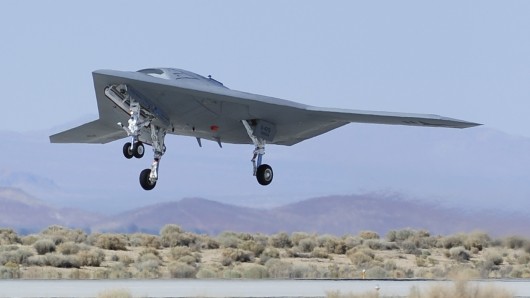
X-47B Drone: Unmanned aircraft completes first major flight-test


The Northrop Grumman-built X-47B has passed the latest checkpoint on its flight path towards becoming the first carrier-based, tailless, fighter-sized, unmanned aircraft in the U.S. Navy’s arsenal with the successful conclusion of the first major phase of flight testing at Edwards Air Force Base (EAFB) in California.

The airworthiness test phase, which kicked off with the maiden flight on February 4, 2011, saw two X-47B Unmanned Combat Air System (UCAS) demonstrators conduct 23 flights in which the aircraft reached altitudes in excess of 15,000 feet and demonstrated multiple maneuvers required for carrier operations.

These included the first flight in cruise mode, extending and retracting a tail hook, completing an aviation-first autonomous “touch-and-go” landing, and landings at a high sink rate and in heavy weight configuration.

Northrop Grumman says the flight tests proved the aircraft’s ability to perform properly at all speeds, weights and altitudes associated with the Navy’s Unmanned Combat Air System Carrier Demonstration (UCAS-D) program.


"The X-47B flight test program at Edwards will be remembered as a very successful collaboration among the Navy, Northrop Grumman and the U.S. Air Force Flight Test Center," said Carl Johnson, vice president and Navy UCAS Enterprise program manager for Northrop Grumman's Aerospace Systems sector.

"The X-47B flight test program at Edwards demonstrated convincingly the maturity, durability and performance of this revolutionary new unmanned system.”

Following the completion of the airworthiness flight tests at EAFB on May 15, the second X-47B has been transported cross-country to Naval Air Station Patuxent River in Maryland.

It joins the first X-47B that was moved there in December 2011 and is currently undergoing electromagnetic interference testing to ensure it is compatible with the electromagnetic signal environment experienced on an aircraft carrier.

Tuesday, May 1, 2012

Robotic Bird Airplane Perching on a Human Hand - YouTube


The work by Aditya Paranjape, Joseph Kim, and Soon-Jo Chung at the Aerospace Robotics and Control Lab, University of Illinois at Urbana-Champaign.

Narration by Jenny Roderick at the University of Illinois at Urbana-Champaign.

By the virtue of their size and speed, birds are uniquely capable of efficient flight while flapping their wings and while gliding.

Researchers at the University of Illinois at Urbana-Champaign have duplicated the control functions that allow birds to successfully perform a soft landing—in this case, perching on a human hand.

“We believe we have the first demonstration of autonomous/robotic flight of a bird-like micro aerial vehicle (MAV) perching on a human hand,” stated Soon-Jo Chung, an assistant professor in the Department of Aerospace Engineering at Illinois.

Because the wings of ornithopters—birds or aircraft with flapping wings—are inherently capable of being reoriented, this capability can be used for controlling and maneuvering the aircraft in a gliding phase, thereby eliminating the need for additional traditional actuators. Gliding is an effective way to conserve energy while soaring, descending, and landing.

“The driving philosophy behind the work is that the maneuverability and control efficiency of avian flight can be replicated by applying their actuation and control principles to advanced MAVs designed on the size scale of small birds,” explained Aditya Paranjape, a postdoctoral scholar working on this project.

The result is based on his PhD thesis and a series of journal papers with Chung.

“We have developed an articulated-wing-based concept for an agile robotic aircraft inspired by birds,” Paranjape added. “Of all manoeuvers executed by flapping wing aircraft in a gliding phase, a perched landing is arguably the most challenging.”

Perching is routinely used by birds to land on objects such as tree branches, power wires, or building ledges. According to the researchers, there are two factors that make perching challenging to engineer: 1) the maneuver’s duration is very short, on the same order as the aircraft dynamics, and 2) a high level of position accuracy is required for a successful perched landing.

“Our aerial robot concept lacks a vertical tail for improved agility, similar to birds, which renders it dynamically unstable and exacerbates both of these factors,” Paranjape said. “We choose a perching maneuver to demonstrate the capabilities of our articulated-winged aircraft concept, novel guidance algorithms, and control design.

In particular, the ability to perform perched landings on a human hand endows our robot with the ability to operate around humans.”

A typical perching maneuver consists of two phases—a gliding phase to bring the bird to a suitable position with respect to the landing spot, and a rapid pitch up (usually to a post-stall angle of attack) accompanied by an instantaneous climb and rapid deceleration.

The researchers noted that the success of the maneuver can be severely impeded by the lateral-directional motion (yaw and roll), particularly when the perched landing has to be accomplished on a small surface such as an electric pole or a human palm.

In the absence of a vertical tail, wing articulation is a promising capability which can be used for both longitudinal and lateral-directional control.

Chung, who joined the Illinois’ faculty in 2009, brought with him a vision for developing aircraft that mimic the autonomy and agility of bats.

“There’s a lot to learn from bio systems,” Chung said. “Bats can fly with damaged wings. They are so agile and highly maneuverable; they can make rapid 180-degree turns autonomously and they can fly indoors without colliding with obstacles. These qualities are desirable for small aircraft that could be used in surveillance, particularly in urban settings where obstacles hamper movement and satellite control is blocked.”

The MAV project was funded by the Air Force Office of Scientific Research.


The technical details of this work can be found in the following papers.
A. Paranjape, J. Kim, and S.-J. Chung, "Closed-Loop Perching of Aerial Robots with Articulated Flapping Wings," IEEE Transactions on Robotics, under review, 2012. https://netfiles.uiuc.edu/sjchung/www/Paranjape12_perching_submitted.pdf

A. A. Paranjape, S.-J. Chung, H. H. Hilton, and A. Chakravarthy, "Dynamics and Performance of a Tailless MAV with Flexible Articulated Wings," AIAA Journal, vol. 50, no. 5, May 2012, pp. 1177-1188. https://netfiles.uiuc.edu/sjchung/www/AIAAJflexnew.pdf

A. A. Paranjape, S.-J. Chung, and M. S. Selig, "Flight Mechanics of a Tailless Articulated Wing Aircraft," Bioinspiration & Biomimetics, vol. 6, 026005, 2011. https://netfiles.uiuc.edu/sjchung/www/dihedral_final.pdf

Saturday, March 3, 2012

Vijay Kumar showing off palm-sized "agile aerial robots" at TED


In his lab at Penn, Vijay Kumar and his team build flying quadrotors, small, agile robots that swarm, sense each other, and form ad hoc teams -- for construction, surveying disasters and far more.

At the University of Pennsylvania, Vijay Kumar studies the control and coordination of multi-robot formations. Full bio »

Tuesday, January 31, 2012

Saturn: Plan to Fly A Nuclear powered Drone craft to Titan

Scientists have proposed a plan to send a nuclear-powered drone to Saturn's moon Titan, which is 10 times more distant from the sun than Earth and has a methane atmosphere that is four times a dense.

Led by BYU professor Jani Radebaugh, the plan is to put the drone in Titan for a year-long flight so it can observe the moon which shares many similarities with the Earth like rivers, oceans, mountains, sand dunes and winds.

"Titan is a really interesting place as far as understanding the processes on the early Earth," said Radebaugh.

"It orbits at a good distance, has organic molecules of carbon and hydrogen, there's energy in the atmosphere and perhaps occasionally water on or near the surface - those are the main things considered necessary for life."

According to the scientists, the proposed drone will operate on a nuclear battery that can power a couple light bulbs.

The battery would power a propeller except when it needed to beam data back to radio telescopes on earth, however, prior to these transmissions, the drone would climb high into Titan's atmosphere.

Power would then shift to the radio cone in the drone's nose as the aircraft glides back down to its usual flight altitude, the researchers explained.

Published in the Experimental Astronomy, Radebaugh and her group noted that while transporting the drone to Titan would take up to 7 years, once there the communication relay time would take a mere 90 minutes.

Titan is of great interest to scientists because it is the only moon in the solar system known to have clouds and a mysterious, thick, planet-like atmosphere.

TITAN
Recent researches have also found Titan to be more Earth-like than previously thought. Here are some interesting facts about this object in the solar system.

• Titan is the biggest of the 53 known moons orbiting Saturn. It is a cold world enclosed by a thick, hazy atmosphere that is yet to be penetrated by telescopes and cameras.

• Titan is the second largest moon in our solar system with an equatorial radius of 2,575 km (1,600 miles). It's bigger than Earth's Moon and the planet Mercury.
• Titan's surface temperature is about -289 degrees Fahrenheit (-178 degrees Celsius).

• Titan orbits Saturn at a distance of about 1.2 million km (745,000 miles), taking almost 16 days to complete a full orbit.

• Titan was discovered on 25 March 1655 by the Dutch astronomer Christiaan Huygens.

Radebaugh wants to collect the data from Titan to get more information on how the moon's geology has formed.

"One of the main things we're looking for is life or precursors for life. Titan has a lot of molecules made of carbon and hydrogen, there's water ice bedrock, and water volcanoes," Radebaugh said.

"With water, organic molecules, and energy, that's all the ingredients for life. It's a really good place to look for precursory biology," she added.

Thursday, December 22, 2011

DARPA's New Spy Satellite

DARPA, Pentagon's research arm, has described its dream military space telescope that could gather intelligence anywhere in the world, doing away with the need for spy planes or drones.

The Defense Advanced Research Projects Agency (DARPA) is an agency of the United States Department of Defense that handles the development of new technology for use by the military.

It is also responsible for funding the development of many technologies which have had a major effect on the world, including surveillance equipments like space telescopes.

As envisioned by DARPA, the military telescope will be a lightweight optics array made of flexible membrae that could deploy in space. The dream telescope should be able to hover in geosynchronous orbit that could take real-time images or videos of any spot on Earth.

For this purpose, DARPA has commissioned Ball Aerospace which had completed a proof-of-concept review as part of $37 million contract for the telescope. The research agency's requirement is a space telescope with a collection aperture or light-collecting power of almost 20 meters in diameter.

DARPA said that the telescope, which image resolution should see objects less than 10 feet (3 m) long within a single image pixel, should be able to spot missile launcher vehicles moving at speeds of up to 60 mph on the ground.

With the completion of the project, U.S. military commanders and intelligence agents should be able to get live streaming video and up-to-date images of battlefields or trouble spots around the world. Such capability could complement the present drones that provides battlefield surveillance to the military.

DARPA's mission has been to assure that the U.S. maintains a lead in applying state-of-the-art technology for military capabilities and to prevent technological surprise from her adversaries.

X-47B Drone Mistaken for a UFO in Kansas

An X-37B drone jet assembled by Northrop Grumman has been mistaken for a UFO by sky watchers.

Upon hearing the revelation, Brooks McKinney, senior manager of Northrop Grumman public relations department, appeared in public to present more information.

He explained that it was the X-47B unmanned combat drone manufactured to function from carriers of aircraft.

It was intended to be transported to the Naval Air Station Patuxent Rive, Maryland.

UMS or Unmanned systems became extremely usual that the Northrop Grumman has designed a special section devoted to drone technology. This you can check out on its official public website, where a specific page was set for X-47B.

"Clearly people are interested in what's going through town. It's unusual to see a shrink-wrapped aircraft, especially one with that shape," said McKinney.

McKinney further explained that the company has already built two of the same crafts for the Navy. Each craft was tested at Edwards Air Force Base in California since March. One is currently heading to Maryland, while the other will have to stay in California.

"It's difficult to fly an unmanned drone through commercial airspace," according to McKinney when asked about the reason why these high-tech crafts weren't flying.

So to end with the question "What's wrong with Kansas?" let's head to the answer: a throbbing absence of alien spaceships.

Monday, October 10, 2011

Drone mission control hit by self-cloning computer virus

How did a persistent computer virus come to haunt the pilots of the Predator drones attacking Al Qaeda targets in Afghanistan and Yemen?

No-one yet knows, and most likely we will never be told.

What we do know is that the top military technology of the age has proven vulnerable to a persistent keylogger, a virus that stores every keystroke made on a computer and which resists deletion.

It was found two weeks ago on the systems that ground pilots use to fly the Reaper and Predator drones at Creech Air Force Base in Nevada, and deleting the virus reportedly has no effect: it simply clones itself if deleted. "It keeps coming back," a Creech AFB operative complained to Wired.

It is most likely that the recent use of removable hard drives to update mission maps was the source of the malware, which appears to be hiding somewhere within the network at Creech. But since that network is not on the internet, the keylogged data should not be reaching any malefactor.

It is possible that top brass at the Pentagon, National Security Agency or the CIA are monitoring their own drone control staff using logging software - but given the mild panic its discovery has caused, that is unlikely.

Experts have also been warning for some time that counterfeit electronics could lead to such problems - and that will doubtless be investigated.

This episode shouldn't affect drone missions, however. They will still be as accurate or inaccurate as intelligence allows.

General Atomics, maker of the Predator, claims on its website that the aircraft has "a fault tolerant flight control system" that allows the plane to continue in safe flight even when contact with the remote control pilot is lost.

Tuesday, August 2, 2011

Global Hawk UAV: Smart Drone Set to Replace U-2 Spy Plane

The Air Force's Global Hawk surveillance plane at Northrop Grumman in Palmdale, Calif. Five will be built this year.

Work tables surround a handful of fuselages, and an unusually long wing, needed to slip through the thin air at 60,000 feet, is ready to be bolted into place.

Open panels await controls for cameras and eavesdropping gear, and bright blue tool bins and parts vats are scattered around the concrete floor.

Just 50 people work in the factory and a test hangar, and only five of the drones will be built this year. But despite a spate of delays, second-guessing and cost overruns, the Global Hawk is once again on track to replace one of America’s most noted aircraft: the U-2 spy plane, famed for its role in the cold war and more recently Afghanistan.

The Air Force decided last month to stick with its $12 billion Global Hawk program, betting that the unmanned drone can replicate the aging U-2’s ability to sweep up a broad mix of intelligence from commanding heights, and do it more safely and for much longer stretches than the piloted U-2.

The Navy is also onboard, with plans to spend $11 billion on a version that could patrol vast ocean areas.

The continued push for the Global Hawk reflects how drones are changing warfare and how critical high-altitude spying can be in any type of fight.

Still, the program remains ensnared in military politics and budget battles, and the aircraft itself awaits some important technical changes that could slow its unveiling.

In particular, creating the new models and their high-tech sensors, which can cost more than the planes, has been difficult.

And in an era in which remotely piloted planes are seen as relatively cheap and easy solutions, the Global Hawk has become the Escalade of drones, the gold-plated one that nearly broke the bank.

“The Global Hawk is a very impressive product, but it is also a very expensive product,” said Richard L. Aboulafia, an aviation analyst at the Teal Group, a consultancy in Fairfax, Va. “Those U-2s were paid for a long time ago.”

Tuesday, March 22, 2011

Global Hawk

Ready for its closeup: The first demilitarized Global Hawk debuts in 2009 at NASA’s Dryden center in California, where scientists will use it to study hurricanes, pollution, and other atmospheric disturbances.

"That's Professor Global Hawk" | Flight Today | Air & Space Magazine

On an April morning last year beneath a bright desert sky, officials at NASA’s Dryden Flight Research Center in California unveiled their newest tool for studying the atmosphere: a Global Hawk. In fact, it was the very first Global Hawk, produced in 1998 as a demonstrator to show the capabilities of the unmanned military airplane.

Originally developed to provide field commanders with high-resolution surveillance imagery and produced by Northrop Grumman, Global Hawks fly high and long. They reach altitudes of 65,000 feet, and can surpass 30 hours and 11,000 nautical miles in a single flight.

For Earth scientists, loading a Global Hawk up with sampling gear and sending it into the stratosphere suggests intriguing applications: measuring levels of pollutants and greenhouse gases like ozone; studying the formation of hurricanes and the shrinkage of ice sheets; monitoring the effects of natural disasters.

“Northrop Grumman and the U.S. Air Force have proved that you can use this plane to do reconnaissance,” says NASA atmospheric scientist Paul Newman, who helped oversee Global Hawk’s first climate research mission. “Well, science is just a different kind of reconnaissance.”

The Global Hawk is no diminutive drone—its slender wings span 116 feet, and its V-tail reaches 15 feet high. With its white paint job, snub nose, humped radome, and single Rolls-Royce AE-3007H turbofan engine, the Global Hawk cuts a figure both elegant and strange; its profile gives the vague impression of a beluga wearing a jetpack.

Global Hawks are well established as military aircraft: The Air Force has deployed them since 2001; 30 have been built and 26 remain operational. But last April marked the first time a Global Hawk had been used for Earth science.

As scientists and NASA officials gathered inside a Dryden hangar to admire Air Vehicle-1, the first Global Hawk made, its sister airplane, AV-6, was heading up the Pacific Northwest coast on a 24-hour tour, one of five flights planned as part of the Global Hawk Pacific (GloPac) mission, a joint effort between NASA and the National Oceanic and Atmospheric Administration to demonstrate the aircraft’s scientific utility.

Friday, April 23, 2010

US military launches top-secret robotic spacecraft

US military launches top-secret robotic spacecraft

A US Air Force unmanned spacecraft blasted off on Thursday from Florida, amid a veil of secrecy about its military mission.

The robotic space plane, or X-37B, lifted off from Cape Canaveral atop an Atlas V rocket at 7:52 pm local time (2352 GMT), according video released by the military.

"The launch is a go," Air Force Major Angie Blair told AFP.

Resembling a miniature space shuttle, the plane is 8.9 meters (29 feet) long and has a wing-span of 4.5 meters.

The reusable space vehicle has been years in the making and the military has offered only vague explanations as to its purpose or role in the American military's arsenal.

The vehicle is designed to "provide an 'on-orbit laboratory' test environment to prove new technology and components before those technologies are committed to operational satellite programs," the Air Force said in a recent release.