Showing posts with label flight test. Show all posts

Saturday, August 9, 2014

NASA LDSD Flight Test: Saucer Flies to Near Space


Ian Clark, principal investigator of the Low-Density Supersonic Decelerator (LDSD), takes us through a play-by-play of NASA’s recent 'flying saucer' Test in Hawaii, using high-definition video shot from cameras on board the test vehicle.

The goal of this experimental flight test, the first of three planned for the project, was to determine if the balloon-launched, rocket-powered, saucer-shaped, design could reach the altitudes and airspeeds needed to test two new breakthrough technologies destined for future Mars missions.

Carried as payload during the shakeout flight were two cutting-edge technologies scheduled to be tested next year aboard this same type of test vehicle.

The Supersonic Inflatable Aerodynamic Decelerator (SIAD) is a large, doughnut-shaped air brake that deployed during the flight, helping slow the vehicle from 3.8 to 2 times the speed of sound.

The second, the Supersonic Disksail Parachute, is the largest supersonic parachute ever flown. It has more than double the area of the parachute which was used for the Mars Science Laboratory (MSL) mission that carried the Curiosity rover to the surface of Mars.

"A good test is one where there are no surprises but a great test is one where you are able to learn new things, and that is certainly what we have in this case." said Ian Clark, principal investigator for LDSD at NASA's Jet Propulsion Laboratory in Pasadena, California.

"Our test vehicle performed as advertised. The SIAD and ballute, which extracted the parachute, also performed beyond expectations. We also got significant insight into the fundamental physics of parachute inflation. We are literally re-writing the books on high-speed parachute operations, and we are doing it a year ahead of schedule."

Monday, May 19, 2014

NASA LDSD: Saucer-shaped craft preps for flight test

Credit: NASA/JPL-Caltech

NASA's Low-Density Supersonic Decelerator (LDSD) project, a rocket-powered, saucer-shaped test vehicle, has completed final assembly at the U.S. Navy's Pacific Missile Range Facility in Kauai, Hawaii.

This experimental flight test is designed to investigate breakthrough technologies that will benefit future Mars missions, including those involving human exploration.

Three weeks of testing, simulations and rehearsals are planned before the first launch opportunity on the morning of June 3.

LDSD was built at NASA's Jet Propulsion Laboratory, Pasadena, California, and shipped to Kauai for final assembly and preparations.

"Our Supersonic Flight Dynamics Test Vehicle number 1 arrived at the Navy's Pacific Missile Range Facility on April 17," said Mark Adler, project manager of the Low-Density Supersonic Decelerator project from JPL.

"Since then, we have been preparing it for flight. One of the last big assemblies occurred on April 30, when we mated the vehicle with its Star-48 booster rocket."

During the June experimental flight test, a balloon will carry the test vehicle from the Hawaii Navy facility to an altitude of about 120,000 feet.

There, it will be dropped and its booster rocket will quickly kick in and carry it to 180,000 feet, accelerating to Mach 4.

Once in the very rarified air high above the Pacific, the saucer will begin a series of automated tests of two breakthrough technologies.

In this picture, NASA's saucer-shaped experimental flight vehicle is prepared for a Range Compatibility Test at the US Navy's Pacific Missile Range Facility in Kaua'i, Hawaii. 

Credit: NASA/JPL-Caltech

In order to get larger payloads to Mars, and to pave the way for future human explorers, cutting-edge technologies like LDSD are critical.

Among other applications, this new space technology will enable delivery of the supplies and materials needed for long-duration missions to the Red Planet.

The upper layers of Earth's stratosphere are the most similar environment available to match the properties of the thin atmosphere of Mars.

The Low Density Supersonic Decelerator mission developed this test method to ensure the best prospects for effective testing of the new and improved technologies here on Earth.

Anyone with Internet access will be able to watch live as video from the June test is relayed from the vehicle to the ground.

The low-resolution images from the saucer are expected to show the vehicle dropping away from its high-altitude balloon mothership and then rocketing up to the very edge of the stratosphere.


NASA's Low-Density Supersonic Decelerator team gathers around the "SIAD-R" -- a Supersonic Inflatable Aerodynamic Decelerator they're developing to assist future planetary exploration missions -- during rocket-sled testing at China Lake, Calif. 

Credit: NASA/JPL

The test vehicle will then deploy an inflatable Kevlar tube around itself, called the Supersonic Inflatable Aerodynamic Decelerator (SIAD).

After the SIAD inflates, the test vehicle will deploy a mammoth parachute called the Supersonic Disk Sail Parachute.

While people watching at home may be fascinated by how these two new technologies operate, the NASA flight team will actually be concentrating on a more fundamental question - "Will the test vehicle work as planned?"

"This first test is a true experimental flight test," said Ian Clark, the LDSD principal investigator from JPL.

"Our goal is to get this first-of-its-kind test vehicle to operate correctly at very high speeds and very high altitudes. "

Wednesday, March 12, 2014

Orion Spacecraft's Boosters for First Flight Test Arrive at Port Canaveral, Florida

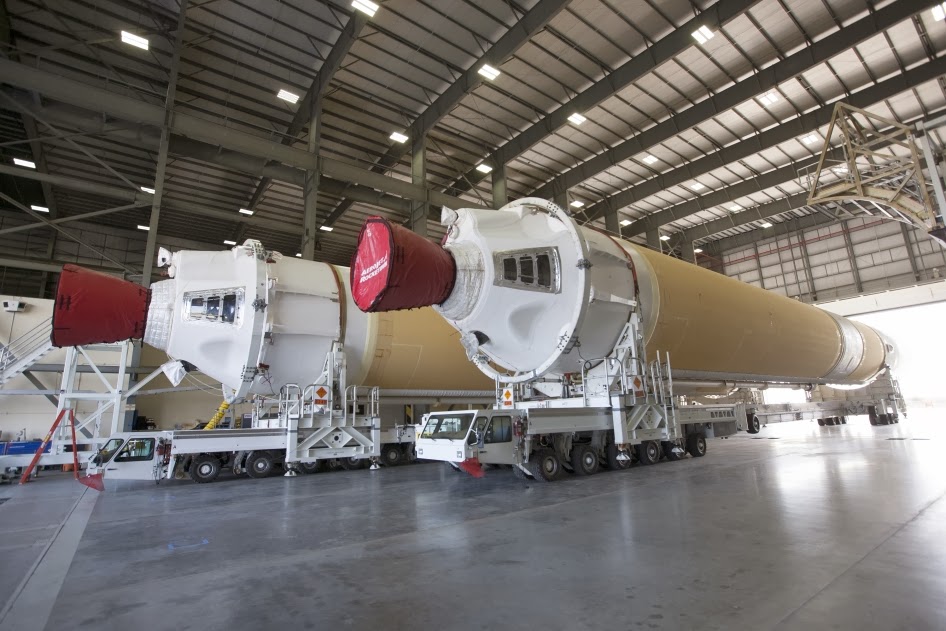
A barge arrives at the U.S. Army Outpost wharf at Port Canaveral in Florida, carrying two of the three United Launch Alliance Delta IV heavy boosters for NASA’s upcoming Exploration Flight Test-1 (EFT-1) with the Orion (MPCV) spacecraft.

The core booster and starboard booster will be offloaded and then transported to the Horizontal Integration Facility (HIF), at Space Launch Complex 37 on Cape Canaveral Air Force Station.

The port booster and the upper stage are planned to be shipped to Cape Canaveral in April. 

At the HIF, all three boosters will be processed and checked out before being moved to the nearby launch pad and hoisted into position.

Orion is the exploration spacecraft designed to carry astronauts to destinations in deep space, including an asteroid and Mars.

It will have emergency abort capability, sustain the crew during space travel and provide safe re-entry from deep space return velocities. 


During the uncrewed EFT-1 flight, Orion will travel 3,600 miles into space -- farther than a spacecraft built for humans has been in more than 40 years -- and orbit the Earth twice.

The capsule will re-enter Earth’s atmosphere at speeds approaching 20,000 mph, generating temperatures as high as 4,000 degrees Fahrenheit, before splashing down in the Pacific Ocean.

The data gathered during the flight will influence design decisions, validate existing computer models and innovative new approaches to space systems development, as well as reduce overall mission risks and costs for later Orion flights.

Image Credit: NASA

Friday, September 7, 2012

Nasa Robotic Lander "Mighty Eagle" - First Free Flight Test

Mighty Eagle during free flight. Credit: NASA/MSFC/Dennis Olive

NASA's robotic lander Mighty Eagle completed a successful free flight test September 5.

The prototype, using its onboard autonomous flight software, moved to an altitude of 100 feet, found its target and descended gently to a controlled landing.

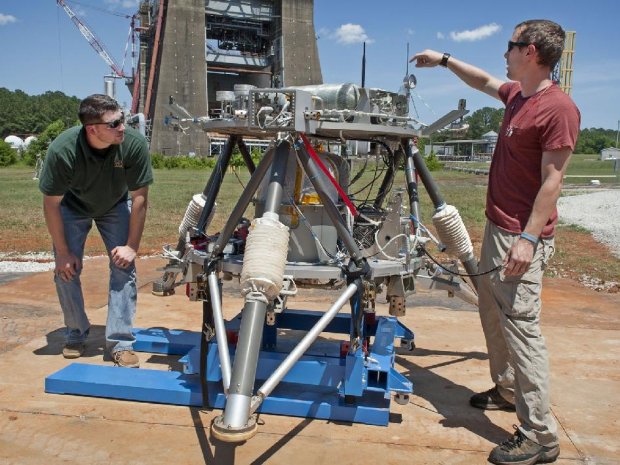
The craft is named after a character from the popular Angry Birds game, and is a test bed for technologies that may be used to build robotic landers for the Moon, asteroids and other destinations in our Solar System.

"The Mighty Eagle had a great flight, fulfilling the objectives we had for this test - finding and landing on its target using a closed-loop system," said Dr Greg Chavers, lead engineer for the project.

Marshall Space Flight Center engineers Logan Kennedy, right, and Adam Lacock check out the lander prototype. Credit: NASA/MSFC/Fred Deaton

After a series of tethered flights during 2011 and 2012, the Mighty Eagle had its first "free" flight on August 8, 2012.

That test met with its targets and was followed by another successful untethered flight on August 16 when the lander hovered at an altitude of about 30 feet, identified its target landing site 21 feet away, moved sideways and descended safely.

The test flight lasted 32 seconds.

An infrared view of the "Mighty Eagle" taking off from the pad. (NASA/MSFC)

Read more about the NASA Mighty Eagle here, at the Lunar Quest mission website.

Wednesday, August 15, 2012

US Air force Hypersonic flight Crashes and Burns!

US Air Force test of its hypersonic X-51A Waverider vehicle, an unmanned aircraft designed to fly six times the speed of sound, ended in catastrophe.

The hypersonic test vehicle lost control and was destroyed before reaching it's 4,600 mph goal.

Controllers identified a fault in one of the X-51A Waverider's control fins shortly after its rocket booster had fired, the service said in a written statement. 

About 16 seconds into the flight, the aircraft "was not able to maintain control due to the faulty control fin and was lost," the service said.

The Air Force had hoped the craft would be able to reach speeds of up to 4,600 mph. The service said it will release details of the failed test in a few weeks, after researchers are able to analyze the data.

The US Air Force hasn’t disclosed the cost of the WaveRider program, but Globalsecurity.org, a website that tracks military spending, says the project has cost $250-300 million since it began in 2004.  

After this loss during testing, only one aircraft remains, and Air Force officials have not decided when or if it will fly.

Background
At just 25 feet long and only a few inches in diameter, the Waverider is a far cry from an aircraft that can carry people anywhere. But the technology one day could send people or troops across the world in just minutes.


Hypersonic travel, meaning speeds of Mach 5 (3,800 miles per hour) and above, has been a focus of the military as it looks to perfect a technology that can become the new stealth. The Pentagon says that countries are becoming wiser to US stealth technology and it is increasingly becoming a less effective tool.

Hypersonic flight does away with stealth because its speeds allow for greater flexibility and control for missions that are not possible with current jet technology.

But in the commercial world, it can mean flights are so quick a flight attendant hardly would have time to serve drinks and a meal, and there would be no more groggy feeling after those transcontinental flights.

The technology is significant because a hypersonic aircraft breaths oxygen, like a regular jet engine, but reaches speeds five times that of commercial aircraft. To get similar results, the only other option is rocket power.

"You would have to have bulky fuel tanks, nozzles and plumbing and that makes rocket power more heavy and more expensive," says Dora Musielak, an adjunct professor of physics at the University of Texas at Arlington.

Monday, June 25, 2012

NASA Orion: Readying for Flight

The NASA team at the Michoud Assembly Facility in New Orleans has completed the final weld on the first space-bound Orion capsule.

The Exploration Flight Test 1 (EFT-1) Orion will be shipped to the Kennedy Space Center for final assembly and checkout operations.

The EFT-1 flight will take Orion to an altitude of more than 3,600 miles, more than 15 times farther away from Earth than the International Space Station.

Orion will return home at a speed of 25,000 miles, almost 5,000 miles per hour faster than any human spacecraft.

It will mimic the return conditions that astronauts experience as they come home from voyages beyond low Earth orbit.

As Orion reenters the atmosphere, it will endure temperatures up to 4,000 degrees F., higher than any human spacecraft since astronauts returned from the moon.

Image Credit: NASA/Eric Bordelon.

Thursday, June 14, 2012

X-47B Drone: Unmanned aircraft completes first major flight-test


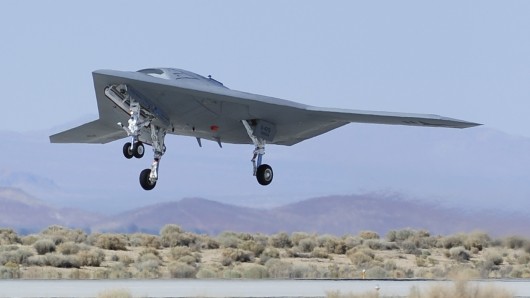
The Northrop Grumman-built X-47B has passed the latest checkpoint on its flight path towards becoming the first carrier-based, tailless, fighter-sized, unmanned aircraft in the U.S. Navy’s arsenal with the successful conclusion of the first major phase of flight testing at Edwards Air Force Base (EAFB) in California.

The airworthiness test phase, which kicked off with the maiden flight on February 4, 2011, saw two X-47B Unmanned Combat Air System (UCAS) demonstrators conduct 23 flights in which the aircraft reached altitudes in excess of 15,000 feet and demonstrated multiple maneuvers required for carrier operations.

These included the first flight in cruise mode, extending and retracting a tail hook, completing an aviation-first autonomous “touch-and-go” landing, and landings at a high sink rate and in heavy weight configuration.

Northrop Grumman says the flight tests proved the aircraft’s ability to perform properly at all speeds, weights and altitudes associated with the Navy’s Unmanned Combat Air System Carrier Demonstration (UCAS-D) program.


"The X-47B flight test program at Edwards will be remembered as a very successful collaboration among the Navy, Northrop Grumman and the U.S. Air Force Flight Test Center," said Carl Johnson, vice president and Navy UCAS Enterprise program manager for Northrop Grumman's Aerospace Systems sector.

"The X-47B flight test program at Edwards demonstrated convincingly the maturity, durability and performance of this revolutionary new unmanned system.”

Following the completion of the airworthiness flight tests at EAFB on May 15, the second X-47B has been transported cross-country to Naval Air Station Patuxent River in Maryland.

It joins the first X-47B that was moved there in December 2011 and is currently undergoing electromagnetic interference testing to ensure it is compatible with the electromagnetic signal environment experienced on an aircraft carrier.