skip to main |
skip to sidebar
Image Credit: NASA/Bill Ingalls
The Orbital Sciences Corporation Antares rocket, with the Cygnus spacecraft onboard, is rolled out of the Horizontal Integration Facility (HIF) to begin the approximately half-mile journey to launch Pad-0A, Thursday, July 10, 2014, at NASA's Wallops Flight Facility in Virginia.
The Antares will launch with the Cygnus spacecraft filled with over 3,000 pounds of supplies for the International Space Station, including science experiments, experiment hardware, spare parts, and crew provisions.
The Orbital-2 mission is Orbital Sciences' second contracted cargo delivery flight to the space station for NASA.
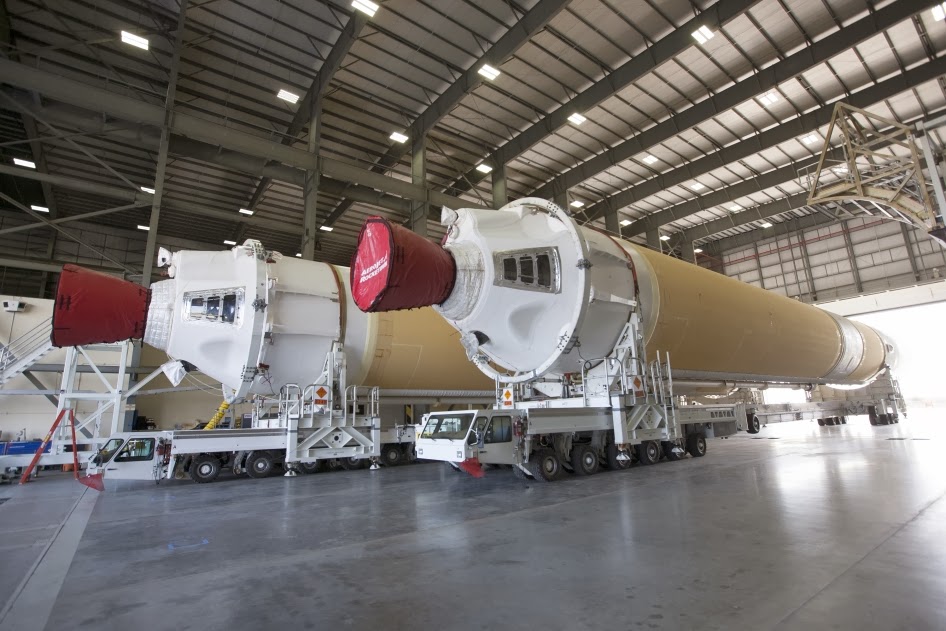
A barge arrives at the U.S. Army Outpost wharf at Port Canaveral in Florida, carrying two of the three United Launch Alliance Delta IV heavy boosters for NASA’s upcoming Exploration Flight Test-1 (EFT-1) with the Orion (MPCV) spacecraft.
The core booster and starboard booster will be offloaded and then transported to the Horizontal Integration Facility (HIF), at Space Launch Complex 37 on Cape Canaveral Air Force Station.
The port booster and the upper stage are planned to be shipped to Cape Canaveral in April.
At the HIF, all three boosters will be processed and checked out before being moved to the nearby launch pad and hoisted into position.
Orion is the exploration spacecraft designed to carry astronauts to destinations in deep space, including an asteroid and Mars.
It will have emergency abort capability, sustain the crew during space travel and provide safe re-entry from deep space return velocities.
During the uncrewed EFT-1 flight, Orion will travel 3,600 miles into space -- farther than a spacecraft built for humans has been in more than 40 years -- and orbit the Earth twice.
The capsule will re-enter Earth’s atmosphere at speeds approaching 20,000 mph, generating temperatures as high as 4,000 degrees Fahrenheit, before splashing down in the Pacific Ocean.
The data gathered during the flight will influence design decisions, validate existing computer models and innovative new approaches to space systems development, as well as reduce overall mission risks and costs for later Orion flights.
Image Credit: NASA




 Posts
Posts


