Showing posts with label arrival. Show all posts

Monday, January 12, 2015

SpaceX Dragon Arrives at ISS - Docked

SpaceX Dragon spacecraft arrives at ISS to unload cargo and refresh astronauts' supplies. 

Credit: NASA

SpaceX's Dragon capsule is set to arrive at the International Space Station this morning.

The cargo craft, launched early Saturday from the Kennedy Space Center in Florida, is carrying more than 5,000 pounds of supplies and payloads, including the Cloud–Aerosol Transport System (CATS), which will monitor cloud and aerosol coverage that directly impacts the global climate.

ESA Astronaut Samantha Cristoforetti tweeted; 'Dragon is berthed! Did leak check & equalized pressure, now our hatch is open. On Dragon hatch "smell of space".' 


Cloud–Aerosol Transport System (CATS) 

Credit: NASA


Thursday, September 25, 2014

SpaceX Dragon Spacecraft arrival at Space Station - Video


The private space company's cargo spacecraft delivered supplies, a 3-D printer and more to the International Space Station on September 23rd, 2014.

A private Dragon cargo ship built by SpaceX arrived at the International Space Station today (Sept. 23) to deliver more than 2 tons of astronaut supplies and experiments for NASA, including the first 3D printer in space and an intrepid crew of 20 lab mice.

After a two-day chase, the Dragon spacecraft caught up to the orbiting laboratory at 6:52 a.m. EDT (1052GMT).

European astronaut Alexander Gerst used the space station's huge robotic arm to grab the capsule with help from NASA astronaut Reid Wiseman.

The spacecraft is packed with 5,000 lbs. (2,268 kilograms) of experiments and supplies.

Sunday, June 1, 2014

NASA Space to Ground Video Update: New ISS Crew arrive at Space Station


NASA's Space to Ground is your weekly update on what's happening aboard the International Space Station.

Credit: NASA

Monday, May 5, 2014

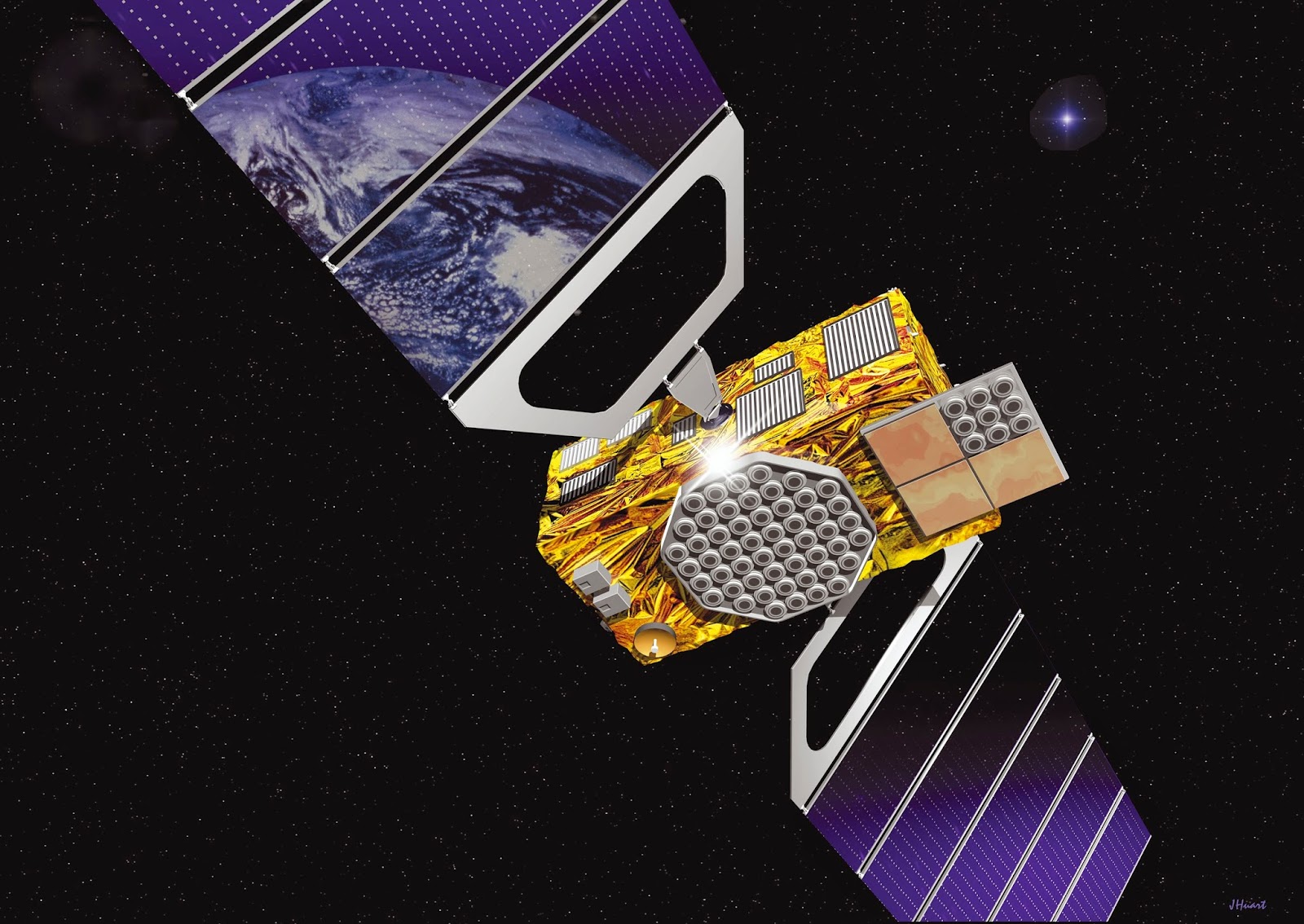
Third Galileo FOC satellite arrives at ESA's test centre

Technicians roll out the third Galileo Full Operational Capability (FOC) satellite from its protective container after its arrival in the cleanroom environment of the ESTEC Test Centre in April 2014. 

Image courtesy ESA-Anneke Le Floc'h.

Europe's latest Galileo navigation satellite has arrived at the Space Agency's Netherlands-based technical centre for testing, as the previous two satellites are prepared for transport to French Guiana for launch in summer this year.

The new satellite travelled safely enclosed within an air-conditioned and environmentally-controlled protective container from its manufacturer, OHB in Bremen, Germany, to ESA's ESTEC Test Centre in Noordwijk, the Netherlands.

The specially-engineered container was only unsealed once the satellite completed its journey by road to the cleanroom conditions of the Test Centre, Europe's largest site for spacecraft testing, containing a suite of test facilities for space simulations and testing under a single roof.

Meanwhile the previous two Galileo satellites have completed their long test campaign at the Test Centre, and are being finalised for shipping to Europe's Spaceport in French Guiana, for launch together by Soyuz.

Europe's first four Galileo satellites are already in orbit, the minimum number needed for achieving a position fix.

These 'In-Orbit Validation' satellites served to demonstrate the overall Galileo system works as planned, while also serving as the operational nucleus of the full Galileo constellation to follow.

Next comes the 22 'Full Operational Capability'(FOC) satellites being made by OHB in Germany, incorporating navigation payloads produced by Surrey Satellite Technology Ltd in the UK.

The three FOC satellites currently at ESTEC are the first of these 22 to be tested for launch - all of them will pass through the gates of ESTEC within the next few years on their way to space.

Now detailed 'acceptance testing' will be carried out on this latest arrival, to check the satellite workmanship is up to standard.

A fourth FOC satellite is scheduled to arrive at the ESTEC Test Centre in June 2014- the test facilities can accommodate two Galileos at a time.

Such a changeover between FOC satellites arriving as others are being readied to leave for launch will become commonplace in the next few years, as Europe builds up its constellation.

And in future two-satellite Soyuz launches will be supplemented by four-satellite Ariane 5 launches, employing a specially customised version of the launcher.

Monday, March 31, 2014

ISS Expedition 39 Crew: Safe Arrival at Space Station After 2-Day Delay

Expedition 39, now a six-member crew, talks to family and mission officials moments after entering the space station for the first time on March 27, 2014. 

Credit: NASA TV

Three new crew members have finally made it to the International Space Station, two days later than originally planned.

A Russian Soyuz spacecraft carrying NASA astronaut Steve Swanson and cosmonauts Alexander Skvortsov and Oleg Artemyev docked with the orbiting lab at 7:53 p.m. EDT (2353 GMT) Thursday (March 27), as the two spacecraft cruised over southern Brazil.

The hatch linking the two vehicles opened at 10:35 p.m. EDT Thursday, NASA officials said.

The three spaceflyers blasted off Tuesday afternoon EDT (March 25) and were slated to arrive at the station just six hours later, but the Soyuz failed to complete one of the automated burns required to pull off this "fast track" trip, forcing mission controllers to revert to a more traditional two-day chase and rendezvous.

All systems on the Soyuz now appear to be functioning normally, NASA officials said in an update Wednesday (March 26).

The arrival of SwansonSkvortsov and Artemyev brings the space station back up to its full complement of six crew members.

The newcomers join NASA's Rick Mastracchio, Japanese astronaut Koichi Wakata (ISS Commander) and cosmonaut Mikhail Tyurin, rounding out the current Expedition 39 aboard the orbiting lab.

Mastracchio, Expedition 39 commander Wakata and Tyurin had had the $100 billion station all to themselves since March 10, when another Soyuz capsule ferried the previous Russian-U.S. crew back down to Earth.

Wednesday, March 26, 2014

Russian-US ISS crew blast off from Kazakhstan - Arrival Delayed

A crew of two Russian cosmonauts and an American astronaut blasted off Tuesday from Kazakhstan on a Russian Soyuz rocket for the International Space Station, with US-Russia space cooperation continuing amicably, despite the diplomatic standoff over Ukraine.

Russians Alexander Skvortsov and Oleg Artemyev along with Steve Swanson of NASA took off in a spectacular night-time launch at the start of a fast-track six-hour journey to the orbiting laboratory, where they will spend half a year.

All the stages of the launch went without a hitch and the Soyuz capsule successfully went into the correct orbit.

Docking with the ISS was expected at 03:04 GMT Wednesday but this has been delayed until 07:58 Thursday.

After the retirement of the US shuttle, NASA is for now wholly reliant on Russia for delivering astronauts to the space station on its tried-and-trusted Soyuz launch and capsule system.

Space officials have made clear that space cooperation, one of the few areas of genuine mutual work between Russia and the United States, will continue unaffected by the mounting diplomatic strains that have seen the US impose sanctions on Russian officials over Moscow's seizure of Crimea.

A yellow toy duck nicknamed "quack" given to Swanson by his daughter hung in the cockpit and started floating a few minutes into launch as the crew started to experience weightlessness.

-'We'll live together peacefully'-

Arrival Delayed
The next trio of crew members destined for the International Space Station is now looking forward to a Thursday arrival at the orbiting laboratory after their Soyuz spacecraft was unable to complete its third thruster burn to fine-tune its approach. 

Flight controllers in the Mission Control Center outside Moscow are now reverting to a backup 34-orbit rendezvous, which would result in an arrival and docking at 7:58 p.m. EDT Thursday, March 27.

Wednesday, March 12, 2014

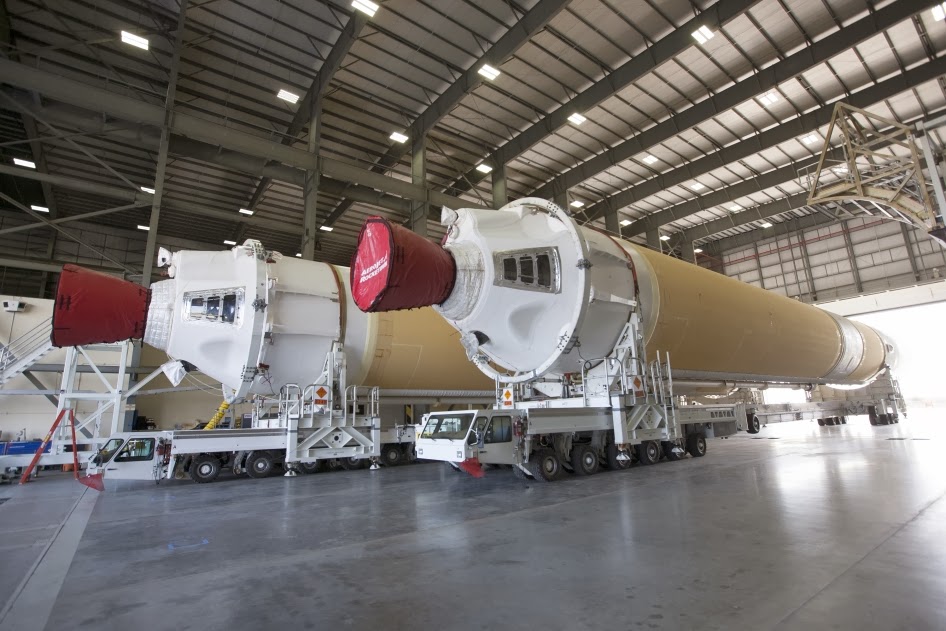
Orion Spacecraft's Boosters for First Flight Test Arrive at Port Canaveral, Florida

A barge arrives at the U.S. Army Outpost wharf at Port Canaveral in Florida, carrying two of the three United Launch Alliance Delta IV heavy boosters for NASA’s upcoming Exploration Flight Test-1 (EFT-1) with the Orion (MPCV) spacecraft.

The core booster and starboard booster will be offloaded and then transported to the Horizontal Integration Facility (HIF), at Space Launch Complex 37 on Cape Canaveral Air Force Station.

The port booster and the upper stage are planned to be shipped to Cape Canaveral in April. 

At the HIF, all three boosters will be processed and checked out before being moved to the nearby launch pad and hoisted into position.

Orion is the exploration spacecraft designed to carry astronauts to destinations in deep space, including an asteroid and Mars.

It will have emergency abort capability, sustain the crew during space travel and provide safe re-entry from deep space return velocities. 


During the uncrewed EFT-1 flight, Orion will travel 3,600 miles into space -- farther than a spacecraft built for humans has been in more than 40 years -- and orbit the Earth twice.

The capsule will re-enter Earth’s atmosphere at speeds approaching 20,000 mph, generating temperatures as high as 4,000 degrees Fahrenheit, before splashing down in the Pacific Ocean.

The data gathered during the flight will influence design decisions, validate existing computer models and innovative new approaches to space systems development, as well as reduce overall mission risks and costs for later Orion flights.

Image Credit: NASA

Monday, March 3, 2014

ESA Sentinel-1A arrives in Kourou - Video

The Sentinel-1A radar satellite has arrived at Europe’s Spaceport in French Guiana to be prepared over the coming weeks for launch on 3 April 

Credits: ESA–M. Shafiq


Sentinel-1 is the first satellite dedicated to Europe’s Copernicus environmental monitoring programme.

This new satellite carries an advanced synthetic aperture radar that works in several specialised modes to provide detailed imagery for monitoring the oceans, including shipping lanes, sea ice and oil spills.


It also provides data to map changing land cover, ground deformation, ice shelves and glaciers, and can be used to help emergency response when disasters such as floods strike and to support humanitarian relief efforts at times of crisis.

Monday, December 16, 2013

James Webb Space Telescope's "Super-eye" arrives - Video


The James Webb Space Telescope's NIRSpec instrument arrived at NASA's Goddard Space Flight Center in Greenbelt, Md., on Sep. 20, 2013. 

The Near-Infared Spectrograph (NIRSpec), provided by the European Space Agency and built by EADS/Astrium, will be the first multi-object spectrograph flown in space. 

Image Credit: NASA's Goddard Space Flight Center

A new NASA video gives viewers an up close view of the arrival of the James Webb Space Telescope's "Super-eye."

The Webb telescope's Near-Infrared Spectrometer (NIRSpec) instrument arrived by truck at NASA's Goddard Space Flight Center in Greenbelt, Md., on Sept. 20, 2013, and NASA videographers documented it for everyone.

After its trans-Atlantic flight to Thurgood Marshall BWI airport, Baltimore, Md., on a specialized Russian transport plane from Germany, it was moved into the world's largest clean room for further testing.

The instrument, built at the EADS ASTRIUM facility in Munich, Germany, is often referred to as the Webb telescope's "Super-eye."

NIRSpec is Webb's instrument that will use infrared light to analyze the physical properties and chemical composition of distant galaxies, stars and planets.

Saturday, November 9, 2013

NASA James Webb Space Telescope: Arrival of ESA EADS 'Super-eye' - Video


A new NASA video gives viewers an up close view of the arrival of the James Webb Space Telescope's "Super-eye."

The James Webb telescope's Near-Infrared Spectrometer, (NIRSpec), instrument arrived by truck at NASA's Goddard Space Flight Center in Greenbelt, Md., on Sept. 20, 2013, and NASA videographers documented it for everyone.

After its trans-Atlantic flight to Thurgood Marshall BWI airport, Baltimore, Md., on a specialized Russian transport plane from Germany, it was moved into the world's largest clean room for further testing.

The instrument, built at the EADS ASTRIUM facility in Munich, Germany, is often referred to as the Webb telescope's "Super-eye."

NIRSpec is Webb's instrument that will use infrared light to analyze the physical properties and chemical composition of distant galaxies, stars and planets.

The video shows NIRSpec after its meticulously coordinated delivery as it was unloaded off a truck, moved into a clean room and situated by engineers for inspection.

The video above runs 1 minute, 51 seconds and is available in high resolution. It was created at the Scientific Visualization Studio at NASA Goddard.

It is the last of the Webb observatory's science instruments to arrive at NASA. At Goddard, each of the Webb's four science instruments will be added to the heart of telescope, known as the Integrated Science Instrument Module (ISIM).

The Fine Guidance System/Near-InfraRed Imager and Slitless Spectrograph (FGS/NIRISS) and the Mid-Infrared Instrument (MIRI) have already been installed on ISIM and are currently undergoing the first cryogenic tests.

"NIRSpec's delivery from Europe to Goddard is an amazing international accomplishment," said Maurice te Plate, European Space Agency's Webb system integration and test manager and ESA MIRI instrument manager at NASA Goddard.

NIRSpec is a unique instrument, made out of a very stable and stiff material called silicon carbide. It holds a special NASA-developed device called the Micro Shutter Array.

"The Micro Shutter Array, is a unique electro-mechanical mask that has never been flown in space before," te Plate said.

"This part will allow the NIRSpec spectrograph system to measure light, sometimes very faint, of up to 100 scientific targets at the same time, while rejecting unwanted objects from its field of view."

Saturday, August 24, 2013

NASA James Webb Space Telescope: backplane arrives at Marshall Centre for testing

The James Webb Space Telescope's backplane element arrives at the Marshall Center. 

Credit: NASA/MSFC/Fred Deaton

A major piece of the James Webb Space Telescope, the mirror's primary backplane support, arrived Aug. 22 at NASA's Marshall Space Flight Center in Huntsville, Ala., for testing in the X-ray and Cryogenic Test Facility.

The backplane is the backbone of the telescope, supporting its 18 beryllium mirrors, instruments and other elements while the telescope is looking into deep space.

The Webb Telescope is the world's next-generation space observatory and successor to the Hubble Space Telescope.

To prepare the telescope for the extreme temperatures of space, engineers at the facility have carefully examined the telescope's mirrors inside a vacuum chamber that simulates the hypercold of space, chilling the hardware from room temperature down to a frigid minus 414 degrees Fahrenheit.

The backplane is the latest and final piece of the telescope to undergo this extreme conditioning at the Marshall Center.

The X-ray and Cryogenic Facility at the Marshall Center (PDF) is the world's largest X-ray telescope test facility and offers a unique, cryogenic, clean-room optical test environment.

Cryogenic testing will take place in a 7,600-cubic-foot, helium-cooled vacuum chamber, chilling the Webb support structure from room temperature to simulate the frigid atmosphere of space.

While the structure changes temperature, test engineers will precisely measure its structural stability to ensure it will perform as designed in the extreme temperatures of space.

The cryogenic testing is targeted to begin in September.

"This testing of the backplane will verify limited movement of the structure when exposed to cryogenic temperatures," said Helen Cole, project manager for Webb Telescope mirror activities at the test facility.

"This is important to overall performance of the telescope."

Crews unload the James Webb Space Telescope's "backplane," which was flown aboard a Lockheed C-5 airplane to NASA’s Marshall Space Flight Center in Huntsville, Ala. 

Credit: NASA/MSFC/Fred Deaton

"Ensuring the best performance for the telescope requires evaluating the hardware at temperatures just as cold as in the environs of space," said Jeff Kegley, the test facility's manager.

 "This is the last in a series of Webb Telescope tests our facility has been performing since 2008; it's great to have the hardware here."

A joint project of NASA, the European Space Agency and the Canadian Space Agency, the Webb Telescope will observe the most distant objects in the universe, provide images of the first galaxies formed and see unexplored planets around distant stars.

ATK built the backplane structure at its facility in Magna, Utah, under a contract with prime contractor Northrop Grumman.