Showing posts with label Orion spacecraft. Show all posts

Monday, December 1, 2014

NASA's Orion Spacecraft at the Launch Pad

With access doors at Nasa Space Launch Complex 37 opened on Nov. 24, 2014, the Nasa Orion spacecraft and Delta IV Heavy stack is visible in its entirety inside the Mobile Service Tower where the vehicle is undergoing launch preparations.

Nasa Orion spacecraft will make its first flight test on Dec. 4 with a morning launch atop the United Launch Alliance Delta IV Heavy rocket.

Orion’s crew module is underneath the Launch Abort System and nose fairing, both of which will jettison about six minutes, 20 seconds after launch.

The tower will be rolled away from the rocket and spacecraft 8 hours, 15 minutes before launch to allow the rocket to be fueled and for other launch operations to proceed.

The spacecraft will orbit the Earth twice, including one loop that will reach 3,600 miles above Earth.

No one will be aboard Orion for this flight test, but the spacecraft is being designed and built to carry astronauts on exploration missions into deep space.

Launch is scheduled for Thursday, Dec. 4 at 7:05 a.m. EST, the opening of a 2 hour, 39-minute window for the day.

Image Credit: NASA/Kim Shiflett

Monday, November 24, 2014

Lockheed Martin Orion spacecraft EFT-1 imminent

As we move closer to the highly anticipated first ever test flight of the Orion spacecraft, there's an aerospace company which would be keeping its fingers tightly crossed during this nail-biting moment for the U.S. spaceflight.

Lockheed Martin which built the manned capsule that will take American astronauts far beyond Earth, is much more than excited about the milestone flight.

"We live for this kind of project. We will tell our kids and our grandkids about this," Allison Rakes, Lockheed Martin spokesperson told reporters.

The company's hard working crew literally lives for this first step of future deep space exploration.

"We've had a team in Florida working around the clock for the past several months preparing for this moment. Once that Delta IV lifts off, you're going to see quite the celebration," Rakes added.


Tuesday, September 30, 2014

NASA Orion spacecraft transfers to Launch Abort System Facility

NASA and Lockheed Martin have finished fueling the Orion spacecraft with ammonia, hydrazine and high pressure helium at Kennedy Space Center's Payload Hazardous Servicing Facility. 

Orion has now been moved to the Launch Abort System Facility for integration with the launch abort system (LAS).

"Once the launch abort system is integrated and functional testing concludes, the spacecraft is considered done," said Michael Hawes Lockheed Martin Orion program manager.

"Then in November we'll integrate to the rocket, which is rolling out to the launch pad today."

NASA engineers and contractors conduct static loads testing of the Orion Launch Abort System (LAS) Fairing Assembly, flight hardware that will be used to cover and protect the Orion crew module during Exploration Flight Test-1 (EFT-1), scheduled for September 2014.

Image Credit: Lockheed Martin

Orion's LAS is a critical launch safety technology designed to immediately pull the capsule and crew out of harm's way in the event of an emergency.

The LAS is the highest thrust and acceleration escape system ever created, significantly improving crew safety from pad operations through ascent.

Orion Exploration Flight Test-1 (EFT-1)
It consists of three solid rocket motors: an attitude control motor, which steers the crew away from the launch vehicle, a jettison motor, which pulls the LAS away from the crew module, and an abort motor, which propels the crew module away from the launch pad.

During Orion Exploration Flight Test-1 (EFT-1) all nominal functions, including separation, will be tested on the LAS, however the abort functions are inactive.

The LAS abort functions were previously tested in New Mexico at White Sands Missile Range during Pad Abort Test 1.

During EFT-1, the uncrewed spacecraft will launch on a Delta IV Heavy rocket and will travel 3,600 miles beyond Earth—15 times further than the International Space Station.

That same day, Orion will return to Earth at a speed of approximately 20,000 mph for a splashdown in the Pacific Ocean.

EFT-1 will provide engineers with data about systems critical to crew safety such as heat shield performance, separation events, avionics and software performance, attitude control and guidance, parachute deployment, and recovery operations to validate designs of the spacecraft before it begins carrying humans to new destinations in deep space.

Thursday, September 11, 2014

NASA Orion (MPCV) spacecraft on the move

NASA's Orion spacecraft, preparing for it's first flight, departs the Neil Armstrong Operations and Checkout Building on its way to the Payload Hazardous Servicing Facility at the Kennedy Space Center, Thursday, Sept. 11, 2014, in Cape Canaveral, Fla. 

Orion is scheduled for a test flight in early December. 

Credit: AP Photo/John Raoux

NASA is one step closer to launching its newest spacecraft designed for humans.

Workers at Kennedy Space Center gathered to watch as the Orion capsule emerged from its assembly hangar Thursday, less than three months from its first test flight.

The capsule, sealed for protection, slowly made its way to its fueling depot atop a 36-wheel platform.

The capsule and its attached service module and adapter ring stretched 40 feet (12 meters) high.

"Isn't this awesome?" said Kennedy's director, Robert Cabana, a former space shuttle commander.

"This is our step to the future, the exploration of establishing a presence in the solar system."

Space center employees lined up along the rope barricade to snap pictures of Orion capsule, NASA's lofty follow-on to the now-retired space shuttle program.

During its Dec. 4 test flight, the unmanned capsule will shoot more than 3,600 miles (5,800 kilometers) into space and take two big laps around Earth before re-entering the atmosphere at 20,000 mph (32,000 kph) and parachuting into the Pacific off the San Diego coast. The entire mission will last 4½ hours.

The second Orion flight won't occur until around 2018 when another unmanned capsule soars atop NASA's new Space Launch System (SLS), still under development.

NASA intends to put astronauts aboard Orion in 2021 for deep space exploration; each capsule can accommodate up to four.

The plan is to use Orion for getting humans to asteroids and Mars, no space station ferry trips for Orion.

A handful of private U.S. companies are competing for these short taxi flights; NASA expects in the next week or so to pick one or two candidates for funding.

NASA's Orion spacecraft, preparing for it's first flight, departs the Neil Armstrong Operations and Checkout Building on its way to the Payload Hazardous Servicing Facility at the Kennedy Space Center, Thursday, Sept. 11, 2014, in Cape Canaveral, Fla. 

Orion is scheduled for a test flight in early December. 

Credit: AP Photo/John Raoux

While Orion may resemble an oversize Apollo capsule on the outside, everything inside and out is modern and top-of-the-line, officials noted Thursday.

"I'm as excited as can be," said NASA's Orion production operations manager, Scott Wilson.

For Orion's dry run, the Lockheed Martin Corp.-built capsule will have hunks of aluminum in place of seats for ballast, and simulators instead of actual cockpit displays. A United Launch Alliance Delta IV rocket will do the heavy lifting.

When asked by a reporter, Cabana said he wishes Orion's flight pace was quicker.

NASA's Orion spacecraft, preparing for it's first flight, arrives at the Payload Hazardous Servicing Facility at the Kennedy Space Center, Thursday, Sept. 11, 2014, in Cape Canaveral, Fla. Orion is scheduled for a test flight in early December. 

Credit: AP Photo/John Raoux

"But it is what it is," he said. "Given the budget that we have, I think we've got the best program that you could imagine."

Orion has its roots in the post-Columbia shuttle era; it originated a decade ago as a crew exploration vehicle to get astronauts beyond low Earth orbit and managed to survive the cancellation of the Constellation moon project.

Friday, August 22, 2014

NASA Orion Spacecraft: Back Shell Tile Panels Installed

Inside the Operations and Checkout Building high bay at NASA's Kennedy Space Center in Florida, technicians dressed in clean-room suits have installed a back shell tile panel onto the Orion crew module and are checking the fit next to the middle back shell tile panel.

Preparations are underway for Exploration Flight Test-1, or EFT-1.

Orion is the exploration spacecraft designed to carry astronauts to destinations not yet explored by humans, including an asteroid and Mars.

It will have emergency abort capability, sustain the crew during space travel and provide safe re-entry from deep space return velocities.

Two one-inch-wide holes have been drilled into tiles on Orion’s back shell to simulate micrometeoroid orbital debris damage. 

Sensors on the vehicle will record how high temperatures climb inside the hole during Orion’s return through Earth’s atmosphere following its first flight in December.

Image Credit: NASA

The first unpiloted test flight of the Orion is scheduled to launch later this year atop a Delta IV rocket from Cape Canaveral Air Force Station in Florida to an altitude of 3,600 miles above the Earth's surface.

The two-orbit, four-hour flight test will help engineers evaluate the systems critical to crew safety including the heat shield, parachute system and launch abort system.

Image Credit: NASA/Dimitri Gerondidakis

Friday, July 4, 2014

Space Launch System (SLS): NASA’s Next Generation Launchers

Image Credit: NASA

NASA’s Space Launch System, or SLS, will be the most powerful rocket in history.

The flexible, evolvable design of this advanced, heavy-lift launch vehicle will meet a variety of crew and cargo mission needs.

In addition to carrying the Orion spacecraftSLS will transfer important cargo, equipment and science experiments to deep space, providing the nation with a safe, affordable and sustainable means to expand our reach in the solar system.

It will allow astronauts aboard Orion to explore multiple deep-space destinations including an asteroid and ultimately Mars.

The first configuration of the SLS launch vehicle will have a 70-metric-ton (77-ton) lift capacity and carry an uncrewed Orion spacecraft beyond low-Earth orbit to test the performance of the integrated system.

As the SLS is evolved, it will be the most powerful rocket ever built and provide an unprecedented lift capability of 130 metric tons (143 tons) to enable missions even farther into our solar system.

Sunday, April 13, 2014

NASA's Orion Spacecraft Powers through First Integrated System Testing

Engineers in the Operations and Checkout Building at NASA’s Kennedy Space Center in Florida, perform avionics testing on the Orion spacecraft being prepared for its first trip to space later this year.

Image Credit: Lockheed Martin

NASA's Orion spacecraft has proven its mettle in a test designed to determine the spacecraft's readiness for its first flight test, Exploration Flight Test-1 (EFT-1), later this year.

EFT-1 will send the spacecraft more than 3,600 miles from Earth and return it safely.

The spacecraft ran for 26 uninterrupted hours during the final phase of a major test series completed April 8 at the agency's Kennedy Space Center in Florida.

The test verified the crew module can route power and send commands that enable the spacecraft to manage its computer system, software and data loads, propulsion valves, temperature sensors and other instrumentation.

Gerstenmaier
"This has been the most significant integrated testing of the Orion spacecraft yet," said William Gerstenmaier, associate administrator for NASA's human exploration and operations at the agency's Headquarters in Washington.

"The work done to test the avionics with the crew module isn't just preparing us for Orion's first trip to space in a few months. It's also getting us ready to send crews far into the solar system."

In October 2013, NASA and Lockheed Martin engineers powered on Orion's main computer for the first time. Since then, they have installed harnessing, wiring and electronics.

This was the first time engineers ran the crew module through its paces to verify all system actuators respond correctly to commands and all sensors report back as planned.

More than 20 miles of wire are required to connect the different systems being powered.

"Getting all the wiring right, integrating every element of the avionics together, and then testing it continuously for this many hours is a big step toward getting to deep space destinations," said Mark Geyer, Orion program manager.

Engineers now are preparing the crew module for vibration testing, scheduled for the week of April 14. In May, the heat shield will be installed and, shortly thereafter, the crew module will be attached with the service module.

During EFT-1, an uncrewed Orion spacecraft will take a four-hour trip into space, traveling 15 times farther from Earth than the International Space Station.

During its reentry into Earth's atmosphere, Orion will be traveling at 20,000 mph, faster than any current spacecraft capable of carrying humans, and endure temperatures of approximately 4,000 degrees Fahrenheit.

The data gathered during the flight will inform design decisions to improve the spacecraft that will one day carry humans to an asteroid and eventually Mars. EFT-1 is targeted for launch in December.

Visiting the Renovated Flight Control Room for NASA's Orion Spacecraft

Mission Operations Director Paul Hill talks to the media as NASA Administrator Charles Bolden and Johnson Space Center Director Ellen Ochoa visit Mission Control in the newly renovated and historic White Flight Control Room, which will be used to support NASA’s Orion spacecraft.

The mission patches that adorn the walls reflect the control room's previous use in the Space Shuttle Program.

Orion is the exploration spacecraft designed to carry astronauts to destinations in deep space, including an asteroid and Mars. 

It will have emergency abort capability, sustain the crew during space travel and provide safe re-entry from deep space return velocities. 

Exploration Flight Test-1 (EFT-1), planned for December 2014, will be Orion's first mission.

EFT-1 will send an uncrewed spacecraft 3,600 miles above the Earth for a two-orbit flight that will give engineers the chance to verify its design and test some of the systems most critical for the safety of the astronauts who will fly on it in the future.

After traveling 15 times farther into space than the International Space Station, Orion will return to Earth at speeds near 20,000 mph, generating temperatures of up to 4,000 degrees Fahrenheit, before splashing down in the Pacific Ocean.

Image Credit: NASA

Wednesday, March 12, 2014

Orion Spacecraft's Boosters for First Flight Test Arrive at Port Canaveral, Florida

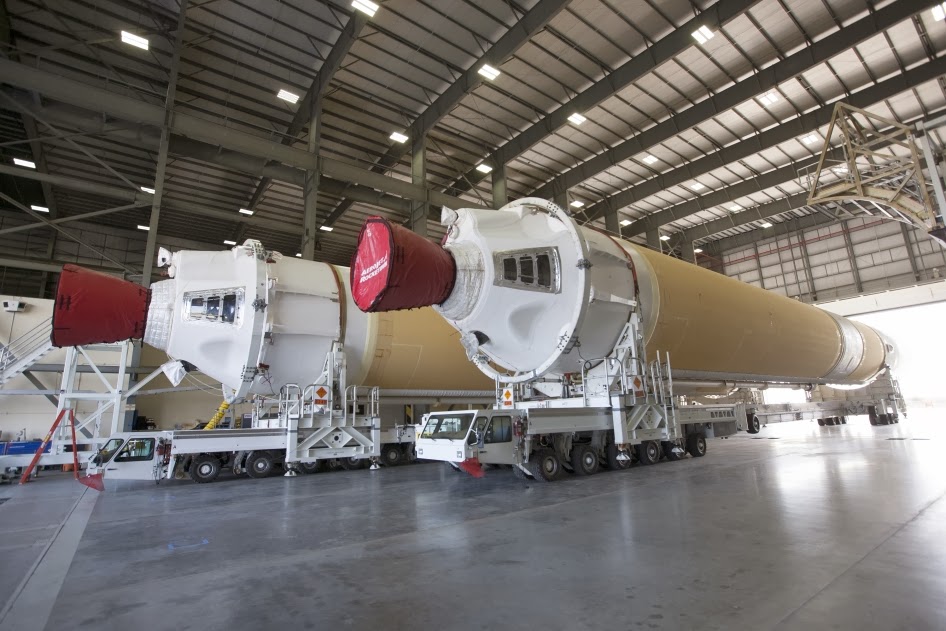
A barge arrives at the U.S. Army Outpost wharf at Port Canaveral in Florida, carrying two of the three United Launch Alliance Delta IV heavy boosters for NASA’s upcoming Exploration Flight Test-1 (EFT-1) with the Orion (MPCV) spacecraft.

The core booster and starboard booster will be offloaded and then transported to the Horizontal Integration Facility (HIF), at Space Launch Complex 37 on Cape Canaveral Air Force Station.

The port booster and the upper stage are planned to be shipped to Cape Canaveral in April. 

At the HIF, all three boosters will be processed and checked out before being moved to the nearby launch pad and hoisted into position.

Orion is the exploration spacecraft designed to carry astronauts to destinations in deep space, including an asteroid and Mars.

It will have emergency abort capability, sustain the crew during space travel and provide safe re-entry from deep space return velocities. 


During the uncrewed EFT-1 flight, Orion will travel 3,600 miles into space -- farther than a spacecraft built for humans has been in more than 40 years -- and orbit the Earth twice.

The capsule will re-enter Earth’s atmosphere at speeds approaching 20,000 mph, generating temperatures as high as 4,000 degrees Fahrenheit, before splashing down in the Pacific Ocean.

The data gathered during the flight will influence design decisions, validate existing computer models and innovative new approaches to space systems development, as well as reduce overall mission risks and costs for later Orion flights.

Image Credit: NASA

Saturday, January 18, 2014

NASA’s Orion spacecraft: Completion of Parachute Jettison Tests

A test version of NASA’s Orion spacecraft touches down in the Arizona desert after its most complicated parachute test to date. 

Image Credit: NASA

Engineers testing the parachute system for NASA's Orion spacecraft increased the complexity of their tests Thursday, Jan. 16, adding the jettison of hardware designed to keep the capsule safe during flight.

The test was the first to give engineers in-air data on the performance of the system that jettisons Orion's forward bay cover.

The cover is a shell that fits over Orion's crew module to protect the spacecraft during launch, orbital flight and re-entry into Earth's atmosphere.

When Orion returns from space, the cover must come off before the spacecraft's parachutes can deploy. It must be jettisoned high above the ground in order for the parachutes to unfurl.

Mark Geyer
"This was a tough one," said Mark Geyer, Orion program manager.

"We'd done our homework, of course, but there were elements here that could only be tested in the air, with the entire system working together."

"It's one of the most complicated tests that we'll do, so we were all excited to see it work just as it was meant to."

Wednesday, November 13, 2013

NASA ORION Spacecraft on track for 2017

The first flight shell of NASA's new Orion spacecraft is presented to invited guests and the media inside the Operations and Checkout building at Kennedy Space Center, Florida on July 2, 2012

The first test mission of a new deep space capsule that could one day take humans to Mars is on track for September 2014, the US space agency said Tuesday.

Orion aims to replace US capacity to reach space—which ended with the retirement of the space shuttle program closed in 2011 after 30 years—and ferry astronauts farther in the solar system than ever before.

Bill Gerstenmaier, NASA associate administrator for human exploration and operations, said the project has made "tremendous progress."

NASA has described Orion as "a flexible system that can to launch crew and cargo missions, extend human presence beyond low-Earth orbit, and enable new missions of exploration throughout our solar system."

Orion will not carry humans on board until 2021 at the earliest.

Its four-hour test flight next year will launch from Cape Canaveral in Florida.

After that, the unmanned craft is to make two orbits around the Earth, traveling at a distance of 3,600 miles (5,800 kilometers) above Earth's surface, and then plunge back into Earth's atmosphere at high speed.

The test tour will take it 15 times farther than the International Space Station's orbit around the globe.

Bill Gerstenmaier speaks at the Kennedy Space Center on July 31, 2009 in Cape Canaveral, Florida

The flight aims to test the vehicle's thermal heat shield as it plunges through temperatures of 4,000 Fahrenheit (2,200 Celsius), and see how well the nearly nine-ton spacecraft splashes down in the Pacific Ocean off California.

However, the Delta IV heavy rocket that will launch the spacecraft is not yet ready.

Gerstenmaier said the space launch system (SLS) is 70 percent complete and again cited "tremendous progress" on the project.

Orion's next space mission—a spin around the Moon—is set for 2017.

Friday, November 8, 2013

NASA Orion Spacecraft: Successful fairing separation in second test

The three panel or fairings encapsulating a stand-in for Orion’s service module successfully detach during a test Nov. 6, 2013 at Lockheed Martin’s facility in Sunnyvale, Calif. 

Credit: Lockheed Martin

The three massive panels protecting a test version of NASA's Orion multipurpose crew vehicle successfully fell away from the spacecraft Wednesday in a test of a system that will protect Orion during its first trip to space next year.

The panels, called fairings, encase Orion's service module and shield it from the heat, wind and acoustics it will experience during the spacecraft's climb into space.

The service module, located directly below the crew capsule, will contain the in-space propulsion capability for orbital transfer, attitude control and high-altitude ascent aborts when Orion begins carrying humans in 2021.

It also will generate and store power and provide thermal control, water and air for the astronauts. The service module will remain connected to the crew module until just before the capsule returns to Earth.

Artist's rendering of NASA Orion during Exploration Flight Test (EFT-1) 

During Exploration Flight Test-1 (EFT-1), the spacecraft's flight test next year, a test service module will be attached to the capsule.

"Hardware separation events like this are absolutely critical to the mission and some of the more complicated things we do," said Mark Geyer, Orion program manager at NASA's Johnson Space Center in Houston.

"We want to know we've got the design exactly right and that it can be counted on in space before we ever launch."

Unlike conventional rocket fairings, these panels are designed to support half of the weight of Orion's crew module and launch abort system during launch and ascent, which improves performance, saves weight and maximizes the size and capability of the spacecraft.

Each panel is 14 feet high and 13 feet wide. The fairings' work is done soon after launch.

They must be jettisoned when Orion has reached an altitude of about 560,000 feet. To make that possible, six breakable joints and six explosive separation bolts are used to connect the fairing panels to the rocket and each other.

In a carefully timed sequence, the joints are fired apart, followed shortly by the bolts. Once all of the pyrotechnics have detonated, six spring assemblies will push the three panels away, leaving the service and crew module exposed to space as they travel onward.

Thursday, October 24, 2013

Pathfinding Operations for Orion Spacecraft at Kennedy Space Center

Add caption
At NASA’s Kennedy Space Center in Florida, the Orion ground test vehicle has been lifted high in the air by crane in the transfer aisle of the Vehicle Assembly Building. 

The ground test vehicle is being used for pathfinding operations, including simulated manufacturing, assembly and stacking procedures.

Orion is the exploration spacecraft designed to carry astronauts to destinations not yet explored by humans, including an asteroid and Mars. 

It will have emergency abort capability, sustain the crew during space travel and provide safe re-entry from deep space return velocities.

The first unpiloted test flight of Orion, Exploration Flight Test (EFT)-1 is scheduled to launch in 2014. EFT-1 will be Orion's first mission, which will send an uncrewed spacecraft 3,600 miles into Earth's orbit. 

As part of the test flight, Orion will return to Earth at a speed of approximately 20,000 mph for a splashdown in the Pacific Ocean.

For more information, visit www.nasa.gov/orion.

Image Credit: NASA/Dimitri Gerondidakis

Monday, August 19, 2013

Orion Spacecraft Stationary Recovery Test at Norfolk Naval Base in Virginia

On August 15, 2013, at the Naval Station Norfolk near NASA’s Langley Research Center in Virginia, NASA and the U.S. Navy conducted a stationary recovery test on the Orion boilerplate test article in the water near a U.S. Navy ship.

NASA and the U.S. Navy are conducting tests to prepare for recovery of the Orion crew module and forward bay cover on its return from a deep space mission.

The stationary recovery tests allow the teams to demonstrate and evaluate the recovery processes, the hardware and the test personnel in a controlled environment.

During the test, the U.S Navy Dive Team checked the capsule for hazards while sailors from the USS Arlington approached the capsule in inflatable boats, and towed it back to the ship’s flooded well deck.

A second test will be conducted next year in the open waters of the Pacific Ocean.

Orion is the exploration spacecraft designed to carry astronauts to destinations not yet explored by humans, including an asteroid and Mars.

It will have emergency abort capability, sustain the crew during space travel and provide safe re-entry from deep space return velocities.

The first unpiloted test flight of the Orion is scheduled to launch in 2014 atop a Delta IV rocket and in 2017 on NASA’s Space Launch System rocket.

> Read More

Image Credit: NASA

Friday, June 7, 2013

NASA's Orion spacecraft proves sound under pressure

After a month of being poked, prodded and pressurized in ways that mimicked the stresses of spaceflight, NASA's Orion crew module successfully passed its static loads tests on Wednesday.

When Orion launches on Exploration Flight Test-1 (EFT-1), which is targeted for September 2014, it will travel farther from Earth than any spacecraft built for humans in more than 40 years.

The spacecraft will fly about 3,600 miles above Earth's surface and return at speeds of approximately 25,000 mph.

During the test, Orion will experience an array of stresses, or loads, including launch and reentry, the vacuum of space, and several dynamic events that will jettison hardware away from the spacecraft and deploy parachutes.


To ensure Orion will be ready for its flight test next year, engineers at NASA's Kennedy Space Center in Florida built a 20-foot-tall static loads test fixture for the crew module with hydraulic cylinders that slowly push or pull on the vehicle, depending on the type of load being simulated.

The fixture produced 110 percent of the load caused by eight different types of stress Orion will experience during EFT-1.

More than 1,600 strain gauges recorded how the vehicle responded. The loads ranged from as little as 14,000 pounds to as much as 240,000 pounds.

"The static loads campaign is our best method of testing to verify what works on paper will work in space," said Charlie Lundquist, NASA's Orion crew and service module manager at the agency's Johnson Space Center in Houston. "This is how we validate our design."

In addition to the various loads it sustained, the Orion crew module also was pressurized to simulate the effect of the vacuum in space.

This simulation allowed engineers to confirm it would hold its pressurization in a vacuum and verify repairs made to superficial cracks in the vehicle's rear bulkhead caused by previous pressure testing in November.

The November test revealed insufficient margin in an area of the bulkhead that was unable to withstand the stress of pressurization.

Armed with data from that test, engineers were able to reinforce the design to ensure structural integrity and validate the fix during this week's test.

To repair the cracks, engineers designed brackets that spread the stress of being pressurized to other areas of the module that are structurally stronger.

During these tests Orion was successfully pressurized to 110 percent of what it would experience in space, demonstrating it is capable of performing as necessary during EFT-1.