Showing posts with label EFT-1. Show all posts

Friday, December 5, 2014

United Launch Alliance Delta 4-Heavy rocket lifts Orion to EFT-1 - Video


NASA’s inaugural Orion spaceship has set sail on a two-orbit, four-hour shakedown cruise around the Earth, leaving port atop a United Launch Alliance Delta 4-Heavy rocket and its incandescent power at 7:05 a.m. EST today.

The 46,000-pound craft rocketed into its preliminary orbit, setting the stage for a coast period and another engine firing by the Delta 4-Heavy rocket later this morning to put Orion on a trajectory to travel 15 times higher than the International Space Station before re-entering over the Pacific Ocean and splashing down 600 miles southwest of San Diego at 11:23 a.m. EST (1623 GMT).

“This is going to be a vehicle that could fly for us for 30 years, potentially, and this is the first one, the first tailnumber coming out the chute. This is like the forefather of this great fleet of vehicles that’s going to be coming online,” said astronaut Rex Walheim, part of the Orion development team and member of the final space shuttle crew.

The Orion Spacecraft in development. This image shows its heat shield.

Credit: NASA

“This is the opening of a new era. It is the opening of the Orion program. It’s really exciting because it’s that transition we have been waiting for. It’s been about three-and-a-half years since I last flew on the space shuttle (and) closed the program down with the anticipation these new programs would be coming along. Now here we are. It’s really exciting to see the first flight of Orion,” Walheim said.

This mission is known as Exploration Flight Test No. 1 (EFT 1) to gather real-life data on the performance of Orion’s avionics, software, radiation protection, heat shield, parachutes and recovery systems.


“EFT 1 is a compilation of the riskiest events that we are going to see when we fly people. So this test flight is a great opportunity to fly those and see them in operation. Some of these events are difficult or even impossible to test on the ground. EFT 1 gives us a chance to put all those together,” said Mark Geyer, Orion program manager.

“Using the Delta 4 heavy gets us 15 times higher than space station and about 84 percent of lunar entry velocity,” he said.

“So we start seeing that different physics, we start seeing those very high temperatures, high velocities, so that’s one of the big things we’ll test.

“And as we go through the Van Allen belts, we’re going to see this radiation effect on the computers. We’re going to measure, with dosimeters, the environment but we’re also going to see how the avionics behave, which is actually more important, and how do our mitigations work?”

As for re-entry, “we have a lot of parachutes because we need to slow the vehicle down from about 300 mph to 20 mph, so we do that in stages,” he said.

“We’ve done a lot of drop tests out in Yuma (Arizona) and looked at failure cases, but until you’ve actually dropped it in the exact air density and speed you’re going to see, we’re certainly going to learn stuff from that.”

Monday, November 24, 2014

Lockheed Martin Orion spacecraft EFT-1 imminent

As we move closer to the highly anticipated first ever test flight of the Orion spacecraft, there's an aerospace company which would be keeping its fingers tightly crossed during this nail-biting moment for the U.S. spaceflight.

Lockheed Martin which built the manned capsule that will take American astronauts far beyond Earth, is much more than excited about the milestone flight.

"We live for this kind of project. We will tell our kids and our grandkids about this," Allison Rakes, Lockheed Martin spokesperson told reporters.

The company's hard working crew literally lives for this first step of future deep space exploration.

"We've had a team in Florida working around the clock for the past several months preparing for this moment. Once that Delta IV lifts off, you're going to see quite the celebration," Rakes added.


Monday, September 8, 2014

NASA Orion crew module completed

NASA’s first completed Orion crew module sits atop its service module at the Neil Armstrong Operations and Checkout Facility at Kennedy Space Center in Florida. 

The crew and service module will be transferred together on Wednesday to another facility for fueling, before moving again for the installation of the launch abort system.

At that point, the spacecraft will be complete and ready to stack on top of the Delta IV Heavy rocket that will carry it into space on its first flight in December.

For that flight, Exploration Flight Test-1 (EFT-1), Orion will travel 3,600 miles above the Earth, farther than any spacecraft built to carry people has traveled in more than 40 years, and return home at speeds of 20,000 miles per hour, while enduring temperatures near 4,000 degrees Fahrenheit.

Image Credit: NASA/Rad Sinyak

Friday, August 22, 2014

NASA Orion Spacecraft: Back Shell Tile Panels Installed

Inside the Operations and Checkout Building high bay at NASA's Kennedy Space Center in Florida, technicians dressed in clean-room suits have installed a back shell tile panel onto the Orion crew module and are checking the fit next to the middle back shell tile panel.

Preparations are underway for Exploration Flight Test-1, or EFT-1.

Orion is the exploration spacecraft designed to carry astronauts to destinations not yet explored by humans, including an asteroid and Mars.

It will have emergency abort capability, sustain the crew during space travel and provide safe re-entry from deep space return velocities.

Two one-inch-wide holes have been drilled into tiles on Orion’s back shell to simulate micrometeoroid orbital debris damage. 

Sensors on the vehicle will record how high temperatures climb inside the hole during Orion’s return through Earth’s atmosphere following its first flight in December.

Image Credit: NASA

The first unpiloted test flight of the Orion is scheduled to launch later this year atop a Delta IV rocket from Cape Canaveral Air Force Station in Florida to an altitude of 3,600 miles above the Earth's surface.

The two-orbit, four-hour flight test will help engineers evaluate the systems critical to crew safety including the heat shield, parachute system and launch abort system.

Image Credit: NASA/Dimitri Gerondidakis

Thursday, May 29, 2014

Orion Crew Module: Heat Shield Connection and Exploration Flight Test-1

Image Credit: NASA

At the Operations and Checkout Building at NASA's Kennedy Space Center, the Orion crew module and heat shield are being moved into position for the mating operation. 

The heat shield will be tested on Orion's first flight in December, Exploration Flight Test-1 (EFT-1), an uncrewed flight that will put to the test the spacecraft that will send astronauts to an asteroid and eventually Mars on future missions.


EFT-1 will launch an uncrewed Orion capsule 3,600 miles into space for a four-hour mission to test several of its most critical systems. 

After making two orbits, Orion will return to Earth at almost 20,000 miles per hour and endure temperatures near 4,000 degrees Fahrenheit, before its parachutes slow it down for a landing in the Pacific Ocean.

Sunday, April 13, 2014

Visiting the Renovated Flight Control Room for NASA's Orion Spacecraft

Mission Operations Director Paul Hill talks to the media as NASA Administrator Charles Bolden and Johnson Space Center Director Ellen Ochoa visit Mission Control in the newly renovated and historic White Flight Control Room, which will be used to support NASA’s Orion spacecraft.

The mission patches that adorn the walls reflect the control room's previous use in the Space Shuttle Program.

Orion is the exploration spacecraft designed to carry astronauts to destinations in deep space, including an asteroid and Mars. 

It will have emergency abort capability, sustain the crew during space travel and provide safe re-entry from deep space return velocities. 

Exploration Flight Test-1 (EFT-1), planned for December 2014, will be Orion's first mission.

EFT-1 will send an uncrewed spacecraft 3,600 miles above the Earth for a two-orbit flight that will give engineers the chance to verify its design and test some of the systems most critical for the safety of the astronauts who will fly on it in the future.

After traveling 15 times farther into space than the International Space Station, Orion will return to Earth at speeds near 20,000 mph, generating temperatures of up to 4,000 degrees Fahrenheit, before splashing down in the Pacific Ocean.

Image Credit: NASA

Tuesday, March 18, 2014

NASA Orion EFT-1: First Test Flight of Orion Space Capsule delayed until December

Artist's concept of a ULA Delta 4 Heavy rocket standing poised on the pad ready to launch NASA's Exploration Flight Test-1 (EFT-1).

The first flight of Orion is now slated for December 2014.

Credit: NASA

he countdown to the maiden launch of Orion, a NASA space capsule designed to take astronauts out into the solar system, is now three months longer than previously planned.

The space agency on Friday (March 14) announced that it was retargeting the first flight of its Orion spacecraft from autumn to just before winter this year.

"The Orion team continues to work toward completing the spacecraft to be ready for a launch in [the] September [to] October [period]," NASA stated on its website.

"However, the initial timeframe for the launch of the Exploration Flight Test-1 (EFT-1) has shifted ... to early December to support allowing more opportunities for launches this year."


The EFT-1 mission will fly the Orion capsule to an altitude of approximately 3,600 miles (5,800 kilometers) above the Earth's surface, more than 15 times farther out than where the International Space Station (ISS) orbits.

By flying out to those distances, NASA will be able to judge how Orion performs in, and returns from, deep-space journeys.

Flying atop a United Launch Alliance (ULA) Delta 4 Heavy rocket, EFT-1 precedes the first flight of the Orion capsule on its intended launch vehicle, NASA's new Space Launch System (SLS), targeted for 2017.

By 2021, NASA plans to send astronauts aboard the Orion spacecraft on a mission to the vicinity of the moon to rendezvous with a redirected asteroid, before ultimately launching a crew to Mars in the 2030s.

Wednesday, March 12, 2014

Orion Spacecraft's Boosters for First Flight Test Arrive at Port Canaveral, Florida

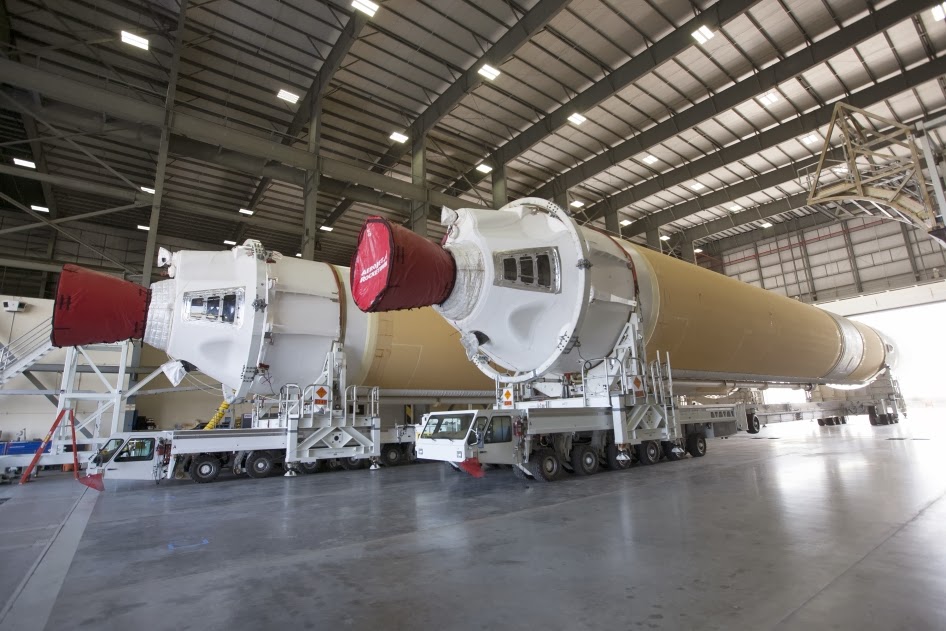
A barge arrives at the U.S. Army Outpost wharf at Port Canaveral in Florida, carrying two of the three United Launch Alliance Delta IV heavy boosters for NASA’s upcoming Exploration Flight Test-1 (EFT-1) with the Orion (MPCV) spacecraft.

The core booster and starboard booster will be offloaded and then transported to the Horizontal Integration Facility (HIF), at Space Launch Complex 37 on Cape Canaveral Air Force Station.

The port booster and the upper stage are planned to be shipped to Cape Canaveral in April. 

At the HIF, all three boosters will be processed and checked out before being moved to the nearby launch pad and hoisted into position.

Orion is the exploration spacecraft designed to carry astronauts to destinations in deep space, including an asteroid and Mars.

It will have emergency abort capability, sustain the crew during space travel and provide safe re-entry from deep space return velocities. 


During the uncrewed EFT-1 flight, Orion will travel 3,600 miles into space -- farther than a spacecraft built for humans has been in more than 40 years -- and orbit the Earth twice.

The capsule will re-enter Earth’s atmosphere at speeds approaching 20,000 mph, generating temperatures as high as 4,000 degrees Fahrenheit, before splashing down in the Pacific Ocean.

The data gathered during the flight will influence design decisions, validate existing computer models and innovative new approaches to space systems development, as well as reduce overall mission risks and costs for later Orion flights.

Image Credit: NASA

Sunday, November 10, 2013

NASA Orion multipurpose crew vehicle: Triple Fairings Jettison Test completed successfully

The three panels or fairings encapsulating a stand-in for Orion’s service module successfully detach and fall into the Fairing Catch System during a test Nov. 6, 2013 at Lockheed Martin’s facility in Sunnyvale, Calif.

Image Credit: Lockheed Martin

The three panels or fairing that moments before encapsulated a stand-in for Orion’s service module lay safely in the Fairing Catch System after a test demonstrating their detachment system on Nov. 6, 2013, at Lockheed Martin’s facility in Sunnyvale, Calif.

Image Credit: Lockheed Martin

The three massive panels protecting a test version of NASA's Orion multipurpose crew vehicle successfully fell away from the spacecraft Wednesday in a test of a system that will protect Orion during its first trip to space next year.

The panels, called fairings, encase Orion's service module and shield it from the heat, wind and acoustics it will experience during the spacecraft's climb into space.

The service module, located directly below the crew capsule, will contain the in-space propulsion capability for orbital transfer, attitude control and high-altitude ascent aborts when Orion begins carrying humans in 2021.

It also will generate and store power and provide thermal control, water and air for the astronauts. The service module will remain connected to the crew module until just before the capsule returns to Earth.

Artist's rendering of NASA Orion during Exploration Flight Test (EFT-1)

During Orion's Exploration Flight Test-1 (EFT-1), the spacecraft's flight test next year, a test service module will be attached to the capsule.

"Hardware separation events like this are absolutely critical to the mission and some of the more complicated things we do," said Mark Geyer, Orion program manager at NASA's Johnson Space Center in Houston.

"We want to know we've got the design exactly right and that it can be counted on in space before we ever launch."

Unlike conventional rocket fairings, these panels are designed to support half of the weight of Orion's crew module and launch abort system during launch and ascent, which improves performance, saves weight and maximizes the size and capability of the spacecraft.

Each panel is 14 feet high and 13 feet wide. The fairings' work is done soon after launch. They must be jettisoned when Orion has reached an altitude of about 560,000 feet.

To make that possible, six breakable joints and six explosive separation bolts are used to connect the fairing panels to the rocket and each other.

In a carefully timed sequence, the joints are fired apart, followed shortly by the bolts. Once all of the pyrotechnics have detonated, six spring assemblies will push the three panels away, leaving the service and crew module exposed to space as they travel onward.