Showing posts with label test. Show all posts

Sunday, September 14, 2014

Toyota i-Road and Grenoble set stage for test in electric ride-sharing


Toyota is testing ride-sharing. As simple as that may sound, the experiment indicates an innovative model for the future of urban transportation.

The Grenoble metro area could turn out to be the trial stage for a new city system in mobility.

The model, which gets under way next month, calls for electric vehicles connected to a public transport system; the result is a weave of route planning, reservations and drop-offs.

Five partners are sharing the vision: the City of Grenoble, the Metro Area, French electricity company EDF, Toyota, and local car-sharing operator, Cité lib.

How it will work: 70 Toyota cars with 27 charging stations will be available for city trips. The stations will be operated by Sodetrel, an affiliate of EDF.

Grenoble riders will be under a pricing plan called "3, 2, 1 euros."

Toyota i-ROAD
Users can pick-up one of the 70 vehicles and drop it off at any station near their destination without having to return it to the original pickup point. They will only be charged for the ride.

The 27 charging stations are in Grenoble, Fontaine, Gières, St Martin D'Hères, Seyssinet-Pariset, et La Tronche, close to tram, bus or train stops.

A smartphone, tablet or PC app shows users the location of cars in the city that have enough charge to be used.

Once a user returns the car to any station and plugs it back in, the vehicle's battery starts charging and the use charge ends.

As for the Toyota cars, 35 of the 70 will be the Toyota i-ROAD, a three-wheel personal mobility vehicle and the other 35 will be the Toyota four-wheel vehicle, Toyota Auto Body COMS.

Supporters say the implications for such a model stretch wider than rider convenience and even "clean" transport, reducing CO2 emissions and improving air quality, and will affect city planning.

The service will eliminate the need for riders to search for a parking place and the compact size of the cars will affect planning for a future parking infrastructure.

How much will all this cost users? "Once the administrative and badging cost of 25 euros is paid, plug-in vehicle users will be able to use the charging service for free until 31 December 2014."

"From January 2015, a pricing schedule will be offered with costs varying between 2 and 5 euros for an hour of charge, depending on charging speed (normal or fast)."

"Charging time will be limited, especially during daytime hours, in order to discourage prolonged parking and allow maximum access to these parking spots," said the Toyota news release on Friday.

Perhaps the most important question of all is, Will this work? Starting October 1, the world will know; the trial entails a three-year period. During this time, project partners will collect data on technical aspects and user behaviour.

Friday, September 12, 2014

DARPA to Test Satellite Repair Droids in Orbit


The United States military's high-technology branch is hoping to test out on-orbit satellite servicing in orbit in the next five years.

Satellites that sit in geostationary orbit, which is about 22,000 miles (36,000 kilometers) above the Earth, are traditionally used for communications and surveillance because the length of the orbit is approximately the same as Earth's day.

This allows a satellite to gaze at the same area of Earth around the clock.

This location is too far away for conventional satellite servicing mission concepts, however, and at the end of the satellite's lifespan it needs to be moved away from that orbital slot to make way for new missions.

As such, the Defense Advanced Research Projects Agency (DARPA) is seeking some sort of a public-private partnership for satellite servicing.

The U.S. military's Defense Advanced Research Projects Agency is considering adding DARPA-developed space robotic technology to commercial spacecraft to create a robotic service droid capable of repairing satellites in geostationary orbits 22,000 miles above Earth. 

 Credit: Defense Advanced Research Agency

The partnership would be for both commercial and military owners with satellites in that space, possibly saving money since new satellites wouldn't need to be launched as often.

"The ability to safely and cooperatively interact with satellites in GEO [geostationary orbit] would immediately revolutionize military and commercial space operations alike, lowering satellite construction and deployment costs and improving satellite lifespan, resilience and reliability," DARPA officials wrote in a statement.

DARPA has put out a request for information looking for "technical, security and business insights" to make this service possible.

The agency is seeking technical information on a possible "robotic servicer" that would make use of previously developed DARPA space robotics.

Ideally, the robot would be able to fix mechanical problems like antenna issues, or inspect spacecraft that had operational problems, providing more information to controllers on Earth.

The servicer might even be able to move satellites into other orbits.

Responses to the request for information are due by Nov. 3. To learn more abotu DARPA's satellite servicing project requirements, read the full request for information.

“We’re asking the space community to think hard about how they want the future of space operations to look and how GEO robotics could help,” said Gordon Roesler, DARPA program manager.

“Their insights are essential as we take the first concrete steps toward viable satellite-servicing capabilities in GEO."

"If we’re successful, we will significantly accelerate development of a capacity to maximize the utility of current space infrastructure and enhance the capabilities of future systems.”

Wednesday, September 10, 2014

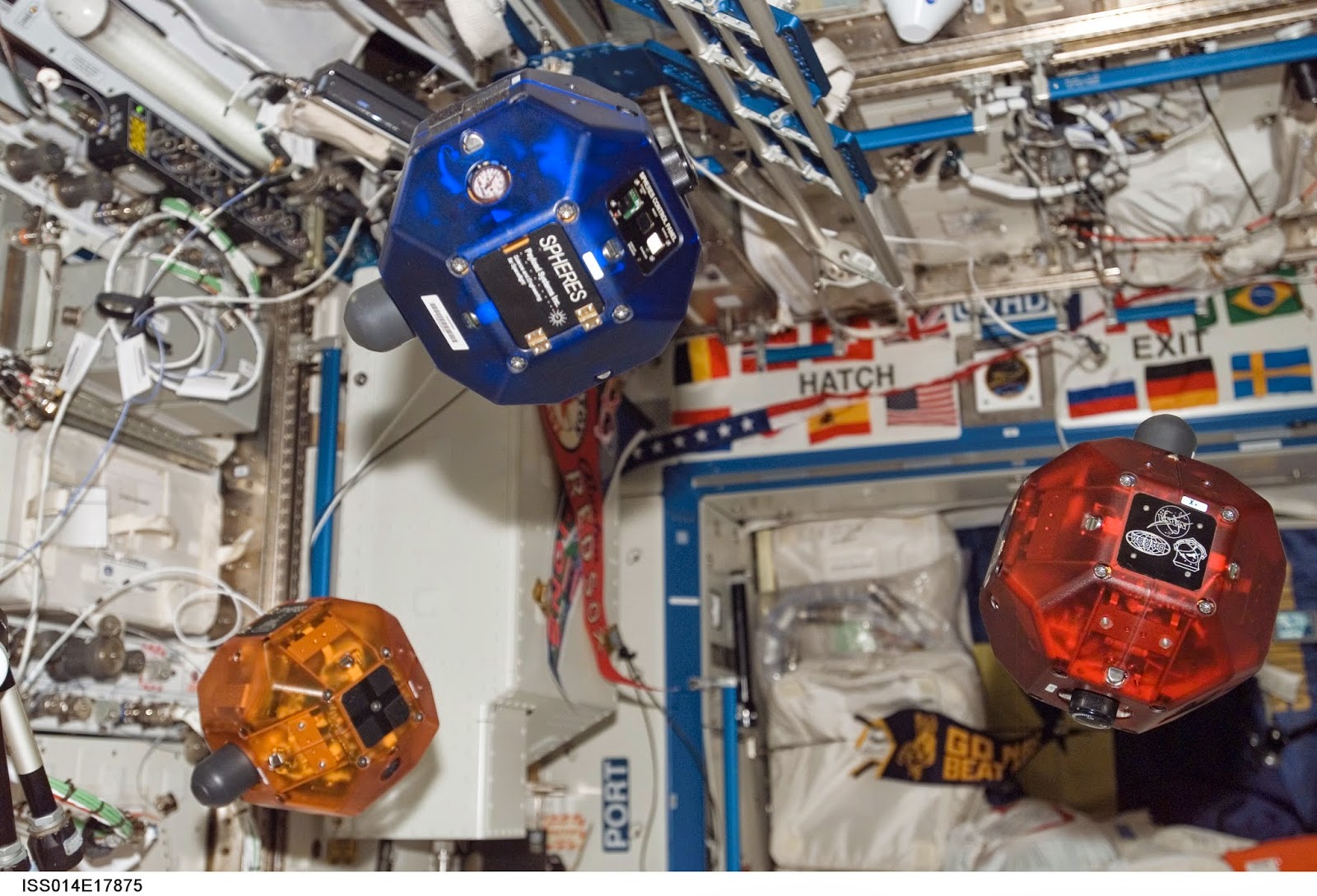
MIT SPHERES: Spin Algorithm tested aboard the International Space Station


MIT researchers tested an algorithm that gauges the rotation of objects in zero gravity aboard the International Space Station. 

This video shows a Zero-G flight where a tracked object is spinning on its major, minor, and intermediate axes.

Objects in space tend to spin, and spin in a way that's totally different from the way they spin on earth.

Understanding how objects are spinning, where their centers of mass are, and how their mass is distributed is crucial to any number of actual or potential space missions, from cleaning up debris in the geosynchronous orbit favoured by communications satellites to landing a demolition crew on a comet.

In a forthcoming issue of the Journal of Field Robotics, MIT researchers will describe a new algorithm for gauging the rotation of objects in zero gravity using only visual information, and at the International Conference on Intelligent Robots and Systems this month, they will report the results of a set of experiments in which they tested the algorithm aboard the International Space Station.

On all but one measure, their algorithm was very accurate, even when it ran in real time on the microprocessor of a single, volleyball-size experimental satellite.

On the remaining measure, which indicates the distribution of the object's mass, the algorithm didn't fare quite as well when running in real time, although its estimate may still be adequate for many purposes, but it was much more accurate when it had slightly longer to run on a more powerful computer.

Space trash

"There are satellites that are basically dead, that are in the 'geostationary graveyard,' a few hundred kilometers from the normal geostationary orbit," says Alvar Saenz-Otero, a principal research scientist in MIT's Department of Aeronautics and Astronautics.

"With over 6,000 satellites operating in space right now, people are thinking about recycling. Can we get to that satellite, observe how it's spinning, and learn its dynamic behaviour so that we can dock to it?"

Moreover, "there's a lot of space trash these days," Saenz-Otero adds. "There are thousands of pieces of broken satellites in space."

"If you were to send a supermassive spacecraft up there, yes, you could collect all of those, but it would cost lots of money, but if you send a small spacecraft, and you try to dock to a small, tumbling thing, you also are going to start tumbling."

"So you need to observe that thing that you know nothing about so you can grab it and control it."

Joining Saenz-Otero on the paper are lead author Brent Tweddle, who was an MIT graduate student in aeronautics and astronautics when the work was done and is now at NASA's Jet Propulsion Laboratory; his fellow grad student Tim Setterfield; AeroAstro Professor David Miller; and John Leonard, a professor of mechanical and ocean engineering.

The researchers tested their algorithm using two small satellites deployed to the space station through MIT's SPHERES project, which envisions that herds of coordinated satellites the size of volleyballs would assist human crews on future space missions.

One SPHERES satellite spun in place while another photographed it with a stereo camera.

Wednesday, August 20, 2014

NASA's Langley Research Center Testing electric propulsion

On Aug. 19, National Aviation Day, a lot of people are reflecting on how far aviation has come in the last century. 

Could this be the future – a plane with many electric motors that can hover like a helicopter and fly like a plane, and that could revolutionize air travel?

Engineers at NASA's Langley Research Center in Hampton, Va., are studying the concept with models such as the unmanned aerial system GL-10 Greased Lightning. 


Greased Lightning GL-10 electric prototype remote control plane. Left to right Zack Johns, William Fredericks and David North prepare the GL10 for a second tethered flight.

The GL-10, which has a 10-foot wingspan, recently flew successfully while tethered. Free-flight tests are planned in the fall of 2014.

This research has helped lead to NASA Aeronautics Research Mission Directorate efforts to better understand the potential of electric propulsion across all types, sizes and missions for aviation.

Image Credit: NASA Langley/David C. Bowman

Wednesday, August 6, 2014

Astronauts Test Google Glass, Heart Monitor in Undersea Base


A team of undersea astronauts took to the ocean floor last week to test out innovative new technologies that may one day make life in space easier.

The space tech sea trials came amid spectacular simulated underwater "spacewalks" during the NASA Extreme Environment Mission Operations mission (NEEMO), in which the underwater astronauts tested out a drill for a potential asteroid mission.

The tests included using Google Glass to help astronauts keep track of what procedures to do next in space, and a Bluetooth heart rate monitor that would improve upon what the International Space Station uses right now.

"There's a lot of equipment on board the station that can cause interference with other devices," NASA astronaut Jeanette Epps told reporters from the Aquarius lab, 62 feet (19 meters) under water off the coast of Key Largo, Florida.

The astronauts tried out the heart rate monitor while using a hair dryer to see if that would produce interference, and early indications show that the monitor still works well, she added.

European Space Agency astronaut Thomas Pesquet does a simulated spacewalk during the NEEMO 18 mission, which took place 62 feet underwater off the coast of Key Largo, Florida.

Credit: NASA

The NEEMO mission, NASA's 18th, aims to test out technologies and procedures that would be useful for future space missions.

Those included a drill astronauts manipulated during excursions in wetsuits and helmets, checking if it was possible to use the tool in a neutrally buoyant environment without unduly stressing either the drill or the astronaut.

The astronauts also ran procedures that could work with a five- or 10-minute delay in communications. In these tests, astronauts had four different places that they visited in a sort of circle.

They would sequentially explain what they saw in each location, move on to the next, and aim to return to the first spot around the same time ground control received the information from the first spot and was able to respond. The astronauts would try to accomplish the same thing for the other three spots.

"With a 10-minute delay in each direction, like we experienced today, you can't hold a rock up to a camera and say this is what you what you want," said NASA astronaut Mark Vande Hei.

"So what we did is we had a circuit of four different places. We went to the first place, we showed a variety of things, and a survey of the general area."

Read the full article here

Tuesday, August 5, 2014

Daewoo Shipyard workers test out robot suits in South Korea

Credit: Daewoo

Industry leaders looking to see how automation and product ion will behave on the next levels will see two technology paths, robots offered as replacements for human labour and robotic technologies that will not replace humans but instead improve the ability of humans to perform their tasks.

A ship-building company in South Korea is interested in the latter path in the form of robotic suits that can support workers' tasks.

Their progress indicates how workers building the world's biggest ships could use exoskeletons to great advantage.

A report in New Scientist has been making the rounds this week about just such an idea that has been put to the test.

Daewoo Shipbuilding and Marine Engineering (DSME) last year conducted the trial at a shipyard in Okpo-dong in South Korea.

The workers in wearable robotics carried large hunks of metal, pipes and other objects.

The suited-up workers were pleased that the exoskeleton allowed them to lift the heavy objects repeatedly without strain, but they also relayed feedback that they wanted to move faster and have the suits support heavier loads.

Gilwhoan Chu, lead engineer for the firm's research and development arm, and his team are working on improvements.

The goal is for the prototypes to turn into suits for regular use in the shipyard. New Scientist said among the challenges to be worked out now involve operating on sloping and slippery surfaces and tasks with twisting motions.

The exoskeleton fits anyone between 160 (about 5 feet 2) and 185 (6 feet) centimeters tall; it has a 28-kilogram frame (62 pounds) of carbon, aluminium alloy and steel but the suit supports itself, engineered to follow the wearer's movements.

A system of hydraulic joints and electric motors running up the outside of the legs, said New Scientist, links to a backpack, which powers and controls the rig.

It can lift objects with a mass of up to 30 kilograms (66 pounds) and has a three-hour battery life,

The world's top three shipbuilding firms are South Korean, Daewoo, Hyundai Heavy Industries and Samsung Heavy Industries, and their shipyards are already recognised for their level of automation, said New Scientist.

DSME, according to the company's site, operates its R&D center for product design, production technologies and other fundamental technologies related to shipbuilding and offshore construction.

Monday, August 4, 2014

NASA's Orion MPV spacecraft mock-up undergoes Recovery test

Credit: NASA, U.S. Navy 

A test version of NASA's Orion MPV spacecraft floats inside the well deck of the U.S.S. Anchorage on Aug. 2, 2014, during recovery tests off the coast of California.

A combined NASA and U.S. Navy team practiced recovery techniques over the weekend, in preparation for Orion's first trip to (and return from) space in Exploration Flight Test-1 (EFT-1) in December.

Orion is the exploration spacecraft designed to carry astronauts to destinations not yet explored by humans, including an asteroid and Mars.

It will have emergency abort capability, sustain the crew during space travel and provide safe re-entry from deep space return velocities.

After traveling 3,600 miles into space on the unmanned or robotic EFT-1, Orion will return to Earth at a speed of 20,000 miles per hour and endure temperatures near 4,000 degrees Fahrenheit before landing in the Pacific Ocean.


Wednesday, July 9, 2014

Prototype Robot With Smartphone to Test 3-D Mapping, Navigation Inside Space Station

Credit: NASA/Ames

Orbital Sciences Corporation's Cygnus spacecraft will carry 3,293 pounds (1,493.8 kg) of cargo on its upcoming commercial resupply mission to the International Space Station, including crew supplies, nanosatellites, student research and this prototype free-flying space robot equipped with a smartphone, known as Smart SPHERES (Synchronized Position Hold, Engage, Reorient Experimental Satellites).

NASA has been testing SPHERES on the space station since 2011. This summer, astronauts will upgrade these existing space robots to use Google’s "Project Tango" smartphone, which features a custom 3-D sensor and multiple cameras.

NASA will then use the Smart SPHERES to test free-flying 3-D mapping and navigation inside the space station.

NASA is developing the Smart SPHERES to perform work on the space station that requires mobile sensing, such as environmental surveys to monitor levels of radiation, lighting and air quality.

They also will be used to monitor inventory and conduct experiments. The development and testing of Smart SPHERES is funded by the Space Technology Mission Directorate at NASA Headquarters in Washington.

Sunday, June 29, 2014

NASA test Mars LDSD 'flying saucer' vehicle on Earth

This image taken from video provided by NASA shows the launch of the high-altitude balloon carrying the LDSD, a saucer-shaped vehicle for NASA, to test technology that could be used to land on Mars, Saturday June 28, 2014 in Kauai, Hawaii. 

Saturday's experimental flight high in Earth's atmosphere is testing a giant parachute designed to deliver heavier spacecraft and eventually astronauts. (AP Photo/NASA)

LDSD, A saucer-shaped NASA vehicle testing new technology for Mars landings made a successful rocket ride over the Pacific, but its massive descent parachute only partially unfurled.

The Low Density Supersonic Decelerator (LDSD) was lifted by balloon 120,000 feet (36,575 meters) into the air from the Hawaiian island of Kauai.


The vehicle then rocketed even higher before deploying a novel inflatable braking system.

But cheers rapidly died Saturday as a gigantic chute designed to slow its fall to splashdown in the ocean emerged tangled.

Still, NASA officials said it's a pretty good test of technology that might one day be used to deliver heavy spacecraft, and eventually astronauts, to Mars. NASA planned a news conference on the flight Sunday.

After several weather delays, NASA will finally launched it's "flying saucer" (LDSD) into Earth's atmosphere Saturday to test technology that could be used to land on Mars.

The attempt off the coast of the Hawaiian island of Kauai tested the disc-shaped vehicle and a giant parachute.

Since the 1970s, NASA has used the same parachute design to slow landers and rovers as they streak through the thin Martian atmosphere.

With plans to send heavier spacecraft and eventually astronauts, the space agency needs a much stronger parachute.

NASA tested the technology high in Earth's atmosphere because conditions there are similar to that of Mars.

High winds at the Kauai military range forced NASA to miss its original two-week launch window in June.

Thursday, June 26, 2014

Raytheon EKV CE-II missile defense system strikes target in test

The Boeing-managed ground-based system intended to shield the continental United States successfully intercepted a simulated incoming missile over the Pacific Ocean for the first time Sunday, the Pentagon said.

The Ground-based Midcourse Defense (GMD) system, with a $40 billion price tag, aims to protect against long-range ballistic missiles from so-called rogue states such as North Korea and Iran. But government records show it has failed a series of tests.

President Barack Obama's administration has announced it plans to spend about $1.3 billion on 14 more interceptors, but only if the closely-watched test was successful.

The interceptor missile was fired from Vandenberg Air Force Base in California and struck a dummy intermediate-range ballistic missile launched from the US Army's Reagan Test Site on Kwajalein Atoll in the Marshall Islands.

"This is a very important step in our continuing efforts to improve and increase the reliability of our homeland ballistic missile defense system," Missile Defense Agency chief Vice Admiral James Syring said in a statement.

The successful test followed the system's failure to hit a simulated missile in five of eight previous tests since president George W. Bush's administration launched the program in 2004.

The latest version of the warhead flown for the test contained hardware and software upgrades, according to manufacturer Raytheon.

It was the first successful intercept by Raytheon's Exoatmospheric Kill Vehicle Capability Enhancement II, or EKV CE-II, which failed in both previous tests conducted in 2010.

"We made the fixes needed to be made from the last test, which was back in December of 2010," Pentagon spokesman Admiral John Kirby told reporters on Friday.

He compared the test to "hitting a BB with a BB... It's pretty significant if it works."

"Testing is critically important to ensuring the advancement of reliable kill vehicles for the protection of the US and its allies," Raytheon Missile Systems president Taylor Lawrence said.

Overall, the test marked the 65th successful intercept out of 81 attempts since 2001 for the Ballistic Missile Defense System, according to the Pentagon.

"This mission met several complex test objectives, including a long-duration flight time for the ground-based interceptor and high velocity closing speeds for intercept," a "proud" Boeing said.

Tuesday, June 24, 2014

First test launch of Russia's Angara rocket June 27

The first test launch of Russia's Angara light-weight rocket, initially set for June 25, may be conducted from the Plesetsk Cosmodrone in the Arkhangelsk region on June 27, a Russian space rocket industry source told reporters.

"Tomorrow the state commission is supposed to make a final decision concerning a date for the Angara launch. It is expected to set the launch for June 27, instead of June 25, as was planned earlier," the source said.

He blamed organizational reasons, not technical difficulties, for the possible postponement.

A universal family of light, medium and heavy-lift Angara launchers is being developed for lifting into orbit practically the entire range of payloads of the Russian Defense Ministry in the designated range of altitudes and orbit inclinations, including the geostationary orbit, and for guaranteeing the genuine independence of Russian military space programs.

Angara launchers will not be using aggressive or toxic fuel, which will significantly improve environmental safety both in the areas around the spaceport and in the zone where rocket fragments fall.

Wednesday, June 18, 2014

NASA’s Cassini Team: Titan Flybys Test their Talents

Cassini will attempt to bounce signals off of Saturn's moon Titan once more during a flyby on June 18, 2014, revealing important details about the moon's surface.

Image Credit: NASA/JPL-Caltech

As NASA’s Cassini spacecraft zooms toward Saturn’s smoggy moon Titan for a targeted flyby on June 18, mission scientists are excitedly hoping to repeat a scientific tour de force that will provide valuable new insights into the nature of the moon's surface and atmosphere.

For Cassini’s radio science team, the last flyby of Titan, on May 17, was one of the most scientifically valuable encounters of the spacecraft’s current extended mission.

The focus of that flyby, designated “T-101,” was on using radio signals to explore the physical nature of Titan’s vast northern seas and probe the high northern regions of its substantial atmosphere.

The Cassini team hopes to replicate the technical success of that flyby during the T-102 encounter, slated for June 18, during which the spacecraft will attempt similar measurements of Titan.

During closest approach, the spacecraft will be just 2,274 miles (3,659 kilometers) above the surface of the moon while travelling at 13,000 miles per hour (5.6 kilometers per second).

During the upcoming flyby, if all goes well as before, Cassini’s radio science subsystem will bounce signals off the surface of Titan, toward Earth, where they will be received by the ground stations of NASA’s Deep Space Network.

This sort of observation is known as a bistatic scattering experiment and its results can yield clues to help answer a variety of questions about large areas of Titan’s surface: Are they solid, slushy or liquid? Are they reflective? What might they be made of?

During the May encounter, Cassini beamed radio signals over the two largest bodies of liquid on Titan, seas named Ligeia Mare and Kraken Mare.

During that first attempt, scientists could not be certain the signals would successfully bounce off the lakes to be received on Earth.

They were thrilled when ground stations received specular reflections, essentially the glint, of the radio frequencies as they ricocheted off Titan.

Cassini team members react with excitement to the successful receipt of radio signals bounced off of Titan during a flyby on May 17, 2014. Image Credit: NASA/JPL-Caltech

Read the full story here.

Friday, June 6, 2014

EADS Airbus Spaceplane Test in South China Seas


Held on 1-4 May, the tests of Airbus Defence and Space's SpacePlane demonstrator validated the dynamic flight conditions encountered in the end-of-flight phase following a return from space.

The tests, supported by the Singapore Economic Development Board, took place 100 kilometers off the coast of Singapore and involved a fleet of seven ships.

The quarter-scale demonstrator used in the tests was built in partnership with HOPE Technik and Airbus Group Innovations, the corporate network of research centres of Airbus Group.

After being winched from the barge by an AS350 B3e Ecureuil helicopter operated by Airbus Helicopters Southeast Asia, the SpacePlane demonstrator was released at a height of around 3,000 metres.

It was then piloted from the barge as it made its return to the ground, ending its flight at sea before being picked up as planned a few hours later.

Thursday, June 5, 2014

ESA Solar Orbiter: Sunshield Undergoes extreme Solar heat test

ESA’s Solar Orbiter mission has undergone its latest major test: its protective shield has been subjected to concentrated sunlight to prove it can cope with the fierce temperatures close in to our parent star.

A ‘structural–thermal’ version of the craft’s sunshield was recently exposed to an artificial Sun for two weeks in Europe’s largest vacuum chamber at ESA’s Technical Centre in Noordwijk, the Netherlands.

The outcome ensures it will balance solar illumination, the cold of deep space and internal heat sources to maintain the perfect operating temperature.

Solar Orbiter, due for launch in 2017, sports a portfolio of instruments for in-situ measurements and high-resolution imaging of the Sun.

ESA’s next generation Sun explorer, Solar Orbiter will be launched in 2017. 

It will investigate the connections and the coupling between the Sun and the heliosphere, a huge bubble in space created by the solar wind. 

The solar wind can cause auroras and disrupt satellite-based communication.

The craft will probe to within almost a quarter of Earth’s distance from the Sun, suffering 13 times the intensity of terrestrial sunlight and temperatures of up to 520°C.

This means Solar Orbiter has been designed around its sunshield: a 3.1 m by 2.4 m sandwich of high-temperature multilayer insulation foil with a black-treated surface.

Openings allow sensors to peep through, some behind protective glass or beryllium.

The sunshield was installed in the 15 m-high and 10 m-diameter Large Space Simulator in May for testing.

Members of ESA’s Solar Orbiter team watch expectantly as an essential part of the spacecraft is lowered into Europe’s largest vacuum chamber: the multi-layered shield that will protect their probe from the Sun’s remorseless glare.

Part was blasted by a beam of simulated sunlight produced by 19 xenon lamps, each consuming 25 kW, and directed onto the shield via a mirror array.

Meanwhile, the chamber’s black walls were chilled by –170°C liquid nitrogen running through them to simulate the cold sky surrounding the craft.

The testing confirmed the design and checked the thermal computer model will accurately predict flight temperatures.

An infrared camera system monitored and measured the temperature of the shield’s front face in real time, along with heat sensors glued to various parts of the multilayer structure.

At the same time, precision ‘photogrammetric’ cameras looked for the slightest movement in the sunshield’s front face as it heated up.

Tuesday, June 3, 2014

NASA begins testing of new EXES spectrograph on SOFIA observatory

EXES, the Echelon-Cross-Echelle Spectrograph, made its first light flight on April 7, 2014. 

The instrument is a mid-infrared spectrograph and is shown mounted to SOFIA's telescope. 

Credit: NASA/SOFIA/EXES/Mathew Richter

Astronomers are eagerly waiting to begin use of a new instrument to study celestial objects: a high-resolution, mid-infrared spectrograph mounted on NASA's Stratospheric Observatory for Infrared Astronomy (SOFIA), the world's largest flying telescope.

This new instrument, the Echelon-Cross-Echelle Spectrograph (EXES), can separate wavelengths of light to a precision of one part in 100,000.

At the core of EXES is an approximately 3-foot (1 meter) bar of aluminum called an echelon grating, carefully machined to act as 130 separate mirrors that split light from the telescope into an infrared "rainbow."

SOFIA is a heavily modified Boeing 747 Special Performance jetliner that carries a telescope with an effective diameter of about 8-feet (2.5-meters) at altitudes of 39,000 to 45,000 feet (12 to 14 km), above more than 99 percent of Earth's atmospheric water vapour.

Lower in the atmosphere, at altitudes associated with most ground-based observatories, water vapor obscures much of what can be learned when viewed in the infrared spectrum.

"The combination of EXES's high spectral resolution and SOFIA's access to infrared radiation from space provides an unprecedented ability to study celestial objects at wavelengths unavailable from ground-based telescopes," said Pamela Marcum, a program scientist at the SOFIA Science Center and Program Office in Moffett Field, California.

"EXES on SOFIA will provide data that cannot be obtained by any other astronomical facility on the ground or in space, including all past, present or those observatories now under development."

EXES successfully carried out its first two flights on SOFIA on the nights of April 7 and 9, according to Matthew Richter, leader of the team that is developing the instrument at the University of California, Davis, Physics Department.

EXES is a collaboration between U.C. Davis and NASA's Ames Research Center in Moffett Field.

"During the two flights, EXES made observations to investigate and characterize the instrument's performance. All the main goals of these observations were successful, although further commissioning flights are required to test EXES in all of its modes," said Richter.

On the first commissioning flight, EXES observed emissions from Jupiter's atmosphere in two molecular hydrogen lines.

These observations will be used to understand how gas rises from deep in Jupiter's interior and mixes into the planet's upper atmosphere.

Thursday, May 29, 2014

Orbital Sciences Cygnus: Launch Postponed after Antares rocket test failure

Orbital Sciences Corp. of Dulles, Va., mated the Cygnus Service Module to the Pressurized Cargo Module Friday, April 4, in Bldg. H-100, payload processing facility, at NASA's Wallops Flight Facility, Va. Image courtesy NASA/P. Black. 

Orbital Sciences Corporation has postponed the launch of the Orbital-2 mission to the International Space Station after an engine test aborted prematurely.

The engine being tested at NASA's Stennis Space Center was slated to be used for a launch in 2015, but Orbital has taken the action to investigate the mishap before attempting to launch Orb-2.

Orbital now is looking no earlier than June 17 for the Orb-2 launch.

Orbital published the following message on their website:

Orbital has rescheduled the launch of its Antares rocket for the Orb-2 mission to a date of no earlier than (NET) June 17, 2014. Orb-2 is the second of eight cargo resupply missions to the International Space Station under Orbital's Commercial Resupply Services (CRS) contract with NASA.

The new launch schedule has been established to allow the engineering teams from the main stage propulsion supplier Aerojet Rocketdyne and Orbital to investigate the causes of an AJ26 (NK33) engine failure that occurred last week at NASA's Stennis Space Center during customary acceptance testing.

That engine was designated for use in a mission slated for 2015 and was undergoing hot fire testing that all Antares AJ26 engines are subject to to ensure nominal performance and acceptance for use in Antares missions.

The NET June 17 is a planning date. The determination of a new firm date will depend on progress of the investigation team, so please check back to this page for further updates.

Monday, May 26, 2014

Orbital Science: Antares rocket engine suffers significant failure during test

Hotfire test of Aerojet Rocketdyne AJ26 engines on the E-1 Test Stand at NASA’s Stennis Space Center on Jan 17, 2014. 

Credit: NASA

A Russian built rocket engine planned for future use in the first stage of Orbital Sciences Corp. commercial Antares rocket launching to the International Space Station failed during pre-launch acceptance testing on Thursday afternoon, May 22, at NASA's Stennis Space Center in Mississippi.

"There was a test failure at Stennis yesterday afternoon (May 22)," Orbital Sciences spokesman Barry Beneski told reporters.

The Aerojet Rocketdyne AJ26 engine failed with extensive damage about halfway through the planned test aimed at qualifying the engine for an Antares flight scheduled for early next year.

"Engineers are examining data to determine the cause of the failure," Beneski said.


The test was initiated at about 3:00 p.m. EDT on Thursday and the anomaly occurred approximately 30 seconds into the planned 54-second test.

"It terminated prematurely, resulting in extensive damage to the engine," Orbital said in a statement.

An investigation into the incident by Aerojet and NASA has begun. The cause of the failure is not known.

"During hot-fire testing on May 22 at NASA's Stennis Space Center, Aerojet Rocketdyne's AJ26 engine experienced a test anomaly. The company is leading an investigation to determine the cause," Aerojet spokesperson Jessica Pieczonka told reporters.

Fortunately no one was hurt.

"There were no injuries," Pieczonka confirmed.

Up close view of two AJ26 first stage engines at the base of an Antares rocket at NASA Wallops. 

These engines powered the successful Antares liftoff on Jan. 9, 2014 at NASA Wallops, Virginia. 

Credit: Ken Kremer

A team of NASA, Orbital Sciences Corporation, Aerojet Rocketdyne and Lockheed Martin engineers tests all of the AJ26 engines on the E-1 Test Stand at NASA's Stennis Space Center before delivering them to the launch site at NASA's Wallops Flight Facility in Virginia.

The testing program began in November 2010.

"Stennis will perform checkouts to the facility to ensure its operational integrity," NASA Stennis spokesperson Rebecca Strecker told reporters.

Antares first stage is powered by a pair of liquid oxygen and kerosene fueled AJ26-62 engines that deliver a combined 734,000 pounds (3265 kilonewtons) of sea level thrust.

To date, the AJ26 engines have performed flawlessly through a total of three Antares launches from NASA's Wallops Flight Facility in Virginia.

They measure 3.3 meters (10.9 feet) in height and weigh 1590 kg (3,500 lb.).

The next Antares rocket is slated to blastoff on June 10 with the Cygnus cargo freighter on the Orb-2 resupply mission to the ISS.

As of today, it's not known whether the June flight will have to be postponed.

"It is too early to tell if upcoming Antares flights will be affected," Beneski said.

Side view of two AJ26 first stage engines at the base of an Antares rocket. 

These engines powered the successful Antares liftoff on Jan. 9, 2014 at NASA Wallops, Virginia. 

Credit: Ken Kremer

The most recent launch of the two stage rocket took place this past winter on Jan. 9, 2014 on the Orb-1 resupply mission.

The AJ26 engines were originally known as the NK-33 and built in the Soviet Union for their manned moon landing program.

Aerojet extensively modified, checked and tested the NK-33 engines now designated as the AJ26-62 to qualify them for use in the first stage Antares core, which is manufactured in Ukraine by the Yuznoye Design Bureau and based on the Zenit launch vehicle.

"Each test of an AJ26 engine is exciting and affirming because it is in direct support of NASA's commercial space flight efforts, as well as a continuation of a very successful Stennis partnership with Orbital and Aerojet Rocketdyne," Stennis Director Rick Gilbrech said in an earlier statement.

Orbital Sciences technicians at work on two AJ26 first stage engines at the base of an Antares rocket. 

These engines powered the successful Antares liftoff on Jan. 9, 2014 at NASA Wallops, Virginia bound for the ISS. 

Credit: Ken Kremer

Orbital Sciences was awarded a $1.9 Billion supply contract by NASA to deliver 20,000 kilograms of research experiments, crew provisions, spare parts and hardware for 8 flights to the ISS through 2016 under the Commercial Resupply Services (CRS) initiative.

The June mission would be the second operational Antares/Cygnus flight.

Monday, April 21, 2014

NASA's MMS observatories stacked for testing - video

All four stacked Magnetospheric Multiscale (MMS), spacecraft with solar arrays are ready to move to the vibration chamber at NASA's Goddard Space Flight Center in Greenbelt, Md., where they will undergo environmental tests. 

Credit: NASA/Chris Gunn

Engineers at NASA's Goddard Space Flight Center in Greenbelt, Md., accomplished another first. Using a large overhead crane, they mated two Magnetospheric Multiscale (MMS) observatories – also called mini-stacks—at a time, to construct a full four-stack of observatories.

Next, the MMS four-stack will be carefully transported from their Goddard cleanroom to a special vibration facility—housed within the same immense integration and testing facility—where they will be secured to a large shaking table and subjected to vibration tests.

These tests help to ensure the structural integrity of the stacked spacecraft prior to shipment to NASA's Kennedy Space Center, Fla.


The vibration tests determine whether the four MMS spacecraft can withstand the extreme vibration and dynamic loads they will experience inside the fairing of the Atlas V launch vehicle on launch day. It's during the first moments after lift-off that the spacecraft is exposed to the most stress.

The MMS mission consists of four spacecraft outfitted with identical instruments.

The mission will fly through near-Earth space to study how the sun and Earth's magnetic fields connect and disconnect, an explosive process that can accelerate particles through space to nearly the speed of light.

This process is called magnetic reconnection and occurs throughout all space.

MMS is a Solar Terrestrial Probes Program (STP), mission within NASA's Heliophysics Division. STP program missions improve our understanding of fundamental physical processes in the space environment from the sun to Earth, to other planets, and to the extremes of the solar system boundary.

Goddard is building the MMS spacecraft and the Fast Plasma Instrument for NASA's Science Mission Directorate in Washington.

Wednesday, March 19, 2014

ESA ATV-5 testing new rendezvous sensors

ESA ATV Albert Einstein shortly after undocking from the International Space Station 28 October 2013. 

Automated Transfer Vehicles (ATVs) are the most complex space vehicles ever developed in Europe and are the largest and most capable resupply ships to dock with the Space Station. 

Credit: ESA/NASA

ESA's space freighter ATV Georges Lemaître, set for launch this summer,will test new rendezvous sensors in space as it approaches the International Space Station.

ESA has set its sights on allowing future spacecraft to rendezvous with 'uncooperative' targets, such as orbiting debris or a Mars sample capsule.

The Laser InfraRed Imaging Sensors (LIRIS) demonstrator on the last Automated Transfer Vehicle ATV, is the first step towards an uncooperative rendezvous in space.

On future missions, infrared cameras and lidar sensors – the light equivalent of radar – would scan the targets while onboard computers processed the data using new guidance navigation and control software.

At 30 km from the target, infrared cameras would be used before lidar took over from 3.5 km out to docking.

Since the first ATV was launched in 2008 they have docked flawlessly with the Space Station using satellite navigation at long range and optical sensors close in, bouncing light off reflectors on the orbital outpost.

ESA contractors Airbus Defence and Space (EADS), with Sodern and Jena-Optronik, proposed using ATV-5 to demonstrate the new approach for future projects.

The infrared camera has been provided by French company Sodern, with German-based Jena-Optronik supplying the lidar.

A simulated image of how ATV-5’s technology demonstrator will ‘see’ the International Space Station using lidar, the light equivalent of radar.

The Laser Infrared Imaging Sensors (LIRIS) demonstrator on the last ATV is the first step towards an ‘uncooperative’ rendezvous in space.

ESA has set its sights on allowing future spacecraft to rendezvous with ‘uncooperative’ targets, such as orbiting debris or a Mars sample capsule. 

Credit: ESA

ATV-5 is the last in the series to deliver supplies to the Station and its mission offers a unique opportunity to space-test LIRIS for comparison with the operational navigation sensors.

Recorders inside ATV's pressurised cargo bay will store the data for later download and analysis.

ATV Albert Einstein, Europe’s supply and support ferry, docked with the International Space Station on 15 June 2013, some ten days after its launch from Europe's Spaceport in French Guiana. 

Credit: ESA/NASA

The hardware is now being installed on ATV at Europe's Spaceport in Kourou, French Guiana.

Friday, February 14, 2014

JAXA ALOS Image: Heart of the Atacama from orbit

The Japanese Advanced Land Observation Satellite (ALOS), captured this image on 30 May 2010.

Credit: JAXA/ESA

This ALOS satellite image shows the heart-shaped Miscanti lake and smaller Miñiques lake in northern Chile.

The lakewater is brackish – meaning that it's saltier than freshwater, but not as much as seawater.

This is due to the salinity in the soil. Chile's largest salt flat, the Salar de Atacama, lies to the west (not pictured).

Two partially snow-covered volcanoes can be seen above and below the lakes on the right, while plains stretch out to the west in a nearly vegetation-free environment.

The area pictured is part of the Atacama Desert, which runs along part of South America's central west coast.

It is considered one of the driest places on Earth, as moisture from the Amazon Basin is blocked by the Andes to the east, as well as from the Pacific Ocean by the Chilean Coastal Range to the west.

Pacific Ocean currents and wind circulation also play a major role in the desert climate.

Because of the Atacama plateau's high altitude, low cloud cover and lack of light pollution, it is one of the best places in the world to conduct astronomical observations and home to two major observatories.

The European ESO ALMA Observatory is located on the Atacama Plateau.

Some areas of the desert have been compared to the planet Mars, and have been used as a location for filming scenes set on the red planet.

Just last year, ESA tested a self-steering rover in the Atacama, which was selected for its similarities to martian conditions.