Showing posts with label LIDAR. Show all posts

Thursday, November 20, 2014

NASA Lidar Lasers to Map Earth's Forests in 3D

An artist's conception of the 3D maps of forest architecture that data from GEDI could produce.

Credit: NASA's Goddard Space Flight Center

A new laser instrument developed for the International Space Station is expected to generate incredible 3D maps of Earth's forests.

The instrument called Global Ecosystem Dynamics Investigation (GEDI) uses lidar, a special kind of laser technology, to create detailed 3D maps and measure the biomass of forests.

NASA has already launched a satellite designed to measure carbon dioxide in the atmosphere, but the new instrument, once launched, will allow scientists to estimate the total amount of carbon stored here on Earth inside trees.

"(GEDI) lidar will have a tremendous impact on our ability to monitor forest degradation, adding to the critical data needed to mitigate the effects of climate change," Patrick O'Shea, chief research officer at the University of Maryland, said in a statement.

Scientists already knew that trees absorb carbon. What scientists don't know is how much they store.

This is a problem because scientists can't predict how much extra carbon would escape into the atmosphere if a forest was destroyed or if planting new trees would be enough to offset the emissions.

"One of the most poorly quantified components of the carbon cycle is the net balance between forest disturbance and regrowth," Ralph Dubayah, the (GEDI) principal investigator at the University of Maryland, said in the same statement.

GEDI's lidar instrument works by shooting streams of light particles at the Earth that then reflect back and are picked up by a detector.

The time it takes the particles to reach Earth and bounce back is converted into a distance.

Every material that the light particles pass through on their journey leaves behind a "fingerprint" that the detector can read.

That means that light particles that pass through leafy tree canopies will look different than the particles that pass through branches or trunks. The unique markers will allow scientists to construct detailed 3D maps of forest architecture.

The lidar pulses will measure the height of trees to about a 3-foot (1 meter) accuracy and allow scientists to estimate the total biomass in a forest and how much carbon it's storing.

GEDI will have three lasers that will shoot out a total of 14 laser beams that will cover about 4 miles (6.5 kilometers). The team of engineers behind GEDI estimate that it will send out about 16 billion laser pulses every year.

Piers Sellers, deputy director of Goddard's Sciences and Exploration Directorate, said GEDI's data will be invaluable when it's combined with historic records of carbon levels collected by satellites like Landsat and MODIS which have been hovering over Earth for decades.

Scientists will also combine the 3D maps with images, maps and data collected from other satellites.

The ultimate goal is to create a database that will monitor changes in forests over time.

Scientists hope the combined data will reveal more about land use, biodiversity and climate change effects.

NASA officials estimate that engineers will complete GEDI by 2018. Once aboard the space station, it will scan most tropical and temperate forests between 50 degrees north and 50 degrees south latitude.

Wednesday, March 19, 2014

ESA ATV-5 testing new rendezvous sensors

ESA ATV Albert Einstein shortly after undocking from the International Space Station 28 October 2013. 

Automated Transfer Vehicles (ATVs) are the most complex space vehicles ever developed in Europe and are the largest and most capable resupply ships to dock with the Space Station. 

Credit: ESA/NASA

ESA's space freighter ATV Georges LemaƮtre, set for launch this summer,will test new rendezvous sensors in space as it approaches the International Space Station.

ESA has set its sights on allowing future spacecraft to rendezvous with 'uncooperative' targets, such as orbiting debris or a Mars sample capsule.

The Laser InfraRed Imaging Sensors (LIRIS) demonstrator on the last Automated Transfer Vehicle ATV, is the first step towards an uncooperative rendezvous in space.

On future missions, infrared cameras and lidar sensors – the light equivalent of radar – would scan the targets while onboard computers processed the data using new guidance navigation and control software.

At 30 km from the target, infrared cameras would be used before lidar took over from 3.5 km out to docking.

Since the first ATV was launched in 2008 they have docked flawlessly with the Space Station using satellite navigation at long range and optical sensors close in, bouncing light off reflectors on the orbital outpost.

ESA contractors Airbus Defence and Space (EADS), with Sodern and Jena-Optronik, proposed using ATV-5 to demonstrate the new approach for future projects.

The infrared camera has been provided by French company Sodern, with German-based Jena-Optronik supplying the lidar.

A simulated image of how ATV-5’s technology demonstrator will ‘see’ the International Space Station using lidar, the light equivalent of radar.

The Laser Infrared Imaging Sensors (LIRIS) demonstrator on the last ATV is the first step towards an ‘uncooperative’ rendezvous in space.

ESA has set its sights on allowing future spacecraft to rendezvous with ‘uncooperative’ targets, such as orbiting debris or a Mars sample capsule. 

Credit: ESA

ATV-5 is the last in the series to deliver supplies to the Station and its mission offers a unique opportunity to space-test LIRIS for comparison with the operational navigation sensors.

Recorders inside ATV's pressurised cargo bay will store the data for later download and analysis.

ATV Albert Einstein, Europe’s supply and support ferry, docked with the International Space Station on 15 June 2013, some ten days after its launch from Europe's Spaceport in French Guiana. 

Credit: ESA/NASA

The hardware is now being installed on ATV at Europe's Spaceport in Kourou, French Guiana.

Wednesday, January 29, 2014

NASA MABEL: Laser Lidar technology reveals how ice measures up

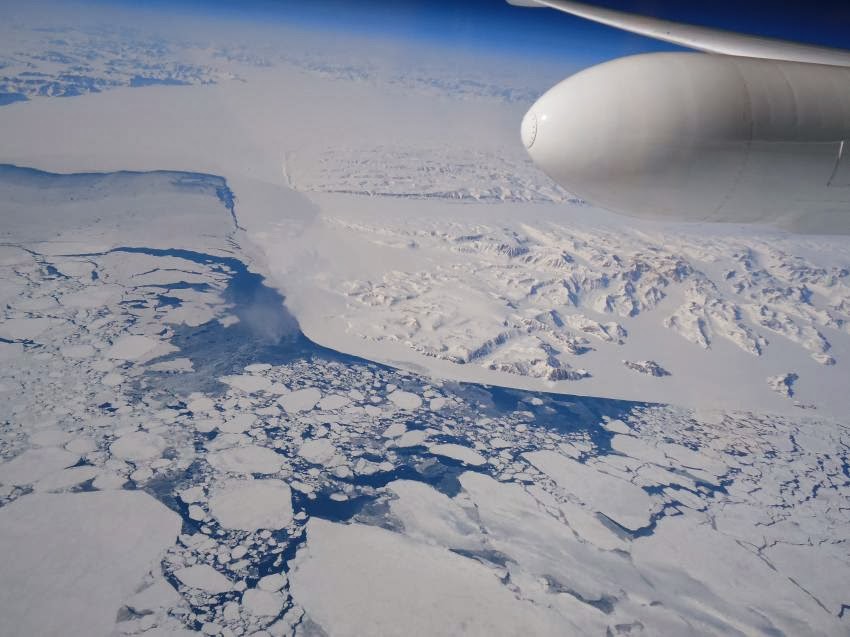
NASA's Multiple Altimeter Beam Experimental Lidar flew over Southwest Greenland's glaciers and sea ice to test a new method of measuring the height of Earth from space. 

Credit: NASA/Tim Williams

New results from NASA's MABEL campaign demonstrated that a photon-counting technique will allow researchers to track the melt or growth of Earth's frozen regions.

When a high-altitude aircraft flew over the icy Arctic Ocean and the snow-covered terrain of Greenland in April 2012, it was the first polar test of a new laser-based technology to measure the height of Earth from space.

Aboard that aircraft flew the Multiple Altimeter Beam Experimental Lidar (MABEL), which is an airborne test bed instrument for NASA's ICESat-2 satellite mission slated to launch in 2017.

Both MABEL and ICESat-2's ATLAS instrument are photon counters – they send out pulses of green laser light and time how long it takes individual light photons to bounce off Earth's surface and return.

ICESat-2's ATLAS instrument
That time, along with ATLAS' exact position from an onboard GPS, will be plugged into computer programs to tell researchers the elevation of Earth's surface – measuring change to as little as the width of a pencil.

This kind of photon-counting technology is novel for satellites; from 2003 to 2009, ICESat-1's instrument looked at the intensity of a returned laser signal, which included many photons.

So getting individual photon data from MABEL helps scientists prepare for the vast amounts of elevation data they'll get from ICESat-2.

"Using the individual photons to measure surface elevation is a really new thing," said Ron Kwok, a senior research scientist at NASA's Jet Propulsion Laboratory in Pasadena, Calif.

"It's never been done from orbiting satellites, and it hasn't really been done much with airborne instruments, either."

Ron Kwok
ICESat-2 is tasked with measuring elevation across Earth's entire surface, including vegetation and oceans, but with a focus on change in the frozen areas of the planet, where scientists have observed dramatic impacts from climate change.

There, two types of ice – ice sheets and sea ice – reflect light photons in different patterns.

Ice sheets and glaciers are found on land, like Greenland and Antarctica, and are formed as frozen snow and rain accumulates.

Sea ice, on the other hand, is frozen seawater, found floating in the Arctic Ocean and offshore of Antarctica.

MABEL's 2012 Greenland campaign was designed to observe a range of interesting icy features, said Bill Cooke, MABEL's lead scientist at NASA's Goddard Space Flight Center in Greenbelt, Md.

With the photon counts from different surfaces, other scientists could start analyzing the data to determine which methods of analyzing the data allow them to best measure the elevation of Earth's surface.

MABEL, short for "Multiple Altimeter Beam Experimental Lidar," serves as an ICESat-2 simulator. 

Credit: NASA /Kelly Brunt

"We wanted to get a wide variety of target types, so that the science team would have a lot of data to develop algorithms," Cooke said.

"This was our first real dedicated science mission."

The flights over the ocean near Greenland, for example, allowed researchers to demonstrate that they can measure the height difference between open water and sea ice, which is key to determining the ice thickness.

MABEL can detect enough of the laser light photons that bounce off Earth surface and return to the instrument, and programs can then make necessary elevation calculations, Cooke said.

Bill Cooke
"Part of what we're doing with MABEL is to demonstrate ICESat-2's instrument is going to have the right sensitivity to do the measurements," Cooke said. "You can do this photon counting if you have enough photons."

In an article recently published in the Journal of Atmospheric and Oceanic Technology, Kwok and his colleagues showed how to calculate elevation from MABEL data, and do so over different types of ice – from open water, to thin, glassy ice, to the snow-covered ice.

Monday, March 18, 2013

Mobile LIDAR technology expanding rapidly

LIDAR can capture considerable data on nearby terrain, as seen in this image of an ordinary highway. (Image courtesy of Oregon State University).

Imagine driving down a road a few times and obtaining in an hour more data about the surrounding landscape than a crew of surveyors could obtain in months.

Such is the potential of mobile LIDAR, a powerful technology that's only a few years old and promises to change the way we see, study and record the world around us.

It will be applied in transportation, hydrology, forestry, virtual tourism and construction - and almost no one knows anything about it.

That may change with a new report on the uses and current technology of mobile LIDAR, which has just been completed and presented to the Transportation Research Board of the National Academy of Sciences.

It will help more managers and experts understand, use and take advantage of this science.

Facing Constraints
The full exploitation of this remarkable technology, however, faces constraints.

  • Too few experts are trained to use it, 
  • too few educational programs exist to teach it, 
  • mountains of data are produced that can swamp the computer capabilities of even large agencies, and 
  • lack of a consistent data management protocol clogs the sharing of information between systems.

"A lot of people and professionals still don't even know what mobile LIDAR is or what it can do," said Michael Olsen, an assistant professor of civil engineering at Oregon State University, and lead author of the new report. "And the technology is changing so fast it's hard for anyone, even the experts, to keep up.

"When we get more people using mobile LIDAR and we work through some of the obstacles, it's going to reduce costs, improve efficiency, change many professions and even help save lives," Olsen said.

This lidar (laser range finder) may be used to scan buildings, rock formations, etc., to produce a 3D model. 

The LIDAR can aim its laser beam in a wide range: its head rotates horizontally; a mirror tilts vertically. 

The laser beam is used to measure the distance to the first object on its path.

LIDAR
LIDAR, which stands for 'light detecting and ranging', has been used for 20 years, primarily in aerial mapping. Pulses of light up to one million times a second bounce back from whatever they hit, forming a highly detailed and precise map of the landscape.

But mobile LIDAR used on the ground, with even more powerful computer systems, is still in its infancy and has only been commercially available for five years.

Mobile LIDAR, compared to its aerial counterpart, can provide 10 to 100 times more data points that hugely improve the resolution of an image. Moving even at highway speeds, a technician can obtain a remarkable, three-dimensional view of the nearby terrain.