Showing posts with label 3D. Show all posts

Thursday, November 20, 2014

NASA Lidar Lasers to Map Earth's Forests in 3D

An artist's conception of the 3D maps of forest architecture that data from GEDI could produce.

Credit: NASA's Goddard Space Flight Center

A new laser instrument developed for the International Space Station is expected to generate incredible 3D maps of Earth's forests.

The instrument called Global Ecosystem Dynamics Investigation (GEDI) uses lidar, a special kind of laser technology, to create detailed 3D maps and measure the biomass of forests.

NASA has already launched a satellite designed to measure carbon dioxide in the atmosphere, but the new instrument, once launched, will allow scientists to estimate the total amount of carbon stored here on Earth inside trees.

"(GEDI) lidar will have a tremendous impact on our ability to monitor forest degradation, adding to the critical data needed to mitigate the effects of climate change," Patrick O'Shea, chief research officer at the University of Maryland, said in a statement.

Scientists already knew that trees absorb carbon. What scientists don't know is how much they store.

This is a problem because scientists can't predict how much extra carbon would escape into the atmosphere if a forest was destroyed or if planting new trees would be enough to offset the emissions.

"One of the most poorly quantified components of the carbon cycle is the net balance between forest disturbance and regrowth," Ralph Dubayah, the (GEDI) principal investigator at the University of Maryland, said in the same statement.

GEDI's lidar instrument works by shooting streams of light particles at the Earth that then reflect back and are picked up by a detector.

The time it takes the particles to reach Earth and bounce back is converted into a distance.

Every material that the light particles pass through on their journey leaves behind a "fingerprint" that the detector can read.

That means that light particles that pass through leafy tree canopies will look different than the particles that pass through branches or trunks. The unique markers will allow scientists to construct detailed 3D maps of forest architecture.

The lidar pulses will measure the height of trees to about a 3-foot (1 meter) accuracy and allow scientists to estimate the total biomass in a forest and how much carbon it's storing.

GEDI will have three lasers that will shoot out a total of 14 laser beams that will cover about 4 miles (6.5 kilometers). The team of engineers behind GEDI estimate that it will send out about 16 billion laser pulses every year.

Piers Sellers, deputy director of Goddard's Sciences and Exploration Directorate, said GEDI's data will be invaluable when it's combined with historic records of carbon levels collected by satellites like Landsat and MODIS which have been hovering over Earth for decades.

Scientists will also combine the 3D maps with images, maps and data collected from other satellites.

The ultimate goal is to create a database that will monitor changes in forests over time.

Scientists hope the combined data will reveal more about land use, biodiversity and climate change effects.

NASA officials estimate that engineers will complete GEDI by 2018. Once aboard the space station, it will scan most tropical and temperate forests between 50 degrees north and 50 degrees south latitude.

Monday, April 21, 2014

Nasa Cassini: Origin of the Equatorial Ridge on Iapetus

Raw image from Cassini space probe of the equatorial ridge on Saturn's moon Iapetus

Image: NASA

A combined team of researchers from Brown University in Rhode Island and the Lunar and Planetary Institute in Texas is suggesting in a paper they've uploaded to the preprint server arXiv, that an equatorial mountainous ridge on Iapetusone of Saturn's moons, has an exogenic origin.

They are basing their theory on 3D models of the moon they've created and an analysis of the types of peaks present.

Iapetus, the 3rd largest of Saturn's approximately 60 moons, is distinct for two reasons.

One is its odd two-tone colouring; the other is the back-bone looking mountain range straddling part of its equator.

Scientists have been puzzled by the origin of the mountain range as the moon doesn't have other geologic qualities that could have given rise to it, such as shifting plates or volcanic activity.

Thus, some have suggested that the mountains came from above, rather than below, or in other words, they have an exogenic origin, meaning they came from somewhere else.

To gain a better understanding of the mountain range, the research team built a 3D model of it on a computer in their lab, faithfully replicating the 12 mile high by 12 mile wide by 800 miles long range in miniature, using data from the Cassini space probe.

Once created, the team set to work measuring the shape of the peaks, which they believed should offer clues as to their origin.

They found that the majority of the peaks sat in what is known as their angle of repose, which is the maximum angle at which material can rest on a peak without falling down to its base.

Normal geologic activity tends to create peaks that are shallower and have less uniformity.

This suggests, the researchers claim, that the mountains did not form due to geologic activity but more likely are part of a ring of material that once circled the moon and was pulled down to the surface.

A ring around the moon would most likely have come about due to a collision, either between another body and the moon, or two other bodies nearby.

The resulting material would have formed a ring around the equator which over time, would have been pulled to the surface by gravity.

Such a theory, the team notes, would also explain Iapetus's asymmetrical orbit and also why it orbits with the same face pointing at Saturn all of the time.

More information: Topographic Constraints on the Origin of the Equatorial Ridge on Iapetus, arXiv:1404.2337 [astro-ph.EP] arxiv.org/abs/1404.2337

Saturday, November 2, 2013

ESA DLR 3D Mars Video Brings Red Planet to Life


A newly released video, created by stitching together with images taken by a veteran Mars spacecraft, provides a richly detailed, three-dimensional view of the Red Planet.

The European Space Agency's Mars Express spacecraft has orbited the Red Planet nearly 12,000 times, capturing images of Martian valleys, canyons and lava flows that have provided unprecedented views of planet's terrain.

Ralf Jaumann
Researchers pieced together the individual images into a video that shows a eye-popping video of Mars in 3D.

"For the first time, we can see Mars spatially — in three dimensions," Ralf Jaumann, project manager for the Mars Express mission at the German Aerospace Center, said in a statement.

The first image of the Martian surface taken by the stereo camera aboard the European Space Agency's Mars Express spacecraft. Credit: DLR

Mars Express has covered 37 million square miles (97 million square kilometers) of Mars' surface (out of 56 million square miles or 145 million square kilometers) in high resolution.

Researchers around the world combine data from Mars Express with other NASA missions at the Red Planet, to better understand the foreign world.

"This has enabled the creation of the most comprehensive data set that has ever been acquired by a German instrument designed to study our solar system," Jaumann said.

A colour-coded elevation model of Olympus Mons from the European Space Agency's Mars Express spacecraft. Credit: DLR

Nine light-sensitive detectors aboard Mars Express sweep across the surface of the planet, capturing images in sequence from nine different angles.

This data is then processed into three-dimensional images by planetary researchers at the German Aerospace Center.

"We can see the entire topography almost as well as if we were standing on Mars ourselves," Jaumann said.

Wednesday, April 24, 2013

NASA Mars Curiosity 3D Stereo View from 'John Klein' to Mount Sharp


Left and right eyes of the Navigation Camera (Navcam) in NASA's Curiosity Mars rover took the dozens of images combined into this stereo scene of the rover and its surroundings. 

The component images were taken during the 166th, 168th and 169th Martian days, or sols, of Curiosity's work on Mars (Jan. 23, 25 and 26, 2013). 

The scene appears three dimensional when viewed through red-blue glasses with the red lens on the left. It spans 360 degrees, with Mount Sharp on the southern horizon.

In the center foreground, the rover's arm holds the tool turret above a target called "Wernecke" on the "John Klein" patch of pale-veined mudstone. 

On Sol 169, Curiosity used its dust-removing brush and Mars Hand Lens Imager (MAHLI) on Wernecke

About two weeks later, Curiosity used its drill at a point about 1 foot (30 centimeters) to the right of Wernecke to collect the first drilled sample from the interior of a rock on Mars. 

This anaglyph was made with the images as captured by the Curiosity. Another version with the seams in the sky eliminated and cropped for optimal 3-D viewing can be seen at PIA16925.

Separate left-eye and right-eye mosaics are combined into the stereo view.

NASA's Jet Propulsion Laboratory, a division of the California Institute of Technology, Pasadena, manages the Mars Science Laboratory Project for NASA's Science Mission Directorate, Washington. JPL designed and built the project's Curiosity rover and the rover's Navcam.

› Full view

Image credit: NASA/JPL-Caltech

Friday, March 8, 2013

Ancient Mega-Flood on Mars Revealed in 3D

The Mars map shows the location of the nearly 1,000-kilometer Marte Vallis channel system on Mars created during an ancient mega-flood. 

Marte Vallis is filled with lava obscuring the source and morphology of the channels. Image released March 7, 2013.

CREDIT: NASA/MOLA Team/Smithsonian Institution

Radar scans of Mars have revealed the first 3D look at water-carved channels buried beneath the Red Planet's surface, researchers say.

The discovery shows that a major underground channel generated by an ancient mega-flood is twice as deep as thought, and sheds light on how water shaped the surface of Mars, scientists added.

Mars today is cold and dry, with most of its water locked in polar ice caps, and researchers think its surface has been largely barren for the past 2.5 billion years. However, channels crisscrossing its surface hint that waters once flooded the Red Planet's surface.

The largest of the channels engraved into Mars within the past 500 million years belong to the 600-mile-long (1,000 kilometer) Marte Vallis system. Probing Marte Vallis could offer hints on a time otherwise thought of as cold and dry.

However, Marte Vallis lies in Elysium Planitia, an expanse of plains along the Martian equator. This area is the youngest volcanic region on Mars, and massive volcanism throughout the past several hundred million years has covered most of its surface with lava, burying evidence of its recent history, including the source and most of the length of Marte Vallis.

Now, using the shallow radar onboard the Mars Reconnaissance Orbiter, scientists have scanned beneath the surface of Elysium Planitia. Their data helped generate a 3D reconstruction of Marte Vallis, revealing many details that lava flows buried long ago.

"This is the first time we've been able to see buried flood channels on a planet other than the Earth," lead study author Gareth Morgan, a geologist at the Smithsonian's National Air and Space Museum, reported.

The researchers found the channels of Marte Vallis were at least 230 feet (70 meters) deep, making them at least twice as deep as thought.

"That shows previous ideas of erosion, of how much water have gone through Marte Vallis, have been underestimated," Morgan said. "There was more significant flooding than before thought, and it's interesting to think of where this water might have come from during this relatively dry period."

This 3D visualization shows the buried Marte Vallis channels beneath the Martian surface created during an ancient mega-flood. 

Marte Vallis consists of multiple perched channels formed around streamlined islands. 

These channels feed a deeper and wider main channel. 

Note the surface has been elevated, and scaled by a factor of 1/100 for clarity, with colours representing the elevation of the buried channels. 

Image released March 7, 2013. 

CREDIT: Smithsonian Institution/NASA/JPL-Caltech/Sapienza University of Rome/MOLA Team/USGS


By mapping the buried channels, researchers discovered the ancient gigantic floods that probably created Marte Vallis apparently originated deep underground from a now-buried portion of fissures known as Cerberus Fossae.

"The source of the floodwaters suggests they originated from a deep groundwater reservoir and may have been released by local tectonic or volcanic activity," Morgan said.

Marte Vallis is similar to more ancient systems of channels on Mars. The gargantuan floods that generated these channels may also have briefly radically changed the Red Planet's climate just as giant floods of Arctic water have on Earth. Learning more about Martian floods could provide information on key parts of that world's history, researchers said.

"There's also evidence of channels buried by lava or other sorts of materials in other areas on Mars, and we'd like to apply the same sort of radar studies to those," Morgan said.

The scientists detailed their findings online today (March 7) in the journal Science.

Thursday, October 18, 2012

ESA Hubble: Elusive Giant Dark Matter Filament in MACS J0717 - 3D Video

This enormous image shows Hubble’s view of massive galaxy cluster MACS J0717.

The large field of view is a combination of 18 separate Hubble images.

The location of the dark matter is revealed in a map of the mass in the cluster and surrounding region, shown here in blue.

The filament visibly extends out and to the left of the cluster core.

CREDIT: NASA, ESA, Harald Ebeling (University of Hawaii at Manoa) & Jean-Paul Kneib (LAM)


Astronomers have taken their first 3D look at a gigantic filament of dark matter, an invisible cosmic structure that can only be detected by its gravitational effects it has on its surroundings.

The universe is thought to be structured like a tangled web, with long strings of mostly dark matter intersecting at giant galaxy clusters.

Since dark matter cannot be seen directly, these filaments are difficult to observe. But using the Hubble Space Telescope, astronomers have managed to probe one of the elusive cosmic strands in 3D.

The researchers sought out a 60 million light-year strand of dark matter around the massive galaxy cluster MACS J0717. The galaxy cluster is one of the largest yet seen and is about 5.4 billion light-years from Earth.

"From our earlier work on MACS J0717, we knew that this cluster is actively growing, and thus a prime target for a detailed study of the cosmic web," study researcher Harald Ebeling, of the University of Hawaii at Manoa, said in a statement Tuesday (Oct. 16).

 [Hubble's Dark Matter Strand View in 3D (Video)]

Tuesday, October 9, 2012

Jaw-dropping rotating 3D nebula

We’ve all dreamed of floating around the cosmos, getting up close and personal with celestial bodies.

One benefit of taking such a trip would be the ability to see the 3D structures of things like nebulas and galaxies, should we catch them at the right distance and angle.

The best we can do from Earth is approximation and imagination. That’s what space photographer J-P Metsävainio does.

He takes as much scientific data as he can, and applies artistic license to the rest.

Friday, September 21, 2012

ESA's GAIA: Billion-pixel space camera passes critical tests

Artist impression of GAIA in orbit observing and monitoring the Milky Way.

The most powerful camera ever designed for space is on track for launch next year following punishing tests to prove it can withstand that environment.

The European Space Agency's Gaia mission will scan the sky with a one-billion pixel detector, producing a 3D map of the Milky Way from its location 1.5 billion km from Earth.

Two telescopes aboard the spacecraft will chart the sky from an orbit around the Sun over five years, noting the position, motion, colour, brightess and composition of around a billion stars in our own galaxy and beyond. These observations will help astronomers learn how our galaxy formed and evolved.

Gaia is also designed to photograph large numbers of other celestial bodies, from asteroids in our own Solar System to more distant galaxies and around 500,000 quasars near the edge of the Universe.


The probe's camera is made up of 106 sensitive electronic detectors made by UK company e2v Technologies, of Chelmsford, Essex, who have also supplied imaging systems for the Curiosity probe now on Mars.

These are basically advanced versions of the chips found in home digital cameras. They were put together like a mosaic to make one huge sensor by EADS scientists at Toulouse, France, for the European Space Agency.

Each detector is slightly smaller than a credit card but thinner than a human hair. Together they are powerful enough to record stars up to a million times fainter than the eye can see.

Gaia is due to be launched by a Soyuz-Fregat rocket from Baikonur in Kazakhstan. When it arrives at the spot called a Lagrangian point (L2) it will fly in a naturally synchronised orbit with Earth and operate at a super-chilled temperature of –110°C.

A giant sunshade on the spacecraft will protect the instruments by keeping them permanently shielded from the heat of the Sun.


Scientists at Toulouse recently checked that Gaia’s service module, housing electronic units to run the science instruments, as well as the units that provide the spacecraft resources, such as thermal control, propulsion, communication, and attitude and orbit control, would function OK in extreme conditions.

During 19 days of tests, they enclosed it in a barrel-shaped chamber at Intespace's test facility where Gaia was subject to vacuum conditions and subjected to a range of temperatures.

The process was similar to that which the James Webb Space Telescope will undergo inside a revamped chamber for NASA.

It experienced temperatures as low as –170°C and tests verified that the spacecraft's instruments could still work properly.

Gaia Project Manager Giuseppe Sarri said: “The thermal tests went very well; all measurements were close to predictions and the spacecraft proved to be robust with stable behaviour.”

He added: “The latest thermal test marks a major milestone achieved in the development of Gaia,” says Giuseppe. “It demonstrated that the service module is compatible with working in space and that we are on track for launch by the end of next year.”

Friday, March 16, 2012

Nano racing Car: Vienna University

This racing car is the size of a grain of sand. Researchers at the Vienna University of Technology used a 3D printer with nano precision to break the world record for fastest two-photon lithography.

The technique sees liquid resin hardened by a laser beam.

The focal point of the laser beam is guided through the resin by movable mirrors, and leaves behind a line of solid polymer, just a few hundred nanometres wide.

This high resolution enables the creation of intricately structured sculptures as tiny as a grain of sand...Picture: TU Wien / Rex Features

Wednesday, February 8, 2012

3D printer creates new jaw for woman


"This is a world premiere, the first time a patient?specific implant has replaced the entire lower jaw," Jules Poukens of the University of Hasselt in Belgium said. "It's a cautious, but firm step."

A Belgium woman is able to chew, speak and breathe normally after the implantation of a new jawbone created on a 3D printer, doctors say.

The replacement jaw, created out of a fine titanium powder sculpted layer by layer by a precision laser beam, has proved a successful substitute for her own jaw all but destroyed by a potent infection called osteomyelitis..

Poukens and fellow researchers collaborated with a 3D printing firm called Layerwise in Leuven, Belgium, which specializes in printing with ultrastrong titanium to make dental implants and facial and spinal bone implants.

An MRI scan of the patient's jawbone was fed into a laser sintering 3D printer which fused tiny titanium particles layer by layer until the shape of her jawbone was recreated, then it was coated in a biocompatible ceramic layer.

The four-hour jaw implant operation was a success, researchers said.

"Shortly after waking up from the anesthetic the patient spoke a few words, and the day after was able to speak and swallow normally again," Poukens said.

Osteomyelitis: Causes, incidence, and risk factors

This severe Bone infection can be caused by bacteria (more common) or fungi (less common).
  • Infection may spread to a bone from infected skin, muscles, or tendons next to the bone, as in osteomyelitis that occurs under a chronic skin ulcer (sore).
  • The infection that causes osteomyelitis can also start in another part of the body and spread to the bone through the blood.
  • A current or past injury may have made the affected bone more likely to develop the infection. A bone infection can also start after bone surgery, especially if the surgery is done after an injury or if metal rods or plates are placed in the bone.

Friday, January 6, 2012

The New Gamers Immersive Dome Display Unit - The TOOB! - Video


WHAT IS THE PLAN?
TOOB plans to manufacture and sell the world’s first affordable dome displays. TOOB has spent the last 2 years developing its 2nd generation product TOOB Earth.

WHAT IS TOOB Earth?
TOOB Earth is a 1.2 Metre (4ft) diameter half dome which when used with a standard projector fitted with a standard lens can project an image onto the inside curved surface giving the viewer the sense of being fully immersed in the content.Think IMAX/ OMNI MAX but in the home.


One of the key differentiator's is that the projector and screen are all contained within the same footprint meaning you no longer need to compromise on space.

TOOB Earth is the first in a range of dome products planned and will be the foundation for the world’s first consumer focused Gaming/ Simulation/ Film curved screen company.

Its uniquely patented design allows you to place your dome on any hard surface or on our GRAVITY-E adjustable stand.
Using the GRAVITY-E stand adds a further layer of flexibility as it then allows you to either use TOOBs brand new TSR/ TFX & M-spec simulation rigs
or use many existing racing or flight rigs which can be comfortably slide underneath. Or simply use the GRAVITY-E as a furniture piece in your room for watching stereo 3D movies.

CORPORATE
TOOB is well suited for the corporate environment and this is a great opportunity to get a TOOB and be one of the first to showcase TOOB Dome technology with your business.

TOOB's 007 reward shows how you can take a TOOB product and customise it with a unique brand or design.

In April 2011 TOOB attended the Gadget Show Live in Birmingham (UK) visted by over 40,000 tech hungry guests.

TOOB was so popular it increased footfall on our partners stand by thousands. The increased footfall generated more sales.

TOOB gave 1400 demos during the event. That guarenteed 1400 more potential customers + the 1000s of people that stoped to look at the technology.
(T.O.O.B. LTD acknowledges all rights, copyrights and trademarks of 3rd parties, the above image is an artists illustration only)


Wednesday, November 30, 2011

WSU Researchers Use a 3D Printer to Make Bone-like Material - YouTube


It looks like bone. It feels like bone. For the most part, it acts like bone and it came off an inkjet printer.

A ceramic powder and 3D printer have been paired to create a bone-like material that could be used in surgery within the next decade.

The material, which has already been tested in vivo tests on rats and rabbits, could be created to order for dental and orthopedic procedures.

Once inserted in the body, it acts as a scaffold for new human bone cells to grow upon after just a week.

The manmade scaffold will eventually dissolve "with no apparent ill effects".

The material was created following a four-year effort by chemistry, materials science, biology and manufacturing researchers at Washington State University.

The main "ingredient" is calcium phosphate but silicon and zinc were added, which "more than doubled the strength of the main material," the team explained.

Inside the printer, an inkjet nozzle sprays a plastic binder liquid over a bed of the powder in layers of 20 microns.

Susmita Bose, co-author of the paper revealing the results of the project and professor in WSU's School of Mechanical and Materials Engineering says that custom-ordered replacement bone tissue could be in common use in the next ten years.

"If a doctor has a CT scan of a defect, we can convert it to a CAD file and make the scaffold according to the defect," she said.

Friday, October 14, 2011

ESA Galileo: Europe leading the way in 3D! - YouTube


A 3D presentation of the Galileo satellite navigation system, a joint development by the European Union and European Space Agency. This constellation of satellites will allow users to pinpoint their location anywhere on Earth -- their launches commencing on 20 October 2011.

Sunday, September 11, 2011

NASA Anaglyph (3D) of Vesta Model

This anaglyph -- best viewed through red-blue glasses -- shows a 3-D model of the protoplanet Vesta, using scientists' best guess to date of what the surface of the protoplanet might look like.

It was created as part of an exercise for NASA's Dawn mission involving mission planners at NASA's Jet Propulsion Laboratory and science team members at the Planetary Science Institute in Tuscon, Ariz.

The images incorporate the best data on dimples and bulges of the protoplanet Vesta from ground-based telescopes and NASA's Hubble Space Telescope.

The cratering and small-scale surface variations are computer-generated, based on the patterns seen on the Earth's moon, an inner solar system object with a surface appearance that may be similar to Vesta.

Vesta, located in the main asteroid belt between Mars and Jupiter, formed very early in the history of the solar system and has one of the oldest surfaces in the system. Scientists are eager to get their first close-up look so they can better understand this early chapter.

Dawn science planners have used images like these to ensure optimal images when Dawn gets into orbit around Vesta in July 2011.

The Dawn mission to Vesta and Ceres is managed by the Jet Propulsion Laboratory, a division of the California Institute of Technology in Pasadena, for NASA's Science Mission Directorate in Washington, DC.

It is a project of the Discovery Program managed at NASA's Marshall Space Flight Center. The University of California, Los Angeles, is home of the mission's principal investigator, Christopher Russell, and is responsible for overall Dawn mission science.

Other scientific partners include the Planetary Science Institute, Tuscon, Ariz.; Max Planck Institute for Solar System Research, Katlenburg-Lindau, Germany; German Aerospace Center Institute for Planetary Research, Berlin; Italian National Institute for Astrophysics, Rome; and the Italian Space Agency. Orbital Sciences Corporation of Dulles, Va., designed and built the Dawn spacecraft.

For more information about the Dawn mission visit http://www.nasa.gov/dawn and http://dawn.jpl.nasa.gov.

Saturday, June 25, 2011

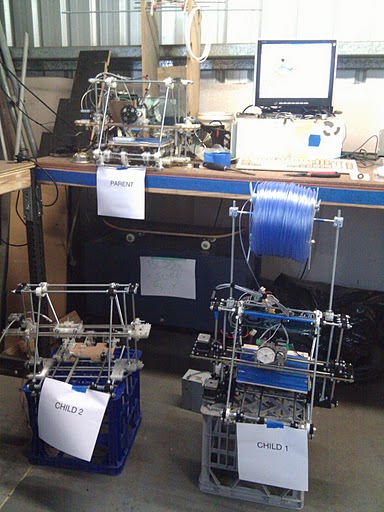
Brilliant Replicating Concept - The RepRap


RepRap from Adrian Bowyer on Vimeo.

RepRap is a free desktop 3D printer capable of printing plastic objects. Since many parts of RepRap are made from plastic and RepRap can print those parts, RepRap is a self-replicating machine - one that anyone can build given time and materials. It also means that - if you've got a RepRap - you can print lots of useful stuff, and you can print another RepRap for a friend...

RepRap is about making self-replicating machines, and making them freely available for the benefit of everyone. We are using 3D printing to do this, but if you have other technologies that can copy themselves and that can be made freely available to all, then this is the place for you too.

Reprap.org is a community project, which means you are welcome to edit most pages on this site, or better yet, create new pages of your own. Our community portal and New Development pages have more information on how to get involved. Use the links below and on the left to explore the site contents. You'll find some content translated into other languages.

Friday, May 14, 2010

Medieval art goes 3D


May 5 - A new exhibition showing the works of Italian medieval master Giotto, allows visitors to watch restorers at work and to ''step inside'' the artist's paintings thanks to 3D technology. Stuart McDill reports. (01:28)

Tuesday, September 22, 2009

Saturn's Rings in 3-Dimensions

Shadows lengthened to stretch thousands of miles across the planet’s famous rings this summer as they slowly tilted edge-on to the Sun, which they do every 15 years, casting into sharp relief every bump and wiggle and warp in the buttery and wafer-thin bands that are the solar system’s most popular scenic attraction.

From her metaphorical perch on the bridge of the Cassini spacecraft, which has been orbiting Saturn for five years, Carolyn Porco, who heads the camera team, is ecstatic about the view. “It’s another one of those things that make you pinch yourself and say, ‘Boy am I lucky to be around now,’ ” Dr. Porco said. “For the first time in 400 years, we’re seeing Saturn’s rings in three dimensions.”

On Monday, Dr. Porco and the Cassini team released a grand view of the rings in all their shadowed glory, including clumps, spikes, undulations and waves two and a half miles high on the edge of one ring.

“We always knew it would be good; instead, it’s been extraordinary,” Dr. Porco said of the cascade of results that have placed her in a spotlight to which she has become increasingly accustomed. “I feel I’m on a great human adventure,” she said.

The work may be carried out by robots, Dr. Porco said, “but we are all explorers.”

“It’s thrilling,” she added, “and I want everyone to know how thrilling it is.”