Showing posts with label Red Planet. Show all posts

Sunday, September 28, 2014

India Mars Orbiter: Red Planet triumph, but at home red tape binds space firms

As India celebrated becoming the first Asian nation to reach Mars, S.M. Vaidya, head of business at conglomerate Godrej’s aerospace division that made the spacecraft’s engine and thruster components, sounded surprisingly downbeat.

The mission was, indeed, a major achievement, he said, and one of which the state-run Indian Space Research Organisation (ISRO) should be proud.

But a single trip to Mars was not enough to sustain a promising yet relatively small industry, he added, and ISRO should be doing more to foster it.

“Unless they fly more, they will not buy more from us,” Vaidya told Reuters, shortly after news broke on Wednesday that Mangalyaan, Hindi for “Mars craft”, had entered into orbit around the Red Planet about 10 months after launching.

“How many Mars missions are you going to have?”

India’s successful mission, completed on a shoestring budget of $74 million, has boosted its prestige in the global space race and, back on Earth, raised the profile of Indian companies involved in the project.

But Godrej and some other firms are frustrated at what they say is the slow execution of projects and lack of government support, which are hampering India’s efforts to compete with China and Russia as a cheaper option for launching satellites.

ISRO did not reply to questions for this article.

The Mangalyaan was built in 15 months with two-thirds of its parts manufactured by domestic firms such as Godrej & Boyce and India’s largest engineering company, Larsen & Toubro.

Prime Minister Narendra Modi has said he wants to expand India’s 50-year-old space program. The government has increased funding for space research by 50 percent to almost $1 billion this financial year.

But the program is still small, and the small number of launches limits the growth potential of private companies that supply them.

Between 2007 and 2012, ISRO accomplished about half of its planned 60 missions, government data showed. The government cited “development complexity” as the reason for the delay in some missions.

Add caption
Between 2012 and 2017 the target is 58 missions.

The agency has completed 17 missions so far, and ISRO did not say why the number remained low.

Some company executives and experts do not see that changing any time soon, with the absence of heavy rocket launchers, too few launch facilities and bureaucratic delays hampering growth.

Read the full article here

Thursday, September 25, 2014

NASA MAVEN: Probe Snaps 1st Red Planet Images

The first observations of Mars' upper atmosphere made by NASA's MAVEN probe, which reached the Red Planet on Sept. 21, 2014.

Credit: Laboratory for Atmospheric and Space Physics, University of Colorado; NASA

NASA's MAVEN spacecraft isn't wasting any time at Mars.

MAVEN sent home its first images of Mars' upper atmosphere early Monday morning (Sept. 22), just eight hours after entering orbit around the Red Planet.

The false-colour images, which NASA released Wednesday (Sept. 24), were captured by MAVEN's Imaging Ultraviolet Spectrograph (IVS) instrument when the probe was 22,680 miles (36,500 kilometers) above the surface of Mars, agency officials said.

"Blue shows the ultraviolet light from the sun scattered from atomic hydrogen gas in an extended cloud that goes to thousands of kilometers above the planet’s surface," NASA officials wrote in an online description of the image.

"Green shows a different wavelength of ultraviolet light that is primarily sunlight reflected off of atomic oxygen, showing the smaller oxygen cloud," they added.

"Red shows ultraviolet sunlight reflected from the planet’s surface; the bright spot in the lower right is light reflected either from polar ice or clouds."


The $671 million MAVEN mission is NASA's first effort to study the Red Planet's upper atmosphere.

MAVEN will use its three onboard instrument suites to measure the rate of gas escape into space, in an attempt to better understand why Mars lost most of its atmosphere over the eons.

NB: The planet's air was relatively thick in the ancient past but is now just 1 percent as dense as that of Earth.

MAVEN's observations should shed light on how and why Mars transitioned from a warm and wet world billions of years ago to the cold, dry planet we know today, mission scientists have said.

The spacecraft is now in a commissioning phase, during which mission team members will lower MAVEN to its final orbit and check out its science gear.

The probe's one-year science mission is scheduled to start in early November.

Tuesday, September 9, 2014

Mars Probes MAVEN and MOM Arrive at Red Planet This Month

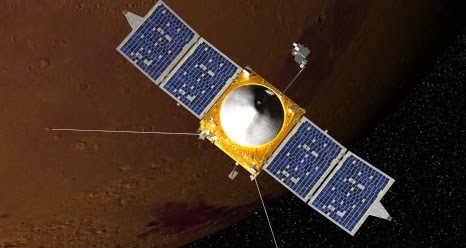
An artist's interpretation of NASA's MAVEN mission, with Mars in the background. 

The probe is scheduled to start orbiting Mars on Sept. 21.

Credit: NASA's Goddard Space Flight Center

The planet Mars is about to have some company. Two new spacecraft, one from the United States and the other from India, are closing in on the Red Planet and poised to begin orbiting Mars by the end of this month.

The U.S.-built probe, NASA's Mars Atmosphere and Volatile EvolutioN (MAVEN) spacecraft, is expected to enter orbit around Mars on Sept. 21.

Just days later, on Sept. 24, India's Mars Orbiter Mission (MOM) orbiter is due to make its own Mars arrival when it enters orbit. Both MOM and MAVEN launched to space in 2013.

MAVEN is the first mission devoted to probing the Martian atmosphere, particularly to understand how it has changed during the planet's history.

An artist's view of India's first Mars probe, the heart of the Mars Orbiter Mission, in orbit around the Red Planet. 

India's first Mars orbiter will arrive at its target on Sept. 24, 2014.

Credit: India Space Research Organisation

Before that happens, however, the spacecraft must burn its engines to go into orbit around the planet, and pass a commissioning phase while taking a few precautions for a "low-risk" situation where a comet will pass fairly close to Mars.

"We've been developing MAVEN for about 11 years, and it comes down to a 33-minute rocket burn on Sept. 21," MAVEN principal investigator Bruce Jakosky, of the University of Colorado, Boulder, told Space.com.

The spacecraft can change tracks as late as 6 hours before entering orbit, but right now, it is so close to the correct path that a planned orbital maneuver on Sept. 12 won't be needed, Jakosky said.

Comet Siding Spring will pass near Mars on Oct. 19, and around that time, MAVEN will take a break from its commissioning to do observations of the comet and the planet's upper atmosphere.

Although not much dust is predicted to result from the event, as a precaution, controllers will turn off nonessential instruments and move the solar panels edge-on to the dust.

The spacecraft will also be behind Mars for 20 minutes during the comet's closest approach.


Saturday, August 16, 2014

NASA Insight: Next Mars Lander Will Peer Deep Into Red Planet's History

A still from an animation shows NASA's new InSight Mars Lander lowering a drill onto Mars to analyze the planet's interior.

Credit: NASA/JPL

NASA's next Mars lander, now under construction, will probe the inner workings and early stages of the Red Planet's development billions of years ago.

The InSight mission (Interior exploration using Seismic Investigations, Geodesy and Heat Transport), a NASA Discovery Program spacecraft, is built to respond to highly focused scientific goals.

"Things are coming together," said Stu Spath, InSight program manager here at Lockheed Martin Space Systems Company, the aerospace firm building the Mars spacecraft for its 2016 liftoff.

NASA Phoenix Mars Lander
Powered descent
In many ways, InSight is a technological kissing cousin to the NASA Phoenix Mars Lander of 2008, which was equipped to investigate ice and soil on Mars's far-northern region.

InSight's will mirror the Phoenix mission in its blistering entry into the Martian atmosphere; parachute deployment; self-controlled, powered descent; and gentle meeting with the planet's surface on three outstretched landing legs.

"The lander structurally looks extremely similar to Phoenix," Spath told reporters. However the new craft's internal electronics, such as its power distribution unit and command and data handling hardware, have been updated.

Mars Atmosphere and Volatile Evolution mission (MAVEN)
InSight's avionics draw from other spacecraft built by Lockheed Martin, Spath said. Specifically, it takes cues from the Mars Atmosphere and Volatile Evolution mission (MAVEN) en route to the Red Planet, the Juno craft headed for Jupiter, and the now-completed twin Gravity Recovery and Interior Laboratory (GRAIL) mission probes that were sent to the moon.

Stu Spath, InSight program manager at Lockheed Martin Space Systems Company, near the back shell for the Mars-bound Interior exploration using Seismic Investigations, Geodesy and Heat Transport (InSight) spacecraft.

Credit: Lockheed Martin

Two chief instruments
The InSight mission will last a Mars year, or roughly two Earth years.

That is 630 days longer than the Phoenix mission lasted, which means that the lander will have to endure a wider range of environmental conditions on the Martian landscape, Spath said.

InSight will study a different aspect of planetary history with instruments never previously used on Mars, Spath said.

The Mars lander's scientific payload consists of two chief instruments:

The Seismic Experiment for Interior Structure provided by the French Space Agency.

A Heat Flow and Physical Properties Package provided by the German Space Agency.

Additionally, the Rotation and Interior Structure Experiment (RISE), led by the Jet Propulsion Laboratory (JPL), will use the lander's X-band radio system to make ultra-precise measurements of planetary rotation.

Wind and temperature sensors from Spain's Centro de Astrobiologia and a pressure sensor will monitor weather at the landing site. A lander magnetometer will measure magnetic disturbances caused by the Martian ionosphere.

NASA's InSight lander mission would add to the number of successful touchdowns on the Red Planet.

Credit: NASA/JPL

Come together
"It is very exciting, seeing the flight hardware start to come together," said Bruce Banerdt, the principal investigator for the InSight mission to Mars at the Jet Propulsion Laboratory (JPL) in Pasadena, California.

"At the same time, this is a very nerve-wracking period in the project, as testing of our instruments and spacecraft subsystems uncover subtle design and manufacturing problems that inevitably occur, and that must be corrected in the short time, just over one and a half years, before launch," Banerdt told reporters.

The cost of the InSight mission, excluding the launch vehicle and related services, is capped at $425 million in 2010 dollars.

California to Mars
An upcoming milestone for the project, in aerospace lingo, is Assembly, Test, and Launch Operations (ATLO), Spath said.

That evaluation begins in early November. Next June, the InSight spacecraft will face a suite of critical tests, with ship and shoot dates in December of 2015 and March of 2016, respectively, Spath said.

After those tests, InSight won't see a speedy sendoff from Florida.

Rather, the lander will travel to Vandenberg Air Force Base in California, where a United Launch Alliance Atlas 5 rocket will give the craft a boost.

This will be the first interplanetary mission ever to launch from California, although in 1994, the joint Ballistic Missile Defense Organization/NASA Clementine spacecraft that studied the moon and an asteroid headed off from that launch area.

Once Mars-bound, InSight will fly a quick trip. After roughly 6.5 months in transit, the craft will stick a landing in the southern Elysium region of Mars in September 2016.

The specific touchdown zone is still under discussion, with Mars researchers making use of super-sharp imagery from the NASA Mars Reconnaissance Orbiter's High Resolution Imaging Science Experiment (HiRISE) to decide InSight's precise destination.

Saturday, August 9, 2014

NASA and ISRO Mars-Bound Probes Nearing the Red Planet

This illustration shows the MAVEN spacecraft in orbit around Mars, imagined with Earth in the background.

Credit: NASA/Goddard

Two Mars-bound spacecraft are both in excellent health ahead of their September arrivals in orbit around the Red Planet, managers for both missions report.

Indian Space Research Organization (MOM) is more than 80 percent of the way to Mars and performing well, according to a Facebook update posted July 21 by the Indian Space Research Organization, MOM is expected to enter orbit on Sept. 14.

The second craft, NASA's Mars Atmosphere and Volatile EvolutioN (MAVEN), is also performing well.

MAVEN is scheduled to embark on its final approach to the Red Planet on Sept. 21, one week after MOM's arrival, principal investigator Bruce Jakosky said.

After months of checkouts and tests, the spacecraft will now be left quiet until close to the big day.

"We have eight science instruments, and they've all been turned off now," Jakosky, who is also the associate science director at the University of Colorado's laboratory for atmospheric and space physics, told Space.com. "We're trying to settle things down to focus on orbit insertion."

Both MOM and NASA's MAVEN probes launched toward Mars in November 2013.


Collision avoidance
With the MAVEN mission, NASA scientists are hoping to learn more about the history of Mars' upper atmosphere. For the past few months, controllers have done "operational readiness" tests, such as a mission-control-like simulation of the craft's approach to the Red Planet.

These drills can help controllers get ready for any emergencies that might crop up.

One important feature of the spacecraft is its ability to maneuver six hours or 24 hours before entering orbit if controllers find out the vessel is on the wrong path, Jakosky said.

This was a "lesson learned" from the 1998 Mars Climate Orbiter, which was destroyed in the planet's atmosphere because controllers could not correct a navigation error until too late.

"The key thing about the orbit insertion burn is we have one shot at it, and it has to go right. If it doesn't go right, we just go right on past Mars and never get to go back," Jakosky said.

Meanwhile, the science team has been making sure MAVEN's hardware is ready to collect the data. One instrument has already gathered information on solar activity.

India's Mars Orbiter Mission (MOM) spacecraft represents the country's first Mars-bound probe.

Credit: Indian Space Research Organisation

In India, MOM spacecraft controllers have been priming the probe for its arrival at the Red Planet.

On Thursday (Aug. 7), flight controllers tested the MOM probe's antenna that will serve as its primary communications link to Earth.

"MOM successfully completed the characterization of its Medium Gain Antenna, which will be used for communicating with Earth during the critical Mars Orbit Insertion (MOI)," ISRO officials wrote in a MOM update on Facebook yesterday. "Only 14 percent of the journey remains in its heliocentric arc towards Mars Orbit Insertion."

Friday, August 8, 2014

NASA Mars Curiosity Rover: Two Years and Counting on Red Planet

This image from the Navigation Camera on NASA's Curiosity Mars rover shows wheel tracks printed by the rover as it drove on the sandy floor of a lowland called "Hidden Valley" on the route toward Mount Sharp.  

Image courtesy NASA/JPL-Caltech.

NASA's most advanced roving laboratory on Mars celebrates its second anniversary since landing inside the Red Planet's Gale Crater on Aug. 5, 2012, PDT (Aug. 6, 2012, EDT).

During its first year of operations, the Curiosity rover fulfilled its major science goal of determining whether Mars ever offered environmental conditions favorable for microbial life.

Clay-bearing sedimentary rocks on the crater floor in an area called Yellowknife Bay yielded evidence of a lakebed environment billions of years ago that offered fresh water, all of the key elemental ingredients for life, and a chemical source of energy for microbes, if any existed there.

"Before landing, we expected that we would need to drive much farther before answering that habitability question," said Curiosity Project Scientist John Grotzinger of the California Institute of Technology, Pasadena.

"We were able to take advantage of landing very close to an ancient streambed and lake. Now we want to learn more about how environmental conditions on Mars evolved, and we know where to go to do that."

During its second year, Curiosity has been driving toward long-term science destinations on lower slopes of Mount Sharp.

Those destinations are in an area beginning about 2 miles (3 kilometers) southwest of the rover's current location, but an appetizer outcrop of a base layer of the mountain lies much closer -- less than one-third of a mile (500 meters) from Curiosity. The rover team is calling the outcrop "Pahrump Hills."

For about half of July, the rover team at NASA's Jet Propulsion Laboratory in Pasadena, California, drove Curiosity across an area of hazardous sharp rocks on Mars called "Zabriskie Plateau."

Damage to Curiosity's aluminum wheels from driving across similar terrain last year prompted a change in route, with the plan of skirting such rock-studded terrain wherever feasible.

The one-eighth mile (200 meters) across Zabriskie Plateau was one of the longest stretches without a suitable detour on the redesigned route toward the long-term science destination.

Monday, February 17, 2014

Mars MRO HiRise: New evidence for ancient ocean

A vast ocean may have once covered a third of the Red Planet. 

Credit: ESA, C. Carreau

Did a vast ocean once cover Mars' northern plains?

The idea has been hotly debated among scientists for the past 20 years, ever since Viking Orbiter images revealed possible ancient shorelines near the pole.

Later findings even suggested that the primordial ocean, dubbed Oceanus Borealis, could have covered a third of the planet.

But even if the evidence has mounted steadily, fostering our hopes of finding signs of past life on the Red Planet, the case for an ancient Martian ocean remains unsettled.

Lorena Moscardelli
Now a new study by Lorena Moscardelli, a geologist at the University of Texas, Austin, puts forward yet another line of evidence.

Today, large fields of boulder-size rocks blanket parts of Mars' northern plains.

By pointing to analogue geological features on our Earth, Moscardelli suggests that the boulders were delivered to their current locations by catastrophic underwater landslides, bolstering evidence for an ancient Martian ocean.


The boulders were spotted by the HiRISE camera on the Mars Reconnaissance Orbiter a while ago.

So Moscardelli is not reporting their presence as something new, but rather a new interpretation of the processes behind their origin.

The paper was published this month in a journal of the Geological Society of America.

Terrestrial Analogy
In the past, geoscientists thought of ocean sediments as mostly fine-grained, floating in the water column and settling like a slow "rain" on the sea floor, Moscardelli explained. But we now know it's not the only possible scenario.

Boulder-size rocks in Arcadia Planitia, northern lowland of Mars (HiRISE ESP_019853_2410). 

Credit: NASA (Moscardelli 2014)

"We know that 'submarine landslides' can transport big boulders, sometimes as big as a house, for hundreds of kilometers into the deep-water of the Earth oceans," she said.

"Imagine a huge landslide affecting the entire state of Texas, but happening in the ocean."

In her new study, Moscardelli documents several sites where these events have occurred on Earth, such as the Pennsylvanian Jackfork Group of south-central Arkansas; the outcrops of the Guandacol Formation in the Pangazo Basin, Argentina; or in the Santos Basin, offshore Brazil.

She even shows that these underwater events can affect huge areas, as with a massive landslide that covered thousands of square kilometers in the Barents Sea, north of Russia, about a million years ago.

Some scientists have suggested that the boulders of Mars's northern plain could be the product of meteorite impacts. But to Moscardelli, that's not a fitting theory.

"That's possible for some of the boulders, especially those found close to craters," she says. "But how do you explain boulder fields that can cover thousands of square kilometers without any impact craters around?

"The submarine hypothesis provides a feasible alternative."

More information: Paper: www.geosociety.org/gsatoday/

Saturday, February 15, 2014

Mars ASU THEMIS camera to get new views of Red Planet

ASU's Thermal Emission Imaging System (THEMIS) is taking regular temperature measurements of the ground as the orbit of NASA's Mars Odyssey spacecraft drifts toward a time of day that will give THEMIS views of Mars around sunrise and sunset. 

This will be the first systematic observations of these times of day in more than a generation. 

Here, THEMIS is imaging the floor of Gale Crater, using its visual wavebands to create a color view of the area where Mars rover Curiosity (too small to be imaged) is exploring for ancient habitable environments. 

Image courtesy NASA /JPL-Caltech /Arizona State University.

For the first time since the Viking Mars mission of the 1970s, which ended more than a generation ago, scientists will soon begin systematic observations of Mars from orbit at times of day around local sunrise and sunset.

The instrument they will use is the Thermal Emission Imaging System (THEMIS) camera, designed at Arizona State University.

Mars Odyssey carries three main science instruments: The Gamma Ray Spectrometer (GRS), the Thermal Emission Imaging System (THEMIS), and the Mars Radiation Environment Experiment (MARIE).

The spacecraft has been drifting toward the new orbit for more than a year, and a small engine burn on Feb. 11 accelerated the drift so it can finalize the orbit in November of 2015.

During the transition, THEMIS will continue observations as the orbital time of day changes.

Philip Christensen
"We don't know exactly what we'll find when we get to an orbit where we see Mars just after sunrise," says Philip Christensen, designer and principal investigator for THEMIS.

He is a Regents' Professor of Geological Sciences in ASU's School of Earth and Space Exploration on the Tempe campus. Christensen developed the post-orbit change observing plan.

THEMIS is a multi-band camera that images Mars in nine infrared (heat-sensitive) "colours" and five visible ones. It was launched on Mars Odyssey in April 2001 and reached the Red Planet in October that year.

The spacecraft spent several months dipping into the Martian atmosphere to regularize its orbit, and THEMIS began science imaging in February 2002.

With more than 12 years elapsed since arrival, Mars Odyssey is the longest-working Mars spacecraft of any nation.


Morning and evening on Mars
Besides revealing landscapes in sharp relief, thanks to the low sun angle, the new orbital time of day for THEMIS promises to let scientists explore frosts, ground fogs, early morning clouds and hazes, and other transient atmosphere-related features that usually vanish as the Martian day goes on.

"We know that in places, carbon dioxide frost forms overnight," says Christensen. "And then it sublimates immediately after sunrise."

"What would this process look like in action? How would it behave? We've never observed this kind of phenomenon directly."

He notes that the Martian atmosphere is more variable than scientists have appreciated in the past.

"We can look for seasonal differences," says Christensen. "Are fogs more common in winter or spring? Do they vary from day to day? From one part of the year to another? From year to year? We'll check it out."

In addition, THEMIS will measure surface temperatures at thousands of locations. These observations can yield insight about materials in the ground and about temperature-driven processes.

These include warm-season flows of water or brine seen on some slopes, and gas-and-sand geysers fed by spring thawing of carbon dioxide ice near Mars' south pole.

Jeffrey Plaut
"We're teaching an old spacecraft new tricks," says Odyssey project scientist Jeffrey Plaut at NASA's Jet Propulsion Laboratory in Pasadena, California.

"We will be in position to do something that has never been done systematically: to watch how morning fog, clouds and surface frost develop at different times of year."

After Mars Odyssey reaches its intended orbit of 6:45 a.m. and p.m. (local time) in November 2015, mission engineers expect Odyssey will have enough propellant for nine to 10 more years of operation, an important matter for ongoing Mars exploration.

Besides conducting its own observations, Odyssey also serves as a crucial communications relay to Earth for the two active rovers, Curiosity and Opportunity, operating on the Martian surface.

"Mars is a dynamic world," says Christensen. "And for a generation, we've not been positioned to explore this part of it so thoroughly."

Tuesday, February 4, 2014

Mars Rover Curiosity Poised at Edge of Red Planet Dune Dingo

This mosaic of images from the Navigation Camera (Navcam) on NASA's Mars rover Curiosity shows the terrain to the west from the rover's position on the 528th Martian day, or sol, of the mission (Jan. 30, 2014).

Credit: NASA/JPL-Caltech

A new photo from NASA's Curiosity rover shows the car-sized robot at the lip of a small Martian sand dune, debating whether or not to drive over the obstacle on its way to a huge Mars mountain range.

In the Mars views from Curiosity, a 3-foot-high (1 meter) dune separates the rover from a valley that may provide a relatively smooth route to the foothills of Mount Sharp, the rover's ultimate science destination.

Curiosity's handlers are studying the new photo — a mosaic composed of images snapped on Jan. 30 — as they map out the 1-ton rover's next steps.

"The rover team is evaluating possible driving routes on the other side before [making] a decision [about] whether [to] cross the gap," NASA officials wrote in a description of the image.

"The view covers a panorama from south, at the left edge, to north-northwest at the right edge. It is presented as a cylindrical projection."

The Curiosity team is seeking out more forgiving terrain for the rover, whose six wheels have accumulated an increasing amount of wear and tear over the last few months.

The route beyond the sand dune, which spans a geological feature that mission scientists have dubbed "Dingo Gap," may give the wheels a bit of a break.

The Curiosity rover landed inside Mars' huge Gale Crater in August 2012 to determine if the Red Planet could ever have supported microbial life.

Mission scientists have already found solid evidence of a habitable environment at a spot near Curiosity's landing site called Yellowknife Bay, but the rover's work is far from done.

Saturday, November 2, 2013

ESA DLR 3D Mars Video Brings Red Planet to Life


A newly released video, created by stitching together with images taken by a veteran Mars spacecraft, provides a richly detailed, three-dimensional view of the Red Planet.

The European Space Agency's Mars Express spacecraft has orbited the Red Planet nearly 12,000 times, capturing images of Martian valleys, canyons and lava flows that have provided unprecedented views of planet's terrain.

Ralf Jaumann
Researchers pieced together the individual images into a video that shows a eye-popping video of Mars in 3D.

"For the first time, we can see Mars spatially — in three dimensions," Ralf Jaumann, project manager for the Mars Express mission at the German Aerospace Center, said in a statement.

The first image of the Martian surface taken by the stereo camera aboard the European Space Agency's Mars Express spacecraft. Credit: DLR

Mars Express has covered 37 million square miles (97 million square kilometers) of Mars' surface (out of 56 million square miles or 145 million square kilometers) in high resolution.

Researchers around the world combine data from Mars Express with other NASA missions at the Red Planet, to better understand the foreign world.

"This has enabled the creation of the most comprehensive data set that has ever been acquired by a German instrument designed to study our solar system," Jaumann said.

A colour-coded elevation model of Olympus Mons from the European Space Agency's Mars Express spacecraft. Credit: DLR

Nine light-sensitive detectors aboard Mars Express sweep across the surface of the planet, capturing images in sequence from nine different angles.

This data is then processed into three-dimensional images by planetary researchers at the German Aerospace Center.

"We can see the entire topography almost as well as if we were standing on Mars ourselves," Jaumann said.