Showing posts with label Space Telescope. Show all posts

Thursday, February 5, 2015

ESA Planck Telescope: Sky Survey changes date on early stars

Planck has mapped the delicate polarisation of the CMB across the entire sky

Scientists working on ESA's Planck satellite say the first stars in the Universe lit up later than was previously thought.

The team has made the most precise map of the "oldest light" in the cosmos.

Earlier observations of this radiation had suggested that the first generation of stars burst into life about 420 million years after the Big Bang.

The new Planck data now indicates they fired up around 560 million years after the Universe got going.

"This difference of 140 million years might not seem that significant in the context of the 13.8-billion-year history of the cosmos, but proportionately it's actually a very big change in our understanding of how certain key events progressed at the earliest epochs," said Prof George Efstathiou, one of the leaders of the Planck Science Collaboration.

Subtle signal
The assessment is based on studies of the "afterglow" of the Big Bang, the ancient light called the Cosmic Microwave Background (CMB), which still washes over the Earth today.

The European Space Agency's (ESA) Planck satellite mapped this "fossil" between 2009 and 2013.

It contains a wealth of information about early conditions in the Universe, and can even be used to work out its age, shape and do an inventory of its contents.

Scientists can also probe it for very subtle "distortions" that tell them about any interactions the CMB has had on its way to us.

Forging elements
One of these would have been imprinted when the infant cosmos underwent a major environmental change known as re-ionisation.

It is when the cooling neutral hydrogen gas that dominated the Universe in the aftermath of the Big Bang was then re-energised by the ignition of the first stars.

These hot giants would have burnt brilliant but brief lives, producing the very first heavy elements. But they would also have "fried" the neutral gas around them - ripping electrons off the hydrogen protons.

And it is the passage of the CMB through this maze of electrons and protons that would have resulted in it picking up a subtle polarisation.

Impression: The first stars would have been unwieldy behemoths that burnt brief but brilliant lives

The Planck team has now analysed this polarisation in fine detail and determined it to have been generated at 560 million years after the Big Bang.

The American satellite WMAP, which operated in the 2000s, made the previous best estimate for re-ionisation at 420 million years.

The problem with that number was that it sat at odds with Hubble Space Telescope observations of the early Universe.

Hubble could not find stars and galaxies in sufficient numbers to deliver the scale of environmental change at the time when WMAP suggested it was occurring.

Planck's new timing "effectively solves the conflict," commented Prof Richard McMahon from Cambridge University, UK.

"We had two groups of astronomers who were basically working on different sides of the problem. The Planck people came at it from the Big Bang side, while those of us who work on galaxies came at it from the 'now side'.

"It's like a bridge being built over a river. The two sides do now join where previously we had a gap," he told reporters.

That gap had prompted scientists to invoke complicated scenarios for how re-ionisation could have occurred, including the ideas that there were an even earlier population of giant stars or energetic black holes. Such solutions are no longer needed.

The finding is also good news for the next generation of observatories like the James Webb Space Telescope, which will have the power to see right through the epoch of re-ionisation.

Sunday, April 20, 2014

US Military Developing Foldable Space Telescope - Video


The United States military's advanced research arm is working on a foldable space telescope that could image Earth in high resolution at a relatively low cost.

The Defense Advanced Research Projects Agency (DARPA) says the telescope design, known as the Membrane Optical Imager for Real-Time Exploitation, (MOIRE), would be of great use in geosynchronous Earth orbit, the spot 22,000 miles (35,000 kilometers) up where most telecommunications satellites reside.

"Membrane optics could enable us to fit much larger, higher-resolution telescopes in smaller and lighter packages," Lt. Col. Larry Gunn, MOIRE program manager, said in a statement.

The Membrane Optical Imager for Real-Time Exploitation (MOIRE) is in Phase 2 of ground testing. 

If it ever reaches orbit. the telescope is billed as lighter than conventional designs and able to get high-definiton pictures of Earth from geosynchronous orbit.

Credit: DARPA

"In that respect, we’re ‘breaking the glass ceiling’ that traditional materials impose on optics design," Gunn added.

"We’re hoping our research could also help greatly reduce overall costs and enable more timely deployment using smaller, less expensive launch vehicles."

MOIRE is now in Phase 2 of development since work began in 2010. When this phase is completed, a 16-foot (5 meters) prototype of the telescope's mirror should be completed for ground testing.

No space missions have been set for MOIRE yet, DARPA officials said.

There are both advantages and disadvantages to the MOIRE design. The membrane is not as efficient as the usual glass, but it is lighter, which allows prime contractor Ball Aerospace & Technologies Corp. to make larger lenses to increase the telescope's efficiency.

DARPA estimates that a membrane system should weigh 86 percent less than a more traditional system of the same resolution and mass.

The size of the Membrane Optical Imager for Real-Time Exploitation (MOIRE)'s mirror compared with that of the Hubble Space Telescope, the James Webb Space Telescope and Spitzer Space Telescope.

Credit: DARPA

Most telescopes either reflect light (using mirrors) or refract it (using lenses), but MOIRE's behaves differently.

Each membrane will instead diffract light using a piece of equipment known as a Fresnel lens.

"It is etched with circular concentric grooves like microscopically thin tree rings, with the grooves hundreds of microns across at the center down to only 4 microns at the outside edge," DARPA officials said in a statement. "The diffractive pattern focuses light on a sensor that the satellite translates into an image."

Friday, December 6, 2013

DARPA MOIRE: First folding space telescope

Instead of using traditional glass mirrors or lenses, MOIRE seeks to diffract light with Fresnel lenses made from a lightweight membrane roughly the thickness of household plastic wrap. 

MOIRE would house the membranes in thin metal “petals” that would launch in a tightly packed configuration. 

Upon reaching its destination orbit, the satellite would then unfold the petals to create the full-size multi-lens optics.

The capability of orbital telescopes to see wide swaths of the earth at a time has made them indispensable for key national security responsibilities such as weather forecasting, reconnaissance and disaster response.

Even as telescope design has advanced, however, one aspect has remained constant since Galileo: using glass for lenses and mirrors, also known as optics.

High-resolution imagery traditionally has required large-diameter glass mirrors, which are thick, heavy, difficult to make and expensive.

As the need for higher-resolution orbital imagery expands, glass mirrors are fast approaching the point where they will be too large, heavy and costly for even the largest of today's rockets to carry to orbit.

DARPA's Membrane Optical Imager for Real-Time Exploitation (MOIRE) program seeks to address these challenges.

MOIRE aims to create technologies that would enable future high-resolution orbital telescopes to provide real-time video and images of the Earth from Geosynchronous Earth Orbit (GEO)—roughly 22,000 miles above the planet's surface.

Size and cost constraints have so far prevented placing large-scale imaging satellites in GEO, so MOIRE is developing technologies that would make orbital telescopes much lighter, more transportable and more cost-effective.

Currently in its second and final phase, the program recently successfully demonstrated a ground-based prototype that incorporated several critical technologies, including new lightweight polymer membrane optics to replace glass mirrors.

Membrane optics traditionally have been too inefficient to use in telescope optics. MOIRE has achieved a technological first for membrane optics by nearly doubling their efficiency, from 30 percent to 55 percent. The improved efficiency enabled MOIRE to take the first images ever with membrane optics.

With a proposed diameter of 20 meters, MOIRE’s membrane optic “lens” would be the largest telescope optics ever made and dwarf the traditional glass mirrors used in the world’s most famous telescopes.

MOIRE technology houses the membranes in thin metal "petals" that would launch in a tightly packed configuration roughly 20 feet in diameter.

Upon reaching its destination orbit, a satellite would then unfold the petals to create the full-size multi-lens optics.

The envisioned diameter of 20 meters (about 68 feet) would be the largest telescope optics ever made and dwarf the glass mirrors contained in the world's most famous telescopes.

Thursday, November 14, 2013

ESO WFI Telescope Image: 'Elephant Trunk' Space Clouds Surround Star Cluster - Video


The new photo shows a mysterious ring and structures known as "elephant trunks" — huge columns of interstellar dust and gas. You can watch the video fly-through of the new space cloud photos provided by ESO.

Astronomers used the European Southern Observatory's La Silla Observatory to capture the amazing new images of the space clouds around the distant star cluster NGC 3572.

"This new image shows how these clouds of gas and dust have been sculpted into whimsical bubbles, arcs and the odd features known as elephant trunks by the stellar winds flowing from this gathering of hot young stars," ESO officials wrote in an image description.

The Wide Field Imager on the MPG/ESO 2.2-metre telescope at ESO’s La Silla Observatory in Chile has captured the best image so far of the star cluster NGC 3572, a gathering of young stars, and its spectacular surroundings. 

Image released Nov. 13, 2013. 

Credit: ESO/G. Beccari

Another interesting aspect of the new image is a ring-shaped nebula located a bit above the center of the picture.

Scientists aren't sure what the origin of the nebula is, but they think it might be a leftover from the cloud of material that formed the star cluster, or it could be a bubble around a hot star.

Some astronomers also suggest that it could be a planetary nebula — the remains of a dying sun-like star.

Stars in clusters might have formed at around the same time, but they are incredibly diverse in size, temperature, colour and mass, ESO officials said.

"These gangs of young stars stick together for a relatively short time, typically tens or hundreds of millions of years," ESO officials said.

"They are gradually disbanded by gravitational interactions, but also because the most massive stars are short-lived, burning through their fuel quickly and ultimately ending their lives in violent supernova explosions, thus contributing to the dispersion of the remaining gas and stars in the cluster."

Tuesday, September 10, 2013

NASA NuSTAR: Space Telescope Discovers 10 Monster Black Holes

This optical colour image of galaxies is seen overlaidwith X-ray data (magenta) from NASA's black hole-hunting NuSTAR space telescope. 

The arrow points to magenta blobs indicating giant, supermassive black holes discovered by the space telescope. 

Credit: NASA/JPL-Caltech`

A powerful NASA space telescope has found not one, but 10 monster black holes lurking in the hearts of distant galaxies — the first major finds for the X-ray space observatory, scientists say.

The discoveries, which scientists say occurred "serendipitously," were made as astronomers reviewed images from NASA's Nuclear Spectroscopic Telescope Array (NuSTAR), an X-ray space telescope designed specifically to hunt black holes.

"We were looking at known targets and spotted the black holes in the background of the images," David Alexander, a professor with Durham University's physics department, said in a statement.

Then the team confirmed what they saw with observations from NASA's Chandra X-ray Observatory and the European Space Agency's XMM-Newton satellite, which also can look at low-energy light.

The 10 black holes discovered are just the beginning of hundreds of expected finds, the scientists added. With every supermassive black hole catalogued, scientists are hoping to better understand the population.

Surrounded by galaxies
According to NASA, discovering the supermassive black holes were a key piece of a puzzle first uncovered in 1962. Astronomers found a glow of X-rays in the background of the universe, but didn't know where the glow came from.

Today, scientists know the glow (also called the cosmic X-ray background) comes from very distant supermassive black holes, some of which are as large as 17 billion times the mass of the sun. But how these black holes form is still under investigation.

"Our early results show that the more distant supermassive black holes are encased in bigger galaxies," stated Daniel Stern, a co-author of the study and the project scientist for NuSTAR at NASA's Jet Propulsion Laboratory. "This is to be expected. Back when the universe was younger, there was a lot more action with bigger galaxies colliding, merging and growing."

While NuSTAR can detect these big black holes, other measurements (such as mass) come from agency observatories including the Wide-field Infrared Survey Explorer (WISE) and Spitzer Space Telescope.

The research appeared Aug. 20 in the Astrophysical Journal.

Wednesday, May 15, 2013

NASA’s Kepler Spacecraft in Jeopardy After #4 Reaction Wheel Malfunction

NASA’s planet-hunting Kepler spacecraft has been crippled by the failure of one of the reaction wheels that keep it pointed, the space agency is announcing this afternoon, according to astronomers close to the situation.

Earlier a statement from Kepler's Command Team stated;

"Kepler’s reaction wheel #4 continues to exhibit signs of elevated friction levels and occasional torque spikes that appear to indicate a deterioration of the wheel bearing. "

"The team is able to monitor general wheel performance twice weekly during scheduled X-band engineering contacts, but must rely on the high rate monthly downlinks for detailed insight."

"All appropriate mitigation steps to prolong wheel life have now been taken. While the wheel may still continue to operate for some time yet, the engineering team has now turned its attention to the development of contingency actions should the wheel fail sooner, rather than later."

"Initially, these contingencies will focus on preserving fuel, but subsequent goals will be to return the failed wheels to service, perhaps at reduced performance levels, and investigating opportunities for gathering science data using a combination of wheels and thrusters."

The Kepler Team is now facing the worst case scenario, whereby the Kepler telescope's Guidance System  is now severely compromised.

If engineers cannot restore the wheel or find some other way to keep the spacecraft’s telescope pointed, it could spell a premature end to one of the most romantic and successful of NASA’s missions: the search for Earth-like planets in habitable orbits around other stars.

Just last month, astronomers reported that Kepler had found two planets only slightly larger than Earth orbiting in the “Goldilocks” zone, where liquid water is possible, of a star 1,200 light-years from here.

More planet candidates, even smaller and closer to being Earth-like, lurk in the pipeline, astronomers say, but they have not yet been confirmed.

Saturday, April 20, 2013

NASA’s Spitzer space telescope: Silica (sand) in the supernova remnant Cassiopeia A.

In 2007 NASA’s Spitzer space telescope found the infrared signature of silica (sand) in the supernova remnant Cassiopeia A. 

The light from this exploding star first reached Earth in the 1600s.

The cyan dot just off center is all that remains of the star that exploded. 

Credit: NASA/JPL-Caltech/ O.Krause (Steward Observatory)

It's a bit like learning the secrets of the family that lived in your house in the 1800s by examining dust particles they left behind in cracks in the floorboards.

By looking at specks of dust carried to earth in meteorites, scientists are able to study stars that winked out of existence long before our solar system formed.

This technique for studying the stars – sometimes called astronomy in the lab—gives scientists information that cannot be obtained by the traditional techniques of astronomy, such as telescope observations or computer modeling.

Now scientists working at Washington University in St. Louis with support from the McDonnell Center for the Space Sciences, have discovered two tiny grains of silica (SiO2; the most common constituent of sand) in primitive meteorites.

This discovery is surprising because silica is not one of the minerals expected to condense in stellar atmospheres—in fact, it has been called 'a mythical condensate.'

Five silica grains were found earlier, but, because of their isotopic compositions, they are thought to originate from AGB stars, red giants that puff up to enormous sizes at the end of their lives and are stripped of most of their mass by powerful stellar winds.

These two grains are thought to have come instead from a core-collapse supernova, a massive star that exploded at the end of its life.

Because the grains, which were found in meteorites from two different bodies of origin, have spookily similar isotopic compositions, the scientists speculate in the May 1 issue of Astrophysical Journal Letters, that they may have come from a single supernova, perhaps even the one whose explosion is thought to have triggered the formation of the solar system.

A summary of the paper will also appear in the Editors' Choice compilation in the May 3 issue of Science magazine.

More information: 
AJL paper: iopscience.iop.org/2041-8205/768/1/L17/

Sunday, April 14, 2013

B612 Sentinel Space Telescope to Hunt Dangerous Asteroids

Artist's Illustration of the B612 Foundation's Sentinel mission, which will search for potentially dangerous near-Earth asteroids.

CREDIT: B612

With the dangers of rogue asteroids made clear by the surprise explosion of a meteor over Russia in February, a non-profit organization is ramping up its effort to search for potentially hazardous space rocks near Earth.

The B612 Foundation was started in 2002 by former NASA astronauts Ed Lu and Rusty Schweickart with colleagues. The organization aims to launch a space telescope called Sentinel in 2017 to catalog near-Earth asteroids, including those that may pose a danger to Earth.

To date, about 90 percent of near-Earth asteroids large enough to destroy the entire planet (about 1 kilometer, or 0.6 miles wide) have been discovered, but far fewer of the smaller, city-killing size (roughly 140 meters, or 460 feet, in diameter) have been found.

"We are essentially flying blind in a cosmic shooting gallery," Scott Hubbard, B612 program architect, told reporters on Tuesday (April 9) at the 29th annual National Space Symposium in Colorado Springs, Colo.

This reality was starkly illustrated on Feb. 15, when a 55-foot-wide (17 meters) meteor exploded over Chelyabinsk, Russia, just hours before an asteroid almost three times its size called 2012 DA14 flew uncomfortably close to Earth.

Sentinel's goal is to detect about 90 percent of this city-killing class of asteroids over a period of 6.5 years.

The $450 million mission is to be privately funded, though the foundation has partnered with NASA to share its data and use the agency's Deep Space Network of satellites to facilitate communications between Sentinel and the ground. NASA and lawmakers have said they enthusiastically support the mission and the B612 Foundation's efforts.

"We must better recognize what the private sector can do to aid our efforts to protect the world," Rep. Lamar Smith, R-Texas, chairman of the House Committee on Science, Space and Technology, said during a Congressional hearing on the asteroid issue Wednesday (April 10).

Friday, March 1, 2013

NASA's Fermi Gamma-ray Space Telescope: Spirograph image

NASA's Fermi Gamma-ray Space Telescope orbits our planet every 95 minutes, building up increasingly deeper views of the universe with every circuit. 

This image compresses eight individual frames, from a movie showing 51 months of position and exposure data by Fermi's Large Area Telescope (LAT), into a single snapshot.

The pattern reflects numerous motions of the spacecraft, including its orbit around Earth, the precesion of its orbital plane, the manner in which the LAT nods north and south on alternate orbits, and more.

The LAT sweeps across the entire sky every three hours, capturing the highest-energy form of light -- gamma rays -- from sources across the universe. 

These range from supermassive black holes billions of light-years away to intriguing objects in our own galaxy, such as X-ray binaries, supernova remnants and pulsars.

Image Credit: NASA /DOE /Fermi LAT Collaboration

Tuesday, February 26, 2013

BRITE: World's smallest space telescope launched

BRITE, the smallest astronomical satellite was launched Monday as part of a mission to prove that even a very small telescope can push the boundaries of astronomy.

The satellite was designed and assembled at the Space Flight Laboratory (SFL) of the University of Toronto Institute for Aerospace Studies (UTIAS).

It will be launched from the Satish Dhawan Space Centre in Sriharikota, India, along with its twin, also designed in Canada, but assembled in Austria.

Each nano-satellite in the BRIght Target Explorer (BRITE) mission is a cube 20 cms per side, and weighing less than 7 kilograms.

The BRITE satellites are part of the new wave of nano-satellites that can be designed, assembled and deployed fast and relatively cheaply.

"SFL has demonstrated that nano-satellites can be developed quickly, by a small team and at a cost that is within reach of many universities, small companies and other organizations," says Cordell Grant, Manager of Satellite Systems for the Space Flight Laboratory at UTIAS.

"A nano-satellite can take anywhere from six months to a few years to develop and test, but we typically aim for two years or less."

Up to now, such nano-satellites had been used only to monitor the earth and experiment with new technologies.

"Researchers, scientists and companies worldwide, who have great ideas for space-borne experiments, but do not have the means to fund a large spacecraft, can now see their ideas realized," said Grant.

"BRITE has the potential to open an entirely new market for low-cost high-performance satellites."

BRITE is the first nano-satellite mission intended for astronomy, and the first-ever astronomy constellation -more than one satellite working toward a common objective- of any size.

The previous world-record holder for small astronomy satellites was the MOST satellite, designed and assembled in part by SFL at UTIAS.

Launched in 2003 and still operating, MOST was the first entirely Canadian satellite for astronomy, weighing in at 53 kilograms. Compared to the 11 metric tons of the Hubble Space Telescope, MOST was aptly called a micro-satellite.

"BRITE is expected to demonstrate that nano-satellites are now capable of performance that was once thought impossible for such small spacecraft," says Grant. But only small telescopes can fit within a 20 centimetre cube.

Therefore, BRITE is not intended to take pretty pictures, but will simply observe stars and record changes in their brightness over time.

Such changes could be caused by spots on the star, a planet or other star orbiting the star, or by oscillations and reverberations within the star itself -the analogue of earthquakes on stars.

The study of these so-called "starquakes" is called astero-seismology.

Friday, September 21, 2012

ESA's GAIA: Billion-pixel space camera passes critical tests

Artist impression of GAIA in orbit observing and monitoring the Milky Way.

The most powerful camera ever designed for space is on track for launch next year following punishing tests to prove it can withstand that environment.

The European Space Agency's Gaia mission will scan the sky with a one-billion pixel detector, producing a 3D map of the Milky Way from its location 1.5 billion km from Earth.

Two telescopes aboard the spacecraft will chart the sky from an orbit around the Sun over five years, noting the position, motion, colour, brightess and composition of around a billion stars in our own galaxy and beyond. These observations will help astronomers learn how our galaxy formed and evolved.

Gaia is also designed to photograph large numbers of other celestial bodies, from asteroids in our own Solar System to more distant galaxies and around 500,000 quasars near the edge of the Universe.


The probe's camera is made up of 106 sensitive electronic detectors made by UK company e2v Technologies, of Chelmsford, Essex, who have also supplied imaging systems for the Curiosity probe now on Mars.

These are basically advanced versions of the chips found in home digital cameras. They were put together like a mosaic to make one huge sensor by EADS scientists at Toulouse, France, for the European Space Agency.

Each detector is slightly smaller than a credit card but thinner than a human hair. Together they are powerful enough to record stars up to a million times fainter than the eye can see.

Gaia is due to be launched by a Soyuz-Fregat rocket from Baikonur in Kazakhstan. When it arrives at the spot called a Lagrangian point (L2) it will fly in a naturally synchronised orbit with Earth and operate at a super-chilled temperature of –110°C.

A giant sunshade on the spacecraft will protect the instruments by keeping them permanently shielded from the heat of the Sun.


Scientists at Toulouse recently checked that Gaia’s service module, housing electronic units to run the science instruments, as well as the units that provide the spacecraft resources, such as thermal control, propulsion, communication, and attitude and orbit control, would function OK in extreme conditions.

During 19 days of tests, they enclosed it in a barrel-shaped chamber at Intespace's test facility where Gaia was subject to vacuum conditions and subjected to a range of temperatures.

The process was similar to that which the James Webb Space Telescope will undergo inside a revamped chamber for NASA.

It experienced temperatures as low as –170°C and tests verified that the spacecraft's instruments could still work properly.

Gaia Project Manager Giuseppe Sarri said: “The thermal tests went very well; all measurements were close to predictions and the spacecraft proved to be robust with stable behaviour.”

He added: “The latest thermal test marks a major milestone achieved in the development of Gaia,” says Giuseppe. “It demonstrated that the service module is compatible with working in space and that we are on track for launch by the end of next year.”

Friday, June 22, 2012

ESA ESTRACK Malargüe webcam

The outdoor webcam at the site of ESA's new deep space tracking station at Malargüe, Argentina, was switched on in May 2010 and brings you a visual update on construction progress.

The Malargüe webcam image is shown below. The camera acquires a new image six times per hour, and the image below will be automatically refreshed.


On 22 June 2009, ESA informed Argentine authorities that an area 40 km south of the town of Malargüe in Mendoza province, about 1000 km (direct line) west and slightly south of Buenos Aires (1400 km by road!), has been chosen as the best option to build a new 35-metre deep space antenna in support of Agency missions.

Together with ESA's DSA-1 (New Norcia, Australia) and DSA-2 (Cebreros, Spain), the 620-tonne antenna in Argentina will complete the 360-degree deep-space coverage needed to ensure full telecommunications during mission-critical events and enhance the return of scientific data.

The station is now under construction and will become operational from mid-2012 in support of scientific and exploration missions.

Thursday, June 21, 2012

Private Deep Space Asteroid Telescope Mission to be Unveiled

Artist’s impression of a 6-mile-wide asteroid striking the Earth. Scientists think approximately 70 of these dinosaur killer-sized or larger asteroids hit Earth between 3.8 and 1.8 billion years ago.

CREDIT: Don Davis

A group of scientists will unveil an audacious plan for the first privately funded deep space telescope next week - a mission that aims to map the inner solar system for potentially dangerous asteroids.

On June 28, members of the B612 Foundation will discuss plans to build, launch and operate the Sentinel Space Telescope Mission during a press conference at the Morrison Planetarium at the California Academy of Sciences in San Francisco.

The briefing will begin at 11:30 a.m. EDT (1530 GMT) and wrap up at around 2 p.m. EDT (1800 GMT), organization officials said in a media alert.

According to the media alert, the telescope will circle the sun and identify space rocks with orbits that cross Earth. Determining the trajectories of these asteroids will help protect Earth from cataclysmic impacts and will also help mission planners chart future expeditions deeper into the solar system.

"Mapping the great unknown of the inner solar system is the first step to opening up this next frontier," organization officials said in a statement.

"The B612 Foundation believes that humanity can harness the power of science and technology to protect the future of civilization on this planet, while extending our reach into the solar system."

The scheduled speakers will include:
  • Ed Lu, B612 Foundation chairman and CEO, former space shuttle, Soyuz and space station astronaut
  • Rusty Schweickart, chairman emeritus, Apollo 9 lunar module pilot
  • Scott Hubbard, project architect from Stanford University, former director of NASA Ames Research Center in Moffett Field, Calif.
  • Harold Reitsema, mission director, former director of science mission development at Ball Aerospace
NASA and other teams of astronomers regularly use telescopes to monitor the sky for asteroids that could pose a threat to Earth. Experts have said that while giant asteroids could pose a global threat to our planet, even a larger space rock measuring about 460 feet wide (140 meters) could create widespread destruction at its impact point.

Last year, NASA scientists announced that they had successfully tracked about 90 percent of the largest asteroids in orbits that approach near Earth.

Data from NASA's infrared WISE space telescope allowed astronomers to estimate that there are about 981 asteroids the size of a mountain or larger on paths that come near Earth. About 911 of those asteroids have been tracked, researchers said.

Wednesday, May 2, 2012

JCMT: The first detailed image of filamentary structure in Orion A cloud

The first detailed image of filamentary structure traced in the Northern part of the Orion A cloud, showing where the stars are forming from clumps of cold gas and dust. 

The ability to image condensations of cold dust with the earlier SCUBA camera, and more recently with SCUBA-2, has made the JCMT one of the choice instruments in the world for studying the earliest stages of star formation.

Credit: Johnstone et al.

The JCMT Celebrates 25 years at the top of the world

The James Clerk Maxwell Telescope celebrates it's 25th anniversary. Named after the famous Scottish Physicist and Astronomer, James Clerk Maxwell who inspired Newton and other groundbreaking scientists.
 
W51, shown here, is located in the constellation of Aquila. It is one of the most massive regions of star formation within the galaxy. 

It is in stellar nurseries such as this that the stars form with enough mass to go on to end their lives in Supernova explosions. 

The background is a mid-infrared Spitzer image while the blue overlay is 850μm data from JCMT's SCUBA-2 in Hawaii, and is sponsored by the UK STFC.

Credit: Spitzer/GLIMPSE, JAC.

Dusty Stellar Nurseries from the Dark Side of a Galaxy

The red colours in this image show the galaxy M66 as it appears at the sub-mm wavelength of 850 microns, while the white background shows the galaxy as it appears in visible light. 

Regions of cold dust that appear as dark streaks in the white image glow brightly in the red image. 

The center of the galaxy contains much more dust than is obvious from looking at the visible image and the sub-mm image also picks out an unusual compact cloud in the southern part of the galaxy that is a prime site for future star formation. Credit: VLT/ESO, JAC, G. Bendo.

One of the world's most powerful cameras, SCUBA-2 is producing its first detailed images of our neighbouring galaxies, revealing previously undetected vast pockets of star formation where the next generation of stars is being created.

The light from these stars is usually obscured by dust, but at the sub-millimetre wavelengths that the camera is designed for, these dust lanes actually glow brightly. The images are revealed in the week of the 25th anniversary of the James Clerk Maxwell Telescope, in Hawaii on which SCUBA-2 is mounted.

"This exquisite image from the galaxy M66 in the constellation Leo is exactly the promising start we were hoping for," said Dr. Stephen Serjeant, the team's co-leader from The Open University. "This is a wonderfully exciting taste of things to come."

When looking up at the Milky Way, an irregular pattern of dark regions obscures the light of the stars. The dark patches are caused by clouds of dust trailing through the spiral arms and blocking out the starlight that would otherwise reveal vast pockets of star formation, or stellar nurseries. These dark lanes are not exclusive to the Milky Way, but can be found in all spiral galaxies.

SCUBA-2, led by STFC's UK Astronomy Technology Centre in Edinburgh is the most powerful camera ever developed for observing light at sub-milimetre wavelengths, 1000 times longer than we can see with our eyes.

This makes it possible to detect stellar nurseries usually obscured by dust that are so remote the light they emit left them within the first billion years after the big bang.

University of Edinburgh astrophysicist Professor James Dunlop said: "These beautiful new images from SCUBA-2 show energy conservation in action, as the same dust which absorbs the blue optical light (obscuring the stars in the optical images) can be seen to re-emit at the much longer wavelengths accessible to SCUBA-2."

This image promises to be the first of many stunning results from the James Clerk Maxwell Telescope Nearby Galaxy Legacy Survey (NGLS). The main aim of the survey is to understand how the broader environment of a galaxy affects its gas and dust content.

For example, galaxies in dense clusters can lose their gas and dust through interactions with other galaxies in the cluster or simply by the head wind they feel while moving through the hot gas trapped inside the cluster.

The NGLS is an international collaboration led by astronomers from Canada, the Netherlands, and the United Kingdom which is using SCUBA-2 to observe 150 galaxies in the local universe.

The NGLS team has spent much of the last five years studying molecular hydrogen emission using another instrument on the James Clerk Maxwell Telescope.

"It is very exciting to now see the first results from the SCUBA-2 side of our programme starting to come in," says Professor Christine Wilson, the Principal Investigator from McMaster University in Canada.

"We have a unique sample of galaxies that we are studying and having SCUBA-2 data will let us measure their gas and dust content. Gas and dust usually go hand-in-hand in galaxies, but from time to time, you find a surprise."

STFC is the UK sponsor of astronomy and operates the Joint Astronomy Centre in Hawaii.

Friday, April 27, 2012

Nice but Dim: A bevy of stars found beyond our Milky Way

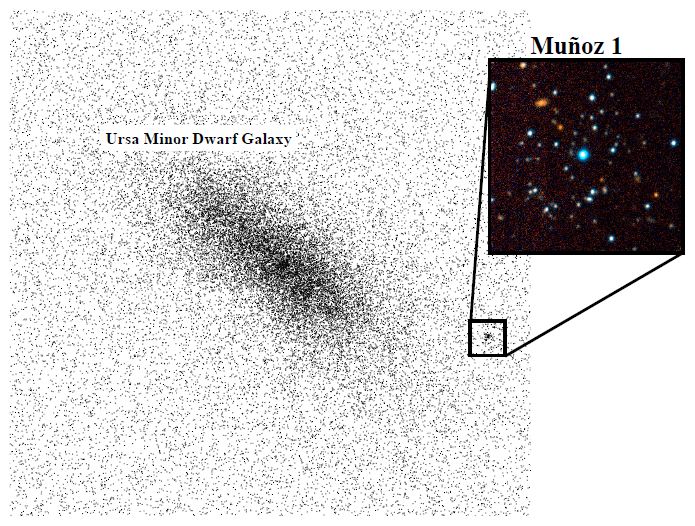
The Muñoz 1 globular cluster is seen to the right of the Ursa Minor dwarf galaxy in this image from the Canada-France-Hawaii Telescope MegaCam imager. Credit: Geha & Muñoz

A team of American, Canadian and Chilean astronomers have stumbled onto a remarkably faint cluster of stars orbiting the Milky Way that puts out as much light as only 120 modest Sun-like stars.

The tiny cluster, called Muñoz 1, was discovered near a dwarf galaxy in a survey of satellites around the Milky Way using the Canada-France-Hawaii Telescope (CFHT) and confirmed using the Keck II telescope, both of which are on Mauna Kea, Hawaii.

“What’s neat about this is it’s the dimmest globular cluster ever found,” said Ricardo Muñoz, an astronomer at the University of Chile and the discoverer of the cluster. A globular cluster is a spherical group of stars bound to each other by gravity so that they orbit around a galaxy as a unit.

“While I was working on the Ursa Minor dwarf galaxy I noticed there was this tiny little object close by,” Muñoz recalled. He made the discovery while he was a postdoctoral associate at Yale University.

Most globular clusters have in the range of 100,000 stars. Muñoz 1 has something like 500 stars. “This is very surprising,” he said.

“It’s ridiculously dim,” agreed Yale astronomer Marla Geha. “There are individual stars that would far outshine this entire globular cluster.” That puts Muñoz 1 head-to-head with the Segue 3 globular cluster (also orbiting the Milky Way) as the dimmest troupe of old stars ever found.

Muñoz 1’s discovery was the result of a survey done with the CFHT MegaCam imager in 2009 and 2010. It was then confirmed by spectroscopic study using the Deep Extragalactic Imaging Multi-Object Spectrograph (DEIMOS) on the Keck II telescope. The researchers will be publishing their results soon in The Astrophysical Journal Letters.

Thursday, April 26, 2012

Planetary Resources to Create 'Gas Stations' in Space

Planetary Resources says it has developed the first line in a family of deep-space prospecting spacecraft, the Arkyd-100 Series.

The craft is essentially a space telescope that will help scientists identify and prioritize near-Earth asteroid targets.

A company based in the northwestern United States called Planetary Resources says it plans to mine near-Earth asteroids for raw materials, ranging from water to precious metals.

Planetary Resources' co-founder Peter Diamandis is an entrepreneur, best-selling author, medical doctor and CEO of the X Prize Foundation.

Speaking at a news conference at the Museum of Flight in Seattle, Washington, Diamandis said he has wanted to be an asteroid miner since he was a teenager.

"The vision of Planetary Resources is to make the resources of space available to humanity, both in space and here on Earth, whether it's propellent from water on asteroids or strategic metals and minerals that are important to promoting and creating a world of abundance here on Earth," said Diamandis.

Company officials say resource extraction from asteroids will grow to be valued at tens of billions of dollars annually, but they stress that that kind of payday is decades away. They add that asteroid mining will provide a sustainable supply of precious metals to Earth's growing population.

Along with Diamandis, Eric Anderson is the co-founder and co-chairman of Planetary Resources.

While precious metal such as platinum would be welcome, Anderson says they also want to mine for elements found in abundance here on Earth - namely hydrogen and oxygen, which are the basis for water...and rocket fuel.

"If we're able to successfully, successfully deploy and mine for water, we're going to create a network of propellant depots, of gas stations, that literally open up the roadways to the rest of the solar system," said Anderson. "So it's going to drastically reduce the cost of deep space exploration."

Planetary Resources says it has developed the first line in a family of deep-space prospecting spacecraft, the Arkyd-100 Series. The craft is essentially a space telescope that will help scientists identify and prioritize near-Earth asteroid targets.

The company says this spacecraft will be launched in about two years. Beyond that, officials said the plan is to mass produce follow-on Arkyd-300 series spacecraft and send them off in swarms on expeditions. Planetary Resources says its mining would be done robotically.

Officials say they hope to identify asteroids to prospect within the decade.

The company's financial backers include billionaires such as Google's CEO Larry Page and Executive Chairman Eric Schmidt.

Planetary Resources counts famed film director and deep-sea explorer James Cameron as a project advisor, but some news reports have identified him as a financial backer. Cameron told VOA that his involvement in this project has been overstated in media reports.

Friday, December 16, 2011

Gamma-rays detected by Fermi's LAT show that the remnant of Tycho's supernova shines in the highest-energy form of light. 

This portrait of the shattered star includes gamma rays (magenta), X-rays (yellow, green, and blue), infrared (red) and optical data. (Credit: Gamma ray, NASA/DOE/Fermi LAT Collaboration; X-ray, NASA/CXC/SAO; Infrared, NASA/JPL-Caltech; Optical, MPIA, Calar Alto, O. Krause et al. and DSS).

In early November 1572, observers on Earth witnessed the appearance of a "new star" in the constellation Cassiopeia, an event now recognised as the brightest naked-eye supernova in more than 400 years.

It's often called "Tycho's supernova" after the great Danish astronomer Tycho Brahe, who gained renown for his extensive study of the object.

Now, years of data collected by NASA's Fermi Gamma-Ray Space Telescope reveal that the shattered star's remains shine in high-energy gamma rays.

The detection gives astronomers another clue in understanding the origin of cosmic rays, subatomic particles - mainly protons - that move through space at nearly the speed of light.

Exactly where and how these particles attain such incredible energies has been a long-standing mystery because charged particles speeding through the galaxy are easily deflected by interstellar magnetic fields. This makes it impossible to track cosmic rays back to their sources.

"Fortunately, high-energy gamma rays are produced when cosmic rays strike interstellar gas and starlight. These gamma rays come to Fermi straight from their sources," said Francesco Giordano at the University of Bari and the National Institute of Nuclear Physics in Italy. He is the lead author of a paper describing the findings in the Dec. 7 edition of The Astrophysical Journal Letters.

Better understanding the origins of cosmic rays is one of Fermi's key goals. Its Large Area Telescope (LAT) scans the entire sky every three hours, gradually building up an ever-deeper view of the gamma-ray sky. Because gamma rays are the most energetic and penetrating form of light, they serve as signposts for the particle acceleration that gives rise to cosmic rays.

"This detection gives us another piece of evidence supporting the notion that supernova remnants can accelerate cosmic rays," said co-author Stefan Funk, an astrophysicist at the Kavli Institute for Particle Astrophysics and Cosmology (KIPAC), jointly located at SLAC National Accelerator Laboratory and Stanford University, Calif.

In 1949, physicist Enrico Fermi - the satellite's namesake - suggested that the highest-energy cosmic rays were accelerated in the magnetic fields of interstellar gas clouds. In the decades that followed, astronomers showed that supernova remnants may be the galaxy's best candidate sites for this process.

Wednesday, September 21, 2011

ROSAT Space telescope set to crash to Earth

As the world waits for the six-ton satellite UARS to crash to Earth this week, we can reveal that a second giant piece of space junk is set for a similar fiery demise within weeks.

It wasn’t always junk. The latest doomed craft, called ROSAT, is a German space telescope that observed in X-ray light from 1990 to 1999 in an orbit 575 km above the Earth.

Atmospheric drag has already brought ROSAT (ROentgen SATellite) to a height of less than 327 km and it has no on-board propulsion system to control its descent.

NASA experts are warning that as many as 30 fragments, weighing a total of 1.6 tons, could survive re-entry to hit the ground, including the largest chunk, the observatory’s hefty glass mirror.

It will re-enter the atmosphere at a speed of around 28,000 km per hour and disintegrate in early November. There is currently an error of plus or minus five weeks in this prediction, so the crash landing could occur in early October.

Fluctuations in solar activity which can cause variation in the density of the fringes of the atmosphere add to the uncertainty.

Most of the inhabited world lies under the track of ROSAT which flies in an orbit that carries it from 53 degrees north to 53 degrees south. Experts expect most of the debris to impact the ground in a compact region but fragments could fall within an 80 km wide path.

EURS and FEMA
With UARS, a massive dead satellite due to plunge back to Earth this week, the Federal Emergency Management Agency (FEMA) is laying the groundwork for a fast response in case the 6 1/2-ton spacecraft falls over, or on American soil.