Showing posts with label Hawaii. Show all posts

Tuesday, August 5, 2014

Robo-AO laser: Laser-wielding robot probes exoplanet systems

The ultraviolet Robo-AO laser originating from the Palomar 1.5-meter Telescope dome. 

Although the laser is invisible to the human eye, it shows up in digital SLR cameras once their internal UV blocking filters are removed. 

The apparent colour of the laser beam is a result of the UV light leaking through the camera's red, green and blue pixel filters by slightly different amounts.

An international team, including Dr. Christoph Baranec of the University of Hawaii at Manoa's Institute for Astronomy, is using the world's first robotic laser adaptive optics system, Robo-AO, to explore thousands of exoplanet systems (planets around other stars) at resolutions approaching those of the Hubble Space Telescope.

The results, which shed light on the formation of exotic exoplanet systems and confirm hundreds of exoplanets, have just been published in the Astrophysical Journal.

The design and operation of the unprecedented instrument has just been published in the Astrophysical Journal Letters.

Laser adaptive optics systems are used by terrestrial telescopes to remove the image-blurring effects of Earth's turbulent atmosphere, thereby capturing much sharper images than are otherwise possible from the ground.

Baranec, Robo-AO's principal investigator and lead author of the Astrophysical Journal Letter, led the development of the innovative Robo-AO system on the Palomar 1.5-meter Telescope.

It is the world's first instrument that fully automates the complex and often inefficient operation of laser adaptive optics.

"We're using Robo-AO's extreme efficiency to survey in exquisite detail all of the candidate exoplanet host stars that have been discovered by NASA's Kepler mission," said Baranec.

"While Kepler has an unrivaled ability to discover exoplanets that pass between us and their host star, it comes at the price of reduced image quality, and that's where Robo-AO excels."


In fact, analysis of the first part of the Robo-AO/Kepler exoplanet host survey is already yielding surprising results.

Nicholas Law
"We're finding that "hot Jupiters," rare giant exoplanets in tight orbits, are almost three times more likely to be found in wide binary star systems than other exoplanets, shedding light on how these exotic objects formed," said Prof. Nicholas Law (University of North Carolina at Chapel Hill's College of Arts and Sciences), Robo-AO's project scientist and lead author on the Astrophysical Journal paper.

"Going further, Robo-AO's unique capabilities have allowed us to discover even rarer objects: binary star systems where each star has a Kepler-detected planetary system of its own.

These systems will be uniquely interesting for studies of how the planets formed, and for science fiction about what life would be like with another planetary system right next door," continued Law.

Indeed, the first Robo-AO survey, covering 715 Kepler candidate exoplanet hosts, is the single largest scientific adaptive optics survey ever.

That record won't stand for very long, as the Robo-AO team is extending the survey to image each and every of the 4,000 Kepler candidate exoplanet hosts, and is ready to observe exoplanet hosts from Kepler's new K2 mission as they are discovered.

The Robo-AO laser being used to probe exoplanet host stars in the Kepler field. Images of the stars on the Robo-AO science camera (inset) are the same size as a single Kepler pixel. Credit: Robo-AO Collaboration.

The key to Robo-AO's success is its efficiency, allowing it to observe hundreds more targets per night than conventional adaptive optics systems.

So far, the Robo-AO system has already been used to make over 13,000 observations. "The automation of laser adaptive optics has allowed us to tackle scientific questions that were unimaginable just a few years ago.

We can now observe tens of thousands of objects at Hubble-Space-Telescope-like resolution in short periods of time," Baranec said.

"Now that the technology has been proven, we're looking to bring it to the pristine skies of Maunakea, Hawaii, where it will be even more powerful."

More information: Christoph Baranec et al. "HIGH-EFFICIENCY AUTONOMOUS LASER ADAPTIVE OPTICS." The Astrophysical Journal Letters Volume 790 Number 1, 2014 ApJ 790 L8 DOI: 10.1088/2041-8205/790/1/L8

Nicholas M. Law et al. "ROBOTIC LASER ADAPTIVE OPTICS IMAGING OF 715 KEPLER EXOPLANET CANDIDATES USING ROBO-AO" The Astrophysical Journal Volume 791 Number 1. 2014 ApJ 791 35 DOI: 10.1088/0004-637X/791/1/35

NASA Earth Observation GOES: Hurricane Iselle threatens Hawaii

Hurricane Iselle is pictured in the Eastern Pacific Ocean on August 3, 2014

Hurricane Iselle picked up strength in the open Pacific on Monday as the powerful storm barrelled toward Hawaii, US forecasters said.

The NOAA Miami-based National Hurricane Centre upgraded Iselle, now some 1,245 miles (2,005 kilometers) east of Hilo, Hawaii, to a Category Four storm on the five-level Saffir-Simpson scale.

Earlier Monday, it had been listed as a Category Three storm.

NOAA's GOES-West satellite captured this image of a very active Eastern and Central Pacific, hosting three tropical cyclones (from left to right) Genevieve, Iselle and Julio.

Image Credit: NASA/NOAA GOES Project

NASA and NOAA satellites have been supplying forecasters with data developing tropical cyclones in the Eastern and Central Pacific Ocean and over the last several days. There have been as many as five tropical systems at the same time.

On Monday, August 4, there were three tropical systems stretching from west to east: Tropical Depression Genevieve in the Central Pacific, Hurricane Iselle and Tropical Storm Julio in the Eastern Pacific.

This false-colored image represents infrared data on Tropical Storm Iselle on July 31 at 5:23 p.m. EDT from the AIRS instrument aboard NASA's Aqua satellite.

Image Credit: NASA JPL

Tropical Depression Genevieve Strengthens
On August 4, Tropical Depression Genevieve was located about 930 miles (1,495 km) southwest of Honolulu, Hawaii. Maximum sustained winds were still near 35 mph (55 kph).

Genevieve was moving westward at about 16 mph (26 kph). NOAA's Central Pacific Hurricane Center forecasts gradual strengthening late on August 4 and 5, so Genevieve could once again reach tropical storm status.

To the east of Genevieve lies low pressure area known as System 93C. It is producing disorganized showers and thunderstorms.

System 93C is located about 500 miles south of Hilo, Hawaii. This low pressure area is moving to the west at 15 mph and currently has a near zero percent chance of becoming a tropical depression over the next couple of days.

Thursday, May 8, 2014

DKIST: Most powerful solar telescope atop Hawaiian volcano

Construction on the new observatory on the summit of the Haleakala Crater on Maui, Hawaii this February. 

The observatory is expected to be completed in 2019. 

Credit: National Solar Observatory / Ruth Kneale

Rising 10,000 feet above the sunburned faces of 2.2 million tourists a year, the largest solar telescope on the planet is under construction atop Haleakala Crater in Maui, Hawaii.

Never mind all those admonitions about never staring at the sun. Astronomers can't wait for the chance.

DKIST Enclosure Cladding

Named after the late Senator Daniel Inouye, the Daniel K. Inouye Solar Telescope (DKIST) will be the world's premier ground-based solar observatory in the world.

With its 4-meter (157.5-inch) primary mirror, DKIST is capable of distinguishing features down to 0.03 arc seconds or just 20-70 km (12-44 miles) wide at the sun's surface.

To achieve such fantastic resolutions the telescope will employ the latest adaptive optics technology to cancel the blurring effects of the atmosphere using a computer-controlled deformable mirror.

Consider that the smallest features visible in large amateur telescopes are solar granules, columns of hot gas rising up from the sun's interior.

Each spans about 930 miles (1,500 km) and together give the sun's surface the texture of finely-etched glass.

McMath-Pierce Solar Telescope
DKIST will resolve features more than 60 times smaller. The current largest sun-dedicated telescope is the McMath-Pierce Solar Telescope , which has kept a steady eye on the home star with its 63-inch (1.6-meter) mirror since 1962 from Kitt Peak, Arizona.

DKIST will focus on three key areas: What is the nature of solar magnetism; how does that magnetism control our star; and how can we model and predict its changing outputs that affect the Earth?

Astronomers hope to clearly resolve solar flux tubes – magnetic field concentrations near the sun's surface – thought to be the building blocks of magnetic structures in the atmosphere.

Observatory cutaway showing light entering the top of the dome and gathered by the primary mirror, which is reflected to a secondary mirror and from there through a series of smaller mirrors to the science gallery below. 

Inset shows the light path in greater detail including the deformable mirror that will cancel the blurring effects of atmospheric turbulence. 

Notice that the secondary mirror is offset with no obstructions between it and the primary mirror that would otherwise lessen the telescope’s ability to resolve fine detail. 

Credit: L. Phelps with enhancements by the author

We still lack a complete understanding of how energy in the sun's turbulent, churning interior is transferred to magnetic fields. Earth's magnetic field is about 0.5 gauss at the surface.

DKIST Mezzanine Floor Structure

Fields within sunspots can range from 1,500 to 3,000 gauss – about the strength of a bar magnet but across a region several times larger than Earth.

A better understanding of small scale magnetic structures, too tiny to be resolved with current telescopes, will help make sense of broader phenomena like sunspot formation, the heating of the solar corona and why the sun's energy output varies.

The solar constant, the amount of radiation we receive from the sun, increases with an increase in solar activity like spots and flares.

DKIST Coudé Rotator with dummy masses

Since the smallest magnetic elements are the biggest contributors to this increase, DKIST will be the first telescope able to image and study these structures directly, helping astronomers understand how variations in the sun's output can lead to climate changes.

DKIST will do its work on rapid times scales, taking images once every 3 seconds. For comparison, NASA's orbiting Solar Dynamics Observatory takes pictures in 8 different wavelengths every 10 seconds, STEREO one image every 3 minutes and SOHO (Solar Heliospheric Observatory) once every 12 minutes.

The speedy shooting ability will help DKIST resolve rapidly evolving structures on the sun's surface and lower atmosphere in a multitude of wavelengths of light from near-ultraviolet to deep infrared thanks to the the extraordinarily clean and dry air afforded by its high altitude digs.

The Daniel K. Inouye Solar Telescope (DKIST) (formerly the Advanced Technology Solar Telescope) is being developed by a consortium led by the National Solar Observatory and comprising the University of Chicago, the New Jersey Institute of Technology, University of Hawaii, the High Altitude Observatory, NASA, the U.S. Air Force and others. For more details on the project, click here.

Tuesday, June 11, 2013

Hawaii Astrobiologists find Martian clay contains Chemical Organics

Electron microscope image showing the 700-million-year-old Martian clay veins containing boron (100 µm = one tenth of a millimeter).

Researchers from the University of Hawaii at Manoa NASA Astrobiology Institute (UHNAI) have discovered high concentrations of boron in a Martian meteorite.

When present in its oxidized form (borate), boron may have played a key role in the formation of RNA, one of the building blocks for life.

The work was published on June 6 in PLOS One.

The Antarctic Search for Meteorites team found the Martian meteorite used in this study in Antarctica during its 2009-2010 field season.

The minerals it contains, as well as its chemical composition, clearly show that it is of Martian origin.

Using the ion microprobe in the W. M. Keck Cosmochemistry Laboratory at UH, the team was able to analyze veins of Martian clay in the meteorite.

After ruling out contamination from Earth, they determined boron abundances in these clays are over ten times higher than in any previously measured meteorite.

"Borates may have been important for the origin of life on Earth because they can stabilize ribose, a crucial component of RNA. In early life RNA is thought to have been the informational precursor to DNA," said James Stephenson, a UHNAI postdoctoral fellow.

RNA may have been the first molecule to store information and pass it on to the next generation, a mechanism crucial for evolution.

Although life has now evolved a sophisticated mechanism to synthesize RNA, the first RNA molecules must have been made without such help.

One of the most difficult steps in making RNA nonbiologically is the formation of the RNA sugar component, ribose. Previous laboratory tests have shown that without borate the chemicals available on the early Earth fail to build ribose.

However, in the presence of borate, ribose is spontaneously produced and stabilized.

This work was born from the uniquely interdisciplinary environment of UHNAI. The lead authors on the paper, Stephenson, an evolutionary biologist, and Lydia Hallis, a cosmochemist who is also a UHNAI postdoctoral fellow, first came up with the idea over an after-work beer.

"Given that boron has been implicated in the emergence of life, I had assumed that it was well characterized in meteorites," said Stephenson.

"Discussing this with Dr. Hallis, I found out that it was barely studied. I was shocked and excited. She then informed me that both the samples and the specialized machinery needed to analyze them were available at UH."

More information: 
Stephenson, J. D., Hallis, L. J., Nagashima K., and Freeland, S. J. 2013, "Boron Enrichment in Martian Clay," PLoS ONE 8(6): e64624. dx.doi.org/10.1371/journal.pone.0064624


Saturday, March 2, 2013

CFH Telescope Image:The Lagoon Nebula, Messier 8

Credit: Canada-France-Hawaii Telescope/Coelum

The Lagoon Nebula, also called Messier 8, lies deeply embedded in the disk of our galaxy. 

Stars form within this giant region, and they gravitationally cluster in the heart of the nebula. 

Ultraviolet radiations from newborn stars ionize hydrogen gas, creating the pink emission.

Wednesday, October 17, 2012

NASA - Jupiter Shakes it off

Jupiter has been suffering more impacts over the last four years than ever previously observed, including this meteoroid impact on Sept. 10, 2012.

The left-hand image was taken from a red-filtered video by amateur astronomer George Hall of Dallas, Texas, on Sept. 10 and processed by Ricardo Hueso (University of the Basque Country, Bilbao, Spain).

The right-hand image is an infrared image from NASA’s Infrared Telescope Facility on Mauna Kea, Hawaii, taken on Sept. 11.

Scientists compare the visible-light images to the infrared images to learn about the fireball's disruption of the Jovian atmosphere.

In this case, the infrared view reveals no long-term disturbance. The circles in the annotated version indicate where the impact occurred.

Scientists think the fireball was caused by an object less than 45 feet (15 meters) in diameter.

Image credit: NASA/IRTF/JPL-Caltech/G. Hall/University of the Basque Country

Sunday, September 2, 2012

Kilauea: Tiny Gravity Changes Show Magma's Underground Movements

Kilauea's current eruption is still going strong after 29 years.

CREDIT: USGS/HVO.

The secret movements of magma deep inside a volcano can be detected by tracking the subtle changes in gravity they cause.

Surprising readings from a Hawaiian volcano have researchers hoping to better understand volcanic activity through gravity monitoring.

Continuous gravity measurements of active volcanoes are relatively rare, with most results coming from Mount Etna in Italy.

"One problem is the expense," researcher Michael Poland, a geophysicist at the U.S. Geological Survey's Hawaiian Volcano Observatory, explained.

"Gravity measurements have always been a really expensive endeavor. The big users are oil and mining companies."

Now scientists have monitored the gravity at Kīlauea, a popular tourist destination on Hawaii's Big Island, and discovered a regular cycle of fluctuations that suggest magma is churning a kilometer (0.6 miles) below the surface.

The way magma churns in underground chambers below volcanic vents is key to understanding how persistent volcanoes are, and whether or not they might catastrophically erupt in the future.

However, what goes on deep under the Earth's surface is difficult to monitor.

One way to peer underground is by looking at Earth's gravity, the researchers said. Anything that has mass has a gravity field that pulls objects toward it.

The strength of this field depends on the amount of mass. Since the Earth's mass is not spread out evenly, this means the strength of the planet's gravitational pull is stronger in some places and weaker in others.

As such, the flow of magma from one place to another can be detected from above.

Most active volcano

"Kīlauea is the world's most active volcano," Poland said. "It's erupted almost continuously since 1983. It's a natural 'lab volcano' ―a great place to try and study something like gravity measurements."

The researchers installed two continuous gravity meters at the summit of the volcano in 2010. One was about 1.2 miles (2 kilometers) northwest of the eruptive vent at the summit and recorded measurements every10 seconds, while the other was placed about 500 feet (150 meters) east and recorded data every second.

They detected gravity fluctuations that came in a cycle about 150 seconds long.

"There was no expectation for that kind of result," Poland reported. "That gravity oscillation came out of nowhere. It points to the idea that there's probably a lot of things going on in volcanoes, glaciers, wherever you look, but we haven't developed the tools to detect these sorts of things."

Thursday, July 19, 2012

Incredibly Old Spiral Galaxy Found

Astronomers have found a spiral galaxy that formed much earlier than astronomers thought possible, a find that could lead to insights into how galaxies like our Milky Way evolved from more chaotic and disc-like structures into grand spirals.

In the journal Nature, a team led by University of Toronto researcher David Law described Wednesday how they examined this galaxy, dubbed BX442, from an observatory on top of Hawaii's dormant Mauna Kea volcano.

The astronomers' observations are a snapshot of the galaxy's distant past, since the light has been traveling to Earth for nearly 11 billion years.

What they saw was a galaxy much larger than most others that existed at that time in the universe (about 3 billion years after the Big Bang). BX442's spiral shape also made it stand out from the rest.

"As you go back in time to the early universe, galaxies look really strange, clumpy and irregular, not symmetric," co-author and UCLA professor Alice Shapley said in a statement Wednesday.

"The vast majority of old galaxies look like train wrecks. Our first thought was, why is this one so different, and so beautiful?"

The authors think that BX442 may have been twisted into a spiral thanks to gravitational interactions with a nearby dwarf galaxy.

Saturday, July 7, 2012

UKIRT Discovers Unusual Binary Stars with Close Orbit

Scientists have discovered four unusual pairs of stars that orbit each other in less than four hours, according to a new study.

Scientists claim that the orbital period is quite strange because till now they have never found a binary star with such close orbital period.

According to the scientists, more than half of the stars in our milky way are part of a binary system and orbit each other at a certain period, which is more than 5 hours.

They believe that if binary stars orbit very close to each other, they will quickly emerge into one huge star.

The unusual binary stars were discovered while monitoring the brightness of thousands of stars, including red dwarfs by using the United Kingdom Infrared Telescope (UKIRT) in Hawaii.

"To our complete surprise, we found several red dwarf binaries with orbital periods significantly shorter than the 5 hour cut-off found for Sun-like stars, something previously thought to be impossible", said Bas Nefs, scientist at the Leiden Observatory, Netherlands, in a statement.

"It means that we have to rethink how these close-in binaries form and evolve," Nefs added.

The study suggested several reasons behind the short orbital period of these stars. One of the reasons is that since stars shrink in size in their lifetime, there is a possibility that their period could also have shrunk; otherwise the stars would have emerged quite long ago.

However, scientists are not sure as to how these orbits could have shrunk so much.

Another possibility is that the magnetic field lines radiating from the cool star companions get twisted and deformed as they orbit each other, generating the extra activity through stellar wind, explosive flaring and star spots.

Powerful magnetic activity could apply the brakes to these spinning stars, slowing them down so that they move closer together.

"Without UKIRT's superb sensitivity, it wouldn't have been possible to find these extraordinary pairs of red dwarfs", said David Pinfield, researcher at the University of Hertfordshire.

"The active nature of these stars and their apparently powerful magnetic fields has profound implications for the environments around red dwarfs throughout our Galaxy," he added.

Sunday, June 3, 2012

STFC UK: Hawaii Telescope Closure is Blue News for UK Astronomers

Astronomers have welcomed a partial reprieve granted to the UK’s northern hemisphere telescopes, but have described the closure of two major facilities in Hawaii as a “sad day for British astronomy”.

A Science and Technology Facilities Council (STFC) prioritisation exercise in 2009 recommended the closure of its island-based telescopes by the end of this year, prompting an outcry from astronomers about the loss of all UK access to optical and infrared telescopes in the northern hemisphere.

On the advice of its science board, however, the STFC has now decided to continue funding for the Isaac Newton Group of Telescopes on La Palma in the Canary Islands until March 2015 while discussions continue with Spain and the Netherlands about sharing running costs.

Meanwhile, the James Clerk Maxwell Telescope (JCMT) and the United Kingdom Infrared Telescope (UKIRT), both in Hawaii, will be kept open until their current experiments are finished. After that, they will be transferred to another operator or decommissioned, with the loss of 40 jobs.

The board of the latter facility says in a statement that it is “very disappointed” and mystified by the STFC’s decision to end its funding in September 2013, arguing that another year of operation would cost less than £100,000.

Prof. David Southwood, president of the Royal Astronomical Society and leading light in ESA, agreed that the Hawaiian telescopes were doing “front-rank” work and described their closure as “a sad day for British astronomy”.

Their loss would “further reduce the capacity of UK astronomers to carry out world-leading science” and damage the UK’s reputation as a “credible” partner in large international projects such as the Square Kilometre Array, whose construction in South Africa and Australia was confirmed last week.

But Professor Southwood, a senior research investigator at Imperial College London, said he had resisted pressure from some astronomers to “jump up and down” on the STFC because he recognised that its hands were tied by the constraints on its budget.

He commended its efforts to minimise the damage to current projects, which represented a partial victory for the society’s lobbying.

He viewed the closures as part of a general move in astronomy towards large international facilities that would continue “as long as scientists say they want bigger and bigger facilities”.

Professor Southwood admitted that the lack of “flexibility” inherent in international collaborations could be frustrating, and, in an ideal world, access would be preserved to national “back-up” facilities.

“But for astronomers in the UK at the moment, we are not living in an ideal world,” he said.

Tuesday, May 29, 2012

Stunning Image of volcanic eruption in Hawaii with Milky way above

Halemaumau vent, with the Milky Way overhead

Picture: G. Brad Lewis / Barcroft Media

Brad Lewis, aka 'Volcano Man,' has been photographing the Kilauea Volcano, the most active on earth, for over 20 years.

He said:"It's such stunningly beautiful, powerful force. Being near an eruption is an awesome experience.You are never quite the same after seeing flowing lava."

Wednesday, May 2, 2012

Dusty Stellar Nurseries from the Dark Side of a Galaxy

The red colours in this image show the galaxy M66 as it appears at the sub-mm wavelength of 850 microns, while the white background shows the galaxy as it appears in visible light. 

Regions of cold dust that appear as dark streaks in the white image glow brightly in the red image. 

The center of the galaxy contains much more dust than is obvious from looking at the visible image and the sub-mm image also picks out an unusual compact cloud in the southern part of the galaxy that is a prime site for future star formation. Credit: VLT/ESO, JAC, G. Bendo.

One of the world's most powerful cameras, SCUBA-2 is producing its first detailed images of our neighbouring galaxies, revealing previously undetected vast pockets of star formation where the next generation of stars is being created.

The light from these stars is usually obscured by dust, but at the sub-millimetre wavelengths that the camera is designed for, these dust lanes actually glow brightly. The images are revealed in the week of the 25th anniversary of the James Clerk Maxwell Telescope, in Hawaii on which SCUBA-2 is mounted.

"This exquisite image from the galaxy M66 in the constellation Leo is exactly the promising start we were hoping for," said Dr. Stephen Serjeant, the team's co-leader from The Open University. "This is a wonderfully exciting taste of things to come."

When looking up at the Milky Way, an irregular pattern of dark regions obscures the light of the stars. The dark patches are caused by clouds of dust trailing through the spiral arms and blocking out the starlight that would otherwise reveal vast pockets of star formation, or stellar nurseries. These dark lanes are not exclusive to the Milky Way, but can be found in all spiral galaxies.

SCUBA-2, led by STFC's UK Astronomy Technology Centre in Edinburgh is the most powerful camera ever developed for observing light at sub-milimetre wavelengths, 1000 times longer than we can see with our eyes.

This makes it possible to detect stellar nurseries usually obscured by dust that are so remote the light they emit left them within the first billion years after the big bang.

University of Edinburgh astrophysicist Professor James Dunlop said: "These beautiful new images from SCUBA-2 show energy conservation in action, as the same dust which absorbs the blue optical light (obscuring the stars in the optical images) can be seen to re-emit at the much longer wavelengths accessible to SCUBA-2."

This image promises to be the first of many stunning results from the James Clerk Maxwell Telescope Nearby Galaxy Legacy Survey (NGLS). The main aim of the survey is to understand how the broader environment of a galaxy affects its gas and dust content.

For example, galaxies in dense clusters can lose their gas and dust through interactions with other galaxies in the cluster or simply by the head wind they feel while moving through the hot gas trapped inside the cluster.

The NGLS is an international collaboration led by astronomers from Canada, the Netherlands, and the United Kingdom which is using SCUBA-2 to observe 150 galaxies in the local universe.

The NGLS team has spent much of the last five years studying molecular hydrogen emission using another instrument on the James Clerk Maxwell Telescope.

"It is very exciting to now see the first results from the SCUBA-2 side of our programme starting to come in," says Professor Christine Wilson, the Principal Investigator from McMaster University in Canada.

"We have a unique sample of galaxies that we are studying and having SCUBA-2 data will let us measure their gas and dust content. Gas and dust usually go hand-in-hand in galaxies, but from time to time, you find a surprise."

STFC is the UK sponsor of astronomy and operates the Joint Astronomy Centre in Hawaii.

Friday, April 27, 2012

Nice but Dim: A bevy of stars found beyond our Milky Way

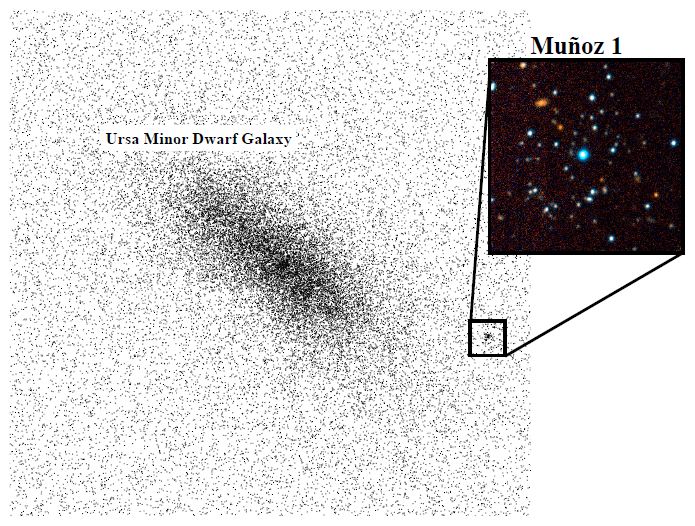
The Muñoz 1 globular cluster is seen to the right of the Ursa Minor dwarf galaxy in this image from the Canada-France-Hawaii Telescope MegaCam imager. Credit: Geha & Muñoz

A team of American, Canadian and Chilean astronomers have stumbled onto a remarkably faint cluster of stars orbiting the Milky Way that puts out as much light as only 120 modest Sun-like stars.

The tiny cluster, called Muñoz 1, was discovered near a dwarf galaxy in a survey of satellites around the Milky Way using the Canada-France-Hawaii Telescope (CFHT) and confirmed using the Keck II telescope, both of which are on Mauna Kea, Hawaii.

“What’s neat about this is it’s the dimmest globular cluster ever found,” said Ricardo Muñoz, an astronomer at the University of Chile and the discoverer of the cluster. A globular cluster is a spherical group of stars bound to each other by gravity so that they orbit around a galaxy as a unit.

“While I was working on the Ursa Minor dwarf galaxy I noticed there was this tiny little object close by,” Muñoz recalled. He made the discovery while he was a postdoctoral associate at Yale University.

Most globular clusters have in the range of 100,000 stars. Muñoz 1 has something like 500 stars. “This is very surprising,” he said.

“It’s ridiculously dim,” agreed Yale astronomer Marla Geha. “There are individual stars that would far outshine this entire globular cluster.” That puts Muñoz 1 head-to-head with the Segue 3 globular cluster (also orbiting the Milky Way) as the dimmest troupe of old stars ever found.

Muñoz 1’s discovery was the result of a survey done with the CFHT MegaCam imager in 2009 and 2010. It was then confirmed by spectroscopic study using the Deep Extragalactic Imaging Multi-Object Spectrograph (DEIMOS) on the Keck II telescope. The researchers will be publishing their results soon in The Astrophysical Journal Letters.

Wednesday, March 28, 2012

STFC: SCUBA-2 reveals wild youth of the Universe

A team of astronomers from the UK, Canada and the Netherlands has begun a revolutionary new study of cosmic star-formation history, looking back in time to when the Universe was still in its lively and somewhat unruly youth.

The consortium, co-led by University of Edinburgh astrophysicist Professor James Dunlop, is using SCUBA-2, the most powerful camera ever developed for observing light at ‘sub-mm’ wavelengths (light that has a wavelength 1000 times longer than we can see with our eyes).

Prof. Dunlop presented the first results from the survey at the UK National Astronomy Meeting on 27 March 2012.

The development of SCUBA-2 was led by STFC’s UK Astronomy Technology Centre in Edinburgh and the revolutionary camera was unveiled in December 2011 (link opens in a new window).

It is mounted on the world's largest sub-mm telescope, the 15-metre James Clerk Maxwell Telescope in Hawaii.

The new project, named the SCUBA-2 Cosmology Legacy Survey, will run for three years and will use the camera to provide the clearest view to date of dust-enshrouded star-forming galaxies.

These objects are so remote that the light we detect left them billions of years ago, so we see them as they looked in the distant past.

With SCUBA-2 astronomers are able to study objects that existed as far back as 13 billion years ago, within the first billion years after the Big Bang.

Because stars form inside clouds of gas and dust, much of the ultraviolet light from young galaxies is absorbed by this cosmic dust which is then heated to a few tens of degrees above absolute zero (-273 degrees Celsius).

The ‘warmed’ (but still rather ‘cool’) dust then emits the absorbed energy at far-infrared wavelengths, which is then further redshifted to longer sub-mm wavelengths en-route to the Earth by the expansion of the Universe.

The first image presented here is made using the SCUBA-2 camera at a wavelength of 450 microns.
(Credit: Jim Dunlop)
Detecting such emission is a challenge, both because Earth-based telescopes are warm and hence glow at sub-mm wavelengths and because water vapour in the atmosphere both absorbs and emits light in this waveband.

To get around the problems of the atmosphere, the latest sub-mm surveys have recently been conducted from space, using the Herschel Space Observatory.

However, the relatively small size (3.5-metre diameter) of Herschel’s telescope means that the images it produces cover large areas but are rather fuzzy.

The James Clerk Maxwell Telescope primary mirror is 20 times larger in area and can provide a much sharper view of the sub-mm sky.

Prof. Dunlop is delighted by these first deep SCUBA-2 images and looking forward to more results over the next few years: “Edinburgh scientists and engineers worked hard to construct this revolutionary new instrument and, together with our colleagues in Canada and the Netherlands, we’re now seeing the fruits of our efforts.

With SCUBA-2 we can study the most violently star-forming galaxies in the young Universe, and slowly but surely start to understand how the primitive cosmos evolved into the Universe we live in today.”

Friday, July 22, 2011

CFHT News: Elliptical galaxies much younger than previously thought

The standard model for elliptical galaxies formation is challenged by a new result uncovered by an international team of astronomers from the Atlas3D collaboration.

Team members from CNRS, CEA, CFHT (Canada-France-Hawaii-Telescope), and the Observatoire de Lyon published in the scientific journal Monthly Notices of the Royal Astronomical Society the first results from their study on two elliptical galaxies exhibiting features characteristic of a fairly recent merging, suggesting they are five times younger than commonly thought.

The common belief on the mass assembly history of massive elliptical galaxies based on their stellar population leads to an age between 7 and 10 billion years old. A different story is shaping up based on ultra-deep images of two galaxies observed with the MegaCam camera mounted on the Canada-France-Hawaii Telescope (CFHT, CNRC/CNRS/University of Hawaii).

Astronomers from CNRS, CEA, CFHT, and the Observatoire de Lyon, all members of the Atlas3D international collaboration, established that the formation of the two studied elliptical galaxies (NGC 680 & NGC 5557) originated from a merger of two giant spiral galaxies that took place only 1 to 3 billions years ago.

Such age estimate is based on the presence of ultra faint filaments in the distant outskirts of the galaxies. These features called tidal streams in the astronomers parlance are typical residuals from a galaxy merger.


They are known not to survive in this shape and brightness for more than a few billion years, hence the new age estimate of the resulting elliptical galaxies. These structures were detected for the first time thanks to a very-deep imaging technique boosting the capabilities of CFHT's wide-field optical imager MegaCam.

The Atlas3D team conducts a systematic survey of more than one hundred nearby elliptical galaxies. If the current result based on the first two galaxies is confirmed on the larger sample, i.e. faint extended features are frequently detected, the standard model for elliptical galaxies formation should be revisited.

Monday, June 14, 2010

Rare Moonbows or Lunar Rainbows over Oregon and Hawaii

We have all seen rainbows during the day but what about rainbows at night? Thomas Thies of Gearhart, Oregon photographed this one after the sun had set on December 8th 2003.

He says, "The rainbow, which lasted for about 20 minutes, was out over the ocean with the moon rising behind us." The several bright yellow lights near the horizon are crab boats.

The moon is the key, just as sunlight produces rainbows during the day, moonlight can produce rainbows at night. This is a lunar rainbow or 'moonbow'.

Moonbows are rare because moonlight is not very bright. A bright moon near to full is needed, it must be raining opposite the moon, the sky must be dark and the moon must be less than 42º high.

Put all these together and you do not get to see a moonbow very often! To the unaided eye they usually appear, as in the small image, without colour because their light is not bright enough to activate the cone colour receptors in our eyes. Nonetheless colours have been reported and might be seen when the moon is bright.

Moonbow and Venus imaged by Rob Ratkowski (photography) in May 2004. Moonbows are very rare.

The moon must be bright and not too high, the sky must be dark else the faint bow will not be visible and there must be rain in the direction opposite the moon.

Orion was setting when Rob took this spectacular image, Venus is the bright object inside the bow.

Mars is above it to the left and Saturn is above Mars and outside the primary. Capella is the bright star to the right (north) of Venus.

Do not expect to see much colour with the unaided eye because moonbows are usually too faint to excite the colour sensors in our eyes. We therefore mostly see them as a series of grey shades.

Sunday, February 28, 2010

Chile quake produces tsunami alert in Pacific


BBC News - Map: Chile quake tsunami

The Chile earthquake caused a tsunami which surged across the Pacific, as the map below shows.

Friday, February 19, 2010

Star Birth and Gemini Multi-Object Spectograph Hawaii

Sharpless 2-106 as imaged by the Gemini Multi-Object Spectrograph on the Gemini North telescope on Mauna Kea in Hawai‘i.

This color composite image shows the nursery of a massive star (hidden within the cloud) obtained with four narrow-band optical filters available for Gemini users at both Gemini North and South.

Credit: Gemini Observatory/AURA/Travis Rector (U. Alaska Anchorage)