Showing posts with label plastic. Show all posts

Tuesday, May 27, 2014

Trillions of tiny bits of plastic pollutant materials trapped in Arctic ice

A team of researchers with Dartmouth College in the U.S. and the University of Plymouth in the U.K. has found that a massive amount of tiny bits of rayon, plastics and other man-made materials are embedded in Arctic sea ice.

In their paper published in the journal Earth's Future, the team describes how they found evidence of the materials in core samples taken in 2005 and 2010 and note that as Arctic sea ice melts, the embedded material will be released into the ocean, likely causing problems for marine life.

We all use plastics and other materials every day, but few of us give much thought to what happens to it after we toss it in the trash after it's no longer useful to us.

A lot of it winds up in landfills, of course, but a lot goes missing and now it appears that the researchers studying core samples, may have found where it's gone: it's been captured in Arctic sea ice, torn apart into tiny pieces during the journey there.

The rayon and plastic bits aren't noticeable to a person walking around in the Arctic because the pieces are so small, typically less than 5 millimeters in length. It's in the form of beads, fibers or irregular fragments.

Scientists have observed such material in the ocean before, particularly around garbage islands such as the Great Pacific Garbage Patch, but never before have scientists noticed them in ice cores taken from the top of the world.

The researchers don't see any imminent threat from the embedded materials, the problem is that global warming is causing Arctic sea ice to melt, and as it does so, it will release the captured material into the sea, and no one knows what sort of impact that will have.

Most of the materials aren't expected to be toxic, but many are known to soak up chemicals, like a sponge. If the chemicals are toxic and an animal eats them, it likely would get sick or die.

In counting the number of bits of material in the ice cores and estimating the amount of ice they are in, the researchers have concluded that there might be in the neighborhood of a trillion pieces of the stuff in position ready to be released into the world's northern oceans.

A little over half of the bits were rayon, the researchers report, others were polypropylene, acrylic, nylon, polyester, polyethylene and polystyrene.

More information: Global warming releases microplastic legacy frozen in Arctic Sea ice, Earth's Future, DOI: 10.1002/2014EF000240

Wednesday, March 6, 2013

Fabbster 3D Printer


The fabbster works on the principle of layer construction. This literally means that it prints the components layer by layer.

The fabbster melts plastic material in the extruder and prints it through a nozzle onto a platform. After printing one layer the print head lifts and applies another layer of melted synthetic material on the just printed one.

The component is built from the bottom upwards layer by layer. While cooling down the material solidifies and connects to a complex object.


The fabbster kit
The fabbster comes in a compact box as a partially assembled construction kit.

The kit is completely mounted within only a few hours; simple and easy through a step-by-step assembly guide, as well as videos of the various construction sequences.

All tools required for the assembly are included in the fabbster kit.

Saturday, March 2, 2013

3-D Printing Using Shredded Milk Jugs


Joshua Pearce's group cleans plastic milk jugs, removes the labels and shreds them into plastic before turning them into plastic filament for 3D printers. 

Credit: Image courtesy of Michigan Technological University

Suppose you could replace "Made in China" with "Made in my garage."

Suppose also that every time you polished off a jug of two percent, you would be stocking up on raw material to make anything from a cell phone case and golf tees to a toy castle and a garlic press.

And, you could give yourself a gold medal for being a bona fide, recycling, polar-bear-saving rock star.

Michigan Technological University's Joshua Pearce is working on it. His main tool is open-source 3D printing, which he uses to save thousands of dollars by making everything from his lab equipment to his safety razor.

Using free software downloaded from sites like Thingiverse, which now holds over 54,000 open-source designs, 3D printers make all manner of objects by laying down thin layers of plastic in a specific pattern.

While high-end printers can cost many thousands of dollars, simpler open-source units run between $250 and $500 -- and can be used to make parts for other 3D printers, driving the cost down ever further.

"One impediment to even more widespread use has been the cost of filament," says Pearce, an associate professor of materials science and engineering and electrical and computer engineering.

Though vastly less expensive than most manufactured products, the plastic filament that 3D printers transform into useful objects isn't free.

Milk Jugs
Milk jugs, on the other hand, are a costly nuisance, either to recycle or to bury in a landfill. But if you could turn them into plastic filament, Pearce reasoned, you could solve the disposal problem and drive down the cost of 3D printing even more.

So Pearce and his research group decided to make their own recycling unit, or RecycleBot. They cut the labels off milk jugs, washed the plastic, and shredded it.

Then they ran it through a homemade device that melts and extrudes it into a long, spaghetti-like string of plastic. Their process is open-source and free for everyone to make and use at Thingiverse.com.

The process isn't perfect. Milk jugs are made of high-density polyethylene, or HDPE, which is not ideal for 3D printing. "HDPE is a little more challenging to print with," Pearce says, but the disadvantages are not overwhelming.

His group made its own climate-controlled chamber using a dorm-room refrigerator and an off-the-shelf teddy-bear humidifier and had good results. With more experimentation, the results would be even better, he says. "3D printing is where computers were in the 1970s."


The group determined that making their own filament in an insulated RecycleBot used about 1/10th the energy needed to acquire commercial 3D filament.

They also calculated that they used less energy than it would take to recycle milk jugs conventionally.

Saturday, June 25, 2011

Brilliant Replicating Concept - The RepRap


RepRap from Adrian Bowyer on Vimeo.

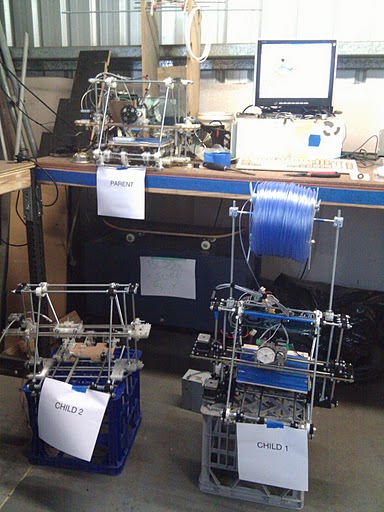
RepRap is a free desktop 3D printer capable of printing plastic objects. Since many parts of RepRap are made from plastic and RepRap can print those parts, RepRap is a self-replicating machine - one that anyone can build given time and materials. It also means that - if you've got a RepRap - you can print lots of useful stuff, and you can print another RepRap for a friend...

RepRap is about making self-replicating machines, and making them freely available for the benefit of everyone. We are using 3D printing to do this, but if you have other technologies that can copy themselves and that can be made freely available to all, then this is the place for you too.

Reprap.org is a community project, which means you are welcome to edit most pages on this site, or better yet, create new pages of your own. Our community portal and New Development pages have more information on how to get involved. Use the links below and on the left to explore the site contents. You'll find some content translated into other languages.

Monday, July 6, 2009

Boeing 787 Superplane: Metal comes to the rescue of revolutionary plastic plane

A section of the Dreamliner undergoes wind tunnel tests, which proved unable to predict the forces experienced by a real plane during flight (Image: shearforce / Margaret S / Flickr (link to http://www.flickr.com/people/shearforce/)

A section of the Dreamliner undergoes wind tunnel tests, which proved unable to predict the forces experienced by a real plane during flight

HE midst of the deepest recession the aviation industry has ever seen is not the best time to discover that your revolutionary aircraft design has yet another serious structural weakness. But that's the predicament Boeing found itself in last week.

The company hopes its 787 airliner will be the first with a pressurised fuselage made from lightweight, fuel-saving carbon-fibre reinforced plastic (CFRP) composite materials, rather than aluminium.

But in 2008, the firm found that the 787's carbon-fibre "wingbox", the internal fuselage structure the wings attach to, was not strong enough and needed stiffening with metal spars. That redesign helped put back the plane's first flight by 15 months.

Then last week, other stress tests on an airframe showed that the plane needs strengthening at 18 points on either side of the fuselage just above the area where the wing attaches. Titanium or aluminium stiffeners are being developed to strengthen those "side-of-body" points.

The plane needs strengthening at 18 points just above the area where the wing attaches

"Data from the test did not match our computer model," says Boeing vice-president Scott Fancher. That highlights the difficulty of predicting the behaviour of advanced CFRP materials being used in very large structures for the first time.

Boeing says its computer model will now be modified in the light of the new data to help its engineers design the stiffeners. A new date for the 787's first flight has not been set.