Showing posts with label printer. Show all posts

Wednesday, February 8, 2012

3D printer creates new jaw for woman


"This is a world premiere, the first time a patient?specific implant has replaced the entire lower jaw," Jules Poukens of the University of Hasselt in Belgium said. "It's a cautious, but firm step."

A Belgium woman is able to chew, speak and breathe normally after the implantation of a new jawbone created on a 3D printer, doctors say.

The replacement jaw, created out of a fine titanium powder sculpted layer by layer by a precision laser beam, has proved a successful substitute for her own jaw all but destroyed by a potent infection called osteomyelitis..

Poukens and fellow researchers collaborated with a 3D printing firm called Layerwise in Leuven, Belgium, which specializes in printing with ultrastrong titanium to make dental implants and facial and spinal bone implants.

An MRI scan of the patient's jawbone was fed into a laser sintering 3D printer which fused tiny titanium particles layer by layer until the shape of her jawbone was recreated, then it was coated in a biocompatible ceramic layer.

The four-hour jaw implant operation was a success, researchers said.

"Shortly after waking up from the anesthetic the patient spoke a few words, and the day after was able to speak and swallow normally again," Poukens said.

Osteomyelitis: Causes, incidence, and risk factors

This severe Bone infection can be caused by bacteria (more common) or fungi (less common).
  • Infection may spread to a bone from infected skin, muscles, or tendons next to the bone, as in osteomyelitis that occurs under a chronic skin ulcer (sore).
  • The infection that causes osteomyelitis can also start in another part of the body and spread to the bone through the blood.
  • A current or past injury may have made the affected bone more likely to develop the infection. A bone infection can also start after bone surgery, especially if the surgery is done after an injury or if metal rods or plates are placed in the bone.

Wednesday, November 30, 2011

WSU Researchers Use a 3D Printer to Make Bone-like Material - YouTube


It looks like bone. It feels like bone. For the most part, it acts like bone and it came off an inkjet printer.

A ceramic powder and 3D printer have been paired to create a bone-like material that could be used in surgery within the next decade.

The material, which has already been tested in vivo tests on rats and rabbits, could be created to order for dental and orthopedic procedures.

Once inserted in the body, it acts as a scaffold for new human bone cells to grow upon after just a week.

The manmade scaffold will eventually dissolve "with no apparent ill effects".

The material was created following a four-year effort by chemistry, materials science, biology and manufacturing researchers at Washington State University.

The main "ingredient" is calcium phosphate but silicon and zinc were added, which "more than doubled the strength of the main material," the team explained.

Inside the printer, an inkjet nozzle sprays a plastic binder liquid over a bed of the powder in layers of 20 microns.

Susmita Bose, co-author of the paper revealing the results of the project and professor in WSU's School of Mechanical and Materials Engineering says that custom-ordered replacement bone tissue could be in common use in the next ten years.

"If a doctor has a CT scan of a defect, we can convert it to a CAD file and make the scaffold according to the defect," she said.

Thursday, July 28, 2011

Southampton engineers fly the world’s first ‘printed’ aircraft

Engineers at the University of Southampton have designed and flown the world’s first ‘printed’ aircraft, which could revolutionise the economics of aircraft design.

The SULSA (Southampton University Laser Sintered Aircraft) plane is an unmanned air vehicle (UAV) whose entire structure has been printed, including wings, integral control surfaces and access hatches.

It was printed on an EOS EOSINT P730 nylon laser sintering machine, which fabricates plastic or metal objects, building up the item layer by layer.

No fasteners were used and all equipment was attached using ‘snap fit’ techniques so that the entire aircraft can be put together without tools in minutes.

The electric-powered aircraft, with a 2-metres wingspan, has a top speed of nearly 100 miles per hour, but when in cruise mode is almost silent. The aircraft is also equipped with a miniature autopilot developed by Dr Matt Bennett, one of the members of the team.

Laser sintering allows the designer to create shapes and structures that would normally involve costly traditional manufacturing techniques. This technology allows a highly-tailored aircraft to be developed from concept to first flight in days.

Using conventional materials and manufacturing techniques, such as composites, this would normally take months. Furthermore, because no tooling is required for manufacture, radical changes to the shape and scale of the aircraft can be made with no extra cost.

This project has been led by Professors Andy Keane and Jim Scanlan from the University’s Computational Engineering and Design Research group.

Professor Scanlon says: “The flexibility of the laser sintering process allows the design team to re-visit historical techniques and ideas that would have been prohibitively expensive using conventional manufacturing. One of these ideas involves the use of a Geodetic structure.

This type of structure was initially developed by Barnes Wallis and famously used on the Vickers Wellington bomber which first flew in 1936. This form of structure is very stiff and lightweight, but very complex.

If it was manufactured conventionally it would require a large number of individually tailored parts that would have to be bonded or fastened at great expense.”

Professor Keane adds: “Another design benefit that laser sintering provides is the use of an elliptical wing planform. Aerodynamicists have, for decades, known that elliptical wings offer drag benefits.

The Spitfire wing was recognised as an extremely efficient design but it was notoriously difficult and expensive to manufacture. Again laser sintering removes the manufacturing constraint associated with shape complexity and in the SULSA aircraft there is no cost penalty in using an elliptical shape.”

SULSA is part of the EPSRC-funded DECODE project, which is employing the use of leading edge manufacturing techniques, such as laser sintering, to demonstrate their use in the design of UAVs.

Saturday, June 25, 2011

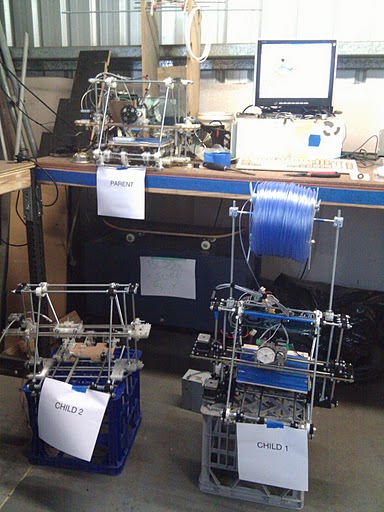
Brilliant Replicating Concept - The RepRap


RepRap from Adrian Bowyer on Vimeo.

RepRap is a free desktop 3D printer capable of printing plastic objects. Since many parts of RepRap are made from plastic and RepRap can print those parts, RepRap is a self-replicating machine - one that anyone can build given time and materials. It also means that - if you've got a RepRap - you can print lots of useful stuff, and you can print another RepRap for a friend...

RepRap is about making self-replicating machines, and making them freely available for the benefit of everyone. We are using 3D printing to do this, but if you have other technologies that can copy themselves and that can be made freely available to all, then this is the place for you too.

Reprap.org is a community project, which means you are welcome to edit most pages on this site, or better yet, create new pages of your own. Our community portal and New Development pages have more information on how to get involved. Use the links below and on the left to explore the site contents. You'll find some content translated into other languages.

Wednesday, March 11, 2009

Green Café culture


A Hand-operated Printer!

Office printers consume energy and may even pose a health risk. But the hand-powered RITI Printer, designed by Jeon Hwan Ju, is different.

Power comes from the user, who has to pull the printer head back and forth as the paper is pulled through. Cleverly, the printer also does away with expensive ink cartridges, instead making use of waste coffee.

The printed product definitely smells of coffee, which some evidence suggests could help reverse the effects of sleep deprivation. And there's no word on how permanent a coffee-printed document is.