Showing posts with label manufacturers. Show all posts
Showing posts with label manufacturers. Show all posts
Saturday, June 25, 2011
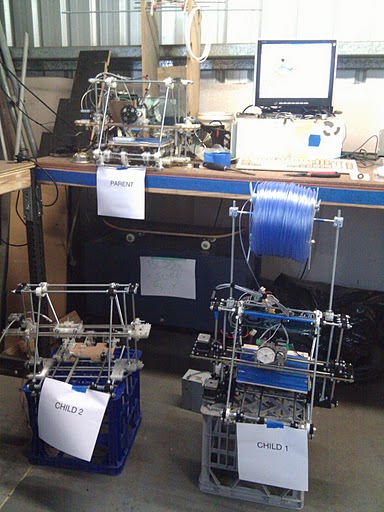
Brilliant Replicating Concept - The RepRap
RepRap from Adrian Bowyer on Vimeo.
RepRap is a free desktop 3D printer capable of printing plastic objects. Since many parts of RepRap are made from plastic and RepRap can print those parts, RepRap is a self-replicating machine - one that anyone can build given time and materials. It also means that - if you've got a RepRap - you can print lots of useful stuff, and you can print another RepRap for a friend...
RepRap is about making self-replicating machines, and making them freely available for the benefit of everyone. We are using 3D printing to do this, but if you have other technologies that can copy themselves and that can be made freely available to all, then this is the place for you too.
Reprap.org is a community project, which means you are welcome to edit most pages on this site, or better yet, create new pages of your own. Our community portal and New Development pages have more information on how to get involved. Use the links below and on the left to explore the site contents. You'll find some content translated into other languages.

Saturday, December 5, 2009
China: DIY Helicopter - still room for the little guy!
 Wu Zhongyuan, 22, a local farmer, sits in his self-made helicopter, in Jiuxian county, Henan province August 1, 2009.
 The local government, out of safety concerns, later halted Wu's plan to fly the helicopter.
The aircraft took Wu two months to build and cost more than 10,000 yuan ($1,460).
Monday, June 15, 2009
Rapid Increase in Satellite Construction & Launch
 There will be many more satellites to build and launch
A 10-year forecast of satellite and launcher markets has good news and bad news for hardware manufacturers:
There will be many more satellites to build and launch, but the average manufacturing and launch price will increase only marginally, if at all, and may even drop after accounting for inflation.
The 12th World Market Survey of satellite construction and launch trends produced by Euroconsult of Paris looks at the likely government and commercial satellite and launch landscape for the 10 years ending in 2018 and compares it to the 10 years ending in 2008.
Taking all markets - commercial, civil government and military - combined, the average satellite mass is likely to drop by 5 percent, to 4,166 pounds (1,890 kg), in the coming 10 years compared to the previous period, Euroconsult concludes.
But while the average satellite built in the next decade will lose weight, the number of satellites will increase. The study concludes that 1,185 spacecraft will be launched in the next 10 years, a 47 percent increase over the 10 years ending in 2008.
The average satellite price over the next decade will be $99 million, compared to $97 million in the past 10 years. The per-satellite launch price is predicted to remain flat, at $51 million, according to Euroconsult.
The report's principal author, Rachel Villain, said the increased participation of emerging-market economies such as India and China in the overall space market will continue to exert downward pressure on launch and satellite prices. The figures do not include microsatellites weighing less than 88 pounds (40 kg) at launch, nor do they include classified military satellites, principally from the United States and Russia.
Subscribe to:
Posts (Atom)


 Posts
Posts