Showing posts with label depth. Show all posts

Sunday, November 23, 2014

WHOI NEREUS Robotic Deep-Sea Vehicle Implodes at Hadal depth

Nereus, before its implosion.

Photo Credit: Ken Kostel/Woods Hole Oceanographic Institution

Victor Zykov is director of research at the Schmidt Ocean Institute in Palo Alto, California.

He heads a team developing a remotely operated, full ocean depth robotic vehicle.

They aim to improve on a deep-sea exploration vehicle that imploded this year.

He explains how they aim to build one that's more than a match for the pressure.

Nereus Implodes

It imploded in the Kermadec trench. The formal investigation is still underway, but the preliminary findings suggest that parts of the vehicle meant to maintain atmospheric pressure may have failed.

It was about 10,000 meters down, where the pressures are immense, like having three Humvees stacked on top of one another pressing on a thumbnail and the pressure is applied and released over and over again as the vehicle goes up and down in the water.

That creates stress fatigue and over time small cracks can spread.

Nereus's mission was to undertake high-risk, high-reward research in the deepest parts of Earth's ocean where pressure on the vehicle can be as great as 16,000 pounds per square inch. 

Credit: Advanced Imaging and Visualization Lab, Woods Hole Oceanographic Institution

A Loss to Marine Research

Nereus was the only vehicle active and available to the international scientific community to conduct research in water deeper than 6,000 meters, also known as hadal depths.

There were five projects planned for Nereus; 2014 would have been the first year of really advanced operations, so its loss was a major blow.

Designing an improved version

For buoyancy, instead of ceramics or hollow glass spheres, we plan to use an advanced material called syntactic foam, an epoxy resin with tiny hollow glass microspheres in it.

The latest version of this can survive at depths of 11,000 meters, and even if some of the glass spheres fail under pressure, they don't usually all fail at once.


Also, the camera enclosures will be much smaller, using miniaturized technology deriving from Deepsea Challenger, and will be made of either sapphire or acrylic.

Compared with glass, both materials are more consistent and have more predictable mechanical properties.

Other improvements

As well as a navigation system that will be precise to within 10 meters, even at 11,000 meters down, and better batteries that don't require a hefty pressure protection chamber, the support ship will have a control room with a nearly 180-degree field of view using high-definition screens in positions that match the placement of cameras on the vehicle.

The WHOI team are also installing 3-D video so that the pilot can perceive depth of image, too. They believe this will provide the operators with the best possible illusion of being in the deep ocean, without exposing them to the great risks of diving to hadal depths.

The new vehicle - NEREUS IIk

The current title is N11k, but that is more of a working vehicle designation than a name.

The team anticipate that they will have a competition with input from researchers, students, scientists, and so on to come up with something appropriate.

The plan is to have it ready for ocean trials in early 2016 and for scientific projects later in that year.

Wednesday, January 29, 2014

NASA MABEL: Laser Lidar technology reveals how ice measures up

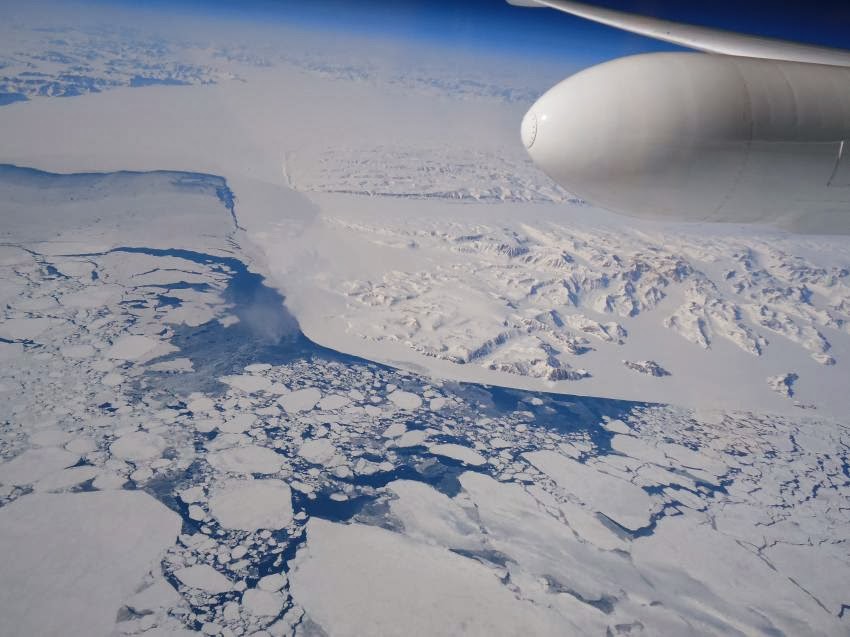
NASA's Multiple Altimeter Beam Experimental Lidar flew over Southwest Greenland's glaciers and sea ice to test a new method of measuring the height of Earth from space. 

Credit: NASA/Tim Williams

New results from NASA's MABEL campaign demonstrated that a photon-counting technique will allow researchers to track the melt or growth of Earth's frozen regions.

When a high-altitude aircraft flew over the icy Arctic Ocean and the snow-covered terrain of Greenland in April 2012, it was the first polar test of a new laser-based technology to measure the height of Earth from space.

Aboard that aircraft flew the Multiple Altimeter Beam Experimental Lidar (MABEL), which is an airborne test bed instrument for NASA's ICESat-2 satellite mission slated to launch in 2017.

Both MABEL and ICESat-2's ATLAS instrument are photon counters – they send out pulses of green laser light and time how long it takes individual light photons to bounce off Earth's surface and return.

ICESat-2's ATLAS instrument
That time, along with ATLAS' exact position from an onboard GPS, will be plugged into computer programs to tell researchers the elevation of Earth's surface – measuring change to as little as the width of a pencil.

This kind of photon-counting technology is novel for satellites; from 2003 to 2009, ICESat-1's instrument looked at the intensity of a returned laser signal, which included many photons.

So getting individual photon data from MABEL helps scientists prepare for the vast amounts of elevation data they'll get from ICESat-2.

"Using the individual photons to measure surface elevation is a really new thing," said Ron Kwok, a senior research scientist at NASA's Jet Propulsion Laboratory in Pasadena, Calif.

"It's never been done from orbiting satellites, and it hasn't really been done much with airborne instruments, either."

Ron Kwok
ICESat-2 is tasked with measuring elevation across Earth's entire surface, including vegetation and oceans, but with a focus on change in the frozen areas of the planet, where scientists have observed dramatic impacts from climate change.

There, two types of ice – ice sheets and sea ice – reflect light photons in different patterns.

Ice sheets and glaciers are found on land, like Greenland and Antarctica, and are formed as frozen snow and rain accumulates.

Sea ice, on the other hand, is frozen seawater, found floating in the Arctic Ocean and offshore of Antarctica.

MABEL's 2012 Greenland campaign was designed to observe a range of interesting icy features, said Bill Cooke, MABEL's lead scientist at NASA's Goddard Space Flight Center in Greenbelt, Md.

With the photon counts from different surfaces, other scientists could start analyzing the data to determine which methods of analyzing the data allow them to best measure the elevation of Earth's surface.

MABEL, short for "Multiple Altimeter Beam Experimental Lidar," serves as an ICESat-2 simulator. 

Credit: NASA /Kelly Brunt

"We wanted to get a wide variety of target types, so that the science team would have a lot of data to develop algorithms," Cooke said.

"This was our first real dedicated science mission."

The flights over the ocean near Greenland, for example, allowed researchers to demonstrate that they can measure the height difference between open water and sea ice, which is key to determining the ice thickness.

MABEL can detect enough of the laser light photons that bounce off Earth surface and return to the instrument, and programs can then make necessary elevation calculations, Cooke said.

Bill Cooke
"Part of what we're doing with MABEL is to demonstrate ICESat-2's instrument is going to have the right sensitivity to do the measurements," Cooke said. "You can do this photon counting if you have enough photons."

In an article recently published in the Journal of Atmospheric and Oceanic Technology, Kwok and his colleagues showed how to calculate elevation from MABEL data, and do so over different types of ice – from open water, to thin, glassy ice, to the snow-covered ice.