Showing posts with label SPHERES. Show all posts

Thursday, October 16, 2014

NASA Contest: Name a Space Station Droid

This scenario shows NASA's free-flying robot in action. 

The space agency has teamed up with TopCoder in a contest to name the new space robot.

Credit: NASA /Topcoder

NASA needs your help to name a new space robot, and you could win some cash doing it.

NASA officials are asking space fans around the world to help name, and design a mission patch for, a new free-flying robot expected to launch to the International Space Station in 2017.

The first-place winner of the challenge will receive $1,000. Officials with the space agency put out the call to any interested space fans during a packed session here at New York Comic Con on Saturday (Oct. 11).

"We have this new free-flying robot that we're building," Jason Crusan, director of NASA's Advanced Exploration Systems division, told a full house at Comic Con. "We don't know what to call it.

'Free-flying robot' sounds kind of boring and not all that exciting, so we're asking you to actually name the robot for us."

Second, third and fourth place also come with cash prizes. Second place will win $500, with third and fourth prize taking home $250 each. NASA has teamed up with Topcoder to organize the contest.

If an artist's depiction of the new space automaton is any indication, the new robot may look like something out of "Star Wars."

In the artist's concept, the robot could appear as a small, ball-shaped droid that will use fans to move itself around the interior of the International Space Station. It is expected to be able to fly itself, or be operated by remote control.

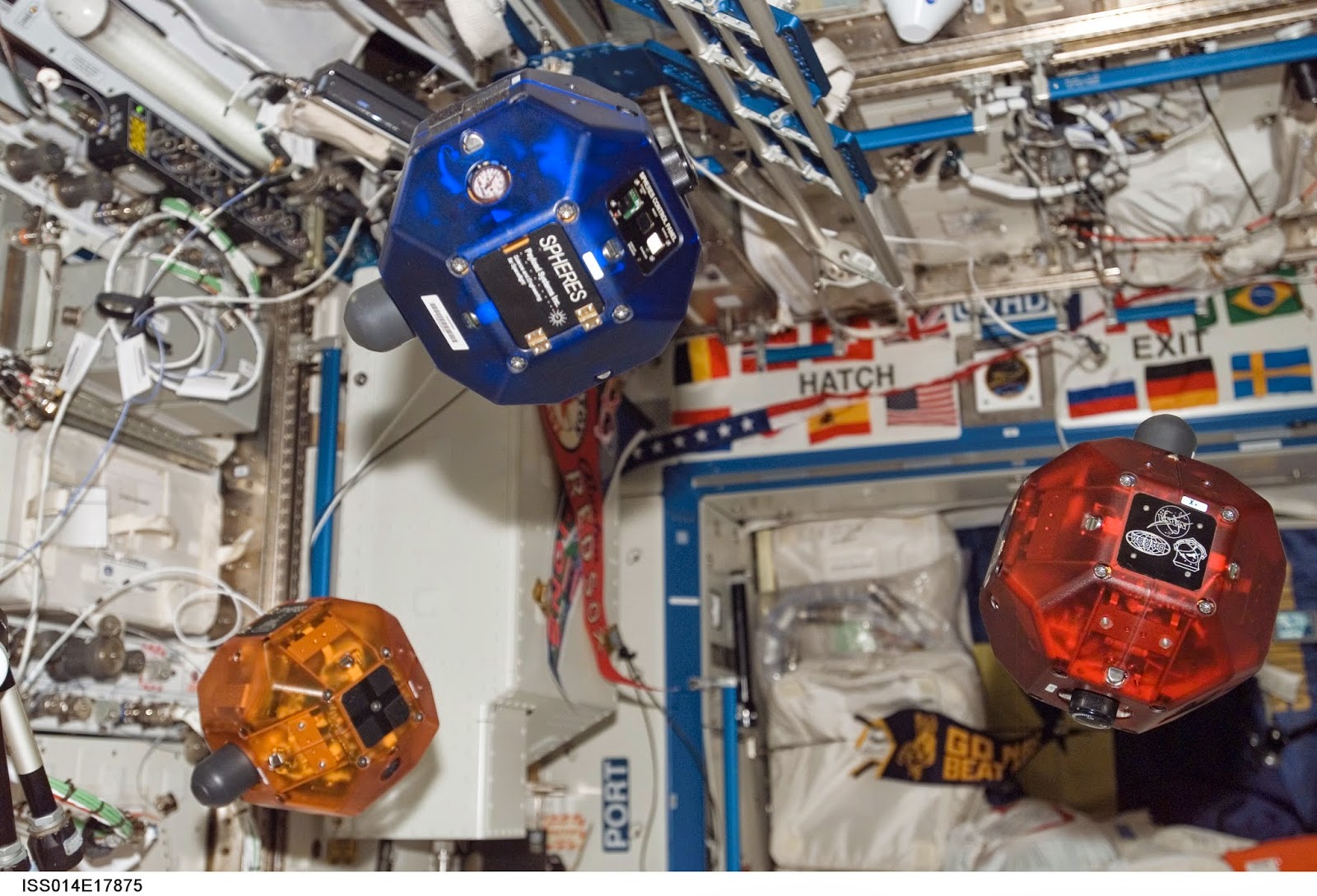
The new free-flying bot would join a group of other free-fliers already on the station. NASA's SPHERES robots (the name is short for Synchronized Position Hold, Engage, Reorient, Experimental Satellites) are already used on the orbiting outpost.

The program has been running for seven years, and is designed to help scientists test robotics hardware and software in microgravity.

The SPHERES robots and the new robot should be able to move around autonomously, but humans living and working on the orbiting outpost can also control the satellites.

"As the push for manned and automated exploration of the solar system expands, NASA and the NASA Ames Research Center are creating controlled and autonomous robotic devices capable of supplementing flight crew," officials wrote in a description of the challenge on the Topcoder website.

"These 'free-flying robots' will eventually extend the research and exploration capabilities of astronauts, as they are capable of working during off-hours and (eventually) in extreme environments."

To participate in the NASA challenge to name the new robot, space fans need to register with Topcoder. Participants will reach a checkpoint where they will receive feedback on their initial designs on Oct. 22, and the challenge ends on Oct. 27. Officials will announce the winners of the competition on Nov. 2.

Wednesday, September 10, 2014

MIT SPHERES: Spin Algorithm tested aboard the International Space Station


MIT researchers tested an algorithm that gauges the rotation of objects in zero gravity aboard the International Space Station. 

This video shows a Zero-G flight where a tracked object is spinning on its major, minor, and intermediate axes.

Objects in space tend to spin, and spin in a way that's totally different from the way they spin on earth.

Understanding how objects are spinning, where their centers of mass are, and how their mass is distributed is crucial to any number of actual or potential space missions, from cleaning up debris in the geosynchronous orbit favoured by communications satellites to landing a demolition crew on a comet.

In a forthcoming issue of the Journal of Field Robotics, MIT researchers will describe a new algorithm for gauging the rotation of objects in zero gravity using only visual information, and at the International Conference on Intelligent Robots and Systems this month, they will report the results of a set of experiments in which they tested the algorithm aboard the International Space Station.

On all but one measure, their algorithm was very accurate, even when it ran in real time on the microprocessor of a single, volleyball-size experimental satellite.

On the remaining measure, which indicates the distribution of the object's mass, the algorithm didn't fare quite as well when running in real time, although its estimate may still be adequate for many purposes, but it was much more accurate when it had slightly longer to run on a more powerful computer.

Space trash

"There are satellites that are basically dead, that are in the 'geostationary graveyard,' a few hundred kilometers from the normal geostationary orbit," says Alvar Saenz-Otero, a principal research scientist in MIT's Department of Aeronautics and Astronautics.

"With over 6,000 satellites operating in space right now, people are thinking about recycling. Can we get to that satellite, observe how it's spinning, and learn its dynamic behaviour so that we can dock to it?"

Moreover, "there's a lot of space trash these days," Saenz-Otero adds. "There are thousands of pieces of broken satellites in space."

"If you were to send a supermassive spacecraft up there, yes, you could collect all of those, but it would cost lots of money, but if you send a small spacecraft, and you try to dock to a small, tumbling thing, you also are going to start tumbling."

"So you need to observe that thing that you know nothing about so you can grab it and control it."

Joining Saenz-Otero on the paper are lead author Brent Tweddle, who was an MIT graduate student in aeronautics and astronautics when the work was done and is now at NASA's Jet Propulsion Laboratory; his fellow grad student Tim Setterfield; AeroAstro Professor David Miller; and John Leonard, a professor of mechanical and ocean engineering.

The researchers tested their algorithm using two small satellites deployed to the space station through MIT's SPHERES project, which envisions that herds of coordinated satellites the size of volleyballs would assist human crews on future space missions.

One SPHERES satellite spun in place while another photographed it with a stereo camera.

Tuesday, July 22, 2014

ESA SPHERES Mission: Activating Spheres robots

Spheres robots on the International Space Station. 

The volleyball-sized satellites have their own power, propulsion and navigation systems and are used in an international competition for secondary-school students. 

Each year a tournament is held where students earn points by writing control algorithms to operate the spheres and by choosing the best tactics to win the game.

Credit: ESA

Code, play and command your space droid, students across Europe can bring a squadron of mini-satellites to life on the International Space Station as the ultimate space robot game.

For the fourth year, the Zero Robotics tournament will turn the Station into a gaming arena for European secondary-school pupils.

The competition challenges youngsters to write instructions that control volleyball-sized satellites through a virtual field mined with obstacles.

The Spheres, (Synchronised Position Hold, Engage, Reorient, Experimental Satellites), obey remote commands and can hover around the weightless Station using their own power, propulsion and navigation.

The tournament is not only about writing code. Participants must solve problems, apply their maths and physics knowledge and work in teams to achieve success.

European contenders should start working now on self-developed software and plan their strategy for the competition, ready for when the final details of the mission are unveiled in September.

May the code be with you
The contest starts with online simulations of increasing difficulty. Competitors can create and visualise their code to get ready for the game from a web browser and free of charge.

Models of the Spheres robots sent to the International Space Station at the Massachusetts Institute of Technology. 

The robots are programmed by students on Earth to perform operations based on real-life situations. 

Compressed air is used to move the spheres in all directions. 

ESA participation in the pilot programme of Zero Robotics involved collaborating with various universities and academic institutes. 

ESA provided the opportunity to send teachers from universities to the Massachusetts Institute of Technology to receive training in Spheres operation and coding. 

The skills learnt were then passed on to the local high school teachers whose teams participated in the event. 

Credit: MIT

After playing against other teams in simulation rounds to build the highest scores, finalists will see their commands ruling the Spheres on the Space Station.

ESA astronaut Samantha Cristoforetti will support the European teams, running the live competition from the front line on the orbital outpost.

NASA astronauts Kevin Ford (background) and Tom Marshburn, setting up two Spheres robots in the Kibo laboratory on the International Space Station. 

The volleyball-sized satellites have their own power, propulsion and navigation systems and are used in an international competition for high-school students. 

Each year a tournament is held where students earn points by writing control algorithms to operate the spheres and by choosing the best tactics to win the game. 

The European finalists of 2013 consisted of six alliances from Italy, Germany, Spain and Portugal. 

Credit: NASA

The finals will take place in January, with the US teams at the Massachusetts Institute of Technology and the European teams at ESA's Technical Centre, ESTEC, in Noordwijk, the Netherlands.

Saturday, March 1, 2014

Mars Yamato Meteorite: Odd 'Tunnels' & 'Spheres' and Ancient Martian Life

This scanning electron microscope image shows spheroidal features in a layer of iddingsite, a mineral formed by action of water, in the meteorite Yamato 000593 that came from Mars. 

An area with the spheres, circled in red, was found to have about twice as much carbon present as an area (circled in blue) without the spheres.

Credit: NASA

The discovery of tiny carbon-rich balls and tunnels inside a Martian meteorite has once again raised the possibility that the Red Planet was teeming with primitive life millions of years ago.

The meteorite, which fell to Earth during the Stone Age, contains microscopic burrows and spheres that resemble the marks microorganisms leave when they eat through rocks on Earth, scientists report in the journal Astrobiology this month.

What's more, these features seem to have been pressed into the Mars rock before it was hurled off the Red Planet by an impact event, the researchers add.

White Lauren M., Gibson Everett K., Thomas-Keprta Kathie L., Clemett Simon J., and McKay David S.; The authors of the new research are not claiming they've found evidence of ancient life on Mars.

In fact, nowhere in their paper do they use the word "life." (Their preferred term is "biotic activity.")

But their findings revive the debate about the possibility of microbes in Mars' past and highlight how much information scientists can actually glean from Martian meteorites that end up on Earth.

"It further strengthens the case for past life on Mars, but, of course, it is by no means proof," said astrobiologist Dirk Schulze-Makuch of Washington State University, who was not involved in the study.

Scientists haven't yet found any solid proof that life actually existed on ancient Mars — but they have found evidence that the planet could have been habitable.

Though Mars is barren today, scientists think water — a key ingredient for life — would have covered its surface in the form of oceans, rivers and streams.

And last year, NASA's newest Mars rover, Curiosity, discovered the first evidence that the Red Planet could have supported living microbes billions of years ago.

While Mars rovers, landers and satellites are hunting for life-friendly conditions on the Red Planet, scientists also can look for evidence of ancient life in Martian meteorites that have landed on Earth.

This scanning electron microscope image of a polished thin section of a meteorite from Mars shows tunnels and curved microtunnels. 

The clay mineral iddingsite is present in this meteorite, named Yamato 000593, which was found in Antarctica in 2000 and identified as originating from Mars. 

The scale bar at lower left is 2 microns. 

Credit: NASA

Monday, February 17, 2014

Space Station SPHERES run circles around ordinary satellites

NASA astronaut Thomas Marshburn tests the SPHERES-Vertigo investigation hardware, which resembles eye goggles, as it flies aboard the International Space Station. 

Credit: NASA

These are, in fact, the droids that NASA and its research partners are looking for.

Inspired by a floating droid battling Luke Skywalker in the film Star Wars, the free-flying satellites known as Synchronized Position Hold, Engage, Reorient, Experimental Satellites (SPHERES) have been flying aboard the International Space Station since Expedition 8 in 2003.

Although there have been numerous SPHERES investigations held on the orbiting laboratory, four current and upcoming SPHERES projects are of particular significance to robotics engineers, rocket launch companies, NASA exploration and anyone who uses communications systems on Earth.

The SPHERES-Vertigo, Department of Defense (DOD) SPHERES-Rings, SPHERES-Slosh and SPHERES-Inspire II investigations all use the existing SPHERES space station facility of these self-contained satellites.

Powered not by an astronaut's use of the Force, but by AA batteries, the satellites act as free-flying platforms that can accommodate various mounting features and mechanisms in order to test and examine the physical or mechanical properties of materials in microgravity.

Each satellite is an 18-sided polyhedron and is roughly the size of a soccer ball.

NASA's Ames Research Center in Moffett Field, Calif., operates and maintains the SPHERES research facility aboard the space station, which is funded by the Human Exploration and Operations Mission Directorate at NASA Headquarters in Washington.

SPHERES provide a unique low risk, low-cost, long-term microgravity research facility that supports quick-reaction testing of technologies that can be repeated numerous times.

Alvar Saenz Otero, Ph.D., associate director and SPHERES lead scientist at the Massachusetts Institute of Technology (MIT) Space Systems Laboratory describes the reusability of SPHERES for multiple microgravity investigations by saying, "if anything goes wrong, reset and try again!"

Operating intermittently since February 2013, the SPHERES Visual Estimation and Relative Tracking for Inspection of Generic Objects (SPHERES-Vertigo) investigation uses what looks like eye goggles and other new hardware and software on multiple satellites during testing.

The purpose of the study is to build 3-D models of a target using mapping algorithms and computer vision-based navigation.

These additions to the satellites help researchers create 3-D maps of a previously unknown object for navigation by flying the SPHERES in a path around that object while taking photos.

Brent Tweddle, a postdoctoral associate with the MIT Space Systems Laboratory, said the SPHERES-Vertigo project differs from previous SPHERES experiments by "adding a pair of stereo cameras, which see, perceive and understand their world visually and can communicate with satellites using Vertigo goggles."

The goggles act "like their own little intelligence block that sticks on the front end of the SPHERES and allows them to see the rest of the world that they want to navigate through," explained Tweddle.

Read the full article here

Tuesday, January 22, 2013

Nasa Sphere Satellites in the ISS

The International Space Station has 3 small Sphere satellites used to test control algorithms. 

They form part of an MIT Project and are available for students to program.

They are designed to act in unison with each other in a group or swarm.

Nasa


Thursday, September 13, 2012

Spheres: Developing a Space Debris Removal Skill - YouTube


In-orbit rendezvous is a potential solution to address space debris removal, considered to be the predominant issue facing the arena of outer space security and safety.

DARPA, the US Defense Advanced Research Projects Agency, is using an unusual resource to develop rendezvous capability with out of control satellites: a high school competition.

“The control procedures that were developed for the Zero Robotics Challenge will certainly benefit the Phoenix program,” said Dave Barnhart, DARPA program manager.

He was referring to DARPA’s defunct satellite recycling project, “but they also potentially have much wider implications for space-based technologies.”

Participants in the Zero Robotics Autonomous Space Capture Challenge designed algorithms to control a bowling-ball-sized programmable satellite known as SPHERES.

There are three SPHERES currently aboard the ISS for use in such experiments in an environment where there is no risk of losing the test subjects.

The algorithms were applied across three different scenarios in which the SPHERES satellite simulated an active spacecraft approaching an object tumbling through space.

The Synchronized Position Hold, Engage, Reorient Experimental Satellites (SPHERES)

Through the Phoenix program, DARPA aims to catch retired communication satellites in geosynchronous orbit in order to collect and re-use some of their components.

To do this, the Phoenix spacecraft will have to perform a delicate dance to safely synchronize movements with tumbling satellites and to be able to deploy tools and attach or remove targeted parts.

Extended use of such a technology could allow the removal of more general space debris like fragments from collisions and exploded rocket bodies or objects from extravehicular activities.