Showing posts with label Algorithm. Show all posts

Wednesday, September 10, 2014

MIT SPHERES: Spin Algorithm tested aboard the International Space Station


MIT researchers tested an algorithm that gauges the rotation of objects in zero gravity aboard the International Space Station. 

This video shows a Zero-G flight where a tracked object is spinning on its major, minor, and intermediate axes.

Objects in space tend to spin, and spin in a way that's totally different from the way they spin on earth.

Understanding how objects are spinning, where their centers of mass are, and how their mass is distributed is crucial to any number of actual or potential space missions, from cleaning up debris in the geosynchronous orbit favoured by communications satellites to landing a demolition crew on a comet.
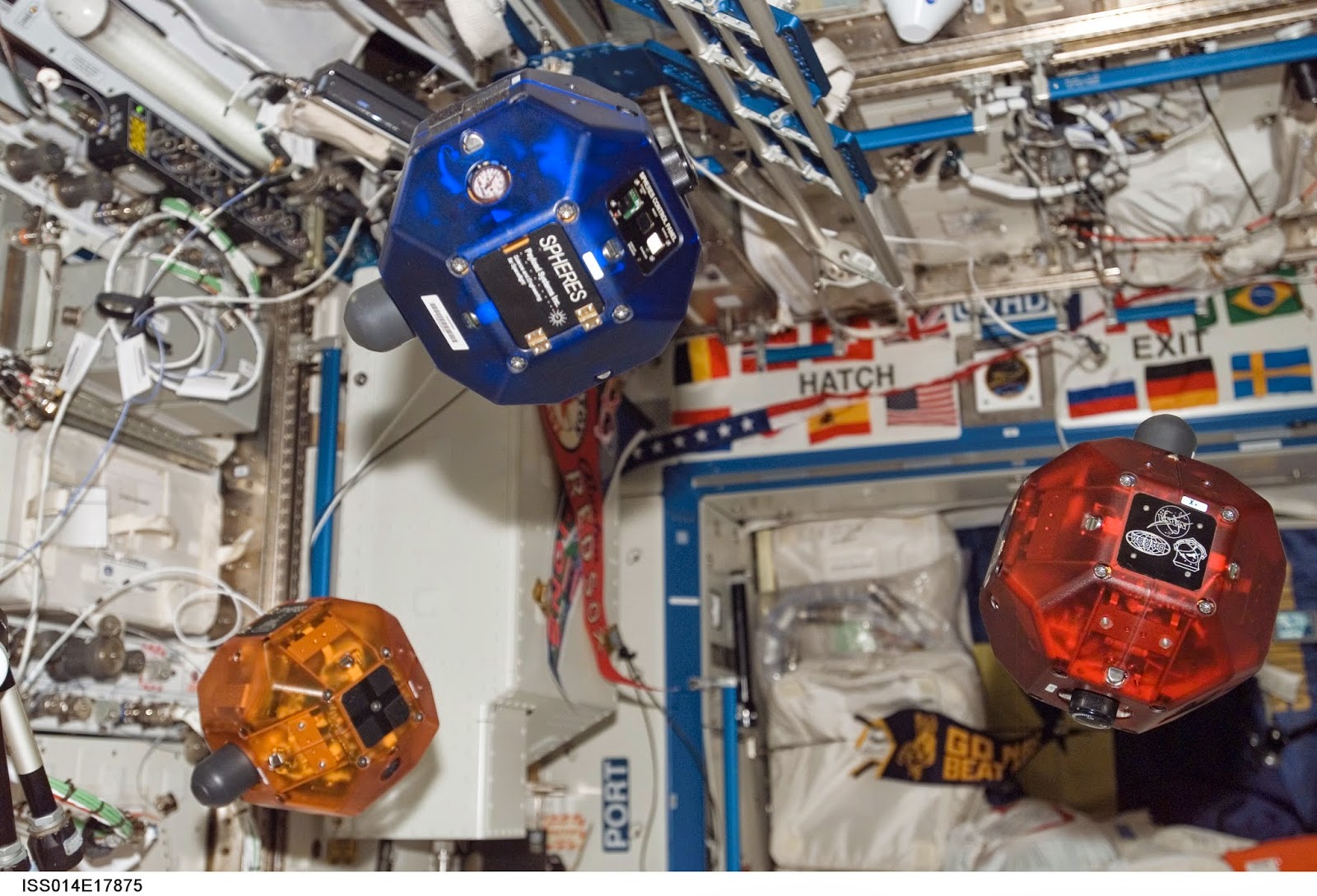
In a forthcoming issue of the Journal of Field Robotics, MIT researchers will describe a new algorithm for gauging the rotation of objects in zero gravity using only visual information, and at the International Conference on Intelligent Robots and Systems this month, they will report the results of a set of experiments in which they tested the algorithm aboard the International Space Station.

On all but one measure, their algorithm was very accurate, even when it ran in real time on the microprocessor of a single, volleyball-size experimental satellite.

On the remaining measure, which indicates the distribution of the object's mass, the algorithm didn't fare quite as well when running in real time, although its estimate may still be adequate for many purposes, but it was much more accurate when it had slightly longer to run on a more powerful computer.

Space trash

"There are satellites that are basically dead, that are in the 'geostationary graveyard,' a few hundred kilometers from the normal geostationary orbit," says Alvar Saenz-Otero, a principal research scientist in MIT's Department of Aeronautics and Astronautics.

"With over 6,000 satellites operating in space right now, people are thinking about recycling. Can we get to that satellite, observe how it's spinning, and learn its dynamic behaviour so that we can dock to it?"

Moreover, "there's a lot of space trash these days," Saenz-Otero adds. "There are thousands of pieces of broken satellites in space."

"If you were to send a supermassive spacecraft up there, yes, you could collect all of those, but it would cost lots of money, but if you send a small spacecraft, and you try to dock to a small, tumbling thing, you also are going to start tumbling."

"So you need to observe that thing that you know nothing about so you can grab it and control it."

Joining Saenz-Otero on the paper are lead author Brent Tweddle, who was an MIT graduate student in aeronautics and astronautics when the work was done and is now at NASA's Jet Propulsion Laboratory; his fellow grad student Tim Setterfield; AeroAstro Professor David Miller; and John Leonard, a professor of mechanical and ocean engineering.

The researchers tested their algorithm using two small satellites deployed to the space station through MIT's SPHERES project, which envisions that herds of coordinated satellites the size of volleyballs would assist human crews on future space missions.

One SPHERES satellite spun in place while another photographed it with a stereo camera.

Wednesday, September 18, 2013

Algorithm finds missing phytoplankton in Southern Ocean

This still image is showing the concentrations of phytoplankton observed by satellites in the Southern Ocean. Credit: Robert Johnson 

NASA satellites may have missed more than 50% of the phytoplankton in the Southern Ocean, making it far more difficult to estimate the carbon capture potential of this vast area of sea.

But now, new research published in the Journal of Geophysical Research, Three improved satellite chlorophyll algorithms for the Southern Ocean, has led to the development of an algorithm that produces substantially more accurate estimates of Southern Ocean phytoplankton populations.

That research from the University of Tasmania's Institute for Marine and Antarctic Studies (IMAS) was led by PhD student Rob Johnson and Associate Prof Peter Strutton

"This new algorithm allows us to detect changes in plankton numbers that have previously gone unnoticed," said Johnson.

"This better understanding of the phytoplankton population will, in turn, allow us to gain a much more accurate idea of how much carbon this ocean can take up."

Phytoplankton
The importance of phytoplankton and their role in our planetary ecosystem cannot be underestimated.

They form the base of the marine food chain, produce half the oxygen on Earth and are partly responsible for the ocean uptake of at least a third of total human induced CO2 emissions.

So it was important to understand why existing ocean colour satellites systematically underestimated the chlorophyll concentration (a proxy for phytoplankton biomass) of the Southern Ocean and Antarctica.

To get the observations needed to make valid comparisons and develop the algorithm, the researchers used more than 1000 Southern Ocean phytoplankton samples collected over 10 years and compared these to satellite measurements.

Once this observational data was collected, the new algorithm was used to process satellite data and make comparisons.

It quickly became clear that the algorithm produced a much closer estimate of phytoplankton numbers than past satellite measurements.

Tuesday, January 26, 2010

Nuclear fission algorithm is created

Nuclear fission algorithm is created

U.S. Department of Energy scientists say they've created a computer algorithm that allows a substantially enhanced view of nuclear fission.

The Argonne National Laboratory scientists said the algorithm, known as the neutron transport code, enables researchers for the first time to obtain a highly detailed description of a nuclear reactor core.

"The code could prove crucial in the development of nuclear reactors that are safe, affordable and environmentally friendly," laboratory officials said in a statement.

To model the complex geometry of a reactor core currently requires billions of spatial elements, hundreds of angles and thousands of energy groups -- all of which lead to problem sizes with quadrillions of possible solutions, the researchers said. Such calculations exhaust computer memory of the largest machines, they said, and therefore reactor modeling codes typically rely on various approximations.

"The (neutron transport code) is intended to reduce the uncertainties and biases in reactor design calculations by progressively replacing existing multilevel averaging techniques with more direct solution methods based on explicit reactor geometries," said Andrew Siegel, leader of Argonne's reactor simulation group.

Officials said the code has run successfully in some of the world's fastest supercomputers, including the IBM Blue Gene at Argonne and the Cray XT5 at the Oak Ridge National Laboratory.

Friday, October 9, 2009

Software Algorithm can detect Gout on CT Scan

Having gout, a painful inflammation of your joints, usually in the feet or knees is bad enough, but diagnosing it is no bargain either (the test involves a needle stick into the offending joint).
But a new software algorithm used to detect gout via a scanner is promising a much less invasive test. On the scan CT values of uric acid deposits show up in red, while other bone formations and calcium are displayed in blue, according to Siemens which developed the system.