Showing posts with label unmanned airborne system. Show all posts

Wednesday, September 26, 2012

NASA Drone: Global Hawk Aircraft

This image captures a perspective of NASA's Global Hawk unmanned aircraft from one of the wings.

The Global Hawk is sitting at the aircraft hangar of NASA's Wallops Flight Facility in Wallops Island, Va. on Sept. 7, 2012.

The month-long Hurricane and Severe Storm Sentinel (HS3), which began in early September, is currently deploying one instrument-laden Global Hawk from the NASA Wallops Flight Facility on Virginia's Eastern Shore to look at the environment of tropical storms.

In 2013 and 2014, a second Global Hawk will be added that will focus on getting detailed measurements of the inner core of hurricanes.

The Global Hawk's ability to fly for a much longer period of time than manned aircraft will allow it to obtain previously difficult-to-get data.

Scientists hope to use that data to gain new insights into how tropical storms form, and more importantly, how they intensify into major Atlantic hurricanes — information that forecasters need to make better storm predictions, save lives, and ultimately prevent costly coastal evacuations if a storm doesn't warrant them.

Image Credit: NASA

Thursday, June 14, 2012

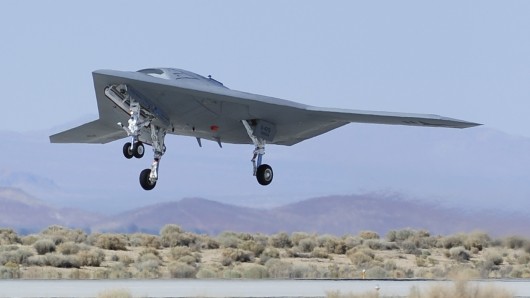
X-47B Drone: Unmanned aircraft completes first major flight-test


The Northrop Grumman-built X-47B has passed the latest checkpoint on its flight path towards becoming the first carrier-based, tailless, fighter-sized, unmanned aircraft in the U.S. Navy’s arsenal with the successful conclusion of the first major phase of flight testing at Edwards Air Force Base (EAFB) in California.

The airworthiness test phase, which kicked off with the maiden flight on February 4, 2011, saw two X-47B Unmanned Combat Air System (UCAS) demonstrators conduct 23 flights in which the aircraft reached altitudes in excess of 15,000 feet and demonstrated multiple maneuvers required for carrier operations.

These included the first flight in cruise mode, extending and retracting a tail hook, completing an aviation-first autonomous “touch-and-go” landing, and landings at a high sink rate and in heavy weight configuration.

Northrop Grumman says the flight tests proved the aircraft’s ability to perform properly at all speeds, weights and altitudes associated with the Navy’s Unmanned Combat Air System Carrier Demonstration (UCAS-D) program.


"The X-47B flight test program at Edwards will be remembered as a very successful collaboration among the Navy, Northrop Grumman and the U.S. Air Force Flight Test Center," said Carl Johnson, vice president and Navy UCAS Enterprise program manager for Northrop Grumman's Aerospace Systems sector.

"The X-47B flight test program at Edwards demonstrated convincingly the maturity, durability and performance of this revolutionary new unmanned system.”

Following the completion of the airworthiness flight tests at EAFB on May 15, the second X-47B has been transported cross-country to Naval Air Station Patuxent River in Maryland.

It joins the first X-47B that was moved there in December 2011 and is currently undergoing electromagnetic interference testing to ensure it is compatible with the electromagnetic signal environment experienced on an aircraft carrier.

Wednesday, April 11, 2012

Pentagon considers NASA's nuclear-powered drones

NASA long duration Global Hawk. Furture UAVs could be powered by nuclear batteries staying airborne for months at a time.

NASA scientists are working on new-generation nuclear-powered unmanned aircraft capable of staying in the air for up to several months.

While being able to tackle a wider range of more complicated tasks compared to their existing analogues, the new drones will not require a costly air base network for refueling and technical maintenance.

What's more, on February 14 President Barack Obama signed the Federal Aviation Administration Reauthorization Act that allows the use drones in U.S. airspace by both state-owned and private companies.

The CIA has often resorted to drones in its war on global terrorism. In the past decade, U.S. drones flew various missions in Afghanistan, Pakistan and other "hot spots".

Unlike manned warplanes, they offer considerable advantages and help avoid a diplomatic scandal that normally erupts whenever pilots are taken prisoner.

In October 2009, the CIA reported that more than a half of 20 most dangerous Al Qaeda leaders were eliminated with the help of drones.

Despite being an effective anti-terror tool, drones have become a nightmare for local residents. Civilian deaths inflicted by drone strikes have repeatedly strained relations between America and Pakistan, one of its key allies in the crackdown on terrorism.

According to a report published by the Washington-based Brookings Institution in 2009, ten times as many civilians as suspected terrorists died in U.S. drone attacks.

Pakistan's patience expired in November 2011 after a drone strike erroneously targeted Pakistani troops, prompting Islamabad to shut NATO supply routes to Afghanistan.

The above Reauthorization Act approved by the Senate and signed into law by President Obama shows that no lessons have been learnt from that incident.

While providing virtually unlimited opportunities for the use of drones in search and rescue effort as well as in battling wildfires, the document gives the "green light" for drone-based domestic spying.

A tandem of the Sandia National Laboratories and Northrop Grumman company is said to be the closest ever to creating nuclear-powered highly-maneuverable missile-carrying drones that can fly for months on end without refueling.

Analysts are warning that the improved drone technology has some major drawbacks to consider.

Drones are not easy to control and the intended proliferation of drones in the skies over the US and other countries may affect the safety of passenger planes and other manned aircraft.

Human rights activists are also ringing alarm over civil liberties violations arising from drone spying.

Monday, May 17, 2010

The Boeing Phantom Ray unmanned airborne system

The Boeing Phantom Ray unmanned airborne system is seen during an unveiling ceremony in St Louis, USA.

With a 50-foot wingspan and measuring 36 feet long, Phantom Ray has advanced technologies, including intelligence, surveillance and reconnaissance; suppression of enemy air defenses; electronic attack and autonomous aerial refuelling

Picture: UPI