Showing posts with label robots. Show all posts

Wednesday, January 14, 2015

Snake Monster: Six-legged robot first of new breed of reconfigurable modular robots - Video


Carnegie Mellon University's latest robot is called Snake Monster, however, with six legs, it looks more like an insect than a snake, but it really doesn't matter what you call it, says its inventor,

Howie Choset, the whole point of the project is to make modular robots that can easily be reconfigured to meet a user's needs.

Choset, a professor in CMU's Robotics Institute, said the walking robot, developed in just six months, is only one example of the robots that eventually can be built using this modular system.

His team already is working on modules such as force-sensing feet, wheels and tank-like treads that will enable the assembly of totally different robots.

"By creating a system that can be readily reconfigured and that also is easy to program, we believe we can build robots that are not only robust and flexible, but also inexpensive," Choset said.

"Modularity has the potential to rapidly accelerate the development of traditional industrial robots, as well as all kinds of new robots."

The Defense Advanced Research Projects Agency (DARPA) sponsored this work through its Maximum Mobility and Manipulation (M3) program, which focuses on ways to design and build robots more rapidly and enhance their ability to manipulate objects and move in natural environments.

Snake Monster, as well as some of Choset's other robots, will be demonstrated at the finals of the DARPA Robotics Challenge, June 5-6 in Pomona, Calif.

For years, Choset's lab has concentrated on building and operating snake-like robots—chains of repeated component joints.

By careful coordination of these joints, the robots can be made to move in ways that are similar to a snake's natural undulations and in other ways not seen in nature, such as rolling.

Applications for these robots include urban search and rescue, archaeological exploration and, thanks to the robots' ability to move through pipes, inspection of power plants, refineries and sewers.

Thursday, October 16, 2014

Octoarm: Flexible 'Tentacle Robots' Could Aid Planetary Exploration

Flexible 'tentacle robots' can stack cones and perform other complex tasks. 

Credit: Ian Walker, Clemson University

Space robots are about to get a whole lot sleeker and slinkier.

Researchers are developing new types of robotic systems inspired by elephant trunks, octopus arms and giraffe tongues.

These flexible, maneuverable "tentacle robots" could have a variety of space applications, from inspecting hard-to-reach gear on the International Space Station to exploring crevices on Mars, scientists say.

"Those are all things that would be difficult for a conventional robot to do," robotic engineer Ian Walker of Clemson University said in April during a presentation with NASA's Future In-Space Operations (FISO) working group.

Robotic systems inspired by elephant trunks, octopus arms and other structures found in nature could have a variety of space applications, experts say.

Credit: Ian Walker, Clemson University

The conventional robots to which Walker refers are mainstays of assembly lines around the world.

They tend to be anthropomorphic, often modeled after the human arm, and are built to do one thing and do it well, over and over again.

These machines perform precision tasks in highly structured environments, with limited flexibility and adaptability, Walker said.

"What we want to do is something rather different than that," he said. The goal is to develop "something that can adapt its shape more completely down its structure, and to be able to adapt to environments you haven't seen before. So it's the non-factory scenario, in many ways."

Such snakelike robots could aid spaceflight and exploration, Walker said.

Monday, September 22, 2014

New RFID technology helps PR2 robots find household objects


A Georgia Tech research team has developed a new search algorithm that improves a robot’s ability to find and navigate to tagged objects.

Mobile robots could be much more useful in homes, if they could locate people, places and objects.

Today's robots usually see the world with cameras and lasers, which have difficulty reliably recognizing things and can miss objects that are hidden in clutter.

A complementary way robots can "sense" what is around them is through the use of small ultra-high frequency radio-frequency identification (UHF RFID) tags.

Inexpensive self-adhesive tags can be stuck on objects, allowing an RFID-equipped robot to search a room for the correct tag's signal, even when the object is hidden out of sight.

Once the tag is detected, the robot knows the object it's trying to find isn't far away.

"But RFID doesn't tell the robot where it is," said Charlie Kemp, an associate professor in Georgia Tech's Wallace H. Coulter Department of Biomedical Engineering.

"To actually find the object and get close to it, the robot has to be more clever."

A PR2 robot successfully navigates to a medication bottle. 

Credit: Georgia Tech/Travis Deyle

That's why Kemp, former Georgia Tech student Travis Deyle and University of Washington Professor Matthew Reynolds developed a new search algorithm that improves a robot's ability to find and navigate to tagged objects.

The team has implemented their system in a PR2 robot, allowing it to travel through a home and correctly locate different types of tagged household objects, including a medication bottle, TV remote, phone and hair brush.

The research was presented September 14-18 in Chicago at the IEEE/RSJ International Conference on Intelligent Robots and Systems (IROS).

The researchers have equipped a PR2 robot with articulated, directionally sensitive antennas and a new algorithm that allows the robot to successfully find and navigate to the intended object.

Due to the physics of radio-frequency propagation, these antennas tend to receive stronger signals from a tag when they are closer to it and pointed more directly at it.

By moving around the antennas on its shoulders and driving around the room, the PR2 can figure out the direction it should move to get a stronger signal from a tag and thus become closer to a tagged object.

In essence, the robot plays the classic childhood game of "Hotter/Colder" with the tag telling the PR2 when it's getting closer to the target object.

Charlie Kemp is an associate professor in the Wallace H. Coulter Department of Biomedical Engineering. Credit: Georgia Tech

In contrast to other approaches, the robot doesn't explicitly estimate the 3D location of the target object, which significantly reduces the complexity of the algorithm.

"Instead the robot can use its mobility and our special behaviors to get close to a tag and oriented toward it," said Deyle, who conducted the study in Kemp's lab while earning his doctoral degree in Electrical and Computer Engineering from Georgia Tech.

Deyle, who currently works at Google, says the research has implications for future home robots and is particularly compelling for applications such as helping people with medicine, as RFID is able to provide precise identification information about an object or a person.

"This could allow a robot to search for, grasp and deliver the right medication to the right person at the right time," he added.

"RFID provides precise identification, so the risk of delivering the wrong medication is dramatically reduced. Creating a system that allows robots to accurately locate the correct tag is an important first step."

More information: 
Travis Deyle, Matt Reynolds and Charles C. Kemp, "Finding and Navigating to Household Objects with UHF RFID Tags by Optimizing RF Signal Strength." IEEE/RSJ International Conference on Intelligent Robots and Systems (IROS), 2014. www.hsi.gatech.edu/hrl/pdf/iro… le_reynolds_kemp.pdf

Thursday, September 18, 2014

'Honeybee' Colias robots replicate swarm behaviour

Colias with grasshopper (for scale).

Credit: Image courtesy of University of Lincoln

Computer scientists have created a low-cost, autonomous micro-robot which in large numbers can replicate the behaviour of swarming honeybees Colias, named after a genus of butterfly, is an open-platform system that can be used to investigate collective behaviours and be applied to swarm applications.

Robotic swarms that take inspiration from nature have become a topic of fascination for robotics researchers, whose aim is to study the autonomous behaviour of large numbers of simple robots in order to find technological solutions to common complex tasks.

Due to the hardware complexities and cost of creating robot hardware platforms, current research in swarm robotics is mostly performed by simulation software.

However, the simulation of large numbers of these robots in robotic swarm software applications is often inaccurate due to the poor modelling of external conditions.


Colias was created by a team of scientists led by the University of Lincoln, UK, with Tsinghua University in China.

It has been proven to be feasible as an autonomous platform, effectively replicating a honeybee swarm.

Its small size (4cm diameter) and fast motion (35cm/s) means it can be used in fast-paced swarm scenarios over large areas.

In comparison to other mobile robots which are utilized in swarm robotic research, Colias is a low-cost platform, costing around £25, making the replication of swarm behaviour in large numbers of robots more feasible and economical for researchers.

Farshad Arvin, from the School of Computer Science, University of Lincoln, was part of the research team which developed Colias.

He said: "The platform must be able to imitate swarm behaviours found in nature, such as insects, birds and fish. Colias has been designed as a complete platform with supporting software development tools for robotics education and research."

Farshad Arvin
"This concept allows for the coordination of simple physical robots in order to cooperatively perform tasks."

"The decentralised control of robotic swarms can be achieved by providing well-defined interaction rules for each individual robot."

"Colias has been used in a bio-inspired scenario, showing that it is extremely responsive to being used to investigate collective behaviours."

"Our aim was to imitate the bio-inspired mechanisms of swarm robots and to enable all research groups, even with limited funding, to perform such research with real robots."

Long-range infrared proximity sensors allow the robot to communicate with its direct neighbours at a range of 0.5cm to 2m.

A combination of three short-range sensors and an independent processor enables the individual robots to detect obstacles.

A similar but more complex mechanism has been found in locust vision, where a specific neuron called the 'lobula giant movement detector' reacts to objects approaching the insects' eyes.

Co-author Professor Shigang Yue, also from Lincoln's School of Computer Science, previously created a computerised system which supports the autonomous navigation of mobile robots based on the locust's unique visual system.

This earlier research, published in the International Journal of Advanced Mechatronic Systems (2013), could provide the blueprint for the development of highly accurate vehicle collision sensors, surveillance technology and even aid video game programming.

The next step for the Colias research team is to work on an extension of the vision module using a faster computer processor to implement bio-inspired vision mechanisms.

Full details of their research have been published in the International Journal of Advanced Robotic Systems.

Journal Reference:
Farshad Arvin, John Murray, Chun Zhang, Shigang Yue. Colias: An Autonomous Micro Robot for Swarm Robotic Applications. International Journal of Advanced Robotic Systems, 2014; 1 DOI: 10.5772/58730

Monday, December 23, 2013

DARPA Robotics Challenge: Japan's SCHAFT team ahead on points

For those wondering who of 16 competing teams would walk away as top performers in the two-day DARPA Robotics Challenge in Florida over the weekend, the suspense is over.

SCHAFT, a Japanese military robotics company newly acquired by Google, won the most points, 27 out of a possible 32. SCHAFT outscored some formidable big-name contenders such as MIT, Carnegie Mellon, and NASA. IHMC Robotics placed second.

Third place went to Tartan Rescue, from Carnegie Mellon University, and fourth place was awarded to a team from the Massachusetts Institute of Technology.

The fifth-place went to RoboSimian, designed by NASA's Jet Propulsion Laboratory.

All in all, there were eight top scorers. Team TRACLabs, WRECS (Worcester Polytechnic Institute) and Team TROOPER (Lockheed Martin) were the next three.

The eight teams now have the opportunity to continue their work with the help of Defense Advanced Research Projects Agency (DARPA) funding and are to compete in the finals event where one team will net the $2 million prize at the end of 2014.

The Finals will require robots to attempt a circuit of consecutive physical tasks with degraded communications between the robots and their operators.

DARPA said that the 16 teams at this year's challenge in Miami represented a mix of government, academic and commercial backgrounds. They were not only from the United States, but also from South Korea and Japan.

SCHAFT's high scores were impressive as the DARPA Robotics Challenge (DRC), established to advance state of the art in humanoid robot competition, is considered as a baseline on the current state of robotics.

The event is a marker for assessing the evolution of robots in hazardous first-responder environments, a demonstration of what is so far possible in pushing technologies closer to the point where robots will help out in a range of rescue tasks quickly, efficiently and with minimal human interaction.

Tuesday, December 17, 2013

Boston Dynamics: Why does Google want access to DARPA robots?

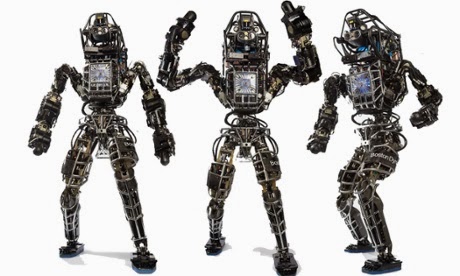
The Atlas humanoid robot is just one of the Boston Dynamics stable of advanced robotic platforms acquired by Google. 

Photograph: Boston Dynamics 

Google’s recent acquisition of Boston Dynamics marks its eighth robotics purchase in the past six months, showing Google’s “moonshot” robotics vision is more than just a pet project.

Boston Dynamics is the most high-profile acquisition, however, instantly adding world-leading robotics capability, including robots that can walk all on their own, to Google’s arsenal – as well as significant links to the US military – conjuring images of Skynet and the artificial intelligence-led robot uprising.

What is it?
Boston Dynamics is an engineering and robotics design company that works across a wide range of computer intelligence and simulation systems, as well as large, advanced robotic platforms.

The company was created as a technology spin-off from Massachusetts Institute of Technology by Prof Marc Raibert in 1992, then the founder and lead researcher of the Leg Lab – a research group focussed on systems that move dynamically, including legged robots.

What does it do?
Raibert describes the Boston Dynamics team as “simply engineers that build robots”, but in reality Boston Dynamics is much more than that.

Its robotics work is at the forefront of the technology creating the self-proclaimed “most advanced robots on Earth” particularly focused around self-balancing humanoid or bestial robots.

Funding for the majority of the most advanced Boston Dynamics robots comes from military sources, including the US Defence Advanced Research Projects Agency (Darpa) and the US army, navy and marine corps.

The terms of contracts currently held by Boston Dynamics with military bodies are unknown, although Google has committed to honouring existing contracts, including recent $10.8m funding from Darpa.


Read the full article here

Tuesday, November 19, 2013

Real Android Matsuken: Robots with real faces

Japanese actor Ken Matsudaira(R), clad in a robot suit, smiles with an android robot (L) in his likeness called Real Android Matsuken at a press presentation in Tokyo. 

The android robot was developed for an advertisement for Japanese telecom company KDDI

Picture: AFP PHOTO / YOSHIKAZU TSUNO

Friday, May 31, 2013

Perfect skin: More touchy-feely robots

Robots could become a lot more 'sensitive' thanks to new artificial skins and sensor technologies developed by European scientists. 

Leading to better robotic platforms that could one day be used in industry, hospitals and even at home.

The new capabilities, and a production system for building touch-sensitivity into different robots, will improve the way robots work in unconstrained settings, as well as their ability to communicate and cooperate with each other and with humans.

The EU-funded project 'Skin-based technologies and capabilities for safe, autonomous and interactive robots' (ROBOSKIN) developed new sensor technologies and management systems which give robots an artificial sense of touch - until now an elusive quality in robotics.

According to the partners behind the research from Italy, Switzerland and the UK, it was important to create cognitive mechanisms that use tactile feedback (the sense of 'touch' or 'feel') and behaviour to make sure human-robot interaction is safe and effective for the envisaged future applications.

The artificial skin is modelled largely on real skin, which has a tiny network of nerves that sense or feel changes like hot/cold or rough/smooth.

In this case, the electronic sensors collect this so-called 'tactile data' and process it using application software which has been front-loaded to include some basic robot behaviours which can be added to over time.

'Here, we opted for programming through demonstration and robot-assisted play so the robots learn as they go along by feeling, doing and interacting,' explains project coordinator Professor Giorgio Cannata of Genoa University, Italy.

Giorgio Cannata
'We had to generate a degree of awareness in the robots to help them react to tactile events and physical contact with the outside world,' he adds.

Kaspar the friendly robot
But robot cognition is extremely complex, so ROBOSKIN started with modest ambitions in lab tests by classifying types or degrees of touch.

They created a geometric mapping using continuous contact between the test robot and the environment to build a 'body representation' - parameters by which data can be assimilated by the robot into behaviour.

KASPAR
Outside the lab, on the other hand, ROBOSKIN sensor patches were applied to common touch points (feet, cheeks, arms) located on the University of Hertfordshire's KASPAR robot, a humanoid robot designed to help autistic children communicate better.

'With our sensors, the robot could sense or detect contact and the data collected formed an important part of the contact classification we did - the distinction between, for example, wanted and unwanted touch,' explains Prof. Cannata.

ROBOSKIN scientists explored various technologies, from the more basic capacitive sensors in today's sensing technologies, to higher-performing transducers found in piezoelectric materials, and flexible organic semiconductors.

'We'll see more and more piezoelectric materials - which can act like sensors because they react to changes brought on by contact with an outside force - in the near future,' predicts Prof. Cannata.

But sensors using organic semiconductors will be the future game-changer, he suggests, as you will be able to print the chips on different organic materials like fake skin or bendable materials, and they will eventually be much cheaper to make, once scaled up.

More information: 'Skin-based technologies and capabilities for safe, autonomous and interactive robots' website.

Wednesday, October 17, 2012

ESA Meteron: Using space internet to control ISS robots


As part of the Meteron project – Multi-purpose End-To-End Robotic Operations Network – astronauts will control the Mocup test robot from ESA’s European Space Operations Centre, Darmstadt, Germany.

Mocup is an acronym of Meteron Operations and Communications Prototype.

Credits: ESA

ESA and NASA have tested a communications protocol that will allow astronauts to control robots from space stations orbiting planets or asteroids.

The test marks the way for a trial-run with an astronaut on the International Space Station next week.

Last week a Space Station user centre at the University of Boulder, USA sent a command to a NASA laptop on the International Space Station to start a script that controlled the Mocup robot at ESA’s ESOC operations centre in Darmstadt, Germany. 

The robot was commanded to move forward and take pictures, which it performed as planned.

Mocup is one of the robots in ESA’s Meteron – Multi-purpose End-To-End Robotic Operations Network – initiative for future missions to the Moon, Mars and other celestial bodies.

Space exploration will most likely involve sending robotic explorers to test the waters on uncharted planets before sending humans to land.
 
In the case of distant planets, these robots could be controlled by astronauts in spacecraft orbiting the planet.

“In these tests we are pretending that Earth is the Moon or Mars,” says Kim Nergaard, Meteron Ground Segment and Operations Manager. (@Kimsy)

Tuesday, October 2, 2012

UK Scientists planning to put artificial bee brains in flying robots

Honey bees are fascinating creatures.

They live harmoniously in large communities, divided into different castes, with some of the worker bees heading out on daily expeditions to gather nectar and pollen from flowers.

Already, a study has suggested that the efficient method in which bees visit those flowers could inspire the improvement of human endeavours such as the building of faster computer networks.

An open-access paper describing the study was published on the journal PLOS Biology.

Now, scientists from the Universities of Sheffield and Sussex hope to build a computer model of the honey bee’s brain, with the ultimate hope of using it to control tiny autonomous flying robots.

The project is called Green Brain – a tip of the hat to IBM’s Blue Brain Project, the aim of which is to create a computer model of the human brain.

The Green Brain team, however, aren’t actually trying to recreate all of a bee’s mental processes. Instead, they’re focusing on the systems that control its vision and sense of smell.

Also, unlike the Blue Brain scientists, they’re not using supercomputers to create their model.

To get the performance they’ll need out of desktop PCs, they are using high-performance GPU (graphics processing unit) accelerators.

Donated by the NVIDIA Corporation, these GPUs are typically used to rapidly generate 3D graphics on home computers and gaming systems. For the Green Brain project, they will instead be used to quickly perform complex calculations.

So, why would anyone want a bee-brained flying robot? Well, in the same way that honey bees can sniff out and visually identify flowers, it is hoped that the autonomous robots could be used to trace odors or gases to their sources.

Not only could this have applications in fields such as environmental monitoring, but it could also prove useful for things like search-and-rescue operations.

The robots might also find use in the pollination of crops. Although real bees currently provide this service, that could change as worldwide bee populations continue to plummet.

On that note, the scientists also hope that by creating the model, they will be better able to understand the bees’ behaviour.

By doing so, they may then gain some insight into why honey bee populations are falling, and perhaps be able to do something about it.

Once it’s time to actually build the bee-bots, a team of scientists at Germany’s Bielefeld University may be able to help – they’ve been working on creating an artificial bee’s eye project, called FLINAVS, specifically for use in micro air vehicles.

A report outlining the Bielefeld team’s findings was published in the journal Bioinspiration & Biomimetics.

Source: University of Sheffield

Wednesday, August 15, 2012

DLR Robot: Paralysed woman uses thoughts to control robot

Almost 15 years after being paralysed by a stroke, a 58-year-old US-American woman was once again able to serve herself a drink of coffee.

This was possible thanks to a state-of-the-art DLR robot arm and hand that she controlled with neural signals sent directly from her brain.

It took just a few moments for her to grasp the drinking bottle with the robot hand, bring it up to her mouth and drink the coffee through a straw.

To accomplish this, software decoded neural signals recorded from a small array of electrodes that reflected her intention to reach and grasp, and converted them into commands that directed the robot arm and hand.

Researchers at the German Aerospace Center (Deutsches Zentrum für Luft- und Raumfahrt; DLR) present the results of their collaboration with Brown University, the United States Department of Veterans Affairs, and Massachusetts General Hospital in the 17 May 2012 issue of the scientific journal Nature.

Sunday, July 29, 2012

Science fiction comes to life in Italian lab

A bionic hand at the Istitute of Biorobotic of the Italian University St. Anna School in Pisa.

At the university, a bionic arm commanded by the human brain or a limb extension that allows rescuers to lift rubble after earthquakes are just some of the futuristic innovations in the pipeline.

At Italy's Sant'Anna university, a bionic arm commanded by the human brain or a limb extension that allows rescuers to lift rubble after earthquakes are just some of the futuristic innovations in the pipeline.

"The idea is to get robots out of factories where they have shown their worth and to transform them into household machines which can live together with humans," says Professor Paolo Dario, director of the college's bio-robotics department.

The university in the historic town of Pisa in Tuscany is a veritable factory of ideas.

Researchers here are working on projects ranging from a robot that can come to your door to collect your recycling to tomatoes that slow the effects of ageing and plants that survive underwater to help flood-prone regions of the world.

A Body Extender robot at the Perceptual Robotics Laboratory at Sant'Anna University in Pisa, Italy.

The exoskeleton or "body extender", a prototype costing a million euros, meanwhile, is a kind of armour weighing 160 kilos which multiplies the strength of its human user by 20. "You can innovate here.

Whoever has a project gets help, ideas are not blocked. We are investing in individuals," the rector of Sant'Anna, Maria Chiara Carrozza, a professor of bio-robotics said in an interview.

The dustcart looks like the famous R2-D2 from Star Wars with its laser scanner and location sensors.

The idea is that it can work through phone bookings to come to your street at a fixed time to collect your waste.

"We tested it for two months with 15 families living in one of the towns near here. Everything worked well but there are still some problems to sort out," said Pericle Salvini, a member of the team behind the project.

"First of all it is slow for security reasons and it sometimes blocks the traffic. Also it cannot legally be on the road since there is no type of insurance for this type of robot in case of an accident," he said.

Researcher Pericle Salvini work on a DustClean Robot at the Institute of Biorobotic at Sant'Anna University in Pisa.

The dustcart looks like the famous R2-D2 from Star Wars with its laser scanner and location sensors.

The idea is that it can work through phone bookings to come to your street at a fixed time to collect your waste.

Professor Dario also heads up a project entitled "The Robot Companions for Citizens" which is one of six contestants for a European Union prize of one billion euros ($1.2 billion) in funding spread out over a decade.

Marco Controzzi, who is working on a bionic arm, says it will operate by using electrodes attached to the skin or implanted in your head. "It will move only according to your intentions," he said, adding that powering it would be easy as it can run on just two mobile phone batteries.

The exoskeleton or "body extender", a prototype costing a million euros, meanwhile, is a kind of armour weighing 160 kilos (353 pounds) which multiplies the strength of its human user by 20. "The idea is to use this type of instrument for emergency workers in disasters like an earthquake," said engineer Marco Fontana.

Wednesday, April 25, 2012

Scientist unveils mind-controlled robot for paraplegics

A professor at a Swiss university on Tuesday unveiled a robot that can be controlled by the brainwaves of a paraplegic person wearing an electrode-fitted cap, news agency ATS reported.

A paralysed man at a hospital in the town of Sion demonstrated the device, sending a mental command to a computer in his room, which transmitted it to another computer that moved a small robot 60 kilometres (37 miles) away in Lausanne.

The system was developed by Jose Millan, a professor at the Federal Polytechnic School of Lausanne who specialises in non-invasive interfaces between machines and the brain.

The same technology can be used to drive a wheelchair, Millan said.

"Once the movement has begun, the brain can relax, otherwise the person would soon be exhausted," he said.

But the technology has its limits, he added. The brain signals can be scrambled if too many people are gathered around a wheelchair, for example.

Besides making paraplegics mobile, neuroprosthetics could be used to help patients recover lost senses, researchers said.

Professor Stephanie Lacour and her team are working on an "electric skin" for amputees, a glove fitted with tiny sensors that would send information directly to the user's nervous system.

Eventually, researchers say they hope to create mechanised prosthetics that are as mobile and sensitive as a natural hand, Lacour said.

Other researchers at Lausanne are working on enabling paraplegics to walk again with electrodes implanted in their spinal cords.

"The goal is that after a year of training with a robotic aide, the patient will be able to walk without a robot. The electrodes would stay implanted for life," said Professor Gregoire Courtine.

He said he is currently setting up clinical trials and hopes to run tests at Zurich's university hospital within a year.

Wednesday, December 21, 2011

NASA’s ‘Smart SPHERES’ to Aid in the Development of Robots

NASA's ongoing "Smart SPHERES" experiment has demonstrated how a smartphone controller can serve as remotely operated assistant after it successfully transmitted motion data gathered by a free-flying robot on the International Space Station to its astronaut handler.

NASA's Human Exploration Telerobotics project, has equipped the compact, free-flying satellites known as Synchronized Position Hold, Engage, Reorient Experimental Satellites, or SPHERES with a Samsung Nexus S handset that features Google's open-source Android platform.

According to NASA, these compact assistants will conduct interior station surveys and inspections, capturing mobile camera images and video in the coming months. NASA also plans to simulate external free-flight excursions and in time will test whether the robots can handle other, more challenging tasks.

"The tests that we are conducting with Smart SPHERES will help NASA make better use of robots as assistants to and versatile support for human explorers -- in Earth orbit or on long missions to other worlds and new destinations," said Terry Fong, project manager of the Human Exploration Telerobotics project and Director of the Intelligent Robotics Group at NASA's Ames Research Center in Moffett Field, Calif.

The volleyball-sized SPHERES each has its own onboard power, propulsion, computing and navigational software. With the addition of the smartphone, the satellite is transformed into a free-flying robot, or "Smart SPHERES," complete with a compact, low-power, low-cost embedded computer and built-in cameras and sensors to enhance and expand robotic operations.

The smartphone is almost identical to the off-the-shelf consumer device except for some minor modifications, including removing the GSM cellular communications chip to avoid interference with station electronics, and replacing the standard lithium-ion battery with AA alkaline batteries.

The Nexus S phone is the first commercial smartphone certified by NASA for use on the space station although NASA anticipates using other types of smartphones on the station in the future. It is connected to a SPHERES free-flyer via a cable. A wireless network connection (Wi-Fi) to the space station's computers provides the data path to the ground.

Thursday, August 12, 2010

Star Wars Meets UPS As Robonaut Packed For Space


Getting into space isn't necessarily easy for astronauts, and it's not much easier for a robotic astronaut, either.

Cocooned inside an aluminum frame and foam blocks cut out to its shape, Robonaut 2, or R2, is heading to the International Space Station inside the Permanent Multipurpose Module in space shuttle Discovery's payload bay as part of the STS-133 mission.

Once in place inside the station, R2, with its humanlike hands and arms and stereo vision, is expected to perform some of the repetitive or more mundane functions inside the orbiting laboratory to free astronauts for more complicated tasks and experiments. It could one day also go along on spacewalks.


Making sure the first humanoid robot to head into space still works when it gets there has been the focus of workers at NASA's Kennedy and Johnson space centers. Engineers and technicians with decades of experience among them packing for space have spent the last few months devising a plan to secure the 330-pound machine against the fierce vibrations and intense gravity forces during launch.

"I think back in May we realized we had a huge challenge on our hands," said Michael Haddock, a mechanical engineer designing the procedures and other aspects of preparing R2 for launch, including careful crane operations inside the Space Station Processing Facility's high bay.

Though it was fast-paced, intense work, the payoff of getting to help R2 into space added extra motivation for the engineers involved.

By spaceflight standards, planning for the packing effort moved quite quickly, particularly considering R2 is perhaps the heaviest payload to be taken into space inside a cargo module.

"The mass is what's driving the crane operations, otherwise we'd be handling the robot by hand," Haddock said. "But the robot itself weighs on the order of 333 pounds and when it is installed in the structural launch enclosure, it will weigh over 500 pounds."

As they must when loading anything for spaceflight, the engineers designed the packaging so astronauts could easily remove R2 from its launch box, known by its acronym SLEEPR or Structural Launch Enclosure to Effectively Protect Robonaut.

Friday, August 7, 2009

NASA Reviving its 'Blue Sky' Think Tank

(C)

(Illustration: NASA/Pat Rawlings/SAIC)

NIAC has funded research into spacesuits that could be coated with proteins to generate electricity solely through the natural movement of the astronauts wearing them

NASA should revive its Institute for Advanced Concepts, a blue-skies idea mill that closed in 2007, says an expert panel – but it says the new incarnation should have its feet a little closer to the ground.

NASA's Institute for Advanced Concepts (NIAC) was founded in 1998 to harvest innovative ideas for spaceflight and aeronautics from outside the NASA community.

It received $4 million a year, about 0.02 per cent of NASA's annual budget, and funded more than 100 futuristic spaceflight and aeronautics projects that no one else would touch. The projects included motion-sensitive spacesuits that generate their own power, techniques to construct buildings in space using radio waves, and spherical robots to explore Mars, among many others.

But in 2007, a combination of budget constraints and internal politics shut the organisation down. On Friday, a committee convened by the US National Research Council released a report suggesting that NASA bring back the think tank.

The committee, which included a mix of people from academia and industry, found that NIAC had been successful right up until its final days. "They were definitely living up to their contract at the time they were terminated," says committee co-chair Robert Braun, a professor of space technology at the Georgia Institute of Technology.

Three NIAC-funded projects are now "on a path toward one day being a NASA mission", Braun says, including a prototype plasma rocket, an X-ray interferometer that is being considered for NASA's Black Hole Imager mission, and a "star shade", which could help existing space telescopes search for extrasolar planets.

Other projects have had unexpected medical spinoffs, like a skin-tight spacesuit that can help children with cerebral palsy walk. "By and large, the topics that they invested in were pushing the state of the art, were very advanced in terms of far-out thinking, and I'd say a decent percentage of them had the possibility of turning into something," Braun told New Scientist.

Thursday, May 14, 2009

Female(?) Robot asks for Directions


Robots are getting better at finding their way around unknown areas, and making their own maps as they explore. But robots lost in urban areas don't need to rely on their own faculties to get from place to place, German roboticists have shown.

Their mobile robot simply rolls up to any humans nearby and asks for directions. By using that strategy, their robot has become one of the first to be properly let loose in the real world, not just carefully controlled environments.

Martin Buss's team at the Technical University of Munich dumped their mobile robot outside the university and instructed it to find its way to the Marienplatz in the centre of Munich, some 1.5 kilometres away.