Showing posts with label Beam. Show all posts

Tuesday, October 21, 2014

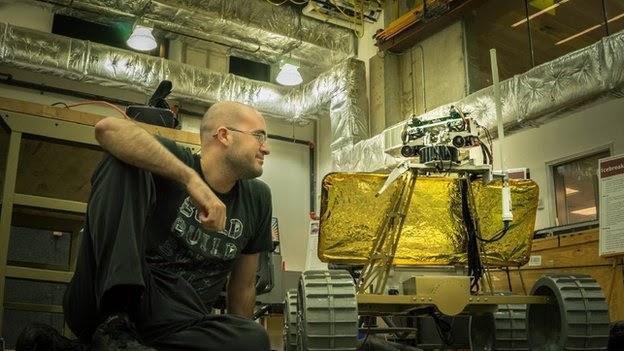
Students build Oculus robot to beam live video from Moon

Daniel Shafrir hopes Andy can transform education about space

Scientists at Carnegie Mellon University have developed a robot which they plan to land on the Moon to act as eyes for Earth-bound space enthusiasts.

The project is part of a $30m prize from Google offered to a team that can send video back from the moon.

The robot has already been shown to potential investors, including Apollo 9 astronaut Rusty Schweickart.

It works in tandem with an Oculus Rift virtual reality headset.

The scientists from Carnegie Mellon have teamed up with space firm Astrobotic to compete for the Google Lunar XPrize, which requires a team to land a robot on the Moon, move it 500m and send back video to Earth.

Astrobotic Technology, which is a spin-off from Carnegie Mellon, has signed a deal with SpaceX - the private space company set up by Elon Musk - to use its Falcon 9 rocket to launch the robot. It is due to take off in 2016.

Non-stop hackathon
"The vision was simple - let anyone on Earth experience the Moon live through the eyes of a robot," explained team leader Daniel Shafrir.

"We weren't just going to go to the Moon. We are going to bring the Moon back," he added.

The telepresence robot, nicknamed Andy after university founder Andrew Carnegie, can be controlled by an operator's head.

Using an Oculus Rift headset, the movements of the user's head are tracked and sent back to Andy's camera so that it will match where the user is looking.

"Imagine the feeling of looking out and seeing rocks and craters billions of years old. Turn your head to the right and you see the dark expanse of space. Turn your head to the left and you see home, Earth," said Mr Shafrir.

To achieve this required complex coding. The team also encountered smaller problems such as the fact that the Oculus software was unable to receive two live video streams at the same time.

"Tackling challenges like that made the project a non-stop, day and night hackathon," explained Mr Shafrir.

Working with games designer Ben Boesel and planetarium director Dan Arnett, the team put Andy through his paces in a demo earlier this month.

The vision is to have "hundreds of the robots on the Moon", said Mr Shafrir.

"With an Oculus headset in every classroom, allowing kids to experience what, to this date, has only been experienced by 12 human beings," he added.

There are currently 18 teams from around the world competing to win the Google-sponsored Lunar X-Prize.

Tuesday, October 7, 2014

Bigelow Expandable Activity Module (BEAM) Launching to Space Station 2015

Artist's concept of the Bigelow Expandable Activity Module (BEAM), which is scheduled to arrive at the International Space Station in 2015.

Credit: Bigelow Aerospace

A privately built inflatable room for astronauts on the International Space Station is on track to launch into orbit next year.

The Bigelow Expandable Activity Module (BEAM) is expected to head to space inside SpaceX's Dragon cargo spacecraft in 2015, according to a senior representative for the company Bigelow Aerospace, which is building the module.

Once BEAM gets to the space station, the robotic Canadarm2 will install it on the Tranquility node's aft port to test out expandable-habitat technology.

NASA is paying Nevada-based Bigelow $17.8 million to send the demonstration module to the station, where it will be in place for at least a couple of years.

Here at the International Astronautical Congress Thursday (Oct. 2), Bigelow representative Mike Gold said BEAM provides an example of what the company, and private firms in general, can do in low-Earth orbit (LEO).

"LEO will become a commercial domain," said Gold, Bigelow's director of D.C. operations and business growth.

"Maybe it's difficult to see at this point, but we go back to telecom, there was a time when every communications satellite was owned by the government," he added, noting that today, private companies are now responsible for this space domain and that it touches every aspect of people's lives, such as cellphones. "This will happen when it comes to crew operations."


The BEAM mission will allow Bigelow to collect even more data about how its expandable habitat modules perform on orbit.

The company blasted two other modules to orbit as stand-alone missions in 2006 and 2007 and plans to launch a private space station someday.

Private work in space, Gold noted, is hampered by International Traffic in Arms Regulations (ITAR), which restrict the sharing of technology with other countries, particularly China.

Citing "Star Trek," Gold joked that Scottish engineer Montgomery Scott would have had trouble speaking openly with Hikaru Sulu (from Japan) if ITAR were in force on the Enterprise.

After gravity, Gold said, ITAR is the second-greatest barrier to getting something off Earth. China, in particular, is the "third rail" of ITAR, Gold said, urging other companies to help him speak to government officials in an attempt to make changes.

"We cannot fight the New Space vs. Old Space battle … with so few companies," he said. "The pie is too small. We need to come together as space enthusiasts."

Wednesday, January 22, 2014

CERN ASACUSA experiment produces first beam of antihydrogen atoms for hyperfine study

A photograph of multiple ring electrodes installed in the cusp magnet. 

Antihydrogen atoms are synthesised inside the left cylinders and are analysed at the right electrodes by the field ionisation technique. 

Credit: N. Kuroda

The ASACUSA experiment at CERN has succeeded for the first time in producing a beam of antihydrogen atoms.

In a paper published today in Nature Communications, the ASACUSA collaboration reports the unambiguous detection of 80 antihydrogen atoms 2.7 metres downstream of their production, where the perturbing influence of the magnetic fields used initially to produce the antiatoms is small.

This result is a significant step towards precise hyperfine spectroscopy of antihydrogen atoms.

Primordial antimatter has so far never been observed in the Universe, and its absence remains a major scientific enigma.


Nevertheless, it is possible to produce significant amounts of antihydrogen in experiments at CERN by mixing antielectrons (positrons) and low energy antiprotons produced by the Antiproton Decelerator.

The spectra of hydrogen and antihydrogen are predicted to be identical, so any tiny difference between them would immediately open a window to new physics, and could help in solving the antimatter mystery.

With its single proton accompanied by just one electron, hydrogen is the simplest existing atom, and one of the most precisely investigated and best understood systems in modern physics.

Thus comparisons of hydrogen and antihydrogen atoms constitute one of the best ways to perform highly precise tests of matter/antimatter symmetry.

Matter and antimatter annihilate immediately when they meet, so aside from creating antihydrogen, one of the key challenges for physicists is to keep antiatoms away from ordinary matter.

To do so, experiments take advantage of antihydrogen's magnetic properties (which are similar to hydrogen's) and use very strong non-uniform magnetic fields to trap antiatoms long enough to study them.

However, the strong magnetic field gradients degrade the spectroscopic properties of the (anti)atoms.

To allow for clean high-resolution spectroscopy, the ASACUSA collaboration developed an innovative set-up to transfer antihydrogen atoms to a region where they can be studied in flight, far from the strong magnetic field.

The ASACUSA CUSP apparatuses in the CERN Antiproton Decelerator. 

Credit: N. Kuroda

"Antihydrogen atoms having no charge, it was a big challenge to transport them from their trap."

"Our results are very promising for high-precision studies of antihydrogen atoms, particularly the hyperfine structure, one of the two best known spectroscopic properties of hydrogen."

Yasunori Yamazaki
"Its measurement in antihydrogen will allow the most sensitive test of matter/antimatter symmetry. We are looking forward to restarting this summer with an even more improved set-up," said Yasunori Yamazaki of RIKEN, Japan, a team leader of the ASACUSA collaboration.

The next step for the ASACUSA experiment will be to optimize the intensity and kinetic energy of antihydrogen beams, and to understand better their quantum state.

Experimental concept of the planned in-flight antihydrogen hyperfine spectroscopy. 

Antihydrogen atoms are synthesised in the cusp trap (shown with magnetic field lines in the left).

Some of them flow out towards the downstream (right) direction and are detected at the end. 

Credit: E. Widmann and N. Kuroda

Progress with antimatter experiments at CERN has been accelerating in recent years.

In 2011, the ALPHA experiment announced trapping of antihydrogen atoms for 1000 seconds and reported observation of hyperfine transitions of trapped antiatoms in 2012.

In 2013, the ATRAP experiment announced the first direct measurement of the antiproton's magnetic moment with a fractional precision of 4.4 parts in a million.

More information: Paper: dx.doi.org/10.1038/ncomms4089

Saturday, November 9, 2013

Nano Panels Beam Heat Into Space - Video


Solar radiation, trapped by our atmosphere, keeps Earth warm but if human activity is making it too warm, Stanford scientists have developed a panel that can return heat to space. Is this a tool for future geo-engineering?

Credit: Today's Green Minute