Showing posts with label ATV. Show all posts

Friday, May 23, 2014

Orion-MPCV-ESM: European service module for Orion approved by ESA

Orion-MPCV-ESM. 

Image courtesy ESA.

The European Space Agency (ESA) has approved the world's second largest space company Airbus Defence and Space's system (EADS) design of the European Service Module (ESM) for the American human Multi-Purpose Crew Vehicle (MPCV) Orion, containing the critical propulsion, power supply and components of the life-support systems of the spacecraft.

This approval gives the green light for the implementation phase, meaning that the initial hardware can now be built in the form of a structural test model.

This model will initially be used for static tests, which are due to start in the next few months. Dynamic tests e.g. simulating loads during launch will then follow over the course of next year.

This is the first time that Europe is producing critical space components for the American Orion mission.

In December 2012, US space agency NASA and the ESA agreed to certify the US' new Orion MPCV in conjunction with the ESM.

This module is based on the design and the experience gained from the Automated Transfer Vehicle (ATV) developed and constructed by Airbus Defence and Space on behalf of ESA and used to carry supplies to the International Space Station.

"The approval of our system design by ESA together with NASA and prime project contractor Lockheed Martin Space Systems is a significant step in the programme."

"We have demonstrated the project's maturity and are now able to move from the paper-based stage to producing the actual hardware," said Francois Auque, Head of Space Systems.

"The fact that NASA has entrusted Europe with system-critical elements is a clear sign of its confidence in the transatlantic partnership and in its European partners' capabilities.

Thomas Reiter
Airbus Defence and Space (EADS) and its European partners have, with ATV, developed and constructed a technological showcase project, thus paving the way for this cooperation," said Thomas Reiter, ESA Director of Human Spaceflight and Operations.

The intention is to use the Orion MPCV for human missions to the Moon, to asteroids and into deep space. Lockheed Martin Space Systems is developing and constructing the space capsule for four or more astronauts on behalf of NASA.

The MPCV-ESM, which is being developed and built by Airbus Defence and Space and based on the ATV, will provide spacecraft propulsion, power supply and life-support systems.

An initial Orion mission, or "Exploration Mission 1", is planned to be an unmanned distant retrograde mission to the lunar Lagrangian points.

The aim of this mission is not only to demonstrate the spacecraft's performance capabilities before it flies with astronauts, but also to achieve qualification for NASA's new Space Launch System rocket. As part of "Exploration Mission 2", the Orion MPCV is scheduled to be launched into space in 2021/22 with astronauts on board.

Tuesday, March 25, 2014

Arianespace Ariane 5 ECA Launches ASTRA 5B and Amazonas 4A

On Saturday, March 22, 2014 at 22:04 UTC, Arianespace carried out the 59th successful Ariane 5 launch in a row, orbiting two telecommunications satellites: ASTRA 5B for the Luxembourg-based operator SES, and Amazonas 4A for the Spanish operator Hispasat. 

ASTRA 5B also hosts an EGNOS (European Geostationary Navigation Overlay Service) payload for the EuropeanCommission.

59th successful launch in a row: Arianespace continues to deliver the world's most reliable launch service!

Today's successful mission, the 59th in a row for ESA's Ariane 5 ECA (Cryogenic Evolution Type A) launcher, confirms that Arianespace continues to set the standard for guaranteed access to space for all operators, whether national or international space agencies, private industry or governments.

Following the announcement of the orbital injection of the ASTRA 5B and Amazonas 4A satellites, Arianespace Chairman and CEO Stephane Israel said: "Today's successful launch, the 59th in a row for Ariane 5, confirms the unrivaled reliability and availability of the European launcher.

"We take particular pride in being able to offer this service excellence to two leading European operators, SES and Hispasat, both long-standing customers of Arianespace, as well as the European Commission, which has an EGNOS satellite navigation payload integrated on the ASTRA 5B satellite."

"For Arianespace and our family of the Ariane, Soyuz and Vega launchers, the watchword in 2014 will be 'Europe', following the launch of Athena-Fidus on February 6, a French-Italian spacecraft that meets both defense and homeland security requirements, and leading up to flagship programs deployed by the European Commission (Copernicus and Galileo) and the European Space Agency (ATV and IXV)."

"In addition, I would also like to express my thanks to Airbus Defence and Space (EADS), as the industrial prime contractor for Ariane 5, to the rest of the European space industry, the teams at Kourou, the Guiana Space Center, and our partners at CNES for today's magnificent success."

Monday, October 28, 2013

ESA ATV Albert Einstein undocks from ISS

The European Space Agency’s fourth Automated Transfer Vehicle (ATV-4) undocks from the aft port of the International Space Station’s Zvezda service module. Image Credit: NASA TV

The European Space Agency’s fourth Automated Transfer Vehicle (ATV-4), also known as the “Albert Einstein,” undocked from the aft port of the International Space Station’s Zvezda service module at 4:55 a.m. EDT Monday.

Its departure sets the stage for the relocation of a Soyuz spacecraft currently docked at the station and the arrival of three new crew members.

Expedition 37 Flight Engineers Luca Parmitano and Oleg Kotov, who together closed up the hatches to the ATV-4 Friday, monitored the automated departure from a control panel inside Zvezda, ready to take control of the process if needed.

Meanwhile Commander Fyodor Yurchikhin photographed the departing space freighter to capture imagery of its docking assembly and a set of sensors at the forward end of the spacecraft.

At the time of undocking, the station was orbiting about 260 miles above Kazakhstan.

Fyodor Yurchikhin
ATV-4, now filled with trash and unneeded items, fired its thrusters to back a safe distance away from the orbiting complex.

An engine firing Saturday will send it into the Earth’s atmosphere for a planned destructive re-entry over an uninhabited area of the southern Pacific Ocean.

The “Albert Einstein,” named in honour of the famed German-born theoretical physicist and icon of modern science, delivered more than 7 tons of food, fuel and supplies to the orbiting complex when it docked automatically on June 15.

During its time at the station, the ATV-4 also provided an additional reboost capability for the complex, as flight controllers periodically commanded its engines to fire to adjust the station’s orbit.

The fifth and final ATV, designated the “Georges LemaĆ®tre” after the Belgian astronomer who first proposed the theory of the expansion of the universe, is scheduled to launch in mid-2014 for a six-month mission at the station.

More than 32 feet long -- about the size of a traditional London double-decker bus – the ATV is the largest and heaviest vehicle in the station’s resupply fleet.

The departure of ATV-4 clears the way for Parmitano, Yurchikhin and Flight Engineer Karen Nyberg to relocate their Soyuz TMA-09M spacecraft from its docking port on the Rassvet module to the newly vacated Zvezda port on Nov. 1.

Sunday, October 27, 2013

ESA ATV undocks from ISS and performs new maneuvres

ATV Albert Einstein, Europe’s supply and support ferry, docked with the International Space Station on 15 June 2013, some ten days after its launch from Europe's Spaceport in French Guiana. 

Credit: ESA/NASA

This year, the ATV team has planned a special departure.

After undocking at 09:00 GMT on 28 October, Albert Einstein will be instructed by the ATV Control Centre in Toulouse, France, to perform a series of delicate manoeuvres over the course of five days to position itself directly below the Station.

Controllers will start the reentry procedure around 1300 CET on 2 November when ATV-4 is 120 km below the Station – so astronauts will observe the craft from above as it disintegrates over the Pacific Ocean.

This procedure will provide valuable information to calibrate future spacecraft reentries.


Wednesday, May 15, 2013

ESA ATV Albert Einstein attached to Ariane-5 Launcher

ATV Albert Einstein is lowered into position for integration with its Ariane 5 launcher inside the Spaceport’s Final Assembly Building as preparations near completion for next month’s mission. 

Credits: CNES/ESA/Arianespace/CSG Service optique

Arianespace marked one of the final steps in preparations for the next Ariane 5 launch as Europe's latest Automated Transfer Vehicle (ATV) was integrated atop the heavy-lift workhorse at the Spaceport.

This latest ATV - named after German-born physicist Albert Einstein - was lowered by an overhead crane onto its Ariane 5 inside the 90-meter-tall Final Assembly Building in French Guiana.

The payload fairing - which will complete the launcher build up - will be mounted closer to the launch date, allowing for loading of late cargo for the ATV's International Space Station servicing mission. This second Ariane 5 flight of 2013 is scheduled for a June 5 liftoff.

Integration of the ATV Albert Einstein for Ariane Flight VA213 is part of this month's activities on four parallel missions involving Arianespace's complete launcher family at the Spaceport - including the successful orbiting of three passengers by the lightweight Vega vehicle on May 7.

Flight VA213's ATV Albert Einstein will have a liftoff mass of 20,235 kg. - the heaviest payload ever lofted by any Ariane vehicle. In addition to resupply, the ATV will be used for maneuvering the International Space Station.

Built by an EADS Astrium-led industry team, ATV Albert Einstein will be the fourth such servicing vehicle launched by Arianespace for the European Space Agency.

Sunday, May 5, 2013

Mars: Are Dreams of Human Habitation and exploration achievable?

NASA and private sector experts now agree that a man or woman could be sent on a mission to Mars over the next 20 years, despite huge challenges.

The biggest names in space exploration, among them top officials from the US space agency and Buzz Aldrin, the second man to walk on the moon, will discuss the latest projects at a three-day conference starting Monday in the US capital.

Renewed interest in the red planet has triggered the launch of several initiatives in recent months, including one proposing a simple one-way trip to cut costs.

The American public also favours sending astronauts to Mars, according to a survey by non-profit group Explore Mars and US aerospace giant, Boeing.

The poll in March of more than a thousand people published in March found that 71 percent of Americans expect that humans will land on Mars by 2033.

Seventy-five percent say NASA’s budget should be doubled to one percent of the federal budget to fund a mission to Mars and other initiatives.

Buzz Aldrin
NASA receives only 0.5 percent of the US federal budget, compared to four percent during the Apollo project to conquer the moon in the 1960s.

The US space agency’s chief, and ex-astronaut, Charles Bolden has stressed that ‘a human mission to Mars is a priority.’

But the US financial crisis is a major obstacle to such a project.

‘If we started today, it’s possible to land on Mars in 20 years,’ said G. Scott Hubbard of Stanford University.

‘It doesn’t require miracles, it requires money and a plan to address the technological engineering challenges,’ added Hubbard, who served as NASA’s first Mars program director and successfully restructured the entire Mars program in the wake of mission failures.

Scott Hubbard
Placing a mass of 30-40 tonnes — the amount estimated to be necessary to make a habitat on the red planet — would be one of the greatest challenges, along with the well-known problem of carrying or producing enough fuel to get back, Hubbard stressed.

The Curiosity rover took a nail-biting seven minutes in August to make its descent on Mars, but it only weighed one tonne.

The $2.5 billion Curiosity mission, which is set to last at least two years, aims to study the Martian environment and to hunt for evidence of water in preparation for a possible future manned mission.

Robotic missions will therefore be necessary to prove the system works before scientists can even contemplate sending humans aboard.

NASA is currently developing a Space Launch System (SLS) and the Orion Crew transport capsule for distant space exploration.

The Orion Transportation Capsule, shown below, will be powered by the European ATV power unit, part of a long-standing collaborative agreement with ESA.


Sunday, April 21, 2013

ESA ATV Albert Einstein: Fully fuelled at Europe's Spaceport in Kourou, French Guiana

ATV Albert Einstein is fuelled at Europe's Spaceport in Kourou, French Guiana. 

Automated Transfer Vehicles (ATVs) carry two types of propellant to the International Space Station. 

Aside from its own propellants, the space ferry brings propellants for the Russian Station thrusters. 

They are loaded in four phases - and each component is highly toxic. 

All non-essential personnel are cleared from the room and operators wear sealed 'scape suits' at all times during fuelling. 

Image courtesy ESA/CNES/Arianespace/Optique Video du CSG.

Automated Transfer Vehicles (ATVs) can deliver up to 7 tonnes of cargo to the International Space Station, including supplies and equipment, water, air, nitrogen, oxygen and fuel.

As the Space Station circles Earth, it slowly loses altitude so ATVs reboost the orbit to keep it aloft.

Part of ATV's cargo includes propellants for the Station's own thrusters to keep the orbital outpost at the right height even when no spacecraft are there to offer a helping hand.

Loading the fuel is a complex and hazardous process that takes place over many days during continuous sessions of up to 30 hours.

Should there be a leak, the operators are protected by 'scape suits' that deliver fresh air and are sealed off from the working environment, much like diving suits.

The operators must remain vigilant at all times, constantly checking progress and signs of leaks. To make matters more complicated, ATV own propellants are different to those used by the International Space Station itself, requiring different equipment each time.

Both fuels need separate oxidisers for combustion outside of Earth's atmosphere. The oxidisers are also loaded separately, meaning that four different liquids are being pumped into Albert Einstein's tanks in total.

Monday, April 1, 2013

ESA Albert Einstein: ATV resupply spacecraft enters final preparations

Europe's fourth Automated Transfer Vehicle (ATV) to service the International Space Station is entering its final preparation phase for a planned Ariane 5 launch this spring from French Guiana on Arianespace's Flight VA213.

Named after Albert Einstein, the ATV is being processed in the Spaceport's S5 payload preparation building, where it was transferred yesterday from the facility's S5C large preparation hall into its S5B high-bay area.

Riding on an air cushion pallet, the ATV was efficiently moved within the S5 building using internal transfer corridors that are maintained to clean-room conditions.

Following its final preparations, ATV Albert Einstein will be moved to the Spaceport's launcher integration building, where the large spacecraft is to be integrated atop Ariane 5.

Weighing approximately 20 metric tons at launch, the series of Automated Transfer Vehicles are developed in a European program for resupply and servicing of the International Space Station, and they rendezvous with the orbital facility after being deployed by Ariane 5.

Produced by an EADS Astrium-led industry team for the European Space Agency, this latest ATV will carry some 6,270 kg. of fuel, water, air, oxygen and dry cargo to the space station.

Additionally, ATVs are commonly used to adjust the International Space Station's orbital altitude and make maneuvers to avoid collisions with space debris.

Flight VA213 signifies the 213th flight of an Ariane with this workhorse family of launchers since 1979.

Arianespace is responsible for launching all ATVs, and has orbited three of them to date: ATV Edoardo Amaldi in 2012, ATV Johannes Kepler in 2011 and ATV Jules Verne in 2008.

Thursday, February 7, 2013

ESA Ariane-5 Launch preparations: Mission ATV - Albert Einstein

Ariane 5’s cryogenic core stage is suspended over the launch table in the Spaceport’s Launcher Integration Building. Credits: ESA/CNES/Arianespace/Optique Video du CSG

The launcher for Arianespaces fourth flight with Automated Transfer Vehicle 4 (ATV-4), Albert Einstein, is rapidly taking shape at the Spaceport, preparing it for liftoff in the spring from French Guiana with the International Space Station’s latest resupply spacecraft.

During activity this month in the Spaceport’s Launcher Integration Building, the heavy-lift vehicle’s core cryogenic stage was suspended over the mobile launch table, followed by positioning of its two solid propellant boosters.

The launcher’s EPS storable propellant upper stage will then be installed, readying the Ariane 5 for transfer to the Final Assembly Building, where the latest ATV (named after Albert Einstein) is to be mated.

Thursday, January 17, 2013

NASA Orion Spacecraft: ESA ATV Providing the Driving Force

ESA is making a major cotribution to the NASA Orion Spacecraft program.

Both agencies continue with the confident spirit of international cooperation that forms the foundation of the International Space Station.

ESA has agreed with NASA to contribute the driving force for the Orion spacecraft, planned for launch in 2017.

Ultimately, Orion will carry astronauts further into space than ever before using a module based on Europe's Automated Transfer Vehicle technology.

Automated Transfer Vehicles (ATVs) have been successfully resupplying the International Space Station since 2008.

The fourth in the series, ATV Albert Einstein, is being readied for launch next year from Kourou, French Guiana.

The ATV-derived service module, sitting directly below Orion's crew capsule, will provide propulsion, power, thermal control, as well as supplying water and gas to the astronauts in the habitable module.

This collaboration between ESA and NASA continues the spirit of international cooperation that forms the foundation of the International Space Station.

ATV is a versatile showcase of European technology performing many functions during a mission to the International Space Station.

The space freighter reboosts the Station and can even push the orbital complex out of the way of space debris.

While docked, ATV becomes an extra module for the astronauts. Lastly, at the end of its mission it leaves the Space Station with waste materials.

"ATV has proven itself on three flawless missions to the Space Station and this agreement is further confirmation that Europe is building advanced, dependable spacecraft," said Nico Dettmann, Head of ATV's production programme.

Thomas Reiter, ESA director of Human Spaceflight and Operations says: "NASA's decision to cooperate with ESA on their exploration programme with ESA delivering a critical element for the mission is a strong sign of trust and confidence in ESA's capabilities, for ESA it is an important contribution to human exploration."

Dan Dumbacher, deputy associate administrator for exploration systems development at NASA headquarters in Washington DC, agrees: "It is a testament to the engineering progress made to date that we are ready to begin integrating designs of an ESA-built service module with Orion."

The first Orion mission will be an unmanned lunar fly-by in 2017, returning to Earth atmosphere at a speed of 11 km/s - the fastest re-entry ever.

Thursday, December 20, 2012

Arianespace Launches a Commemorative Patch

During 2012, the Arianespace launcher family performed a total of 10 missions from the Spaceport in French Guiana, led by the heavy-lift Ariane 5 with its 10-metric-ton payload lift performance – which has logged 53 consecutive successes during the past 10 years.

Arianespace’s mission cadence in 2012 was called “remarkable” by Chairman & CEO Jean-Yves Le Gall.

“It confirms the interest, effectiveness and availability of our launcher product line – which enables us to launch all satellites, for all of our customers, to all orbits,” he said during comments after today’s flight.

“In addition, 2012 also marked a yearly record in terms of payload mass placed into orbit, since – for the first time – we have reached a total of nearly 75 tons, of which 20 tons was for the Edoardo Amaldi Automated Transfer Vehicle (ATV)!”

Wednesday, September 26, 2012

ESA ATV Edoardo Amaldi undocking from ISS, postponed

The undocking of ATV-3, Edoardo Amaldi, from the International Space Station late last night was postponed due to an incorrect command.

During operations ATV-3 performed perfectly in line with its pre-defined measures.

A new attempt to undock will likely be made on Thursday, pending approval by the board of the Station management team this afternoon.

Meanwhile, ATV Edoardo Amaldi is safe and in a dormant mode. Watch the ATV-3 Mission Video here.

The issue was discovered by the Space Station crew shortly before undocking, when they attempted to send a command from a control panel to ATV-3.

Receipt of the command was not confirmed by ATV-3, so the undocking was suspended.

Experts from ESA, NASA and Roscosmos have determined that the problem was caused by commands being sent using the wrong spacecraft identification number.

Power and data links had already been disconnected between ATV-3 and the Station to prepare for the departure. Afterwards, they were re-established by controllers at ESA’s ATV Control Centre in Toulouse, France.

“The joint ESA/CNES mission operations team reacted professionally and skilfully to this unexpected delay,” said Massimo Cislaghi, ESA’s ATV-3 Mission Manager.

“Engineers immediately set to work to reschedule the undocking and reconfigure ATV-3 into safe mode while we and our international partners were troubleshooting the issue.”

ATV Edoardo Amaldi performed perfectly during the undocking procedure and is standing by for the next attempt.

Operational considerations will now postpone ATV-3 reentry to at least 2 October.

Saturday, July 28, 2012

KOUNOTORI3 (HTV3) - Third Expedition to Space - YouTube

In this Japanese video the narrator states that the HTV is only means of providing the ISS crews with fuel and supplies, this is of course, untrue. The European (ESA) ATV and the Soyuz Progress module are still in operation. Progress has long been the most reliable vessel for uplifting astronauts and a key support provider of the ISS.

Sunday, April 22, 2012

ESA Astronaut AndrƩ Kuiper's Video tour inside ATV-3 Edoardo Amaldi


ESA astronaut AndrĆ© Kuipers and cosmonaut Oleg Kononenko open the hatch and start unloading ESA’s supply ship Automated Transfer Vehicle ‘Edoardo Amaldi’ in this video produced by ESA TV.

The Automated Transfer Vehicle docked with the International Space Station on 29 March 2012 delivering around two tonnes of dry cargo, 285 kg of water and more than three tonnes of propellants.

Saturday, April 7, 2012

ESA ATV Edoardo Amaldi Boosts Space Station: The Inside Story - YouTube


Caption from ReelNASA: As the International Space Station is boosted into a higher orbit, Expedition 29 Commander Mike Fossum and Flight Engineers Satoshi Furukawa and Sergei Volkov float freely to demonstrate the acceleration of the orbiting complex.

ISS Reboost
One of the crucial tasks of all ATVs is Station reboosting. This interesting and partly-scientific video shows what it’s like to be inside the ISS when it’s being accelerated.

The Station accelerates forward while the astronauts, who are in free-flight orbit around Earth (albeit in side the station)  drift backwards, relative to the Station. Thus providing further proof that Newton was indeed correct!

Monday, April 2, 2012

ESA ATV production terminated: Executive Decision on follow-on under review


The cargo carrier pictured will fly on the ATV 4 mission, dubbed Albert Einstein. It has been delivered to an integration site in Bremen, Germany, for final assembly and testing before shipping to the launch site in French Guiana for liftoff in early 2013. Credit: ESA

Five ATV flights pay off ESA's operating cost burden until 2017. With the space station program extended until the end of the decade, ESA now owes approximately 450 million euros, or about $600 million, to meet its commitments between 2017 and 2020.

Confronted by parts obsolescence and waning political support, the European Space Agency has shut down subsystem production lines for the Automated Transfer Vehicle as member states debate how they will contribute to future international space exploration efforts, according to industry officials.

The huge cargo freighters, weighing more than 20 tons fully loaded, will stop flying in 2014 when the fifth resupply craft delivers equipment to the International Space Station.

ESA member states decided to discontinue the program after briefly considering redesigning the throwaway cargo craft to return hardware in a hardened re-entry capsule.

Three ATVs have launched since 2008, including a spacecraft now docked to the orbiting outpost. Two more spacecraft are due to launch in 2013 and 2014, and assembly of those vehicles has progressed enough to allow officials to shut down vendor production of the ATV's subsystems, according to UK's Bob Chesson, Program Manager of ESA's human spaceflight directorate.

The parts for the two remaining ATVs are mostly delivered to assembly plants in Italy and Germany, where the spacecraft's two main components are integrated.

"If we wanted to reopen production lines, there is a significant obsolescence problem at the equipment [and] component level," Chesson told reporters.

ESA launched the $2 billion development of the Automated Transfer Vehicle to pay the agency's share of the space station's common operating costs.

Instead of exchanging money, the space station's partners prefer to arrange barter agreements to pay debts for operating costs and launch services. Each ATV mission costs about $600 million.

ESA managers are consulting the agency's member states on the alternatives to pay their share of the station's operating costs. Officials expect representatives of the member states to decide on an option, or barter element, at a ministerial council meeting in November.

One option, tentatively favoured by Germany but dismissed by Italian and French space officials, is to sign an agreement with NASA to supply a service module to the Orion crew capsule, or multipurpose crew vehicle. The service module would be based on the ATV's propulsion section.

Germany is Europe's largest contributor to the space station program, followed by France and Italy.
Engineers in the United States and Europe are studying the scenario. Lockheed Martin Corp., the Orion spacecraft's manufacturer, is currently on contract to build the vehicle's service module.

The ATV service vehicle is built by EADS' Astrium Space Transportation.

Chesson said any derivative of the ATV will require major upgrades and a redesign of the avionics system to ensure modern components are commercially available. Such changes could put upward pressure on the cost of a follow-on to the ATV.

Instrumentation, cables and avionics being built up for the ATV 4 mission. Credit: ESA

The ATV consists of the service module and a pressurized cargo carrier, built in Italy by Thales Alenia Space, to uplift supplies, propellant, water and breathing air to the space station.

The automated spacecraft is now the largest resupply vehicle flying to the space station, following the retirement of the NASA Space Shuttle.

It is capable of transferring tons of rocket fuel into the outpost's Russian segment, reboosting the lab's orbit, and delivering hundreds of bags of food, clothing, experiments and other gear.

Bill Gerstenmaier, NASA's associate administrator for human exploration and operations, said the space station's demand for propellant will decrease in the next few years, curtailing the program's need for a large fuel-carrying freighter like the ATV.

"That's allowed us to essentially fill up the propellant tanks aboard the space station, so at this point, the unique capability of the Automated Transfer Vehicle to carry propellant is not needed," Gerstenmaier said in the March 28 testimony to the House Science Committee.

Commercial flights by U.S. spacecraft are expected to make up the rest of the lost capacity when the ATV program ends.

Acting as the space station program's chief integrator, NASA plans to request the Japan Aerospace Exploration Agency (JAXA) to order more H-2 Transfer Vehicles to cover that country's slice of the lab's operating costs.

JAXA is developing a returnable version of the HTV to fly as soon as late 2017, assuming funding to develop the modified spacecraft clears Japanese government budget-writers.

If approved, the re-entry upgrade, called HTV-R, could enter service before the end of the decade, bringing back to Earth up to 3,500 pounds of cargo on each flight.

"HTV provides a unique capability," Gerstenmaier said. "It can carry external cargo, which is important to us. It also has a large hatch where you can carry full research racks across to the space station."

Gerstenmaier told lawmakers NASA would like to have four HTVs fly after 2015. The last of seven HTVs currently on contract would launch in 2016, so two or three additional missions may be required through 2020.

ESA ATV-s, Edoardo Amaldi: Wrapped up against the rigours of Space


ESA ATV-s, Edoardo Amaldi: Unloading the Automated Transfer Vehicle, ATV3

Unloading the Automated Transfer Vehicle, ATV3. in near Zero Gravity.

Friday, March 30, 2012

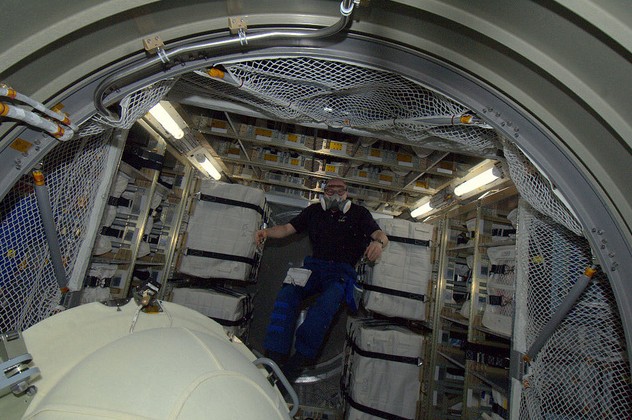
ESA Astronaut Andre Kuipers' floating inside the ATV-3

ESA Astronaut Andre Kuipers' first time floating inside the ESA ATV-3, Edoardo Amaldi. 

He is wearing a mask and protective glasses as a safety precaution, just in case the air is bad or there is hazardous material or dust floating around inside. Fortunately, all was ok.

Credit: ESA/NASA

ESA ATV-3, Edoardo Amaldi docks with ISS - Image

ESA supply vehicle, ATV-3, Edoardo Amaldi, approaches the ISS in a remote docking manoeuvre. 

You can see the glow from the stabilising thruster jets and the spotlight illuminating the scene.