Showing posts with label Air. Show all posts

Monday, July 28, 2014

ESA ATV-5, Georges Lemaître, Fully Loaded and Hatch Closed

ESA’s fifth Automated Transfer Vehicle, Georges Lemaître, is now scheduled for launch to the International Space Station at 23:44 GMT on 29 July (01:44 CEST 30 July) on an Ariane 5 rocket from Europe’s Spaceport in Kourou, French Guiana.

ATV-5 will deliver more than six tonnes of cargo to the Station, again breaking the record for the heaviest spacecraft launched on Ariane.

Everything has been loaded and the ferry is now sealed until it reaches the orbital outpost.

ESA astronaut Alexander Gerst, currently on board the ISS, will be the first to open the hatch of ATV-5, Georges Lemaître, in space when he takes responsibility for the cargo as ‘loadmaster’.

Alexander will manage the unloading of 6.6 tonnes of experiments, spare parts, clothing, food, fuel, air, oxygen and water for the six astronauts living in the 'weightless' (Zero Gravity) laboratory.

ATV-5, Georges Lemaître showing the closed hatch after completion of cargo loading.

Thursday, February 20, 2014

Tightly-Packed and Aligned Carbon Nanotube Fibres outperform copper

Scanning electron microscope images show typical carbon nanotube fibers created at Rice University and broken into two by high-current-induced Joule heating.

Rice researchers broke the fibres in different conditions; air, argon, nitrogen and a vacuum, to see how well they handled high current. 

The fibers proved overall to be better at carrying electrical current than copper cables of the same mass. 

Image courtesy Kono Lab /Rice University

On a pound-per-pound basis, carbon nanotube-based fibers invented at Rice University have greater capacity to carry electrical current than copper cables of the same mass, according to new research.

While individual nanotubes are capable of transmitting nearly 1,000 times more current than copper, the same tubes coalesced into a fibre using other technologies fail long before reaching that capacity.

But a series of tests at Rice showed the wet-spun carbon nanotube fiber still handily beat copper, carrying up to four times as much current as a copper wire of the same mass.

That, said the researchers, makes nanotube-based cables an ideal platform for lightweight power transmission in systems where weight is a significant factor, like aerospace applications.

Junichiro Kono
The analysis led by Rice professors Junichiro Kono and Matteo Pasquali appeared online this week in the journal Advanced Functional Materials.

Just a year ago the journal Science reported that Pasquali's lab, in collaboration with scientists at the Dutch firm Teijin Aramid, created a very strong conductive fiber out of carbon nanotubes.

Present-day transmission cables made of copper or aluminum are heavy because their low tensile strength requires steel-core reinforcement.

Scientists working with nanoscale materials have long thought there's a better way to move electricity from here to there.

Certain types of carbon nanotubes can carry far more electricity than copper.

Matteo Pasquali
The ideal cable would be made of long metallic "armchair" nanotubes that would transmit current over great distances with negligible loss, but such a cable is not feasible because it's not yet possible to manufacture pure armchairs in bulk, Pasquali said.

In the meantime, the Pasquali lab has created a method to spin fiber from a mix of nanotube types that still outperforms copper.

The cable developed by Pasquali and Teijin Aramid is strong and flexible even though at 20 microns wide, it's thinner than a human hair.

Read the full article here

More Information: 'High-Ampacity Power Cables of Tightly-Packed and Aligned Carbon Nanotubes' - Xuan Wang, Natnael Behabtu, Colin C. Young, Dmitri E. Tsentalovich, Matteo Pasquali, Junichiro Kono: DOI: 10.1002/adfm.201303865

Wednesday, November 21, 2012

Water, Footprints or Life on Mars? NASA Says; Maybe not!

NASA downplayed Wednesday talk of a major discovery by its Martian rover after remarks by the mission chief raised hopes it may have unearthed evidence life once existed on the Red Planet.

Excitement is building over soon-to-be-released results from NASA's Curiosity rover, which is three months into a two-year mission to determine if Mars has ever been capable of supporting microbial life.

Its Sample Analysis at Mars (SAM) instruments have been sending back information as it hunts for compounds such as methane, as well as hydrogen, oxygen and nitrogen, that would mean life could once have existed there.

In an interview aired Tuesday, lead mission investigator John Grotzinger hinted at something major but said there would be no announcement for several weeks.

"We're getting data from SAM," he said. "This data is gonna be one for the history books. It's looking really good."

A spokesman for NASA's Jet Propulsion Laboratory, which is managing the project, appeared to pour cold water Wednesday on the hopes of space enthusiasts looking forward to an earth-shattering discovery.

"John was delighted about the quality and range of information coming in from SAM during the day a reporter happened to be sitting in John's office last week. He has been similarly delighted by results at other points during the mission so far," spokesman Guy Webster reported.

"The scientists want to gain confidence in the findings before taking them outside of the science team. As for history books, the whole mission is for the history books," Webster said.

Scientists do not expect Curiosity to find aliens or living creatures but they hope to use it to analyze soil and rocks for signs the building blocks of life are present and may have supported life in the past.

The $2.5 billion Curiosity rover, which landed in Gale Crater on Mars on August 6, 2012, also aims to study the Martian environment to prepare for a possible human mission there in the coming years.

US President Barack Obama has vowed to send humans to the planet by 2030.

Friday, March 30, 2012

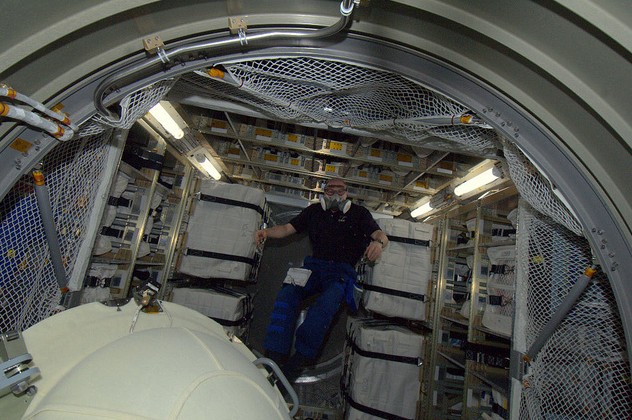
ESA Astronaut Andre Kuipers' floating inside the ATV-3

ESA Astronaut Andre Kuipers' first time floating inside the ESA ATV-3, Edoardo Amaldi. 

He is wearing a mask and protective glasses as a safety precaution, just in case the air is bad or there is hazardous material or dust floating around inside. Fortunately, all was ok.

Credit: ESA/NASA

Tuesday, January 24, 2012

NASA Space Shuttle Discovery: National Air and Space Museum

Discovery is expected to land at Washington Dulles International Airport on April 17 and transfer to the Udvar-Hazy Center on April 19. 

Join us to launch Space Shuttle Discovery on its new mission to educate & inspire!

Activities related to the arrival of Discovery — including a fly-over — have not been finalized at this time. 

Information on arrival activities, including public events and opportunities, will be released at a later date.

Discovery, the champion of the space shuttle fleet, associated with major historic, scientific and technological achievements, will be the first of the flown space shuttles to go on display.

Exact details will become available in the next few weeks. Check back here for updates. You can also subscribe to the Museum's e-newsletter, What's Up, fan our Facebook page, or follow @airandspace on Twitter for the latest news.

Please note that arrival activities are weather contingent and will be rescheduled in the event of inclement conditions.

For those participating from a distance, many of the activities will be available for viewing on TV or the web. Details coming soon.

Find out more about Space Shuttle Discovery

Tuesday, January 10, 2012

The Air Powered Motorcycle: O2-Pursuit


Last month industrial designer Dean Benstead unveiled the 02 Pursuit — a prototype for a motorcycle fueled not by gas or electricity, but by compressed air.

Based on the geometry of a 250cc motocrosser, the O2 Pursuit prototype uses the breakthrough engine technology developed by Angelo Di Pietro of Engineair.

Benstead, a recent graduate of the Royal Melbourne Institute of Technology (RMIT), has harnessed the power that exists in the air tanks to mechanically drive the vehicle.

According to Benstead, testing of the motorcycle showed close to a quarter of an hour running time with stops at around 25-45 km/h. 

During stationary testing, Benstead’s team timed the speed off the back wheel, registering over 100 km/h. 

Preliminary testing of the prototype was limited to an indoors factory environment on a circular track.

“The bike is running a standard scuba tank which runs air compressed up to 200 bar, with further developments, we would be looking at running a tank at 400 bar with increased capacity to also increase the range,” he said.

The innovation was the result of Benstead’s final-year design research into the future of motorcycles, looking at air as a genuine alternative to petrol and electricity.

“Air was the starting point back in 2010, but I continued to explore this for the prototype because of its low-tech nature,” Benstead said. 

“A solar panel and a compressor now becomes your refinery and without huge battery packs to dispose of, we now have a low-cost to free powered bike with minimum impact on the environment.”

The project began mid last year at the RMIT Ecomoto, the only motorcycle-specific design studio in Australia. 

Led by RMIT Lecturer and Acting Program Director Simon Curtis, Benstead’s super motard bike project won him the Product Design – Automotive and Transport award at the 2010 Melbourne Design Awards.

The air engine developed by Engineair is still yet to be commercialized. The motor used in the 02 Pursuit was one of five prototypes in the world.

Benstead, recently named in Melbourne’s Top 100 most influential people, is currently working with Australia’s Engineair on a new design that can bring the technology to the market.

02 Pursuit specs:
  • Top Speed: >100 km/h
  • Weight: <100kg
  • Engine: ‘Di Pietro’ 9 chamber air engine
  • Engine Weight: 10kg
  • Material: Aluminium
  • Development: Melbourne

Thursday, November 17, 2011

Lunar Ionosphere: Our Mysterious Moon

How can a world without air have an ionosphere? Somehow the Moon has done it.

Lunar researchers have been struggling with the mystery for years, and they may have finally found a solution. But first, what is an ionosphere?

Every terrestrial planet with an atmosphere has one. High above the planet's rocky surface where the atmosphere meets the vacuum of space, ultraviolet rays from the sun break apart atoms of air. This creates a layer of ionized gas--an "ionosphere."

Here on Earth, the ionosphere has a big impact on communications and navigation. For instance, it reflects radio waves, allowing shortwave radio operators to bounce transmissions over the horizon for long-range communications. The ionosphere also bends and scatters signals from GPS satellites, sometimes causing your GPS tracker to mis-read your position.

The first convincing evidence for an ionosphere around the Moon came in the 1970s from the Soviet probes Luna 19 and 22. Circling the Moon at close range, the orbiters sensed a layer of charged material extending a few tens of km above the lunar surface containing as many as 1000 electrons per cubic centimeter-a thousand times more than any theory could explain.

Radio astronomers also found hints of the lunar ionosphere when distant radio sources passed behind the Moon's limb.

The idea of an "airless Moon" having an ionosphere didn't make much sense, but the evidence seemed compelling.

As a matter of fact, the Moon isn't quite as airless as most people think. Small amounts of gas created by radioactive decay seep out of the lunar interior; meteoroids and the solar wind also blast atoms off the Moon's surface.

The resulting shroud of gas is so thin, however, that many researchers refuse to call it an atmosphere, preferring instead the term "exosphere."

The density of the lunar exosphere is about a hundred million billion times less than that of air on Earth-not enough to support an ionosphere as dense as the ones the Luna probes sensed.

For 40 years, the Moon's ionosphere remained a mystery until Tim Stubbs of the Goddard Space Flight Center published a possible solution earlier this year. The answer, he proposes, is moondust.

Stubbs--a 30-something scientist who wasn't even born when the Moon's ionosphere was discovered-read the accounts of Apollo 15 astronauts who reported seeing a strange glow over the Moon's horizon. Many researchers believe the astronauts were seeing moondust.

Tuesday, July 12, 2011

Micro Air Vehicles - AVs

Dr Gregory Parker, Micro Air Vehicle team leader, holds a small winged drone that resembles a dragonfly at Wright Patterson Air Force Base in Dayton, Ohio.

The Micro Air Vehicles unit of the Air Force Research Laboratory at Wright Patterson AFB is developing small military drones, with the goal of making them so small that they resemble small birds and insects, including some that will have moving wings.

Picture: REUTERS

Thursday, June 30, 2011

Homemade Air Purifier: Reduces 90% of allergen particles


Many people with sinus problems have underlying allergies to dust, pollen, mold or animal dander. All of these can build up in the air inside homes.

One of the best ways to get rid of allergy symptoms is to avoid allergens in the first place, says Jeffery E. Terrell, M.D., director of the University of Michigan Health System’s Michigan Sinus Center. To avoid indoor allergens, many doctors recommend using an air purifier with a High Efficiency Particulate Air (HEPA) filter.

The cost of these machines can run from $75 up to $800 for high-end systems.

For those who are looking for a cheaper alternative for high-use rooms such as the bedroom, Terrell offers a do-it-yourself solution at a fraction of the cost.

“This is a filtration system that you can put together with items from your local hardware store for $25 to $30 and use in your home to cut indoor allergens by about 90 percent,” says Terrell.

Start with a 20-inch by 20-inch box fan, which often retails for about $12. To the front of it, tape a 20-inch by 20-inch by 1-inch furnace filter.

Friday, March 4, 2011

ESA GOCE Delivers

The first geoid based on only two months of GOCE data, from November and December 2009, shows the excellent capability of the satellite to map tiny variations in Earth’s gravity.

The geoid is the shape of an imaginary global ocean dictated by gravity in the absence of tides and currents. It is a crucial reference for accurately measuring ocean circulation, sea-level change and ice dynamics – all affected by climate change.

An accurate model of the geoid is also important for surveying and geodesy, and for studying Earth interior processes.

Credits: ESA

More information on the ESA Portal

Tuesday, September 29, 2009

In Liquid and Air, Scientists Find Order Among the Chaos - NYTimes.com

In Liquid and Air, Scientists Find Order Among the Chaos - NYTimes.com

Assisted by instruments that can track in fine detail how parcels of fluid move, and by low-cost computers that can crunch vast amounts of data quickly, researchers have found hidden structures beyond Monterey Bay, structures that explain why aircraft meet unexpected turbulence, why the air flow around a car causes drag and how blood pumps from the heart's ventricles. In December, the journal Chaos will highlight the research under way to track the moving skeletons embedded in complex flows, known as Lagrangian coherent structures.

Shared via AddThis