Showing posts with label CNES. Show all posts

Tuesday, November 25, 2014

ESA IXV Spaceplane set for February launch

Arianespace has put the launch of its IXV spaceplane back on the schedule, announcing a February 2015 date for the flight.

The launch was recently postponed, but the organisation now says it's agreed with French space agency CNES that the Intermedia eXperimental Vehicle (IXV), will ascend to space on February 11 2015.

The IXV was delivered to the French Guiana spaceport in September, but hopes for a November 2014 launch were dashed in October when the European Space Agency (ESA) announced it would be postponed.

At that time, the ESA said it needed more time to analyse the flight trajectory of the Vega launcher that will hoist the space plane, because instead of the usual polar trajectory the launcher uses, the IXV test will head eastwards.

Since an easterly launch is “unprecedented” for Vega, the ESA said it wanted to generate more information on the performance of the launch vehicle, “should an anomaly occur after liftoff”.

Vega will carry the IXV to 320 km, after which it will rise under its own power to 420 km.

It will reach a speed of 7.5 km/second before re-entry, which the agency says is “fully representative of any mission from low orbit”.

The ultimate aim for the two-tonne IXV is to develop the technologies needed to launch cargoes to targets like the ISS in a reusable autonomous craft. Lift is generated not by wings but by the body design, with a couple of flaps controlling its flight.

The IXV will land in the Pacific Ocean, but the ESA ultimately wants to develop a craft that can land on conventional runways

Wednesday, October 8, 2014

France Proceeding with Next Generation Communications despite budget cuts

French officials continue to debate whether to outsource the nation’s next-generation Syracuse military telecommunications system (above, Syracuse 3A satellite) to the private sector, as has been done in Britain and, to a lesser extent, in Italy and Germany; or to proceed with a conventional procurement. 

Credit: Thales Alenia artist's concept

The French Defense Ministry on Oct. 1 said its planned electronic-intelligence satellite and next-generation military telecommunications satellite systems have survived a rough arbitrage of France’s budget and would be under contract in 2015.

The budget package outlined Oct. 1 does not specify cost amounts. It further suggests that the Defense Ministry may have recourse to a sale-and-leaseback formula to generate near-term cash that will help meet the requirements of its priority programs.

Dossier Information
French officials continue to debate whether to outsource the nation’s next-generation Thales Syracuse military telecommunications system to the private sector, as has been done in Britain and, to a lesser extent, in Italy and Germany; or to proceed with a conventional procurement.

France has also been talking with Italian and British military planners about combining at least part of their future military satellite communications needs, perhaps with a jointly owned satellite that would act as a backup for these nations’ primary satellite telecommunications assets.

Meanwhile, France’s Ceres electronic-intelligence satellite system, planned as three spacecraft flying in formation in low Earth orbit, has been a French priority for several years but has struggled for traction in a harsh budget environment.

Here is a translated extract from the French Finance Bill 2014 "The program CERES 20 is to have an operational capacity to listen, that could allow the interception and location of electromagnetic emissions from space (detection and radar transmitters or telecommunications location). This need was formalized through the launch of the preparation stage of the operation CERES, June 27, 2007. The system cost is estimated at around 460 million euros."

"The financial effort applied to the French Ministry of Defence at work 2011-2013 triennial budget planning has resulted in a shift of the CERES program. Planning now assumes an operational implementation in 2020."

Adding to the problem has been France’s inability to interest other European nations in joining Ceres.

"In autumn 2007, the EMA and the DGA jointly proposed to the countries cooperating MUSIS, as well as Sweden and Switzerland to join the operation CERES. Only Greece and Sweden have responded positively to the preparatory work and contributed financially. At the end of the work, in May 2011, Sweden announced it would terminate its participation for budgetary reasons."

Airbus Defence and Space (EADS) and Thales Alenia Space, Europe’s two biggest satellite manufacturers, which both have a large presence in France, are already under contract for initial Ceres studies.

Both have also expressed interest in managing the future military telecommunications satellite program with France as the anchor customer.

Wednesday, October 1, 2014

ESA Galileo: Soyuz launch glitch linked to frozen Hydrazine fuel pipe

A frozen fuel pipe in the upper stage of a Soyuz launcher likely caused the failure last month to place two European navigation satellites in orbit, a source close to the inquiry said Wednesday.

Confirming a report in French daily Le Monde, the source said investigators suspect a pipe containing hydrazine fuel, used by the Fregat upper stage to drive the satellites to their orbital slots, had frozen during launch.

The hydrazine pipes are located near a pipe that circulates ultra-cold liquid helium, the source said.

The two satellites, launched from Europe's base in Kourou, French Guiana, were intended to be the first two fully operational satellites in the new-generation navigation system Galileo.

30-satellite Galileo constellation. 

Credit: ESA

Two more satellites had been expected to be hoisted by the end of 2014, opening the way for a first phase of Galileo services in 2015, including applications for smartphones and in-car navigation and search-and-rescue location.

By 2017, according to the Galileo schedule, all 24 operational satellites would be in place.

Six backups would join the fleet by 2020, at which point the system would be fully operational.

Launched by a Russian-made Soyuz, the misplaced satellites should have been slotted into a circular orbit at an altitude of 23,500 kilometres (14,600 miles), inclined at 56 degrees to the equator.

Instead, they were placed in an useless elliptical orbit at a height of 17,000 kilometres (11,000 miles).

The failure adds to a catalogue of problems encountered by the 5.4-billion-euro ($7.2-billion) programme, designed to give the EU independence in satellite navigation from the US Global Positioning System (GPS).

Add caption
ESA Galileo IOV in orbit. 

Credit: ESA

Galileo, according to the project's defenders, will be more accurate and have a stronger signal, particularly in built-up areas, than its competitors.

Thursday, September 18, 2014

France raises heat on decision for next Ariane rocket

France's space agency on Thursday unveiled a revised proposal for an Ariane rocket ahead of a tough decision on launchers by the European Space Agency (ESA).

Ministers must decide whether they can afford to fund the development of two projects for Europe's next rocket.


These are an Ariane 6, promoted by France, that would be operational from the next decade and an intermediate launcher, the Ariane 5 ME, backed by Germany.

At a press conference in Paris, France's National Centre for Space Study (CNES) said the overhauled plans for the Ariane 6 resulted in a "simple design with great payload capacity," able to take between five and 10 tonnes into orbit.

It could be ready for launch in 2020, said CNES boss Jean-Yve Le Gall, a date that is a year or two earlier than was expected in July 2013.

"We are looking at a two-booster version, with costs of around 65 million euros [$83.85 million] per launch, and a four-booster version, at around 85 million euros per launch," said Le Gall.

"The per-kilo cost will be around 10,000 euros, roughly half that of Ariane 5 today," he said, referring to ESA's current workhorse.

CNES' previous design for the Ariane 6 had promised a 30-percent gain on Ariane 5 per-kilo launch costs.

"The industrial and institutional organisation of the project will be simplified, with the goal being to save costs," Le Gall pledged.

He admitted there would have to be "compromises" in Luxembourg, adding that around eight billion euros will be earmarked for launchers for the next decade.

"We tend to want everything, but the means to do so aren't always there," he said.

The presentation came a day after a preparatory meeting at ESA where the revised plans were approved by other figures in the space industry, including the head of launch operator Arianespace, Stephane Israel.

The December 2 meeting in Luxembourg will determine the outcome of a difficult political compromise in 2013 between ESA's major partners as nimble US firms such as SpaceX eye the market for satellite launches.

The German-backed Ariane 5 ME, standing for Midlife Evolution, would be a tweaked version of the Ariane 5.

It would in theory be ready by 2017 and yield operational costs over the existing ECA and ES models, which are highly reliable but need hefty subsidies.

In February, France's national auditor disclosed that French policymakers favoured dropping the ME to keep down development costs and prevent a feared delay to the Ariane 6.

Wednesday, July 30, 2014

ESA Pharao space clock delivered to ISS - Video


ESA has welcomed the arrival of Pharao, an important part of ESA's atomic clock experiment that will be attached to the International Space Station in 2016.

Delivered by France's CNES space agencyPharao is accurate to a second in 300 million years, which will allow scientists to test fundamental theories proposed by Albert Einstein with a precision that is impossible in laboratories on Earth.

Time is linked to gravity and, for example, passes faster at the top of Mount Everest than at sea level.

These effects have been proved in experiments on Earth but the Atomic Clock Ensemble in Space, ACES, will make more precise measurements as it flies 400 km high on humanity's weightless laboratory.

Comparing clocks under different gravity levels allows researchers to test Einstein's theories on space-time and other theories in fundamental physics.

To achieve its accurate timekeeping, the Pharao space clock uses lasers to cool caesium atoms down to -273 C, close to absolute zero.

Internet of clocks
Accurate timekeeping is vital for pinpointing our location, secure banking and fundamental science, but it is not easy to compare data from the many atomic clocks on Earth.

ACES is more than just one clock in space. Pharao will be accompanied by the Space Hydrogen Maser, which uses a different technique to keep track of time.

This clock uses hydrogen atoms as a frequency reference and offers better stability but for a shorter time.

By coupling the two clocks, ACES will provide the scientists with a unique, highly stable time reference in space.

The project will link together atomic clocks in Europe, USA, Japan and Australia with their space counterparts via microwave and optical links to create an 'internet of clocks' and to deliver precise timekeeping.

Connecting all these clocks is a significant part of ACES, with France's Cadmos User Support and Operations Centre taking responsibility for operating the instruments on the Station.

ESA astronaut Thomas Pesquet will be on the orbital outpost when ACES arrives in 2016. Using the Station's robotic arm, the 375 kg payload will be installed on a platform outside Europe's Columbus space laboratory.

Sunday, July 27, 2014

The source of the sky's X-ray glow

In findings that help astrophysicists understand our corner of the galaxy, an international research team has shown that the soft X-ray glow blanketing the sky comes from both inside and outside the solar system.

The source of this "diffuse X-ray background" has been debated for the past 50 years.

Does it originate from the solar wind colliding with interplanetary gases within our solar system?

Or is it born further away, in the "local hot bubble" of gas that a supernova is believed to have left in our galactic neighborhood about 10 million years ago?

The scientists found evidence that both mechanisms contribute, but the bulk of the X-rays come from the bubble.

The solar wind, a stream of charged particles continuously emitted by the sun, appears to be responsible for at most 40 percent of the radiation, according to new findings published in the journal Nature.

"The overarching science goal of our work is to try to answer questions like: What does the local astrophysical environment look like? And what is the environment in which the sun was born?" said Susan Lepri, an associate professor of atmospheric, oceanic and space sciences in the University of Michigan College of Engineering.

"It's part of trying to understand our place in the universe."

Lepri, who studies the physics of the sun, provided key measurements of the solar wind and its charge states.

"This is a significant discovery," said Massimiliano Galeazzi, associate chair in the Department of Physics in the College of Arts and Sciences at the University of Miami and principal investigator of the study.

"Specifically, the existence or nonexistence of the local bubble affects our understanding of the galaxy in the proximity to the sun and can be used as foundation for future models of the galaxy structure."

The findings confirm the existence of a local hot bubble, which had been previously debated.

The research team launched a research rocket into the upper atmosphere in 2012 to analyze the diffuse X-ray background. They focused on low-energy X-rays.

"At that low energy, the light gets absorbed by the neutral gas in our galaxy, so the fact that we observe it means that the source must be 'local,' possibly within a few hundred light-years from Earth," Galeazzi said.

"Until now it was unclear whether it comes from within the solar system (within few astronomical units from Earth), or a very hot bubble of gas in the solar neighbourhood (hundreds of light-years from Earth)."

That's like trying to decide if a bright light in the sky is from an airplane or a star, Lepri said.

The next phase of the mission is scheduled to launch in December 2015. The research team also included scientists from NASA, the University of Wisconsin, the University of Kansas, Johns Hopkins University and CNES in France.

More information: The origin of the local 1/4-keV X-ray flux in both charge exchange and a hot bubble. Nature. DOI: 10.1038/nature13525

Wednesday, May 7, 2014

NASA CNES SWOT: Surface Water and Ocean Mission Proceeds

SWOT will be able to measure the ocean's surface with 10 times the resolution of current technologies. 

This will allow scientists to study small-scale features that are key components of how heat and carbon are exchanged between the ocean and atmosphere.

NASA and the French space agency Centre National d'Etudes Spatiales (CNES) have agreed to jointly build, launch and operate a spacecraft to conduct the first-ever global survey of Earth's surface water and to map ocean surface height with unprecedented detail.

SWOT spacecraft concept: current design
NASA Administrator Charles Bolden and CNES President Jean-Yves Le Gall signed an agreement Friday at NASA Headquarters in Washington to move from feasibility studies to implementation of the Surface Water and Ocean Topography (SWOT) mission.

The two agencies began initial joint studies on the mission in 2009 and plan to complete preliminary design activities in 2016, with launch planned in 2020.

SWOT integrated measurement approach
"With this mission, NASA builds on a legacy of Earth science research and our strong relationship with CNES to develop new ways to observe and understand our changing climate and water resources," said NASA Administrator Charles Bolden.

"The knowledge we'll gain from SWOT will help decision makers better analyze, anticipate and act to influence events that will affect us and future generations."

SWOT is one of the NASA missions recommended in the National Research Council's 2007 decadal survey of Earth science priorities.

The satellite will survey 90 percent of the globe, studying Earth's lakes, rivers, reservoirs and ocean to aid in freshwater management around the world and improve ocean circulation models and weather and climate predictions.

This new agreement covers the entire life cycle of the mission, from spacecraft design and construction through launch, science operations and eventual decommissioning.

SWOT Flight system configurations
NASA will provide the SWOT payload module, the Ka-band Radar Interferometer (KaRIn) instrument, the Microwave Radiometer (MR) with its antenna, a laser retroreflector array (LRA), a GPS receiver payload, ground support and launch services.

NB: KaRIn is an updated version of Interferometric Synthetic Aperture Radar (InSAR) technique

SWOT measurement concept
CNES will provide the SWOT spacecraft bus, the KaRIn instrument's Radio Frequency Unit (RFU), the dual frequency Ku/C-band Nadir Altimeter, the Doppler Orbitography and Radiopositioning Integrated by Satellite (DORIS) receiver package, satellite command and control, and data processing infrastructure.

For more information on the SWOT mission check out the NASA Presentation here (pdf) and the Science Requirements doc (pdf)

Tuesday, March 25, 2014

Arianespace Ariane 5 ECA Launches ASTRA 5B and Amazonas 4A

On Saturday, March 22, 2014 at 22:04 UTC, Arianespace carried out the 59th successful Ariane 5 launch in a row, orbiting two telecommunications satellites: ASTRA 5B for the Luxembourg-based operator SES, and Amazonas 4A for the Spanish operator Hispasat. 

ASTRA 5B also hosts an EGNOS (European Geostationary Navigation Overlay Service) payload for the EuropeanCommission.

59th successful launch in a row: Arianespace continues to deliver the world's most reliable launch service!

Today's successful mission, the 59th in a row for ESA's Ariane 5 ECA (Cryogenic Evolution Type A) launcher, confirms that Arianespace continues to set the standard for guaranteed access to space for all operators, whether national or international space agencies, private industry or governments.

Following the announcement of the orbital injection of the ASTRA 5B and Amazonas 4A satellites, Arianespace Chairman and CEO Stephane Israel said: "Today's successful launch, the 59th in a row for Ariane 5, confirms the unrivaled reliability and availability of the European launcher.

"We take particular pride in being able to offer this service excellence to two leading European operators, SES and Hispasat, both long-standing customers of Arianespace, as well as the European Commission, which has an EGNOS satellite navigation payload integrated on the ASTRA 5B satellite."

"For Arianespace and our family of the Ariane, Soyuz and Vega launchers, the watchword in 2014 will be 'Europe', following the launch of Athena-Fidus on February 6, a French-Italian spacecraft that meets both defense and homeland security requirements, and leading up to flagship programs deployed by the European Commission (Copernicus and Galileo) and the European Space Agency (ATV and IXV)."

"In addition, I would also like to express my thanks to Airbus Defence and Space (EADS), as the industrial prime contractor for Ariane 5, to the rest of the European space industry, the teams at Kourou, the Guiana Space Center, and our partners at CNES for today's magnificent success."

Monday, March 24, 2014

ESA ATV-5 Georges Lemaître: Testing the solar panels for ATV-5

The solar panels for ATV Georges Lemaître undergoing testing at Europe's Spaceport in Kourou, French Guiana. 

The launch of ATV-5 on board an Ariane-5 is scheduled for 25 July 2014.

Credits: ESA-CNES-Arianespace /Optique Video du CSG - S. Martin

Wednesday, February 26, 2014

ESA Gaia: Largest Space Camera is ready to map a billion stars

Now whizzing through space, 1.5 million km from Earth. 

Credit: ESA-CNES-Arianespace / Optique Vidéo du CSG - G. Barbaste

After its successful launch in December, European Space Agency's (ESA) Gaia has now taken up its position in space and is ready to survey the skies.

With the help of two onboard telescopes focused onto the largest ever space camera, Gaia is estimated to catalogue nearly one billion stars in its 5-year mission.

Like Hipparcos before it, ESA's Gaia will map stars in the Milky Way. It will do this by measuring the brightest billion objects and determine their three-dimensional distribution and velocities.

It also has the ability to measure the temperature, mass, and chemical composition of these billion objects.

Gaia will be able to discern objects up to 400,000 times dimmer than those visible to the naked eye.

The positional accuracy of its measurements are akin to measuring the width of a human hair at a distance of 500 km.

The process will involve scanning each part of the sky an average of 70 times over its five-year mission lifetime.

This means scanning the entire sky twice every 63 days, once through each of the two telescopes, making it a powerful tool for spotting time-evolving phenomena such as binary systems, supernovae, and exoplanets.

Compared to ESA's Hipparcos Space Telescope, ESA's Gaia will be able to measure 500 times the number of stars, extending to objects 1000 times dimmer than the dimmest that Hipparcos could catalogue.

Test image from Gaia: Slightly shaky to start with, but it’ll get there. Credit: ESA/DPAC/Airbus DS

The technology that makes this possible is the largest camera ever launched into space – 940 million pixels.

That is why a lot of effort before launch was on figuring out exactly how to get the huge amount of data Gaia will produce back down to Earth.

When a picture is taken a number of charged-coupled devices (CCDs), the stuff most digital camera sensors are made off, are dedicated to spotting objects before they fall onto the main focal plane.

This allows the instrument to track the objects as they pass and only retain small regions around the object, reducing the file-size needed to be sent to Earth.

In five years it will send only 100 TB of data (1 TB is 1000 GB).

Once the data arrives to Earth, there is a system in place to analyse the data and distribute alerts to ground-based observatories if anything quickly evolving and potentially interesting is spotted, such as supernovae.

The catalogue produced by Gaia is expected to contribute to many areas of astrophysics;

  • multiply our database of exotic objects such as' 
    • exoplanets, 
    • white and brown dwarfs, and 
    • supernovae many-fold, contribute to more precise measurements of General Relativity, 
  • help to constrain the measurements of the presence and location of dark matter, and 
  • give us more accurate information about our galactic neighbourhood and its evolution.


Wednesday, January 22, 2014

Water Found on Dwarf Planet Ceres, May Erupt from Ice Volcanoes

An artist's impression of water outgassing from two sources on the dwarf planet Ceres, which is also the largest asteroid in the solar system. 

Credit: IMCCE-Observatoire de Paris/CNRS/Y.Gominet, B. Carry

Astronomers have discovered direct evidence of water on the dwarf planet Ceres in the form of vapour plumes erupting into space, possibly from volcano-like ice geysers on its surface.

Using European Space Agency's Herschel Space Observatory, scientists detected water vapor escaping from two regions on Ceres, a dwarf planet that is also the largest asteroid in the solar system.

The water is likely erupting from icy volcanoes or sublimation of ice into clouds of vapour.

Artist's impression of Ceres. Credit: ESA/ATG medialab

"This is the first clear-cut detection of water on Ceres and in the asteroid belt in general," said Michael Küppers of the European Space Agency, Villanueva de la Cañada, Spain, leader of the study detailed today (Jan. 22) in the journal Nature.

The research has implications for how Ceres formed, and supports models that suggest the planets moved around a lot within the solar system during its formation, Küppers told reporters.

ESA Scientists have suspected that there is a substantial amount of water on Ceres for about 30 years.

An earlier study found hints of water in the form of hydroxide, a product of water's dissociation, on Ceres in 1991, but the finding wasn't confirmed by later observations.

Now, Küppers and his ESA colleagues have confirmed the finding, using the ESA Herschel Space Observatory's spectrometer to look for signals of water.

Clouds of water vapour around Ceres absorbed the heat that radiates from the dwarf planet, which Herschel's instrument detected.

The team found that Ceres produces about 2×10^26 molecules, or 13 lbs. (6 kilograms), of water vapour per second from its surface.

Read the full article on the ESA Herschel portal

More Information: 'Localized sources of water vapour on the dwarf planet Ceres': Nature 505, 525–527 (23 January 2014) doi:10.1038/nature12918

Monday, November 4, 2013

ESA's ATV-5 for launch by Arianespace begins its pre-flight checkout

The Automated Transfer Vehicle (ATV) "Georges Lemaitre" has begun pre-flight checkout in the Spaceport's clean room facilities, following its arrival in French Guiana for a scheduled Ariane 5 flight next year.

As the fifth and final ATV to be launched by Arianespace under current arrangements with the European Space Agency, this spacecraft's Integrated Cargo Carrier (ICC) has now been removed from its special shipping container in the S5C preparation hall.

The ICC makes up 60 percent of the Automated Transfer Vehicle's total volume, with the capacity of ferrying up to 6.6 metric tons of cargo - both dry and fluid - on the spacecraft's servicing mission to the International Space Station (ISS).

Incorporating a two-part design, the Integrated Cargo Carrier includes a pressurized module for docking to the space station, where all dry materials are contained.

Up to two ISS astronauts can access this section while the spacecraft is attached to the orbital facility, working to unload supplies or conduct experiments.

Fluid cargo - such as propellant for refueling of the International Space Station - is stored in the ICC's non-pressurized area and transferred to the space station through pipes or manually operated hoses.

Prior to Georges Lemaitre's ESA-targeted launch date in 2014, final assembly of the spacecraft will be carried out at the Spaceport, including the Integrated Cargo Carrier, the Service Module solar panels and the Separation and Distancing Module (SDM) that links the ATV to its Ariane 5 vehicle.

Designated Georges Lemaitre after the Belgian physicist and father of the Big Bang theory, the fifth Automated Transfer Vehicle will resupply the International Space Station, as well as perform maneuvers to maintain this manned facility's nominal orbit.

An Astrium-led industry consortium is responsible for producing this series of resupply spacecraft under the European Space Agency-managed program.

To date all four Automated Transfer Vehicles have been orbited by Ariane 5 ES launchers, beginning with "Jules Verne" in March 2008, which was followed by "Johannes Kepler" in February 2011, "Edoardo Amaldi" in March 2012, and this June's flight with "Albert Einstein."


Thursday, February 28, 2013

EADS Arianespace Vega: Lite Launcher is readied for its second mission

The four-stage Vega was conceived as a capable lightweight launcher, joining Arianespace's medium-lift Soyuz and heavyweight Ariane 5 to provide a complete family of vehicles that meet the company's motto of delivering "any payload, to any orbit.anytime."

The Spaceport's ZLV launch site in French Guiana is busy with activity as the second Vega undergoes its assembly for a mission scheduled in April.

Build-up of the smallest member in Arianespace's launcher family marked a new milestone this week when its solid propellant second-stage was integrated atop the first stage, which also uses solid propellant.

The vertical assembly process for Vega no. 2 is being performed on the ZLV launch pad, protected by a mobile gantry that will be withdrawn prior to the vehicle's liftoff.

This complex uses the same site previously employed for missions from French Guiana with the cornerstone Ariane 1 and 3 vehicles - having been updated and adapted where needed to meet operational requirements of the new lightweight launcher.

Proba-V Satellite
Vega's upcoming second flight will orbit the Proba-V and VNREDSat-1A satellites, and follows the light-lift vehicle's on-target maiden launch in February 2012 with a payload of nine spacecraft - which served as its qualification mission.

The Proba-V passenger for Vega's no. 2 launch was produced by prime contractor Qinetiq Space Belgium for the European Space Agency, and will monitor global vegetation growth.

With an estimated mass of 160 kg., it is to operate in a Sun-synchronous polar orbit, carrying a newly-designed version of the Vegetation instrument already flown on the CNES Spot series of Earth observation satellites - which also were orbited by Arianespace.

Vega's VNREDSat-1A co-passenger is an optical observation spacecraft built by Astrium on behalf of the Vietnam Academy of Science and Technology.

Vegetation Instrument
With a mass of approximately 120 kg., it will support the Vietnamese government's initiative to create an infrastructure that enables better monitoring and studies of climate change effects, improves predictions and actions to prevent natural disasters, while also optimizing the management of its natural resources.

The four-stage Vega was conceived as a capable lightweight launcher, joining Arianespace's medium-lift Soyuz and heavyweight Ariane 5 to provide a complete family of vehicles that meet the company's motto of delivering "any payload, to any orbit.anytime."

Developed in a European program led by Italy's ASI space agency and industrial prime contractor ELV SpA., Vega is tailored to orbit small- to medium-sized satellites, including institutional and scientific spacecraft.

Monday, August 20, 2012

NASA Mars Rover Curiosity: ChemCam Laser-Zapped it's First Rock Sample

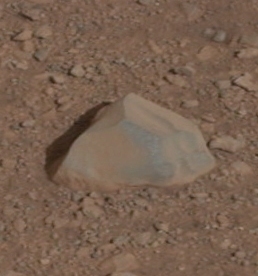
This composite image, with magnified insets, depicts the first laser test by the French designed Chemistry and Camera, or ChemCam, instrument aboard NASA's Curiosity Mars rover. 

The composite incorporates a Navigation Camera image taken prior to the test, with insets taken by the camera in ChemCam.

The circular insert highlights the rock before the laser test. The square inset is further magnified and processed to show the difference between images taken before and after the laser interrogation of the rock.

The test took place on Aug. 19, 2012.

In the composite, the fist-sized rock, called "Coronation," is highlighted.

Coronation is the first rock on any extraterrestrial planet to be investigated with such a laser test.

The widest context view in this composite comes from Curiosity's Navigation Camera. The magnified views in the insets come from ChemCam's camera, the Remote Micro-Imager.

The area shown in the circular inset is 6 centimeters (2.4 inches) in diameter. It was taken before the rock was hit with the laser.

The area covered in the further-magnified square inset is 8 millimeters (about one-third of an inch) across.

It combines information from images taken before and after the test, subtracting the "before" image from the "after" image to make the changes in the rock visible.

ChemCam hit Coronation with 30 pulses of its laser during a 10-second period. Each pulse delivered more than a million watts of power for about five one-billionths of a second.

The energy from the laser excited atoms in the rock into an ionized, glowing plasma. ChemCam also caught the light from that spark with a telescope and analyzed it with three spectrometers for information about what elements are in the target.

This initial use of the laser on Mars served as target practice for characterizing the instrument but may provide additional value.

Researchers will check whether the composition changed as the pulses progressed. If it did change, that could indicate dust or other surface material being penetrated to reveal different composition beneath the surface.

ChemCam was developed, built and tested by the U.S. Department of Energy's Los Alamos National Laboratory in partnership with scientists and engineers funded by France's national space agency, Centre National d'Etudes Spatiales (CNES) and research agency, Centre National de la Recherche Scientifique (CNRS).

Friday, April 27, 2012

NASA CNES Jason 1 Satellite: Returning to Service May 4 in Lower Orbit

The U.S.-French Jason-1 ocean-altimetry satellite, which was put into a safe-hold mode on March 3 after an on-board failure, is expected to return to service May 4 from a lower orbit, program managers said April 26.

The new orbit of 1,323.4 kilometers in altitude — some 12.6 kilometers lower than the former position — will permit ground controllers to operate Jason-1 until it fails completely, as this altitude is considered low enough to serve as a graveyard orbit, officials said.

The lower position means Jason-1 will not clutter the more-useful operational orbit in the event it fails without warning. It also reduces the number of years it will take before atmospheric drag pulls it into a destructive re-entry once it is retired.

Jason-1 was launched in December 2001 on what was supposed to be a three-year mission to succeed the larger U.S.-French Topex-Poseidon satellite.

Ocean altimetry’s popularity with civil and military customers has only grown since then.

Jason-2 was launched in August 2008, and has been operated in tandem with Jason-1 to increase the frequency of altimetry data returned to users. Jason-3 is scheduled for launch in 2014 and a successor satellite to that is being designed by the 19-nation European Space Agency.

The U.S.-French Jason operating team said Jason-1, whose payload instruments were switched on starting April 24 after a seven-week outage, should be able to perform partial service for at least another year.

“The move from the altimetry reference orbit has been a difficult decision to take, but it also signals the start of an exciting new chapter in the extraordinary mission of Jason-1,” the Jason-1 team from the NASA Jet Propulsion Laboratory and the French space agency, CNES, said in an April 23 message to users.

Monday, February 13, 2012

ESA's Third ATV Edoardo Amaldi: Set for launch to ISS

ATV Edoardo Amaldi being moved to a different building at the Guiana Space Centre. 

ESA's third automated space freighter, Edoardo Amaldi, will carry about two tonnes of dry cargo, 285 kg of water and more than three tonnes of propellants to the International Space Station. 

Credits: ESA/CNES/Arianespace/Optique Video du CSG-J.M. Guillon.

Wednesday, October 19, 2011

Galileo Satellites positioned on Fregat final stage


The first Galileo satellites positioned on the Fregat Upper Stage and dispenser, ahead of their launch on 20 October 2011.

These satellites will be placed into orbit by the first Soyuz flight from Europe's Spaceport, Kourou in French Guiana.

For more great images of Galileo and further information on this historic launch, please visit: www.esa.int/GalileoIOV

Credits: ESA, CNES, Arianespace, Optique Video du CSG, S.Martin


Soyuz Fregat - Cargo Dispenser

The high-performance Fregat space tug originated as a propulsion stage for the Soviet Mars probes. It was later adapted for many deep-space missions, thanks to its ability to fire its engine multiple times and function in space for prolonged periods.

Technical specifications of the Fregat upper stage (118; 207)

Wednesday, June 22, 2011

ESA ATV-2: Johannes Kepler undocking from Space Station


Alors qu’il vient de se séparer de la Station spatiale internationale, l’ATV Kepler glisse lentement dans la nuit au terme d’une mission de 4 mois couronnée de succès.

Cette image a été prise le lundi 20 juin depuis la Station peu après le désamarrage qui s’est effectué à 16h46 heure de Paris. Le lendemain, l’ATV Kepler, piloté depuis le Centre Spatial Toulousain du CNES, s’est désintégré comme prévu vers 23h au-dessus de l’Océan Pacifique.

Picture credit: ESA/CNES

Tuesday, June 21, 2011

ESA ExoMars: French Concerns Throw Mission Plan Into Doubt


The U.S.-European Mars exploration program featuring launches in 2016 and 2018 is facing new turbulence following the French government’s refusal to endorse new spending until the 2018 mission is better defined and given a bigger budget, according to European government and industry officials.

The French space agency, CNES, had already signaled to its fellow European Space Agency (ESA) governments in late May that it needed more time to evaluate the impact of NASA’s decision to scrap a NASA rover in 2018 in favour of a joint NASA-ESA vehicle.

Lone among ESA governments taking part in the mission, CNES voted against forwarding ESA’s ExoMars program, which includes a 2016 Mars orbiter in addition to the 2018 launch of the rover, to ESA’s check-writing body, called the Industrial Policy Committee.

CNES’s concerns were apparently insufficient to prevent ESA’s Human Spaceflight and Operations Directorate, meeting May 26-27, from approving the new ExoMars configuration despite the many unknowns about the NASA-ESA rover.

Precise information on the rover’s cost and configuration, including the work distribution between ESA and NASA, will not be settled until October 2011.

ESA’s Industrial Policy Committee, which approves the agency’s expenditures, is scheduled to meet June 29-30 to approve a resumption of full ExoMars spending following a suspension of most work in April.

The work suspension was caused by NASA’s decision, announced in March, that it could no longer afford its own rover and would seek a single U.S.-European rover for the 2018 launch.

The Industrial Policy Committee had been expected to reopen the ExoMars financial spigot given the approval of the Human Spaceflight and Operations Directorate.

Given that France is a major partner and owns some of the most experienced manufacturers of aerospace equipment (EADS, THALES, etc.), it is uncertain whether the financial approval can occur. Something that ESA and CNES will be well aware of.

ESA officials had wanted to approve continued funding of ExoMars as soon as July 1 because of what they said were tight deadlines for the industrial contracting team working on the 2016 mission.

ESA’s ExoMars prime contractor, Thales Alenia Space of France and Italy, had said it needed to begin full-scale construction on the 2016 mission, which features a Mars telecommunications relay orbiter, this summer without waiting for the end of negotiations on the 2018 rover.

Read more here

Monday, June 6, 2011

ESA Human Spaceflight and Exploration - New Zero Gravity training

A new way to fly experiments takes off tomorrow with the first campaign dedicated to research in ‘partial’ gravity. Scientists on Europe’s ‘Zero-G’ Airbus will experiment with gravity conditions like those on the Moon and Mars.

The Joint European Partial-g Parabolic Flight campaign is an unprecedented research mission organised jointly by ESA and the French and German space agencies, CNES and DLR.

The pilots will follow special parabolic paths to create Moon and Mars gravity conditions for at least 25 seconds each time. The final parabola will provide full weightlessness for the experiments.


Each flight can provide a total of up to 12 minutes of partial gravity inside the aircraft. The Airbus A300, owned by Novespace, will perform consecutive flights on the three days starting tomorrow from Mérignac-Bordeaux airport, France.

Thirteen European experiments selected by the three agencies will test the effects of partial gravity.

The scientists’ response to this new partial gravity opportunity has been enormous. “This is a unique campaign in the world, and we have received outstanding scientific proposals from all over Europe,” say the agencies’ project managers.


The science behind the flights
The experiments cover a wide range of research, such as biology, human physiology and physics, as well as technology demonstrations.

The goal is improve our knowledge about how systems react to different accelerations and where the level of sensitivity is.

“Lunar and martian reduced-gravity environments will provide scientists with additional data at different gravity levels,” explain the campaign’s managers.

The physical behaviour of bubbles, dust and granular packing will be closely monitored. Engineers will test technologies for the ExoMars robotic mission in martian gravity.

Plants and rats are also among the passengers, together with a video game console to be tested as a training device for balance control under reduced-gravity conditions.