Showing posts with label Mars mission. Show all posts

Tuesday, April 8, 2014

Mars Mission 'Risk': Astronauts may suffer Vision Damage

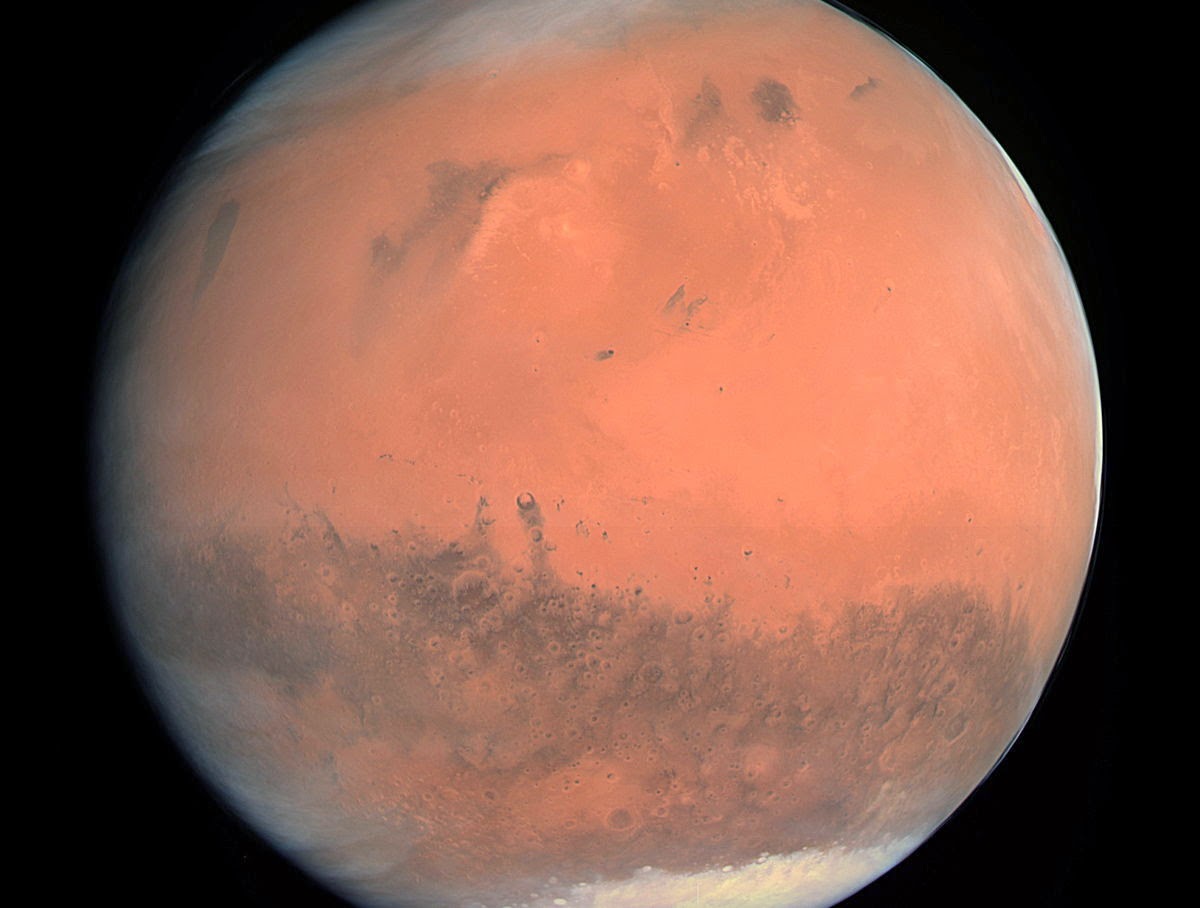
A manned mission to Mars could feasibly launch sometime in the 2030s, according to a panel of experts.

Credit: ESA

Mars may possess a stark and austere beauty, but a manned Red Planet mission will likely not be easy on the eyes.

Recently, scientists have begun realizing that spaceflight can cause serious and perhaps permanent vision problems in astronauts.

NASA researchers are working hard to understand the issue, which could present a major hurdle to mounting manned missions to Mars and other faraway destinations.

"This is one that we don't yet have a good handle on, and it can be a showstopper," Mark Shelhamer, chief scientist for the NASA Human Research Program at Johnson Space Center in Houston, said last week during a presentation with the agency's Future In-Space Operations (FISO) working group.


The human body suffers in the microgravity environment of space. For example, without effective countermeasures — i.e., vigorous weight-bearing exercise — astronauts' muscles atrophy and their bones shed calcium, becoming more and more brittle over time.

Spaceflight can also affect the eyes. Researchers have known this for decades, but they're just now beginning to appreciate the gravity of the situation.

"Over the last 40 years there have been reports of visual acuity impairments associated with spaceflight through testing and anecdotal reports," a 2012 NASA report about spaceflight-related vision problems states.

"Until recently, these changes were thought to be transient, but a comparison of pre- and postflight ocular measures have identified a potential risk of permanent visual changes as a result of microgravity exposure."

Thursday, December 19, 2013

Mars Missions: JPL Test New Supersonic Decelerator Technology - Video


Video of rocket-sled testing of the SIAD-R device, conducted in fall 2012 at China Lake, Calif. 

The SIAD-R is one of three supersonic deceleration devices now being prepared for flight testing by the Low-Density Supersonic Decelerator project at NASA's Jet Propulsion Laboratory in Pasadena, Calif. 

The devices, which slow the rate of descent for vehicles entering the atmosphere of another planet, could be used in Mars missions launching as early as 2018.


Validation tests are crucial to working out the kinks before a system of this type is used for future space missions.

A giant crane will tower above NASA's Jet Propulsion Laboratory in Pasadena, Calif., shooting out of a hilly mesa like an oversized erector set, ready to help test components of NASA's Low Density Supersonic Decelerator (LDSD) project.

The goal of the challenging technology, led by JPL, is to enable a future mission to Mars or other planetary bodies that uses heavier spacecraft and lands them at locations that were previously not achievable.

The crane-test is scheduled for tomorrow, Dec. 18, weather permitting. The test will simulate the acceleration of a large parachute being pulled away from a spacecraft.

The purpose of the test is to show that all of the parachute lines and bridles come out in an organized manner and do not catch on other vehicle hardware as they are deployed.

NASA's Low-Density Supersonic Decelerator team gathers around the "SIAD-R" -- a Supersonic Inflatable Aerodynamic Decelerator they're developing to assist future planetary exploration missions -- during rocket-sled testing at China Lake, Calif. 

Image Credit: NASA/JPL

Validation tests are crucial to working out the kinks before a system of this type is used for future space missions. During this test, the parachute, which has a diameter of roughly 100 feet (30.5 meters), will not open.

Its size is a significant upgrade by comparison to parachutes that have come before it. For instance, last year's successful landing of NASA's Mars Curiosity Rover utilized a parachute that measured only 51 feet (15.5 meters) across, about half the size.

The heavier planetary landers of the future require much larger drag devices than any now in use to slow them down -- and those next-generation drag devices will need to be deployed at higher supersonic speeds to safely land a vehicle, plus crew and cargo for potential human missions.

Artist impression of SIAD-R over Mars
Current Mars landing techniques date back to NASA's Viking mission, which put two landers on Mars in 1976.

That mission's basic parachute design has been in use ever since, with additional landing technologies, and was used again in 2012 to deliver the Curiosity rover to Mars.

To conduct more massive exploration missions in the future, however, NASA must advance the technology to a new level of sophistication.

Testing for the LDSD project began in 2012 at the U.S. Navy's China Lake Naval Air Weapons Station in California and will be conducted through 2015.

In the next few years, the Low Density Supersonic Decelerator Technology Demonstration Mission will conduct full-scale, stratospheric tests of these breakthrough technologies high above Earth to prove their value for future space exploration missions.

Monday, November 11, 2013

India's Ambitious MARS Mission hits a major snag

India's mission to Mars has hit a snag, after a planned engine burn failed to raise the spacecraft's orbit around Earth by the intended amount.

The problem occurred during a manoeuvre designed to boost the craft's maximum distance from 71,623km to 100,000km.

A problem with the liquid fuel thruster caused the 1,350kg vehicle to fall short of the mark.

But the head of the Indian Space Research Organisation (Isro) said the spacecraft remained "healthy".

As a solution, the Mars Orbiter Mission (MOM) - known informally as Mangalyaan, or Mars-craft - will be commanded to execute an additional thruster firing at 05:00 IST on Tuesday (23:30 GMT on Monday) to make up for the shortfall.

However, independent experts cont acted by the BBC said they were puzzled by Isro's working hypothesis for the failure.

Instead of flying directly to Mars, the probe is scheduled to orbit Earth until the end of the month, building up the necessary velocity to break free from our planet's gravitational pull.

This was the fourth in a series of five engine burns known as "midnight manoeuvres" because several constraints require that they are carried out in the early hours of the morning.

Speaking to Pallava Bagla, science editor at Indian broadcasting network NDTV, Isro's chairman K Radhakrishnan said: "The spacecraft is healthy and it encountered a problem when a specific redundancy test was being conducted and it failed to reach the desired velocity it was to achieve."

In that redundancy test, two coils in the liquid engine were supposed to be energised simultaneously.

"When you are going so far away, if one thing fails, you want to have a standby option. Everything is almost doubled up on the satellite, which is why they were not able to carry so much scientific equipment," Mr Bagla explained.

Tuesday, October 22, 2013

India ISRO sets November 5 for Mars Orbiter mission launch

File pictures show scientists and engineers working on a Mars Orbiter vehicle at the Indian Space Research Organisation's (ISRO) satellite centre in Bangalore, southern India on September 11, 2013

Scientists on Tuesday set November 5 for the delayed launch of India's first mission to Mars, which was postponed due to problems in positioning a seaborne tracking system.

Blast-off for the unmanned Mars Orbiter Mission had to be rescheduled after the state-run Indian Space Agency Organisation (ISRO) said at the weekend that it would be unable to launch as expected on October 28.

Two Indian ships have been sent to Fiji in the Pacific Ocean to enable constant tracking of the rocket, but one of them has been late to arrive because of bad weather.

"The Mars Orbiter Mission has been rescheduled to November 5 and its spacecraft will be launched at 14:36 IST (Indian Standard Time) from Sriharikota spaceport," ISRO spokesman Deviprasad Karnik told AFP.

The 1.3-tonne Orbiter probe will be launched on a 350-tonne rocket from Sriharikota on the Bay of Bengal, about 80 kilometres (50 miles) northeast of Chennai. The nine-month Mars mission was approved by the government and has a budget of 4.5 billion rupees (73 million dollars).

India says the mission will mark a significant step in its space programme, which has already placed a probe on the Moon and is a source of national pride in the country of 1.2 billion.

But the spending has also attracted criticism as the government struggles to tackle widespread poverty and massive infrastructure problems. A host of countries have previously launched missions to Mars, including the United States, Russia, Japan and China.

Monday, April 29, 2013

Mars Mission May Carry Asteroid-Smashing Probe ISIS and Insight in 2016


Impactor for Surface and Interior Science (ISIS) nears asteroid target: 1999 RQ36.

CREDIT: Steve Chesley

When a NASA mission to study Mars' deep interior blasts off in 2016, it may also carry a tag-along experiment that will slam an impactor into a potentially hazardous asteroid.

Scientists are studying the possibility of adding the asteroid-deflection effort — dubbed Impactor for Surface and Interior Science (ISIS) — to NASA's InSight Mars mission, which is slated to launch a lander toward the Red Planet in March 2016.

Once set loose in space, ISIS is designed to slam into the asteroid target of the already-on-the-books NASA mission Osiris-Rex, which aims to launch a robotic probe toward potentially dangerous asteroid 1999 RQ36 in September 2016.

Hardware alignment
"This opportunity with a free launch and the observer spacecraft already at the asteroid is like a planetary alignment. It almost never happens," said Steven Chesley of the solar system dynamics group at NASA's Jet Propulsion Laboratory in Pasadena, Calif. who is leading the potential ISIS mission.

Chesley discussed ISIS here during the 2013 International Academy of Astronautics' Planetary Defense Conference, which ran from April 15 to 18.

SIS would take advantage of a boost into space from the InSight Mars lander mission in 2016.

CREDIT: Steve Chesley

NASA's Osiris-Rex mission has an amalgam of asteroid-studying duties, as the name suggests: Origins, Spectral Interpretation, Resource Identification, Security, Regolith Explorer.

The Osiris-Rex mission is a partnership involving the University of Arizona, NASA’s Goddard Space Flight Center and Lockheed Martin, with collaborators worldwide.

The Osiris-Rex spacecraft is scripted for travel to 1999 RQ36, a near-Earth carbonaceous asteroid.

The probe will rendezvous with that space rock in 2019-2021, gathering and returning specimens of the object for delivery to Earth in 2023.

The new plan being devised has ISIS arriving after Osiris-Rex has done its science work at the asteroid. ISIS would smack at high velocity into the near-Earth asteroid, creating a crater tens of meters in diameter.

Celestial wallop
From a safe vantage point, Osiris-Rex would observe the celestial wallop.

After debris clears, the probe would then approach the asteroid and image the crater for comparative analysis of previously mapped terrain. In addition, spectra of the pristine material exposed by the impact could be obtained.

The purposeful crash of ISIS into the asteroid is viewed, in part, as a seismic experiment. Global alterations (toppled rocks, landslides) due to shock waves and reverberations are anticipated, as is lofting of material far from the impact site. Just how much the asteroid is deflected from its course will also be measured.

The outcome of the ISIS impact, and the data it generates, are meant to showcase planetary defense aspects of an asteroid deflection experiment, like demonstrating terminal guidance capability.

ISIS also spotlights important science return per dollar, advocates say.

On the exploration side, ISIS squarely addresses numerous critical and strategic knowledge gaps for human exploration of near-Earth asteroids, Chesley told conference attendees.

Tuesday, May 1, 2012

Spacesuit lets you feel like an astronaut on Mars


What would it feel like to be an astronaut on Mars?

Physicist Daniel Schildhammer wears the Aouda.X spacesuit simulator during a field test of Oesterreichisches Weltraum Forum (Austrian space forum) inside the Eisriesenhoehle (giant ice cave) at Dachstein mountain near the village of Obertraun April 28, 2012.

The outfit mimics Mars's lower atmospheric pressure and is equipped for extreme temperatures, with an onboard computer that controls a heating and cooling system based on information from a network of sensors.

Headphones allow the wearer to communicate wirelessly with colleagues on smartphones, with a radio backup should the main system fail.

Compared to the first version of the suit, which was tested in 2009, the current model is equipped with more robust electronics and a better voice recognition system to control field instruments.

However, according to Gernot Groemer, (www.ostina.org) the team leader, there are still improvements to be made. "The goal is to create a simulation that's so realistic that by closing your eyes, you would think you were on Mars," he says.

The suit is being tested in ice caves at Dachstein mountain in Austria to simulate astrobiology experiments. It is designed to collect samples without contaminating the external environment as long as the right procedures are followed. These are currently being evaluated at the site.

Thursday, March 29, 2012

MARS Exploration: Russia is Developing a Nuclear Space Engine by 2017

According to press agency RIA Novosti, Russia is developing a Megawatt-class nuclear propulsion system for long-range manned spacecraft.

“At present we are testing several types of fuel,” said Denis Kovalevich, Skolkovo Foundation’s Nuclear Cluster head, “the engine is expected to be ready by 2017.”

The source reports a government allocation of 500 million rubles ($16.7 million) in 2010 to start a project of a nuclear powered spacecraft, with a projected total investment of about 17 billion rubles (over $580 million) by 2019.

The engine will be used for interplanetary manned missions targeted to the Moon and Mars. A recently leaked document from the Russian space agency drafted an ambitious plan for planetary exploration, both manned and unmanned.

Nuclear power is generally considered a promising technology for interplanetary exploration, especially beyond Earth’s orbit, where solar power gets weak.

NASA has been trying to promote nuclear propulsion several times, including a project in 2003, but funding was eventually cut down.

Thursday, November 24, 2011

Phobos Grunt: ESA Pursuing Strategies to Maintain Contact with Russian Mars Mission

The European Space Agency (ESA), which was able to established a two-way communication with Russia's Phobos-Grunt mission after its successful contact on Tuesday, said it is pursuing strategies to consolidate contact with the mission.

In an update posted on its website, ESA said its 15 m-diameter antenna at Perth, Australia, was again used to contact Russia's Phobos-Grunt spacecraft during the night of Nov. 23-24.

A total of five communication passes were available between 20:19 and 04:08 GMT.

Teams working at the Perth station and at ESA's Space Operations Centre, Darmstadt, Germany, were delighted to see a clear signal during the first of the passes.

"The first pass was successful in that the spacecraft's radio downlink was commanded to switch on and telemetry was received," said Wolfgang Hell, ESA's Service Manager for Phobos-Grunt.

Hell said the signals received from Phobos-Grunt during the second contact were much stronger than those initially received on 22 November, in part due to having better knowledge of the spacecraft's orbital position.

Hell explained that one of the two low-gain antennas on Phobos-Grunt was oriented toward Perth, thus, communication worked.

The second contact was short and so it was used only to uplink commands while in the next three passes the spacecraft's orbital position changed, and the second, opposing, antenna had to be used, but no signal was received from Phobos-Grunt.

"Our Russian colleagues will use this result for troubleshooting and to plan their commands for us to send tonight," says Manfred Warhaut, ESA's Head of Mission Operations.

Another five communication slots are available during the night of 24-25 November, and the Perth tracking station will again be allocated on a priority basis to Phobos-Grunt, ESA said.

If revived, the Phobos-Grunt mission may still have a short window to journey across space and visit a new target, such as an asteroid, Russian space officials said.

Friday, November 18, 2011

China's Yinghuo Mars Satellite Lost with Phobos Grunt


The loss of Russia's Phobos-Grunt mission has shocked the spaceflight community.

There's been plenty of attention placed on this high-profile mission, but relatively little coverage of its piggyback payload, Yinghuo-1.

This small satellite was set to become China's first Mars mission. The loss of Phobos-Grunt ended the mission of Yinghuo at the same time.

China's state media were fairly quick and frank to declare Yinghuo lost alongside Phobos-Grunt. In fact, they seemed to be far more direct in reporting the loss of the two spacecraft than Russia's own officials. Having stated this, there was no more reportage on Yinghuo-1.

This is understandable for three main reasons. There was little more that could be said about the fate of the probe, and little incentive to over-report on bad news. Also, China's aerospace reporters were preoccupied with another major story.

As Yinghuo was launched, China's Tiangong 1 space laboratory and Shenzhou 8 spacecraft were successfully operating in orbit. These twin missions have been the real stars of China's recent space activities, and they truly deserve the limelight.

But let's return to Yinghuo-1, which remains stored inside a truss structure beneath Phobos-Grunt. The two spacecraft will probably make an uncontrolled re-entry before the end of the year.

Yinghuo never even got a chance to unfurl its solar panels or perform any real operations in space. It would be tempting to declare this mission a total failure, but this is both unfair and untrue.

Yinhuo-1 was a fairly low-cost and low-key way for China to begin its planetary exploration program. If the program is treated as an exercise in starting such a program, it should be considered successful. Chinese engineers were able to design and assemble a flight-ready spacecraft.

They forged international partnerships for acquiring instrumentation. They developed procedures for controlling the spacecraft and analyzing its data. They probably uncovered technical and procedural gremlins along the way, and learned to defeat them.

Like the tip of an iceberg, the small Yinhuo spacecraft is just one part of a larger program, with infrastructure, personnel, and knowledge. The rest of this program is on the ground, and it remains intact.

Friday, September 9, 2011

NASA: Viking Lander Model

NASA's Viking Project found a place in history when it became the first U.S. mission to land a spacecraft successfully on the surface of Mars.

Two identical spacecraft, each consisting of a lander and an orbiter, were built.

Each orbiter-lander pair flew together and entered Mars orbit; the landers then separated and descended to the planet's surface.

Viking 2 launched 36 years ago today on Sept. 9, 1975. This artist's concept depicts a Viking lander on the surface of Mars.

The Viking 2 lander settled down at Utopia Planitia on Sept. 3, 1976, while the Viking 1 Lander touched down on the western slope of Chryse Planitia (the Plains of Gold) on July 20, 1976.

Besides taking photographs and collecting other science data on the Red Planet's surface, the two landers conducted three biology experiments designed to look for possible signs of life.

These experiments discovered unexpected and enigmatic chemical activity in the Martian soil, but provided no clear evidence for the presence of living microorganisms in soil near the landing sites. According to scientists, Mars is self-sterilising.

They believe the combination of solar ultraviolet radiation that saturates the surface, the extreme dryness of the soil and the oxidizing nature of the soil chemistry prevent the formation of living organisms in the Martian soil.

Although the Viking mission was planned to continue for 90 days after landing, each orbiter and lander operated far beyond its design lifetime. Viking Orbiter 1 functioned until July 25, 1978, while Viking Orbiter 2 continued for four years and 1,489 orbits of Mars, concluding its mission Aug. 7, 1980.

Because of the variations in available sunlight, both landers were powered by radioisotope thermoelectric generators -- devices that create electricity from heat given off by the natural decay of plutonium.

That power source allowed long-term science investigations that otherwise would not have been possible. The last data from Viking Lander 2 arrived at Earth on April 11, 1980. Viking Lander 1 made its final transmission to Earth Nov. 11, 1982.

Image Credit: NASA/JPL-Caltech/University of Arizona

Tuesday, August 23, 2011

ESA and Russia's Roskosmos joint venture to MARS!

With just months to go before the end of a Moscow-based simulated journey to Mars, the European Space Agency (ESA) head said on Wednesday a joint mission with Russia to the Red Planet was in the pipeline.

Speaking to reporters at an air show near Moscow on Wednesday, ESA head Jean-Jacques Dordain said ESA and Russia's Roskosmos space agency would "carry out the first flight to Mars together."

Dordain said it was too early to define a timeframe, but added that the Mars500 project was a factor in the preparation for a real mission to Mars.

The 520-day simulated Mars500 project, run by Russia's Institute of Biomedical Problems with ESA's participation, aims to investigate just how well humans can cope with a return trip to the Red Planet. The six crew members are due "to return to Earth" in November.

Experts say a manned journey to Mars is still decades away because of the technological and financial challenges involved.

Friday, June 24, 2011

MARS Simulation on Tenerife mountain top

One of the most exciting parts of my astrobiology research is working out how to search for evidence of past Martian life - signs of ancient biology that may have fallen extinct hundreds of millions of years ago.

One promising technique for finding these "biosignatures" - which could be pockets of organic molecules or even microbial life - is to entice them to glow in the dark using an ultraviolet laser mounted on a robotic probe. A camera on the probe would then detect the glow.

If you've ever had a gin and tonic in a nightclub you are probably already familiar with this effect. You'll have noticed how the ultraviolet lights in the club (we see them as black) cause the G&T to emit an eerie blue glow. This is caused by quinine, an organic molecule in the tonic water, fluorescing. It is this bitter-tasting compound that gives tonic water its anti-malarial properties so it's funny to think how far we've come since Victorian colonists in East Africa supped medicinal G&T sun-downers!

I have been testing this technique in the lab but it is now time to try the equipment in a more realistic scenario. So next week I'm flying out to Tenerife in the Canary Islands to carry out fieldwork in the volcanic caldera that sits like a giant pimple on the face of this tiny island. The barren rocky terrain and volcanic geology around Tenerife are a good approximation to the Martian landscape, and, in fact, prototypes for Mars rovers are put through their paces here.

I am part of a team of scientists, lead by Derek Pullan at Leicester University, who will be field-testing different instruments and camera systems. The system I'll be testing involves a sensitive digital camera and an ultraviolet light source. Because we'll be operating by day I'll have to shield everything from the bright sunlight beneath a thick photographic blanket. My rucksack will also be laden with other snazzy kit like a laser range-finder and GPS-equipped camera to record the environment around my test sites.

There are still a few things to sort out, but I'm pretty much good to go now. Holiday snaps to follow!

Tuesday, June 21, 2011

ESA ExoMars: French Concerns Throw Mission Plan Into Doubt


The U.S.-European Mars exploration program featuring launches in 2016 and 2018 is facing new turbulence following the French government’s refusal to endorse new spending until the 2018 mission is better defined and given a bigger budget, according to European government and industry officials.

The French space agency, CNES, had already signaled to its fellow European Space Agency (ESA) governments in late May that it needed more time to evaluate the impact of NASA’s decision to scrap a NASA rover in 2018 in favour of a joint NASA-ESA vehicle.

Lone among ESA governments taking part in the mission, CNES voted against forwarding ESA’s ExoMars program, which includes a 2016 Mars orbiter in addition to the 2018 launch of the rover, to ESA’s check-writing body, called the Industrial Policy Committee.

CNES’s concerns were apparently insufficient to prevent ESA’s Human Spaceflight and Operations Directorate, meeting May 26-27, from approving the new ExoMars configuration despite the many unknowns about the NASA-ESA rover.

Precise information on the rover’s cost and configuration, including the work distribution between ESA and NASA, will not be settled until October 2011.

ESA’s Industrial Policy Committee, which approves the agency’s expenditures, is scheduled to meet June 29-30 to approve a resumption of full ExoMars spending following a suspension of most work in April.

The work suspension was caused by NASA’s decision, announced in March, that it could no longer afford its own rover and would seek a single U.S.-European rover for the 2018 launch.

The Industrial Policy Committee had been expected to reopen the ExoMars financial spigot given the approval of the Human Spaceflight and Operations Directorate.

Given that France is a major partner and owns some of the most experienced manufacturers of aerospace equipment (EADS, THALES, etc.), it is uncertain whether the financial approval can occur. Something that ESA and CNES will be well aware of.

ESA officials had wanted to approve continued funding of ExoMars as soon as July 1 because of what they said were tight deadlines for the industrial contracting team working on the 2016 mission.

ESA’s ExoMars prime contractor, Thales Alenia Space of France and Italy, had said it needed to begin full-scale construction on the 2016 mission, which features a Mars telecommunications relay orbiter, this summer without waiting for the end of negotiations on the 2018 rover.

Read more here

Thursday, August 5, 2010

UA-Operated Stereo Camera Selected For Mars Mission


The UA's High Resolution Stereo Color Imager, or HiSCI, features an innovative rotation drive for three-dimensional imaging.

As the instrument orbits the Red Planet, it snaps pictures once a feature of interest on the surface below comes into view.

HiSCI then swings around and takes more pictures of the feature as it passes overhead.

NASA and the European Space Agency, or ESA, have embarked on a joint program to explore Mars in the coming decades and have selected five science instruments - including one from the University of Arizona - for the first mission.

The ExoMars Trace Gas Orbiter, scheduled to launch in 2016, is the first of three joint robotic missions to the Red Planet. It will study the chemical makeup of the Martian atmosphere with a 1,000-fold increase in sensitivity over previous Mars orbiters.

The mission will focus on trace gases, including methane, which could be potentially geochemical or biological in origin and be indicators for the existence of life on Mars. It also will serve as an additional communications relay for Mars surface missions beginning in 2018.

A stereo camera called the High Resolution Stereo Color Imager, or HiSCI, operated by the UA, will be a part of the orbiter.

"The HiSCI camera will provide us with the very best color and stereo imaging of Mars we have ever seen, so we can find and study surface changes," said Alfred McEwen, a professor of planetary science at the UA who leads the HiSCI project.

HiSCI will be operated by the same team at the UA's Lunar and Planetary Lab, or LPL, that has been acquiring images from Mars in stunning detail using the High Resolution Imaging Science Experiment, or HiRISE, camera that is orbiting Mars.

HiSCI's color images will be much wider (more than 5 miles) than those of HiRISE (less than 1 mile), which will allow researchers to see much more of the Martian surface and changes that are occurring there.

Having the three-dimensional and color information from HiSCI also will add to the value of existing high-resolution images from HiRISE, according to Shane Byrne, assistant professor at LPL and deputy principal investigator on the HiSCI project.

Tuesday, March 30, 2010

China's Yinghuo-1 Mars mission via Russian Soyuz launcher

Yinghuo-1, China's third major space exploration plan after the manned space project and moon mission, was originally scheduled to be launched by a Russian carrier rocket, accompanied by the Russian spacecraft Phobos-Grunt.

The Russian spacecraft is making a sample return mission to Phobos, one of the moons of Mars.

The launch of China's first Mars probe "Yinghuo-1" has been postponed until 2011 due to Russia's "technical reasons", a Chinese space exploration official said here Wednesday.

Ye Peijian, chief designer of Chang'e-1, the country's first moon probe, told Xinhua about the delay on the sidelines of the ongoing annual session of the Chinese People's Political Consultative Conference (CPPCC) National Committee, China's top political advisory body.

"Actually, China is now completely capable of exploring Mars independently," said Ye, also a member of the CPPCC National Committee. "With the improvement of our technologies, there is no problem for China to launch its Mars probe with its own observation and control system."

Ye said the most suitable time to launch the Mars probe would be in the years 2011, 2013 and 2016 when the distances between Mars and the Earth are the shortest.

The Chinese Mars probe is 75 centimeters long, 75 cm wide and 60 cm high. It weighs 115 kilograms and was designed for a two-year life to discover why water disappeared from Mars and explain other environmental changes on the planet.