Showing posts with label Phobos. Show all posts

Wednesday, April 30, 2014

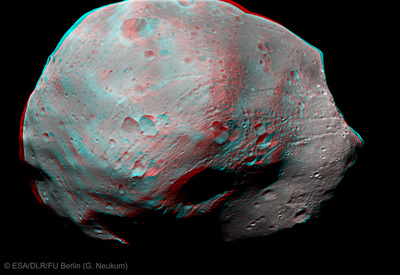
ESA: Phobos Occults

Credit: ESA/DLR/FU Berlin (G. Neukum)

Mars' moon Phobos has already been extensively observed – this image is just one example, taken in 2009 – so its occultation of ESA Mars Express on 28 April 2014 is not expected to yield dramatic discoveries.

But science lies in the smallest things – like obtaining a 'snapshot in time' of continuous change.

The occultation meant that, for a brief time, Phobos passed between ESA Mars Express and Earth, blocking the spacecraft's radio signal.

The break in the signal was small – about nine seconds – but the precise start and end times are valuable information.

These will allow scientists to calculate the orbit of Phobos with great precision – specifically the mean distance from Mars, which is notoriously difficult to pin down because Phobos' natural motion around the planet changes over time.

Phobos and sister moon Deimos are formidable scientific enigmas.

There is no confirmed theory of their origin that offers a satisfactory explanation for their current orbits and appearances.

They could be excellent targets for future robotic landings.

ESA experts analysed yesterday's data from the tracking station and found the occultation to have started just before 01:08:24 GMT, lasting until shortly before 01:08:33 GMT.

Now, we'll know the orbit of Phobos with just a little more precision, at least for a while.

Wednesday, April 23, 2014

How many moons does Venus have?

A radar view of Venus taken by the Magellan spacecraft, with some gaps filled in by the Pioneer Venus orbiter. 

Credit: NASA/JPL

There are dozens upon dozens of moons in the Solar System, ranging from airless worlds like Earth's Moon to those with an atmosphere (most notably, Saturn's Titan).

Jupiter and Saturn have many moons each, and even Mars has a couple of small asteroid-like ones.

But what about Venus, the planet that for a while, astronomers thought about as Earth's twin?

The answer is no moons at all. That's right, Venus (and the planet Mercury) are the only two planets that don't have a single natural moon orbiting them.

Figuring out why is one question keeping astronomers busy as they study the Solar System.

Phobos
Astronomers have three explanations about how planets get a moon or moons. Perhaps the moon was "captured" as it drifted by the planet, which is what some scientists think happened to Phobos and Deimos (near Mars).

Deimos
Maybe an object smashed into the planet and the fragments eventually coalesced into a moon, which is the leading theory for how Earth's Moon came together.

Or maybe moons arose from general accretion of matter as the solar system was formed, similar to how planets came together.

Considering the amount of stuff flying around the Solar System early in its history, it's quite surprising to some astronomers that Venus does not have a moon today. Perhaps, though, it had one in the distant past.

David Stevenson
In 2006, California Institute of Technology (CalTech) researchers Alex Alemi and David Stevenson presented at the American Astronomical Society's division of planetary sciences meeting and said Venus could have been smacked by a large rock at least twice.

"Most likely, Venus was slammed early on and gained a moon from the resulting debris."

"The satellite slowly spiraled away from the planet, due to tidal interactions, much the way our Moon is still slowly creeping away from Earth," Sky and Telescope wrote of the research.

"However, after only about 10 million years Venus suffered another tremendous blow, according to the models. The second impact was opposite from the first in that it 'reversed the planet's spin,' says Alemi."

"Venus's new direction of rotation caused the body of the planet to absorb the moon's orbital energy via tides, rather than adding to the moon's orbital energy as before."

"So the moon spiraled inward until it collided and merged with Venus in a dramatic, fatal encounter."

Venus as photographed by the Pioneer spacecraft in 1978. 

Some exoplanets may suffer the same fate as this scorched world. 

Credit: NASA/JPL/Caltech

There could be other explanations as well, however, which is part of why astronomers are so interested in revisiting this world.

Figuring out the answer could teach us more about the solar system's formation.

Tuesday, December 31, 2013

ESA Mars Express: Phobos Flyby - Video


On 29 December 2013, ESA's Mars Express will make the closest flyby yet of the Red Planet's moon Phobos, skimming past only 45 km above its surface.

As the spacecraft passes close to Phobos, it will be pulled slightly off course by the moon's gravity, by a few tens of centimetres. 

This small deviation will be measured using the spacecraft's radio signals, and then translated into measurements of gravity, mass and density at different locations on the moon.

Tuesday, December 24, 2013

ESA Mars Express heading towards daring flyby of Phobos

The High Resolution Stereo Camera (HRSC) onboard the ESA spacecraft Mars Express took this image of Phobos using the HRSC nadir channel on 7 March 2010, HRSC Orbit 7915. 

This image has additionally been enhanced photometrically for better bringing features in the less illuminated part. Resolution: about 4.4 meters per pixel. 

Credit: ESA/DLR/FU Berlin (G. Neukum)

Late this month, ESA's Mars Express will make the closest flyby yet of the Red Planet's largest moon Phobos, skimming past at only 45 km above its surface.

The flyby on 29 December will be so close and fast that Mars Express will not be able to take any images, but instead it will yield the most accurate details yet of the moon's gravitational field and, in turn, provide new details of its internal structure.

As the spacecraft passes close to Phobos, it will be pulled slightly off course by the moon's gravity, changing the spacecraft's velocity by no more than a few centimetres per second.

These small deviations will be reflected in the spacecraft's radio signals as they are beamed back to Earth, and scientists can then translate them into measurements of the mass and density structure inside the moon.

Earlier flybys, including the previous closest approach of 67 km in March 2010, have already suggested that the moon could be between a quarter and a third empty space – essentially a rubble pile with large spaces between the rocky blocks that make up the moon's interior.

Knowing the structure of the roughly 27 x 22 x 18 km Phobos will help to solve a big mystery concerning its origin and that of its more distant sibling, Deimos, which orbits Mars at approximately three times greater distance.

The leading theories propose that the duo are either asteroids captured by Mars, or that they were born from debris thrown up from giant impacts on Mars.

The innermost moon of Mars, Phobos, is seen here in full 360 degree glory. 

The images were taken by the High Resolution Stereo Camera (HRSC) on ESA’s Mars Express at various times throughout the mission’s 10 years. 

The moon’s parallel sets of grooves are perhaps the most striking feature, along with the giant 9 km-wide Stickney impact crater that dominates one face of the 27 x 22 x 18 km moon. 

The origin of the moon’s grooves is a subject of much debate.

One idea assumes that the crater chains are associated with impact events on the moon itself. 

Another idea suggests they result from Phobos moving through streams of debris thrown up from impacts 6000 km away on the surface of Mars, with each ‘family’ of grooves corresponding to a different impact event.

Mars Express has imaged Phobos from a wide range of distances, but will make its closest flyby yet on 29 December 2013, at just 45 km above the moon. 

Although this is too close to take images, gravity experiments will give insight into the interior structure of Phobos. 

Credit: ESA / DLR / FU Berlin (G. Neukum)

"By making close flybys of Phobos with Mars Express in this way, we can help to put constraints on the origin of these mysterious moons," says Olivier Witasse, ESA's Mars Express project scientist.

In addition to probing the gravitational field of Phobos during its close approach, Mars Express will be making measurements of how the solar wind influences the moon's surface.

"At just 45 km from the surface, our spacecraft is passing almost within touching distance of Phobos," says Michel Denis, Mars Express Operations Manager.

"We've been carrying out manoeuvres every few months to put the spacecraft on track and, together with the ground stations that will be monitoring it on its close approach, we are ready to make some extremely accurate measurements at Phobos."

Friday, November 15, 2013

How astronauts would explore Phobos, the Martian moon

Projected timeline of the MARS-X project. 

Credit: MARS-X

Humans would spend more than a year orbiting and bouncing on the Martian moon Phobos under a mission concept developed by students at the International Space University.

The very theoretical MARS-X mission - presented more as a concept than a firm plan—would see technology development taking place from 2018 to 2022, with communications satellites and rovers winging their way to the planet to be used by astronauts.

In 2023 to 2024, the spacecraft would be built in low-Earth orbit, requiring several launches to accomplish the massive task. Astronauts would then depart in 2024, spending eight months in transit before arriving at Phobos.

There, the mission would last 495 days, and the astronauts would take five months to get home. While NASA and Lockheed Martin helped sponsor the students who created the plan as part of their academic work, the concept itself is not yet funded beyond the students' initial development.

Piotr Murzionak
But Piotr Murzionak, a member of the ISU team, said the proposal is one way that could help fuel interest in space exploration, if it was to be executed.

"It paves the way to Mars. It will be the initial step towards the landing mission on the Martian surface, but without the extra risk involved in order to land directly to Mars," Murzionak said.


The Mars Exploration Vehicle (as the crew vehicle would be called) would use nuclear propulsion and liquid hydrogen to bring two habitats along with it.

One of those would (along with several fuel tanks) be used on Phobos for up to 40 days of surface operations.

It would travel during solar maximum in 2024 to reduce the effects of cosmic radiation from outside the solar system, since the sun's activity would blow the radiation further away.

Further, the crew would be protected from solar flares with high-density polyethylene, as well as a temporary solar storm protection chamber lined with 50 centimeters of water.

The habitat would be spun at 4.4 revolutions per minute, with a habitat of 0.38 to 0.53 the force of gravity—about equivalent to what is on Mars. (This would take 2.5 metric tonnes of fuel to do.)

A graphic detailing the MARS-X spacecraft and technical performance. 

Credit: MARS-X.

The students estimate this would cost about $20 billion, but it could go to at least double this due to factors such as "the volatility of political systems and the large amount of bureaucracy involved in any such endeavor," they write in their final report, which is available here.

Thursday, August 15, 2013

Mars Curiosity Rover Captures 2 Mars Moons Together - NASA Video


A spectacular new video from NASA's Mars rover Curiosity shows the Red Planet's two tiny moons eclipsing each other in an otherworldly skywatching first.

Curiosity snapped 41 images of the Mars moons in the night sky on Aug. 1, with rover scientists then stitching them together to make the final 30-second video. It is the first time a view of the two Martian satellites — called Phobos and Deimos — eclipsing each other has been captured from the vantage point of the planet's surface, NASA officials said.

The new Curiosity video has plenty of scientific value in addition to its gee-whiz appeal, officials said. For example, researchers are studying the images to refine their knowledge of the orbits of Phobos and Deimos, both of which appear to be captured asteroids.

Mark Lemmon
"The ultimate goal is to improve orbit knowledge enough that we can improve the measurement of the tides Phobos raises on the Martian solid surface, giving knowledge of the Martian interior," Mark Lemmon of Texas A&M University said in a statement.

"We may also get data good enough to detect density variations within Phobos and to determine if Deimos' orbit is systematically changing," added Lemmon, who is a co-investigator for Curiosity's Mastcam instrument, which took the pictures using its telephoto lens.

Phobos' orbit is taking it closer to the surface of Mars very slowly, researchers said, while Deimos may gradually be getting farther and farther away from the planet.

Phobos is just 14 miles (22 kilometers) wide on average, while Deimos is even smaller. But Curiosity was able to spot both of them because they orbit quite close to the Red Planet's surface — 3,700 miles (6,000 km) in Phobos' case and 12,470 miles (20,070 km) for Deimos.

Earth's moon is gigantic compared to Phobos and Deimos, with a diameter of about 2,160 miles (3,475 km). But our planet's natural satellite orbits much farther away — its average distance is 239,000 miles (384,600 km) — so Phobos appears half as big in the sky to Curiosity as Earth's moon does to human skywatchers, NASA officials said.

This illustration provides a comparison for how big the moons of Mars appear to be, as seen from the surface of Mars, in relation to the size that Earth's moon appears to be when seen from the surface of Earth. 

Deimos, at far left, and Phobos, beside it, are shown together as they actually were photographed by the Mast Camera (Mastcam) NASA's Mars rover Curiosity on Aug. 1, 2013.

Credit: NASA/JPL-Caltech/Malin Space Science Systems/Texas A&M Univ.

Wednesday, July 3, 2013

Mars Moon Phobos Seen By Rover Curiosity MSL - Video

The Mars Science Laboratory snapped imagery during a pass of the Martian moon shortly after sunset. Twenty seven minutes are sped up in this time-lapse. Credit: NASA / JPL-Caltech

Sunday, May 19, 2013

Field tests in Mojave Desert pave way for human exploration of Asteroids and Small Moons

Top Image: 538 meter-long Near Earth Asteroid (25143) Itokawa imaged by Japan’s Hayabusa spacecraft

The asteroid is likely a loosely consolidated rubble pile 

Credit: JAXA

Bottom Image: Similar scaled Asteroid Hill at the National Training Center, Fort Irwin, California, the site of the April 2013 NASA Mojave Field Test

Note the graduation of large blocks of rock, down to a small gravel surface. The rocks and debris here is primarily made of granite tors and debris. 

Credit: NASA

A team of researchers from the SETI Institute, the Mars Institute, NASA Ames Research Center, and the space robotics company Honeybee Robotics, has successfully completed a first series of field tests aimed at investigating how humans will explore and work on Near-Earth Asteroids (NEAs) and eventually the two moons of Mars, Phobos and Deimos.

From 13 to 15 April 2013, field experiments were conducted at the U.S. Army's National Training Center (NTC) at Fort Irwin, California, to evaluate geotechnical methods and systems that will enable humans to be productive explorers in the low gravity environment of small rocky bodies.

Sub-kilometer sized NEAs, Phobos, and Deimos are among destinations currently considered by NASA for future human missions into Deep Space.

Pascal Lee
"Human missions to Near-Earth Asteroids and to the moons of Mars present us with the exciting challenge of exploring planetary bodies with extremely low gravity" says Pascal Lee, planetary scientist at the SETI Institute and leader of the field test.

"The goal of our field test was to learn how to characterize the physical properties of small body surfaces, and to test ideas that might enable humans to more productively explore these low-gravity worlds."

Pascal Lee (SETI Institute and Mars Institute) (left) measures the bearing capacity of gravelly soil at Asteroid Hill, National Training Center, Fort Irwin, California, using a static cone penetrometer, while Kris Zacny (Honeybee Robotics) drives an anchor into the same material to evaluate the system’s design and performance.

These field tests will help design surface exploration systems optimized for the exploration of Near-Earth Asteroids, Phobos, and Deimos. 

Credit: First Canyon Media

Kris Zacny
The Mojave field test included three investigations:

  1. a study of whether conventional field tools commonly used to characterize the mechanical properties of soils on Earth are suitable for small bodies; 
  2. an evaluation of how different anchoring systems might allow robotic spacecraft and astronauts to remain bound to a low gravity body; 
  3. a study of how astronauts might conduct geological sampling on a small body while using anchors and tethers.

"It's important to analyze and understand how conventional civil engineering methods and systems perform in natural settings on Earth before adapting them to the exploration of small bodies" explains Kris Zacny, Director of planetary exploration robotics at Honeybee Robotics in Pasadena, California.

Honeybee Robotics is the company that developed the Rock Abrasion Tool (RAT) on NASA's Mars Exploration Rovers, Spirit and Opportunity, and the Sample Manipulation System (SMS) and Dust Removal Tool (DRT) on NASA's Mars Science Laboratory (MSL) rover, Curiosity.

Pascal Lee (SETI Institute and Mars Institute) (right) and Sgt Andre Pearson (U.S. Army, NTC) conduct “small body” geological sampling in simulated spacesuits while anchored and tethered on a steep boulder slope at Asteroid Hill, National Training Center, Fort Irwin, California. 

Credit: NASA

The Mojave field test was carried out on a small rocky hill at the NTC with many exposed blocks of weathered granite called tors. The site, now named "Asteroid Hill", is reminiscent of the blocky rock surface of Near-Earth Asteroid (25143) Itokawa, which was explored in 2005 by Japan's Hayabusa robotic spacecraft.

"While neither the composition of the rocks nor the gravity at Asteroid Hill are similar to what they are on NEAs, the relevance of the site resides in the similarity in terrain texture (gravel and block abundance and sizes), topography, and scale between Asteroid Hill and Itokawa" notes Lee.

Terry Fong
"This is an interesting analogue site for planning future NASA robotic and human asteroid exploration, as it not only resembles the surface of the only sub-kilometer NEA explored by spacecraft to date, Itokawa, but it is well supported logistically by the U.S. Army's National Training Center" said Terry Fong, Director of the Intelligent Robotics Group at NASA Ames Research Center.

Tuesday, September 18, 2012

NASA Mars Curiosity: MastCam Image of Phobos moon taking a bite out of the Sun

NASA Mars Rover Curiosity's Mastcam captures the eclipse on Sol 37 (September 13, 2012). 

Credit: NASA/JPL-Caltech/Malin Space Science Systems

People often go to exotic locations to try and get the perfect view of a solar eclipse, but the Curiosity rover on Mars only had to look up to see an eclipse of a different kind.

Careful planning by the mission engineers ensured that the NASA rover had its cameras ready to capture the transit of Mars’s moon Phobos across the face of the Sun.

The partial eclipse occurred on September 13 (Sol (Martian day) 37 of Curiosity's time on the planet) and it took around 15 minutes for Phobos to graze the edge of the Sun.

The NASA Mars Rover Curiosity's MastCam camera is capable of filtering out some sunlight, meaning that it can safely look at the Sun.

Curiosity took more photos of the Mars' two moons crossing the face of the Sun on September 17.

Unlike a total solar eclipse on Earth, the moon Phobos is not large enough to completely block out the Sun’s disc.

Phobos is an irregular shaped moon measuring 27 by 22 by 18 kilometres, so it will only disrupt a portion of the Sun’s light.

In contrast, our Moon is 3,480 kilometres across, is 400 times smaller than the Sun and 400 times closer to Earth than the Sun, meaning that on Earth we can occasionally see a total solar eclipse.

Earth is the only planet in the solar system where a total solar eclipse can occur.

Mars’ moon Deimos is even smaller than Phobos, measuring 15 by 12 by 11 kilometres, and has a higher altitude, meaning that it will blot out far less of the Sun than Phobos when it transits the face of the disc.

Phobos has previously been caught in the act of eclipsing the Sun by the Opportunity rover in December 2010.

Opportunity’s twin, Spirit, also witnessed Phobos fade from the night sky as it passed within Mars’ shadow, in the equivalent of a lunar eclipse.

Phobos orbits Mars at a very low altitude of 9,400 kilometres, so it needs to travel fast in order to stop it from spiralling down towards the red planet.

This high speed means that it orbits Mars three times for every one rotation of the planet.

Monday, August 20, 2012

ESA Mars Express Image: 3D Pictures of Phobos

Credit: ESA/DLR/FU
Some 135 years after its discovery, Mars’ largest moon Phobos is seen in fantastic detail – and in 3D – in an image taken by ESA’s Mars Express spacecraft as it passed just 100 km by.

This view is much different to the faint object that astronomer Asaph Hall would have just been able to make out as he observed the Red Planet through the United States Naval Observatory’s 66 cm telescope in 1877.

Through this telescope he discovered Mars’ smaller, outermost moon Deimos on 12 August and the larger, innermost moon Phobos on 18 August.

More than a century later later, spacecraft in orbit around Mars are studying Phobos in unprecedented detail.

In this image, a bite-sized chunk appears to be missing from the right edge of the irregular shaped moon – this is a side-on view of the rim of large impact crater Stickney, so-called after the maiden name of the discoverer’s wife.

Families of grooves appear to emanate from Stickney, carving channels across the approximately 27 km length of the moon.

Initially thought to be associated with the Stickney impact crater, one recent theory suggests that they were instead formed when Phobos passed through debris clouds thrown up from the surface of Mars by asteroid impacts onto the planet’s surface.

Orbiting Mars at just 6000 km from the planet’s surface, it is closer to its parent planet than any other known moon in our Solar System.

The moon’s proximity means that it hurtles around Mars faster than the planet rotates: for an observer on the surface of Mars, Phobos would appear to rise and set twice a day.

The moon’s orbit is decreasing and in some 50 million years time it will likely break up to form a debris ring around Mars, before colliding with the planet’s surface.

Wednesday, February 1, 2012

Space Radiation Doomed Russian Phobos Satellite


Space radiation most likely caused the demise of a Russian Mars probe that got stuck in Earth orbit shortly after launch and ultimately crashed back to the surface earlier this month, Russia's Federal Space Agency chief said today (Jan. 31), according to media reports.

Russian space chief Vladimir Popovkin said that an investigation pointed to cosmic radiation as the likely culprit in the failure of the Phobos-Grunt mission, but also suggested that an imported spacecraft component may not have been adequately hardened for the harsh radiation environment in space, reported the Associated Press.

"Two components of the onboard computer system were spontaneously rebooted and it switched into a standby mode," Popovkin said in a televised remark, according to the Russian news service Ria Novosti. "The most likely reason [for the glitch] is the impact of heavy charged space particles."

Russia's Phobos-Grunt space probe malfunctioned shortly after its November 2011 launch, preventing it from continuing on toward Mars.

Thursday, January 19, 2012

Phobos Grunt Links Removed from US Military Tracking Site

The U.S. military broke from its standard practice by removing links to data tracking Russia’s failed Phobos-Grunt Mars moon probe from its Space Track website, Aviation Week reported Jan. 18.

Instead of including final re-entry data for the defunct probe, which plunged into the Pacific Ocean on Jan. 15, the public website, managed by U.S. Strategic Command, posted only a vague statement that Phobos-Grunt “decayed within the forecast period of 16:59-17:47” GMT.

The data removal comes as some in Russia have suggested the United States may be responsible for Phobos-Grunt’s failure. NASA denied a Russia claim that its asteroid tracking radar may have disabled the spacecraft.

Tuesday, January 17, 2012

Space Debris: How Much Junk is in Orbit?

Credit: NASA/ J.-C. LiThis chart shows statistics relating to space junk circling the Earth.

 Credit: NASA/Orbital Debris Program Office.Each dot represents a bit of known space junk that's at least 4 inches (10 cm) in low-Earth orbit, where the space station and shuttles roam. In total, some 19,000 manmade objects this size or bigger orbit Earth as of July 2009; most are in low-Earth orbit. Countless smaller objects are also circling the planet.

Sunday, January 15, 2012

Russian Phobos-Grunt Mars probe falls in Pacific Ocean


Doomed Russian Phobos-Grunt Mars probe that's been stuck in Earth orbit for two months has crashed down in the Pacific Ocean on late Sunday.

"Phobos-Grunt fragments have crashed down in the Pacific Ocean," Russia's Defense Ministry official Alexei Zolotukhin told RIA Novosti, adding that the fragments fell in 1,250 kilometers to the west of the island of Wellington.

The spacecraft fell at about 21:45 on Sunday Moscow time [17:45 GMT].

As of 20.15 Sunday, the spacecraft was moving in the near-Earth orbit with an altitude that varied between 113.8 km at perigee and 133.2 km at apogee, the Russian space agency Roscosmos said.

Saturday, January 14, 2012

Rocosmos update: Phobos Grunt

As of January 14 spacecraft (SC) "Phobos-Grunt" is on the earth elliptical orbit with the following parameters:

- Apogee (maximum altitude) - 174.2 km;

- Perigee (minimum altitude) - 149.7 km;

- Inclination - 51.44 degrees.;

- Period - 87.57 min.

The projected drop box residues of spacecraft "Phobos-Grunt" on Earth is determined by the dates from the 15th to 16th January, with a central point - 15 January at 21:51 GMT. Possible area falling in the "band" of 51.4 degrees north latitude to 51.4 degrees south latitude is shown in the diagram.

Operational Group is monitoring the convergence of the orbit of the spacecraft "Phobos-Grunt."

Friday, January 13, 2012

Did US shoot Phobos-Grunt down? No!

Sometime this weekend, Phobos-Grunt will crash into the Indian Ocean.

The Russian space probe was supposed to return a sample from Mars's moon Phobos (hence the name – grunt means "ground" in Russian).

Unfortunately, after its launch on 9 November, the upper stages failed, and it remained stuck in low Earth orbit – so low that atmospheric drag will draw it back to Earth and destroy it.

It took more than a decade and some $163 million to build Phobos-Grunt, so it its inexplicable failure was understandably frustrating for the Russians.

In a bizarre interview, Vladimir Popovkin, the head of Russia's space agency, alluded to foul play: "We don't want to accuse anybody, but there are very powerful devices that can influence spacecraft now. The possibility they were used cannot be ruled out," he said, in The New York Times's translation.

He insinuated that the US was to blame: "The frequent failure of our space launches, which occur at a time when they are flying over the part of Earth not visible from Russia, where we do not see the spacecraft and do not receive telemetric information, are not clear to us."

The claim that Phobos-Grunt was shot down is absurd but that's not because it would be hard to do. If you can launch satellites, it is easier to destroy them, and to do so with deniability isn't much harder.

Had the US wanted to destroy Phobos-Grunt, it could have but it's hard to fathom why – not least of all because doing so would have messed with a couple of scientific missions piggy-backed onto the Russian probe: a Chinese Mars orbiter and an experiment run by the Planetary Society, an American space advocacy group co-founded by Carl Sagan.

More importantly, there is a global taboo on war in space. The US would not have broken it arbitrarily to destroy a scientific probe.

No country has ever (so far as is known in the unclassified literature) attacked another's satellite.

When China tested an anti-satellite weapon against one of its own satellites in 2007, it provoked an international outcry because it created more than 4000 new bits of debris, increasing by almost half the amount of trackable "space junk".

The US broke a de facto moratorium on space weapon testing in 2008, when a missile launched from a navy cruiser destroyed an American satellite, the first such test since 1985 (when an F-15-launched missile was the weapon of choice).

The US has by far the most invested in space. That gives it the most to lose. Military hawks talk about space as the "ultimate high ground."

This is silly, space is high ground, sure enough, and tremendously useful militarily but spacecraft are (and always will be) fragile, vulnerable things, unlike castles or forts built on normal, non-ultimate high grounds.

Popovkin's speculation is almost certainly incorrect and comes from a paranoid nation. I also suspect it was likely to be deliberate nationalist pandering, perhaps not meant to be taken seriously but there are two reasons why this is worrisome.

The first is that it's hard to prove he's wrong, so when the next, more militarily useful, spacecraft fails, the accusation can resurface. The other is that Popovkin, and the Soyuzes he controls, are the only way to get American astronauts to the International Space Station.

Thursday, January 12, 2012

Phobos Grunt: ESA coordinates international satellite reentry campaign

An international campaign to assess the imminent atmospheric reentry of Russia's Phobos–Grunt Mars craft is being coordinated by experts in ESA's Space Debris Office.

Participants include NASA and Roscosmos as part of the 12-member Inter-Agency Space Debris Coordination Committee.

ESA experts are working with international partners in a coordinated prediction campaign focused on Phobos–Grunt, a Russian Mars mission that is expected to largely burn up in Earth's atmosphere in the next few days.

Phobos–Grunt was launched on 8 November 2011 into an initial Earth orbit of 206 x 341 km. The injection into an Earth-escape trajectory to Mars failed, and the spacecraft was declared lost by the Russian space agency, Roscosmos, on 13 December.

On 2 January, a comprehensive reentry prediction campaign for Phobos–Grunt was begun by the Inter-Agency Space Debris Coordination Committee (IADC), a technical forum for the worldwide coordination of activities related to human-made and natural debris in space.

ESA - ESA coordinates international satellite reentry campaign

Tuesday, January 10, 2012

Russian Phobos Grunt Probe: Latest In-Orbit Images

Latest Phobos-Grunt true colour images with good colour rendition between solar panels and the body.

Thursday, January 5, 2012

Report: Russia’s Phobos Grunt Probe to Fall to Earth January 15 - International Business Times

Russia's stranded Phobos Grunt spacecraft could fall to Earth on January 15, according to the spokesman of Russia's military space forces.

Spokesman Alexei Zolotukhin told Russian news agencies that fragments of Russia's stranded Mars probe Phobos-Grunt could fall to Earth on January 15.

"As of Wednesday morning, the fragments of Phobos-Grunt are expected to fall January 15, 2012. The final date could change due to external factors," said spokesman Alexei Zolotukhin.

In November, the military space forces" monitoring centre had predicted that the probewould fall to Earth in January or February.

Between 20 to 30 fragments of the Phobos Grunt spacecraft are expected to fall to Earth, but Russian space officials said the spacecraft's highly toxic fuel will burn up on entering the Earth's atmosphere.

Earlier, a Russian space official said that while the 13.5 ton probe, which is carrying highly toxic fuel, could also crash into the earth, it is impossible to predict the exact position of such an event.

"The crash area of any craft can only be estimated in the final 24 hours," said Vitaly Davydov, deputy head of Roscosmos in the first official acknowledgment on failed probe Davydov said. "Before then, saying what will fall and where is pointless."

Russia launched the Phobos-Grunt research probe to the Martian moon Phobos on Nov. 9, in an attempt to reinvigorate its interplanetary program which had not seen a successful mission since the fall of the Soviet Union.

Because of the failed probe, Davydov said that in the future Russia may just focus on sending probes to the Earth's moon and researching on Mars in cooperation with its international partners.

It will be recalled that towards the end of 2010, Russia's already troubled space industry was further shaken by the failure of the Proton rocket sending a trio of GLONASS satellites, costing more than $138 million, to crash down into the ocean.

This was followed by the failed launch of the Rockot booster, which left a new-generation Geo-IK-2 military satellite in a useless orbit.

In August 2011 the agency again suffered the loss of the Ekspress-AM4 communications satellite and the unprecedented crash of a Progress cargo ship heading to the International Space Station.

Then came the Phobos-Grunt fiasco which is expected to re-enter the Earth's atmosphere next week

Tuesday, December 27, 2011

Soyuz Rocket Debris Fireball

Astrophotographer Roman Breisch snapped this photo of a fireball created by a re-entering Russian rocket stage over Germany on Dec. 24, 2011. 

The rocket debris was part of a Soyuz rocket that successfully launched a new crew to the International Space Station on Dec. 21.
CREDIT: Roman Breisch

A dazzling fireball that lit up the night sky above Europe in a bright Christmas Eve display was no meteor or comet.

A falling piece of a Russian rocket created the light show to cap the end of its successful mission, scientists say.

The fireball was spotted over several European countries on the evening of Dec. 24. By Christmas Day, astronomers at the Belgium Royal Observatory pinned down the source of the night-sky fireworks.

"The fireball observed above Belgium, the Netherlands, France and Germany on December 24 around 17h30, was the re-entry of the third stage of the Soyuz rocket that transported the Dutch astronaut Andre Kuipers to the International Space Station," observatory officials said in a written update.

The rocket's spent upper stage then fell back to Earth in a fiery re-entry through the atmosphere. But despite the man-made nature of the fireball, it still amazed skywatchers who happened to look up as the rocket debris fell to Earth