
Showing posts with label Soyuz Rocket. Show all posts
Showing posts with label Soyuz Rocket. Show all posts
Friday, October 12, 2012

DLR Galileo: Two more satellites for the Galileo GPS system
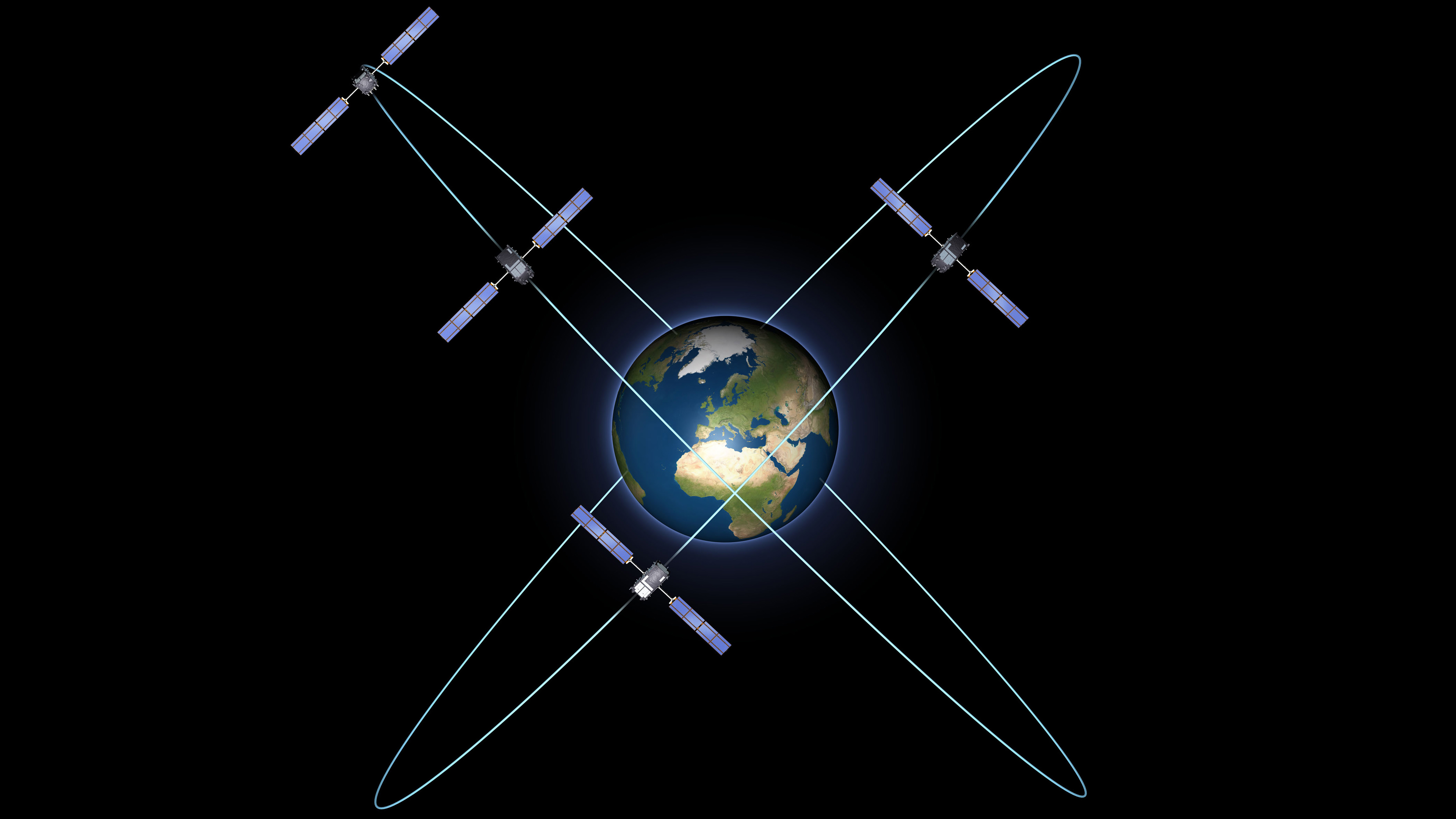
Now, two more are about to follow; on 12 October 2012 at 20:15 CEST, a Soyuz rocket will launch satellites three and four into their position in space.
Four satellites will then be flying in their orbits at an altitude of 23,000 kilometres.
For Walter Päffgen, Director of the DLR Space Applications Company (Gesellschaft für Raumfahrtanwendungen; GfR), this is a highpoint of the programme thus far: "With signals from four Galileo satellites, we can determine a location on Earth for the first time."
The satellites are controlled from the Galileo Control Centre at the German Aerospace Center (Deutsches Zentrum für Luft- und Raumfahrt; DLR) site in Oberpfaffenhofen.
To be well prepared for the next challenging phase of implementing the satellite navigation system, during the last few weeks his staff were put to the test with simulated failures during rehearsals for satellite operations.
"Everyone needs to be trained to respond quickly and safely in an emergency." Additional intensive training programmes were also part of the work of the crew in the control room.
The compatibility of the two satellites – named David and Sif after two children from the Czech Republic and Denmark – has also been tested at the Control Centre while they were on the ground.
Sunday, July 15, 2012
NASA Soyuz Expedition 32 Trio Launch - Video Gallery
Expedition 32 Flight Engineers Suni Williams, Yuri Malenchenko and Aki Hoshide launched aboard the Soyuz TMA-05M spacecraft at 10:40 p.m. EDT Saturday (8:40 a.m. Kazakhstan time on Sunday) from Baikonur Cosmodrome, Kazakhstan.
Wednesday, May 23, 2012
Final Launch of R-7 Rocket (Soyuz-U) - YouTube
On May 17, Russia launched its final Soyuz-U rocket from the Plesetsk Space Center. The 40 year old launch vehicle family will be replaced by the Soyuz-2 and Angara-A3 carrier rockets.
The Soyuz-U is a medium class carrier rocket that was developed from the R-7 ballistic missile in the mid-1950′s. The first Soyuz-U launched in 1973, also from the Plesetsk Space Center, carrying Cosmos 559, a Zenit military spy satellite.
Since that time, it has launched 434 times, carrying 430 spacecraft into orbit. It carried its first crew in 1974, delivering the Soyuz 16 in preparation for the Apollo-Soyuz Test Project.
It was later used to launch the Soyuz-TMA capsule that continues to transport crew to the International Space Station, although it last performed this function in 2002.
The Soyuz was developed by the TsSKB design bureau, now TsSKB-Progress. It comes in two version, the Soyuz-U/Ikar and the Soyuz-U/Fregat, and was the basis for the Soyuz-FG which uses a different first stage from the Soyuz-U.
The Soyuz-FG is also slated to be phased out. The most prolific launch vehicle in history, the Soyuz-U was known for many years as the most reliable as well. This reputation added to international consternation in August 2011 when a Soyuz-U crashed after launch due to a blocked fuel line.
In its final journey, the Soyuz-U placed Cosmos 2480, a spy satellite, in orbit as part of Russia’s Oko (Eye) orbital missile early warning network of 70 satellites.
Tuesday, December 27, 2011
Soyuz Rocket Debris Fireball

Astrophotographer Roman Breisch snapped this photo of a fireball created by a re-entering Russian rocket stage over Germany on Dec. 24, 2011.
The rocket debris was part of a Soyuz rocket that successfully launched a new crew to the International Space Station on Dec. 21.
CREDIT: Roman Breisch
A dazzling fireball that lit up the night sky above Europe in a bright Christmas Eve display was no meteor or comet.
A falling piece of a Russian rocket created the light show to cap the end of its successful mission, scientists say.
The fireball was spotted over several European countries on the evening of Dec. 24. By Christmas Day, astronomers at the Belgium Royal Observatory pinned down the source of the night-sky fireworks.
"The fireball observed above Belgium, the Netherlands, France and Germany on December 24 around 17h30, was the re-entry of the third stage of the Soyuz rocket that transported the Dutch astronaut Andre Kuipers to the International Space Station," observatory officials said in a written update.
The rocket's spent upper stage then fell back to Earth in a fiery re-entry through the atmosphere. But despite the man-made nature of the fireball, it still amazed skywatchers who happened to look up as the rocket debris fell to Earth
Thursday, September 8, 2011
Roscosmos to enhance control of Soyuz rocket engines' production

A Soyuz rocket engine failure resulted in the loss of the Progress M-12M space freighter on August 24, the first loss of a Progress freighter in the history of Russia's space industry.
The freighter failed to separate from the rocket and fell in South Siberia's Altai Republic.
A clogged fuel supply pipe caused the engine failure, the commission discovered, describing the defect as "accidental," Roscosmos said.
However, the space agency said, the commission still recommended introducing additional control procedures to ensure that other similar engines do not have same defects.
The recommendation follows an order by Russian Prime Minister Vladimir Putin to review and improve control procedures in the space industry that came after the August 24 accident, another one is a series of misfortunes faced by Russia's space industry over the last nine months.
After the retirement of the U.S. shuttle fleet earlier this summer, Russian Soyuz spacecraft became the only way for astronauts to reach the ISS until at least the middle of the decade.
NASA is paying its Russian counterpart Roscosmos more than $1 billion for crew transport services over the next four years.
Wednesday, August 31, 2011
Roscosmos plans to return three ISS crew members on Sept 16

This is later than previously scheduled due to a failed launch of the Progress cargo vehicle, the Russian space agency Roscosmos said Wednesday.
"There is no any danger for the ISS crew.
The crew possesses everything it needs for work," Roscosmos deputy head Vitali Davydov said during a television link between Moscow and Astana, the Interfax news agency reported.
Davydov said two Russian cosmonauts and one American astronauts would be sent back to Earth.
The official also promised that the launches of the Proton and Soyuz carrier rockets, which have been temporarily suspended due to the recent accidents, would not be postponed for a long time.
A Progress M-12M cargo ship failed to reach orbit Aug. 24 after the engine of a Soyuz-U carrier rocket turned off during the ascent. Following this incident, Russia decided to delay the launch of the next manned spaceship to the ISS.
Besides, Russia would not abandon the Baikonur space center in Kazakhstan, even after completion of the construction works at the new Vostochny launch site in Russia, said Davydov.
"There are no plans to abandon Baikonur. We have an agreement (with Kazakhstan) on using that space center until 2050," he was quoted by Interfax news agency as saying.
Located in the desert steppe of Kazakhstan, Baikonur cosmodrome was originally built by the Soviet Union in 1955 and is currently leased by the Kazakh government to Russia until 2050.
Russian Crash Could Delay SpaceX Mission to Space Station

Space Exploration Technologies — better known as SpaceX — is planning to launch its Dragon capsule toward the orbiting lab on Nov. 30, with a historic docking slated for nine days later.
BUT as a result of the Aug. 24 crash of the unmanned Russian Progress 44 supply ship, there might not be any astronauts aboard the station to receive Dragon in early December.
If that's the case, Dragon's launch would have to be postponed, officials said
How Would NASA & Russia Evacuate the International Space Station?

The unprecedented move would mark the first time in more than 10 years that the orbiting outpost has gone unmanned.
The space station evacuation is one possibility following the failure of the unmanned Russian supply spacecraft just after its Aug. 24 launch — a surprise given the reliable track record of its workhorse Soyuz rocket.
The vehicle’s Progress 44 cargo craft, and its 2.9 tons of supplies bound for the International Space Station, crashed in Siberia.
An investigation into the cause of the failure is under way, but until the issue is resolved NASA and its Russian partners are delaying upcoming launches to crews and cargo to the space station.
The Soyuz rockets used to launch Progress vehicles are similar to ones used to launch crews into orbit, station managers said.
[Photos: Russia's Lost Cargo Ship Progress 44]
Sunday, November 7, 2010
Russian Soyuz Progress 40 Cargo vessel attached to ISS

Tuesday, June 15, 2010
Rocket in place for space station mission
 Soyuz-FG Rocket carrying TMA-19 to ISS |
The rocket will carry cosmonaut Yuri Yurchihin and U.S. astronauts Shannon Walker and Douglas Wheelcock to the orbiting space station where they will join the current crew of two Russians and American Tracy Dyson.
The spacecraft, dubbed TMA-19, will lift off from the Baikonur Space Center in Kazakhstan on Wednesday.
The RIA Novosti news agency said engineers had raised the space station's orbit by 2 ½ kilometers (1.6 miles) to get into position to dock with TMA-19.
Subscribe to:
Posts (Atom)


 Posts
Posts


