Showing posts with label Two Satellites. Show all posts

Friday, October 12, 2012

DLR Galileo: Two more satellites for the Galileo GPS system

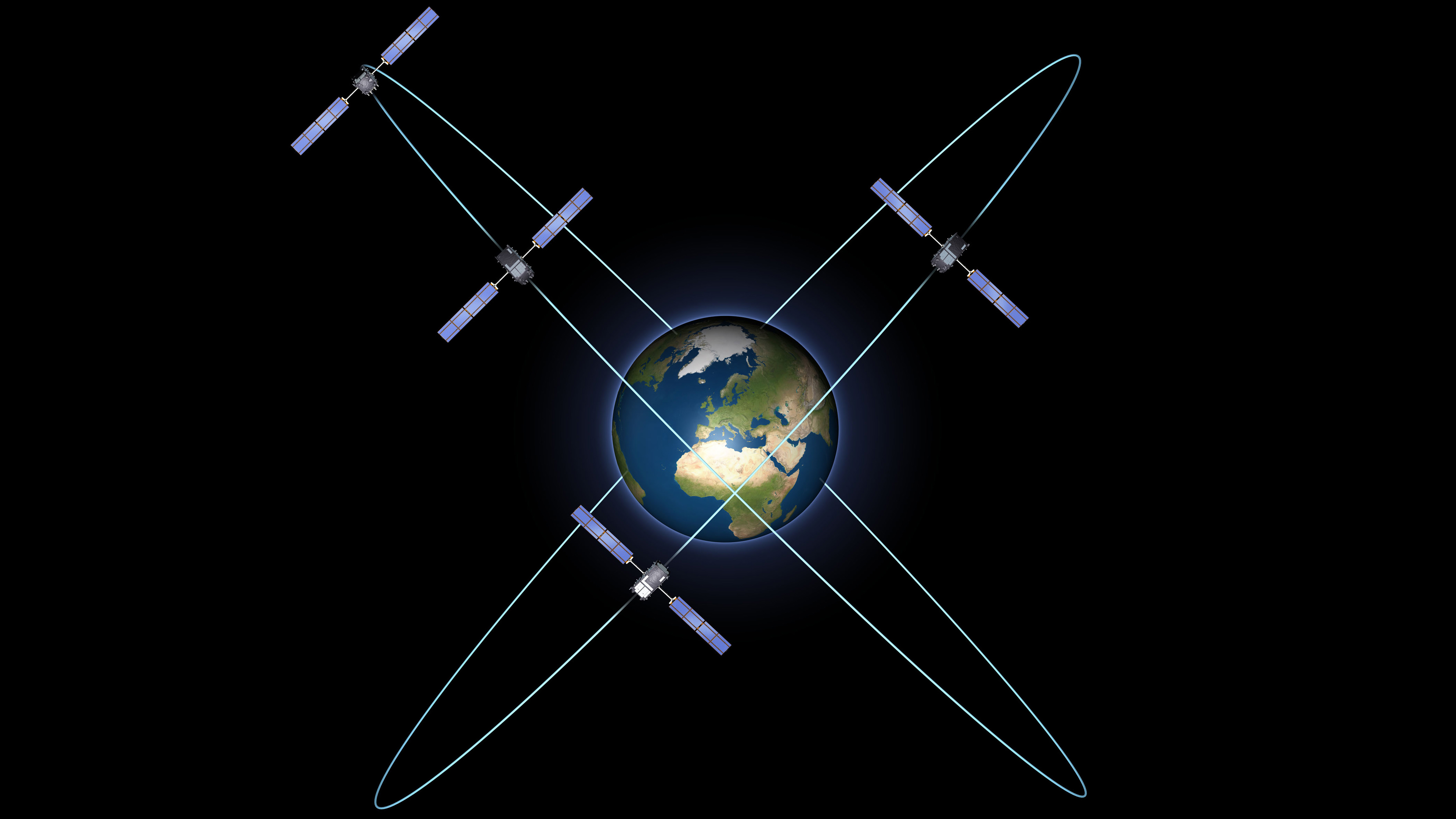
The first two satellites for the European Galileo navigation system have been orbiting Earth since 21 October 2011. 

Now, two more are about to follow; on 12 October 2012 at 20:15 CEST, a Soyuz rocket will launch satellites three and four into their position in space. 

Four satellites will then be flying in their orbits at an altitude of 23,000 kilometres. 

For Walter Päffgen, Director of the DLR Space Applications Company (Gesellschaft für Raumfahrtanwendungen; GfR), this is a highpoint of the programme thus far: "With signals from four Galileo satellites, we can determine a location on Earth for the first time."

The satellites are controlled from the Galileo Control Centre at the German Aerospace Center (Deutsches Zentrum für Luft- und Raumfahrt; DLR) site in Oberpfaffenhofen.

To be well prepared for the next challenging phase of implementing the satellite navigation system, during the last few weeks his staff were put to the test with simulated failures during rehearsals for satellite operations.

"Everyone needs to be trained to respond quickly and safely in an emergency." Additional intensive training programmes were also part of the work of the crew in the control room.

The compatibility of the two satellites – named David and Sif after two children from the Czech Republic and Denmark – has also been tested at the Control Centre while they were on the ground.

Tuesday, August 14, 2012

Space Weather: RBSP - Twin NASA probes around our Earth

Spectacular events on Mars are making most of the space headlines, but NASA is getting ready to launch an upcoming mission to explore the environment of our own planet Earth.

Twin Radiation Belt Storm Probes (RBSP) are due to lift off aboard a United Launch Alliance Atlas V rocket on August 23 from Cape Canaveral, Florida.

They were placed, in their nose cone, atop the rocket on August 10. 

The two satellites will travel in orbits that take them through two extreme and dynamic regions of space surrounding the Earth called the Van Allen Radiation Belt.

They will probe space weather, the direct effects of activity on the Sun, which can in extreme cases damage satellite electronics, GPS services and cause power grids to fail.

Barry Mauk, RBSP project scientist at the Johns Hopkins University, in Maryland, said: "The dramatic dynamics of Earth's radiation belts caused by space weather are highly unpredictable.

"One of the fundamental objectives of the RBSP mission is to use Earth's magnetosphere as a natural laboratory to understand generally how radiation is created and evolves throughout the universe. There are many mysteries that need to be resolved."

The radiation belts, named after their discoverer, James Van Allen, are two concentric, donut-shaped rings filled with high-energy particles that dance about, bounce and drift through the region.

Sometimes these particles shoot down to Earth's atmosphere, sometimes they escape into space.

The radiation belts swell and shrink over time, a change that is part of a much larger space weather system that is driven by solar activity as material from the Sun spreads through space.

NASA says that the RBSP probes, the second mission in NASA's Living With a Star program, will help scientists to understand this radiation zone better and to design spacecraft that can survive such environments better.

The spacecraft carrying out such research may eventually help scientists predict space weather before it hits the Earth's neighbourhood.

Follow the RBSP team on Twitter with #RBSP and on their account @RBstormProbes

Thursday, August 5, 2010

Arianespace Launches Two Satellites


Arianespace Launches Two Satellites

This latest successful launch of Ariane 5, the third in 2010, once again proves the launcher's operational capabilities.

Ariane 5 is the only commercial satellite launcher now on the market capable of simultaneously launching two payloads and handling a complete range of missions, from commercial launches into geostationary orbit to scientific satellites boosted into special orbits.

The 52nd launch of an Ariane 5, and the 38th successful mission in a row, clearly confirms the launcher's reliability and availability. Arianespace's launch Service and Solutions continue to set the global standard and guarantee independent access to space for all customers, including national and international space agencies, private firms and governments.

With this evening's mission, Arianespace has now orbited six out of eleven commercial communications satellites launched worldwide since the beginning of the year, or more than half of the total. At the same time, Arianespace has signed nine new launch contracts for geostationary satellites to be orbited by Ariane 5, and five contracts for dedicated Soyuz launches, a new record.

Monday, December 14, 2009

ESA Proba-3: Star Tiger Two Satellites working in Tandem

The two-satellite coronagraph will create a perpetual eclipse for observations of the solar corona.

The first 'occulter' spacecraft casts a perfectly controlled shadow onto the face of the second, carrying the mission instruments.

Proba-3 will be the first mission to fly such a 'giant external coronagraph'.

Bring together a small group of highly motivated researchers, grant them full access to laboratory and production facilities, remove all administrative distractions, and let them work intensively for four to six months. That's what 'StarTiger' is all about!

It is a different approach to conducting research and development that aims to demonstrate the feasibility of a new and promising technology within a very short time scale.

Within this initiative, ESA is running a six-month crash effort to design an instrument to operate between a pair of satellites flying in formation. One will cast a precisely-controlled shadow across the other to produce a perpetual solar eclipse, revealing parts of the Sun's corona usually hidden in sunlight.

ESA's latest StarTiger project is to create a complete working model of such a 'giant external coronagraph'. The effort began on 15 September, with a core team of seven multidisciplinary experts from France, Belgium, Greece and Italy based at the Laboratoire d'Astrophysique de Marseille (LAM) in France, plus a 20-strong support team. Project hardware is being designed and manufactured, with testing due to begin early next year.

"StarTiger is an initiative within the Agency's Basic Technology Research Programme (TRP), aimed at facilitating breakthrough innovation," said Peter de Maagt, the project's manager. "It is innovative not just in terms of technology but also by changing the way research and development is done."

Eike Kircher, Head of ESA's TRP, added: "Researchers work together face-to-face, participating in a very dynamic design flow on a rapid turn-around basis. They also work against the clock, because at the end of the process they produce a complete instrument from scratch."

Read More .......