Showing posts with label Arianespace. Show all posts

Thursday, January 22, 2015

ESA’s Intermediate eXperimental Vehicle (IXV) has been fueled and “topped off”

The loading of IXV (Intermediate eXperimental Vehicle)’s hydrazine maneuvering propellant was performed inside the S5B hall at Europe’s Spaceport in French Guiana.

Credit: Arianespace, ESA

ESA’s IXV (Intermediate eXperimental Vehicle) has been “topped off” at the Spaceport in French Guiana as preparations continue for its launch with Vega’s year-opening mission on February 11.

Loading of IXV’s hydrazine maneuvering propellant was performed in the S5B hall of the Spaceport’s large S5 payload preparation facility.

Thales Alenia Space engineers working on the IXV.

Credit: Thales Alenia Space, ESA

IXV (Intermediate eXperimental Vehicle) was built for the European Space Agency (ESA) by Thales Alenia Space, and is designed to flight test technologies and critical systems for Europe’s future automated reentry systems as they return from low Earth orbit.

Artist impression of ESA's Intermediate eXperimental Vehicle (IXV).

Credit: ESA

The unmanned IXV is to be deployed into a suborbital trajectory by Vega at a 320-km. altitude.

After IXV coasts up to an altitude of 420 km., it will begin the reentry phase, recording data from a large number of conventional and advanced sensors.

The IXV Intermediate eXperimental Vehicle is being prepared for launch at Europe's Spaceport in Kourou, French Guiana.

Credit: ESA

The entry speed of 7.5 km. per second creates the same conditions as those for a vehicle returning from low Earth orbit, with IXV subsequently descending via parachutes for a safe splashdown in the Pacific Ocean approximately 100 minutes after liftoff.

Vega’s February 11 mission will mark the lightweight launcher’s second flight within the European Space Agency-managed VERTA (Vega Research and Technology Accompaniment) program to showcase this vehicle's flexibility.

The industrial prime contractor for Vega is ELV S.p.A., a company created by Avio and the Italian Space Agency (ASI) in December 2000.

Engineers forging ahead with the final tests on ESA’s Intermediate eXperimental Vehicle, IXV.

Credit: ESA

The IXV (Intermediate eXperimental Vehicle) is being prepared for launch at Europe's Spaceport in Kourou, French Guiana.

IXV will be launched 320 km into space on top of a Vega  rocket, climbing up to 420 km before beginning a long glide back through the atmosphere.

In the process, IXV will gather data on reentry conditions to help guide the design of future spaceplanes. 

Tuesday, December 2, 2014

ESA Ministerial Council approve Arianespace Ariane 6 design - Video


Decided upon in Luxembourg by the European Space Agency Council Meeting at Ministerial Level, Ariane 6 is a modular three-stage launcher (solid–cryogenic–cryogenic) with two configurations using: four boosters (A64) or two boosters (A62).


Images of the Ariane 6 launcher design agreed at today's Ministerial Conference

Credit: ESA


Friday, October 17, 2014

ESA Ariane 5 Launch and Orbital insertion of Intelsat 30 and ARSAT-1

On 16 October 2014, Ariane 5 flight VA220 lifted off from Europe’s Spaceport in Kourou, French Guiana to place two telecommunications satellites, Intelsat-30/DLA-1 and Arsat-1, into their planned transfer orbits. 

Credit: ESA

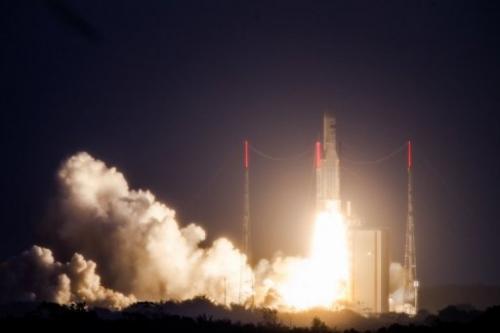
An Ariane 5 has lifted off from Europe's Spaceport in Kourou, French Guiana and delivered two telecom satellites, Intelsat-30/DLA-1 and Arsat-1, into their planned orbits.

Launch of flight VA220 occurred on 16 October at 21:44 GMT (23:44 CEST, 18:44 local time).

Intelsat-30/DLA-1, with a mass of about 6320 kg and mounted with its launch vehicle adapter on top of Ariane's Sylda dual-payload carrying structure, was the first to be released 28 minutes into the mission.


On 16 October 2014, Ariane 5 flight VA220 lifted off from Europe’s Spaceport in French Guiana and delivered two telecom satellites, Intelsat-30/DLA-1 and Arsat-1, into their planned orbits. 

Credit: ESA/Arianespace

Following a series of burns controlled by Ariane's computer, the Sylda structure encasing Arsat-1 was then jettisoned. Arsat-1, with a mass of 2973 kg, was released into its own transfer orbit about six minutes after the first satellite.

Intelsat-30/DLA-1, owned and operated by Intelsat, will be positioned at 95°W longitude in geostationary orbit to provide telecommunications and direct-to-home broadcast services to Latin America. The satellite has a design life of about 15 years.

Arsat-1, owned by Arsat in Argentina, will be positioned at 71.8°W in geostationary orbit to provide direct-to-home television, Internet access services, data transmission and IP telephony to Argentina and neighbouring countries. It has a design life of 15 years.

The payload mass for this launch was 10 083 kg. The satellites totalled 9293 kg, with payload adapters and carrying structures making up the rest.

Flight VA220 was the 76th Ariane 5 mission.

Friday, September 19, 2014

Arianespace Ariane 5 Flight VA220 Payload: ISDLA-1 and ARSat-1 satellites

Preparation activity is underway with Ariane 5 Flight VA220’s ISDLA-1 co-passenger at the Spaceport’s S5C facility in French Guiana.

September 18, 2014 – Ariane 5 Flight VA220

Credit: Arianespace

Pre-launch payload processing is moving into full swing for Arianespace’s next Ariane 5 flight, with the mission’s ISDLA-1 telecommunications satellite now undergoing preparations for a targeted October 16 liftoff from French Guiana.

To be orbited for two long-standing Arianespace partners – Intelsat and DIRECTV – the high-powered ISDLA-1 is built by SSL (Space Systems/Loral) based on the 1300-series satellite platform.

Following its deployment from Ariane 5, this spacecraft will expand direct-to-home entertainment offerings in Latin America, along with providing backup and restoration services.

With a design life of 15 years, ISDLA-1 will be co-located with Intelsat’s Galaxy 3C satellite at 95 deg. West.

Ariane 5 will also carry the milestone ARSAT-1 spacecraft for ARSAT on this heavy-lift mission.

As the first geostationary satellite built in Argentina, ARSAT-1 is produced by INVAP with Airbus Defence and Space and Thales Alenia Space serving as leading equipment suppliers.

From its orbital position at 72 deg. West, ARSAT-1 will deliver a wide range of telecommunications, data transmission, telephone and television services across Argentina, Chile, Uruguay and Paraguay.

Arianespace’s upcoming October heavy-lift mission is scheduled to be the fifth Ariane 5 launch this year and is designated Flight VA220 in the company’s numbering system.

Thursday, September 18, 2014

France raises heat on decision for next Ariane rocket

France's space agency on Thursday unveiled a revised proposal for an Ariane rocket ahead of a tough decision on launchers by the European Space Agency (ESA).

Ministers must decide whether they can afford to fund the development of two projects for Europe's next rocket.


These are an Ariane 6, promoted by France, that would be operational from the next decade and an intermediate launcher, the Ariane 5 ME, backed by Germany.

At a press conference in Paris, France's National Centre for Space Study (CNES) said the overhauled plans for the Ariane 6 resulted in a "simple design with great payload capacity," able to take between five and 10 tonnes into orbit.

It could be ready for launch in 2020, said CNES boss Jean-Yve Le Gall, a date that is a year or two earlier than was expected in July 2013.

"We are looking at a two-booster version, with costs of around 65 million euros [$83.85 million] per launch, and a four-booster version, at around 85 million euros per launch," said Le Gall.

"The per-kilo cost will be around 10,000 euros, roughly half that of Ariane 5 today," he said, referring to ESA's current workhorse.

CNES' previous design for the Ariane 6 had promised a 30-percent gain on Ariane 5 per-kilo launch costs.

"The industrial and institutional organisation of the project will be simplified, with the goal being to save costs," Le Gall pledged.

He admitted there would have to be "compromises" in Luxembourg, adding that around eight billion euros will be earmarked for launchers for the next decade.

"We tend to want everything, but the means to do so aren't always there," he said.

The presentation came a day after a preparatory meeting at ESA where the revised plans were approved by other figures in the space industry, including the head of launch operator Arianespace, Stephane Israel.

The December 2 meeting in Luxembourg will determine the outcome of a difficult political compromise in 2013 between ESA's major partners as nimble US firms such as SpaceX eye the market for satellite launches.

The German-backed Ariane 5 ME, standing for Midlife Evolution, would be a tweaked version of the Ariane 5.

It would in theory be ready by 2017 and yield operational costs over the existing ECA and ES models, which are highly reliable but need hefty subsidies.

In February, France's national auditor disclosed that French policymakers favoured dropping the ME to keep down development costs and prevent a feared delay to the Ariane 6.

Sunday, September 14, 2014

ESA's Partner Arianespace Claims 60% of the Commercial Launch Market

European commercial launch provider Arianespace has announced that it has signed four new commercial launch contracts.

This marks an impressive 11 launch contracts signed so far this year for the company, with two current contracts under negotiation to be completed by the year’s end.

According to the company, these four contracts bring Arianespace’s total launch backlog to 38 satellite launches for 29 different customers.

The value of these combined orders exceeds $5.82 billion. The company claims to now hold 60% of commercial launch market.

JCSAT-1
All four launches satellites are between 3,300 and 3,500kg and will be launched by an Ariane 5 rocket with other, heavier satellites, whose launches are already on the books.

The Ariane 5 is capable of delivering 10,000kg of payload to geosynchronous transfer orbit, over twice as much as its competitor SpaceX’s Falcon 9 rocket.

This ability to lift two larger satellites at once helps the company stay competitive with other providers.

“Dual manifesting allows Arianespace to be very competitive on price,” a company spokesperson told me. “It is part of our business model.”

SSL's Optus 10 satellite being prepped for launch at Arianespace’s launch center. 

Credit: Arianespace

In 2016, Arianespace will be launching communications satellite JCSAT-1 for its customer SKY Perfect JSAT Corporation.

The satellite will be used to broadcast TV signals for its customers.

This will be the 29th satellite that Arianespace has launched for SKY Perfect since 1989.

KTSat's Koreasat 7
For Korean satellite communications provider, KTSat, Arianespace will be launching Koreasat 7.

This satellite, to be launched in 2016, will provide communications services to customers in Korea, the Philippines, Indonesia and India.

This will mark the third KTSat launch performed by Arianespace.


Thales Alenia Space will build Koreasat-5 and Koreasat 7.

Avanti Communications Hylas 4
In 2017, Arianespace will be launching the telecommunications satellite Hylas 4 on behalf of its customer, the London-based Avanti Communications.

Hylas 4 will be built by Orbital Sciences and will provide TV and data services to Africa, Europe and Latin America.

During the third quarter of 2016, Arianespace will launch IntelSat 36 on behalf of telecoms service provider Intelsat.

This will be the 55th satellite that Arianespace has launched for Intelsat.

The satellite will deliver data services to customers in Asia and Africa.

An Arianespace Soyuz rocket lifting off. 

Credit: Arianespace

“We are very honoured by our customers’ renewed confidence, as well as the new customers we have added to our clientele,” Chairman and CEO Stéphane Israël said in a statement.

“The eleven contracts signed so far this year, and the two exclusive negotiations under way, clearly demonstrate the pertinence of Arianespace’s product offering, which strikes an optimum balance between reliability, availability and cost.”

Arianespace has had 256 successful launches since it was founded in 1980.

Its next launch is scheduled for September 11, where it will be taking two telecommunications satellites into orbit.

Sunday, August 24, 2014

Soyuz Rocket Launches European Galileo Satellites Into Wrong Orbit


The launch service provider Arianespace confirmed late Friday (Aug. 22) that two satellites for Europe's Galileo navigation network were released into the wrong orbit after launching aboard a Soyuz rocket from French Guiana.

It was not immediately clear whether the two satellites have enough fuel to make up for the orbit injection error.

Arianespace and European Space Agency officials initially heralded Friday morning's launch as a success, declaring the satellites healthy and claiming they were deployed into their targeted orbit approximately 23,500 kilometers, or 14,600 miles, above Earth.

The Russian-built Soyuz ST-B rocket carrying the Galileo navigation payloads blasted off at 8:27 a.m. EDT (1227 GMT) from the French-run Guiana Space Center in South America.

The Soyuz launcher's three booster stages gave way to a Russian Fregat-MT upper stage less than 10 minutes after liftoff.

The Fregat was programmed to fire two times to propel the Galileo satellites into a circular medium Earth orbit tilted at an angle of 55 degrees to the equator.


But U.S. military orbital tracking data indicated the satellites were flying in a lower orbit than planned. Officials confirmed a launch anomaly in a statement late Friday.

"Complementary observations gathered after separation of the Galileo FOC M1 satellites on Soyuz Flight VS09 have highlighted a discrepancy between targeted and reached orbit," Arianespace, the French launch services company, said in a statement.

Arianespace said investigations into the launch anomaly are underway and more information will be provided after a flight data analysis to be completed Saturday.

Thursday, August 21, 2014

ESA Galileo Soyuz Rocket Launch Cancelled - Bad Weather

A Soyuz rocket carrying a pair of Galileo In-Orbit Validation satellites lifts off from Europe'’s Spaceport in Sinnamary, 12km from Kourou, French Guiana on October 12, 2012

Foul weather has delayed the blast-off of two satellites for the Galileo navigation network, launch firm Arianespace said Thursday, as it announced 12 more launches starting next year to "step up" deployment of Europe's rival to GPS.

The liftoff of the fifth and sixth Galileo satellites, already delayed by more than a year, had been scheduled at 1231 GMT Thursday from the European space centre at Kourou in French Guiana on a Russian-made Soyuz rocket on Thursday.

But "unfavourable" weather intervened to cause an indefinite delay, Arianespace said in a statement.

"Another launch date will be decided depending on the evolution of the weather conditions in Kourou," it said.

Arianespace also announced it had signed a deal with the European Space Agency (ESA) to launch 12 more satellites "from 2015 onwards", for the EU-funded Galileo network.

The staggered launches aboard dedicated Ariane 5 ES rockets would "step up the deployment" of the navigation system, the company said, without specifying over what period they would happen.

The 5.4-billion-euro ($7.2-billion) Galileo constellation is designed to provide an alternative in case of signal failure on the existing US Global Positioning System and Russia's Glonass, and will have search and rescue capabilities.

Tuesday, July 8, 2014

ESA ATV-5 Georges Lemaitre loaded with cargo after integration with Ariane 5 launcher

All ATVs have been orbited by Ariane 5 launchers, beginning with "Jules Verne" in March 2008, which was followed by "Johannes Kepler" in February 2011, "Edoardo Amaldi" in March 2012, and last June's flight with "Albert Einstein."

Europe's fifth, and final, Automated Transfer Vehicle (ATV) is now integrated with its Ariane 5 launcher, enabling final cargo loading in preparation for Arianespace's July 24 mission from French Guiana.

The ATV is named after Belgian physicist and father of the Big Bang theory, Georges Lemaitre, and it will deliver fuel, air and more than 2,600 kg. of dry cargo to the International Space Station.

ESA ATV-5 cargo racks filled with cargo for ISS.

In addition, this ATV resupply spacecraft will perform maneuvers to maintain the facility's nominal orbit, as well as test new rendezvous sensors in space.

Using a hoist system set-up in Ariane 5's Final Assembly Building at the Spaceport, the remaining cargo is being loaded through the ATV's top hatch, carefully securing these bags supplied by the European, U.S. and Japanese space agencies.

The ATV program, managed by the European Space Agency (ESA), is part of Europe's contribution to the International Space Station's operation. Prime contractor is Airbus Defence and Space, which also is the industrial architect for Ariane 5.

All ATVs have been orbited by Ariane 5 launchers, beginning with "Jules Verne" in March 2008, which was followed by "Johannes Kepler" in February 2011, "Edoardo Amaldi" in March 2012, and last June's flight with "Albert Einstein."

Arianespace's latest ATV mission in support of International Space Station operations is designated Flight VA219 in the company's numbering system, and will utilize an Ariane 5 ES version of the heavy-lift workhorse.

Tuesday, March 25, 2014

Arianespace Ariane 5 ECA Launches ASTRA 5B and Amazonas 4A

On Saturday, March 22, 2014 at 22:04 UTC, Arianespace carried out the 59th successful Ariane 5 launch in a row, orbiting two telecommunications satellites: ASTRA 5B for the Luxembourg-based operator SES, and Amazonas 4A for the Spanish operator Hispasat. 

ASTRA 5B also hosts an EGNOS (European Geostationary Navigation Overlay Service) payload for the EuropeanCommission.

59th successful launch in a row: Arianespace continues to deliver the world's most reliable launch service!

Today's successful mission, the 59th in a row for ESA's Ariane 5 ECA (Cryogenic Evolution Type A) launcher, confirms that Arianespace continues to set the standard for guaranteed access to space for all operators, whether national or international space agencies, private industry or governments.

Following the announcement of the orbital injection of the ASTRA 5B and Amazonas 4A satellites, Arianespace Chairman and CEO Stephane Israel said: "Today's successful launch, the 59th in a row for Ariane 5, confirms the unrivaled reliability and availability of the European launcher.

"We take particular pride in being able to offer this service excellence to two leading European operators, SES and Hispasat, both long-standing customers of Arianespace, as well as the European Commission, which has an EGNOS satellite navigation payload integrated on the ASTRA 5B satellite."

"For Arianespace and our family of the Ariane, Soyuz and Vega launchers, the watchword in 2014 will be 'Europe', following the launch of Athena-Fidus on February 6, a French-Italian spacecraft that meets both defense and homeland security requirements, and leading up to flagship programs deployed by the European Commission (Copernicus and Galileo) and the European Space Agency (ATV and IXV)."

"In addition, I would also like to express my thanks to Airbus Defence and Space (EADS), as the industrial prime contractor for Ariane 5, to the rest of the European space industry, the teams at Kourou, the Guiana Space Center, and our partners at CNES for today's magnificent success."

Wednesday, February 26, 2014

ESA Gaia: Largest Space Camera is ready to map a billion stars

Now whizzing through space, 1.5 million km from Earth. 

Credit: ESA-CNES-Arianespace / Optique Vidéo du CSG - G. Barbaste

After its successful launch in December, European Space Agency's (ESA) Gaia has now taken up its position in space and is ready to survey the skies.

With the help of two onboard telescopes focused onto the largest ever space camera, Gaia is estimated to catalogue nearly one billion stars in its 5-year mission.

Like Hipparcos before it, ESA's Gaia will map stars in the Milky Way. It will do this by measuring the brightest billion objects and determine their three-dimensional distribution and velocities.

It also has the ability to measure the temperature, mass, and chemical composition of these billion objects.

Gaia will be able to discern objects up to 400,000 times dimmer than those visible to the naked eye.

The positional accuracy of its measurements are akin to measuring the width of a human hair at a distance of 500 km.

The process will involve scanning each part of the sky an average of 70 times over its five-year mission lifetime.

This means scanning the entire sky twice every 63 days, once through each of the two telescopes, making it a powerful tool for spotting time-evolving phenomena such as binary systems, supernovae, and exoplanets.

Compared to ESA's Hipparcos Space Telescope, ESA's Gaia will be able to measure 500 times the number of stars, extending to objects 1000 times dimmer than the dimmest that Hipparcos could catalogue.

Test image from Gaia: Slightly shaky to start with, but it’ll get there. Credit: ESA/DPAC/Airbus DS

The technology that makes this possible is the largest camera ever launched into space – 940 million pixels.

That is why a lot of effort before launch was on figuring out exactly how to get the huge amount of data Gaia will produce back down to Earth.

When a picture is taken a number of charged-coupled devices (CCDs), the stuff most digital camera sensors are made off, are dedicated to spotting objects before they fall onto the main focal plane.

This allows the instrument to track the objects as they pass and only retain small regions around the object, reducing the file-size needed to be sent to Earth.

In five years it will send only 100 TB of data (1 TB is 1000 GB).

Once the data arrives to Earth, there is a system in place to analyse the data and distribute alerts to ground-based observatories if anything quickly evolving and potentially interesting is spotted, such as supernovae.

The catalogue produced by Gaia is expected to contribute to many areas of astrophysics;

  • multiply our database of exotic objects such as' 
    • exoplanets, 
    • white and brown dwarfs, and 
    • supernovae many-fold, contribute to more precise measurements of General Relativity, 
  • help to constrain the measurements of the presence and location of dark matter, and 
  • give us more accurate information about our galactic neighbourhood and its evolution.


Thursday, November 14, 2013

ESA Launchers: Arianespace announces preliminary requirements for Ariane-6

Ariane 6. Credit: ESA–D. Ducros, 2013

The preliminary requirements for Europe's next-generation Ariane 6 launcher have been agreed and the project is set to move on to the next stage.

In November 2012, the ESA Council at Ministerial level, meeting in Naples, Italy, approved the start of preparatory activities for Europe's next-generation Ariane 6 launch vehicle.

The objective of Ariane 6 is to guarantee autonomous access to space for Europe, serving European institutional missions, without requiring public support to exploit.

The performance requested for the new vehicle is up to 6.5 tonnes in equivalent geostationary transfer orbit, to cover both institutional and commercial needs.

The configuration retained was 'PPH' – indicating the sequence of stages: a first and a second stage using solid propulsion (P) and a third stage using cryogenic propulsion (H).

Ministers also requested that the new vehicle exploits maximum commonalities with the cryogenic reignitable upper stage of Ariane 5 ME.

The next step for the Ariane 6 project is the completion of a first Design Analysis Cycle, which is planned for the end of February, and which includes trade-offs for several subsystems.

"Decisions taken by the ESA Council at Ministerial level in November 2012 are being implemented strictly and timely," noted Antonio Fabrizi, ESA's Director of Launchers.

Monday, November 4, 2013

ESA's ATV-5 for launch by Arianespace begins its pre-flight checkout

The Automated Transfer Vehicle (ATV) "Georges Lemaitre" has begun pre-flight checkout in the Spaceport's clean room facilities, following its arrival in French Guiana for a scheduled Ariane 5 flight next year.

As the fifth and final ATV to be launched by Arianespace under current arrangements with the European Space Agency, this spacecraft's Integrated Cargo Carrier (ICC) has now been removed from its special shipping container in the S5C preparation hall.

The ICC makes up 60 percent of the Automated Transfer Vehicle's total volume, with the capacity of ferrying up to 6.6 metric tons of cargo - both dry and fluid - on the spacecraft's servicing mission to the International Space Station (ISS).

Incorporating a two-part design, the Integrated Cargo Carrier includes a pressurized module for docking to the space station, where all dry materials are contained.

Up to two ISS astronauts can access this section while the spacecraft is attached to the orbital facility, working to unload supplies or conduct experiments.

Fluid cargo - such as propellant for refueling of the International Space Station - is stored in the ICC's non-pressurized area and transferred to the space station through pipes or manually operated hoses.

Prior to Georges Lemaitre's ESA-targeted launch date in 2014, final assembly of the spacecraft will be carried out at the Spaceport, including the Integrated Cargo Carrier, the Service Module solar panels and the Separation and Distancing Module (SDM) that links the ATV to its Ariane 5 vehicle.

Designated Georges Lemaitre after the Belgian physicist and father of the Big Bang theory, the fifth Automated Transfer Vehicle will resupply the International Space Station, as well as perform maneuvers to maintain this manned facility's nominal orbit.

An Astrium-led industry consortium is responsible for producing this series of resupply spacecraft under the European Space Agency-managed program.

To date all four Automated Transfer Vehicles have been orbited by Ariane 5 ES launchers, beginning with "Jules Verne" in March 2008, which was followed by "Johannes Kepler" in February 2011, "Edoardo Amaldi" in March 2012, and this June's flight with "Albert Einstein."


Tuesday, July 9, 2013

ESA Approves EADS Arianespace design for next-generation Ariane 6 rocket

An Ariane 5 rocket carrying two satellites sits on the launch pad on February 6, 2013 at the European space centre of Kourou, French Guiana.

The European Space Agency (ESA) on Tuesday said it had approved the final design for a next-generation rocket, Ariane 6, aimed at maintaining Europe's grip on the fast-changing market for satellite launches.

ESA ministers gave political approval for the scheme in Naples, Italy, last November, and since then the agency's experts have been working with Europe's space industry to hammer out the design.

Ariane 6 is sketched as a lower-cost flexible launcher able to place a single payload of between three and 6.5 tonnes in geostationary orbit—the popular parking slot for telecommunications satellites.

ESA's current flagship launcher is the bigger and highly reliable Ariane 5, a multiple-payload launcher that is expensive to operate.

It requires support of 120 million euros ($154 million) each year, at a time when sleek US entrepreneurs are starting to nibble at the satellite market.

In a press release, ESA said the design was for a three-stage vehicle.

Its first stage would comprise three motors, set in a line as opposed to a more conventional "cluster" configuration, that would be powered by 135 tonnes of solid propellant.

The second stage will also be driven by a solid-propellant motor.

An Ariane 5 rocket carrying two satellites sits on the launch pad at the European space centre of Kourou, French Guiana, on on February 6, 2013. 

The European Space Agency (ESA) on Tuesday said it had approved the final design for a next-generation rocket, Ariane 6, aimed at maintaining Europe's grip on the fast-changing market for satellite launches.

The third will be propelled by a planned liquid-fuelled engine, Vinci, designed to be restartable rather than a single-burn motor, to give more options for placing payloads in complex orbits.

If all goes well, Ariane 6 will make its maiden flight in 2021 or 2022, becoming Europe's workhorse launcher for the next decade.

Jean-Yves Le Gall, head of France's National Centre for Space Studies (CNES), said the rocket's smaller size and newer technology would make Ariane 6 launches 30 percent cheaper than those of Ariane 5, which cost about 100 million euros per six-tonne satellite.

Around four billion euros in investment will be needed, mainly coming from countries whose industries will get most of the work.

The decision to back Ariane 6 set France at odds with Germany, whose industrialists complained that its development time was way too long.

Under a compromise, ministers backed a tweak of the Ariane 5 called Ariane 5 ME—for "Midlife Evolution"—that would be ready by 2017 at a putative cost of two billion euros.

It would be the first rocket to use the new Vinci upper-stage engine.

Its payload capacity would be two satellites of more than five tonnes each, hoisted to geostationary orbit, providing a 20-percent gain in cost over the present EADS Ariane 5 ECA and ES models, according to prime contractor EADS Astrium.

Under the deal, EADS Arianespace's Ariane 6 will incorporate as much of the Ariane 5 ME technology as possible to save waste and time.

Monday, June 24, 2013

Four O3b Network satellites integrated to Arianespace Soyuz launcher

The fifth Soyuz to be launched from French Guiana is now complete following the integration of its upper composite consisting of four O3b Networks satellites, their protective payload fairing and the Fregat upper stage.

This activity was performed at the Spaceport's ELS launch complex near the town of Sinnamary, beginning with the composite's transfer on a special transporter, followed by hoisting to the upper level of a purpose-built mobile gantry.

Final checkout of the Soyuz is now underway, leading to the Arianespace liftoff planned on Monday, June 24 at precisely 3:53:51 p.m., local time in French Guiana.

The cluster of four O3b Networks satellites to be orbited on Arianespace's upcoming flight will initiate the creation of a next-generation satellite network for telecommunications operators, Internet service providers, enterprise and government customers in emerging markets.

A total of 12 O3b Networks satellites are to be orbited by Arianespace in groups of four, with the next mission planned for later this year, and another in 2014.

These Ka-band relay platforms are produced by Thales Alenia Space, and have a liftoff mass of 700 kg. each.

Monday, June 17, 2013

ESA Plan for modified Ariane-5 rocket gets backing at Paris Air Show

An Ariane 5 rocket carrying two satellites is pictured after blasting off on February 7, 2013, at the European space centre in Kourou, French Guiana.

Two major figures in the European space industry on Monday backed plans to modify the Ariane 5 rocket to help it shoot larger satellites into orbit.

Two major figures in the European space industry on Monday backed plans to modify the Ariane 5 rocket to help it shoot larger satellites into orbit.

The head of the European Space Agency, Jean-Jacques Dordain, said he would ask ESA member states for fast-track approval to have the modification carried out by the end of 2015.

"The proposal has been made, and this week or next week we will be discussing at the next (ESA) Launchers Programme Board," he told a press conference at the Paris Air Show.

"(...) The goal is to have the modification operational by 2015 at the latest," he said.

The idea had been floated by the new head of satellite launch firm Arianespace, Stephane Israel, whose firm markets services from Kourou, French Guiana, by ESA's Ariane and Vega rockets and Russia's veteran Soyuz.

In an interview with AFP earlier this month, Israel called for a modification of the successful Ariane 5 ECA launcher so that it can handle larger electric-propelled satellites, one of the most promising areas of the satellite launch market.

The proposed "Ariane 5 ECA Adaptation" would have a larger fairing, or nose cone, to accomodate the more voluminous payload.

Separately, the new head of France's National Centre for Space Studies (CNES), a major contributor to ESA and shareholder in Arianespace, said Monday he also backed the "adaptation" plan.

"Obviously, this is something that we fully support, as it's the key to ensuring that the Ariane 5 ECA can meet trends in the satellite market," said Jean-Yves Le Gall, who moved from Arianespace to CNES earlier this year.

Israel's proposal coincides with a mood of belt-tightening among ESA's 20 nations, many of whom are grappling with budget problems at home.

Dordain, though, did not seem to think that getting the modification money would be a problem. "It's not extravagant sums... around 30 million (euros)," or $39.9 million, he said.

France and Switzerland, whose industries would carry out most of the modification work, would be asked to contribute the lion's share, he indicated.

Israel said the Ariane adaptation would not affect plans for an Ariane 5 ME, which ESA hopes will be ready by 2017, or for its successor Ariane 6, whose maiden launch would be in 2021-2022.

Europe has been faced with tough decisions about how to cope with the fast-changing satellite launch market.

Some experts see a movement towards larger satellites but others expect a trend to smaller ones that can be launched in batches.

Tuesday, June 4, 2013

Stephane israel: Arianespace's New chief urges Ariane 5 modification for big satellites

The new head of European satellite launch firm Arianespace on Tuesday called for a fast-track modification of the Ariane 5 launcher to help it place larger satellites into orbit.

Stephane Israel, who took over as Arianespace's chairman and chief executive from Jean-Yves Le Gall in April, said in an interview that he considered the plan one of his "two main priorities."

Just last November, ministers of the European Space Agency (ESA) agreed after tough debate to fund a new launcher called Ariane 5 ME, and work towards a successor rocket, Ariane 6, whose maiden flight would be in 2021 or 2022.

But Israel said he also wanted a "fast-track adaptation" of the existing Ariane 5 ECA, "which would be available in less than two years." He described it as a "quick win."

It would slightly increase payload volume, enabling the rocket to handle larger electric-propelled satellites, one of the most promising areas of the satellite-launch market.

"Our analysis is that satellites are going to be more voluminous, so we need to gain a bit of space under the fairing," or nose-cone, he said in a press interview.

The proposed "Ariane 5 ECA Adaptation" would not affect plans for the Ariane 5 ME and Ariane 6, he said.
"The cost would be very limited, in the region of several dozen million euros" (dollars), he said.

Arianespace markets the services of Ariane, the Russian-made medium-range Soyuz and the lightweight Vega at ESA's base at Kourou, French Guiana.

The ministerial decision in Naples last November was a compromise between leading ESA members France and Germany, and came at a time of tightening budget constraints.

France had been pushing for a smaller, sleeker Ariane 6, able to deal with one or multiple payloads up to about six tonnes, to meet an expected trend towards smaller satellites.

It would require investment of about four billion euros ($5.2 billion).

Industrialists preferred a DLR, German-backed option, an Ariane 5 ME (for "Midlife Evolution"), able to carry two large satellites each weighing five to six tonnes, and using a new engine from Snecma, the Vinci, that can perform controlled shutdowns and reignites, allowing it to drop off payloads in different orbits.

It would be ready by 2017 at a putative cost of two billion euros ($2.6 billion).

In the end, engineers will push ahead with the ME but try to ensure that its technology is compatible with the Ariane 6.

At the same time, ESA will carry out a review this year of the fast-changing market for satellite launches.

Monday, June 3, 2013

ESA set for record-breaking Ariane 5 ES launch carrying ATV-4

Nearly 40 years ago, European countries worried by US and Soviet dominance of space gave the green light to the first Arianespace rocket, a small launcher capable of hoisting a satellite payload of just 1.8 tonnes—the equivalent mass of two small cars.

On Wednesday, the fifth and mightiest generation of Arianes is set to take a whopping 20.2 tonnes into orbit, a cargo craft the size of a double-decker bus and a record for Europe, proud engineers say.

The payload is the fourth cargo delivery by the European Space Agency (ESA) to the International Space Station (ISS), bringing food, water, oxygen, scientific experiments and special treats to the orbiting crew.

An Ariane 5 ES is scheduled to blast off from ESA's base at Kourou in French Guiana at 6:52 pm (2152 GMT) Wednesday, taking aloft an Automated Transfer Vehicle (ATV-4), a robot space truck dubbed the Albert Einstein.

Automated Transfer Vehicle (ATV-4)
The cargo craft will carry almost seven tonnes of dry and fluid cargo for its five-month mission.

About an hour after liftoff, somewhere over New Zealand, the ATV, some 10 metres (33 feet) long, will detach from the rocket's upper stage and then deploy its four energy-generating solar panels and navigate autonomously, guided by starlight, to the space station.

It will dock with the ISS on July 15 at an altitude of about 400 kilometres (250 miles) above the planet.

Bart Reijnen
"By then it has a velocity of 28,000 kilometres (18,000 miles) per hour, and has to fly to a destination (the docking mechanism) about 60 cm (23 inches) in width," said Bart Reijnen, head of orbital systems at the EADS corporation's Astrium space company which built the lifeline craft.

"It has to fly there fully autonomously and dock with this target of 60 cm with a precision of six cm (2.4 inches). That is something that might be difficult to imagine."

The craft has enough fuel to make three docking attempts if something were to go wrong during the final approach, said Jean-Michel Bois, ATV operations manager in Toulouse, France, from where the vessel's flight path will be monitored.

In the case of a failed attempt, the ATV would retreat from the ISS and go into a different orbit, returning two days later to try again.

This has never happened, said Bois, adding: "I cross my fingers."

The Albert Einstein will boast the largest assortment of goods yet delivered to the ISS—a total of 1,400 individual items that include everything from pyjamas and toothbrushes to peanut butter, lasagne and tiramisu for its six astronauts.

Apart from several months' worth of food, the craft carries 4.8 tonnes of fuel needed to dock with the ISS and give it a boost into higher orbit with its onboard engines.

This is necessary because the ISS is in a low Earth orbit and encounters atmospheric resistance which causes it to fall towards our planet at a rate of about 100m (300 feet) per day.

ATVs can also push the ISS out of the way of oncoming space debris.

ESA is contracted to provide five ATVs as its contribution to the ISS, a US-led international collaboration.

ESA's ATV-4 Mission Manager Alberto Novelli (right) sitting with Astrium's ATV Programme Manager Gilles Debas (left) in the Jupiter control room at Kourou on 29 May 2013 during the dress rehearsal for ATV-4 launch.

The three previous missions have performed flawlessly, muting criticism of the billion-euro ($1.3-billion) development cost.

The Albert Einstein will carry 800 kg (1,760 pounds) of propellant to be pumped into the ISS itself, as well as more than 500 kilos (1,100 pounds) of water and 100 kilos of oxygen, according to Astrium.

And it will bring a scientific experiment designed to test the behaviour of emulsions—a mixture of liquids that do not blend, like mayonnaise—in weightless conditions.

The ATV's pressurised cabin will provide welcome extra space for the ISS crew—Americans Chris Cassidy and Karen Nyberg, Russians Fyodor Yurchikhin, Pavel Vinogradov and Alexander Misurkin, and Italian Luca Parmitano.

After completing its mission, the ATV-4 will undock from the ISS filled with about six tonnes of garbage and human waste, and burn up over the Pacific.

Wednesday, May 1, 2013

ESA Arianespace VEGA Launcher: An Italian creation

The name "VEGA" is an acronym for Vettore Europeo di Generazione Avanzata, which translates to "Advanced Generation European Carrier Rocket." 

VEGA is the new, expendable space launch vehicle now in use by Arianespace, launching from the Guiana Space Centre located in Kourou, French Guiana.

This vehicle is an Italian creation that was jointly developed by the Italian Space Agency (ISA) and the European Space Agency (ESA).

Although the concept began as a pure Italian venture, serious development started in 1998 after ISA and ESA joined forces. The first VEGA launch took place on February 13, 2012.

The design provides for payloads in the range of 300 to 2,500 kg. This satisfies many satellite applications such as scientific experiments and Earth observation missions.

Orbital destination options include polar and other low Earth orbits. The reference VEGA mission is placing a 1,500-kg satellite into a 700-km polar orbit.

VEGA consists of three solid rocket stages: P80 first stage; Zefiro 23 second stage; Zefiro 9 third stage.

In addition, there is a liquid rocket upper module called AVUM (Attitude Vernier Upper Module).

This module consists of a propulsion unit and an avionics package. AVUM uses the Ukrainian RD-869 rocket engine which burns pressure-fed UDMH and nitrogen tetroxide.

The first VEGA launch about 14 months ago carried several small satellites to low Earth orbits.

The second launch (VV02), scheduled for this week, will demonstrate extended capabilities partially due to the addition of the VESPA (Vega Secondary Payload Adapter).

This will allow the release of three satellites into two different orbits.

Proba-V is the prime payload on VV02 and is the first of four ESA missions that will use Vega. This satellite carries a reduced version of the Vegetation camera currently flying on the Spot satellites to provide a daily overview of global vegetation growth.

The other two payloads are the Vietnam Natural Resources, Environment and Disaster Monitoring Satellite (VNRedsat) and ESTCube-1, a test of advanced solar sail technologies

Wednesday, March 20, 2013

ILS Forced to Lower Launch Prices in wake of Failures

International Launch Services (ILS) on March 18 said it has been forced to reduce prices in the wake of its December failure in order to accommodate customers paying higher insurance premiums to use ILS’s Proton heavy-lift rocket.

ILS said it hopes that its prices will recover as the Reston, Va.-based company proceeds with six planned launches between March and August and re-establishes its credibility among customers.

In a press briefing here during the Satellite 2013 conference, ILS President Philip R. Slack said the three failures of Russian Proton rockets in the past two years has caused insurers to bump up their rates for commercial Proton launches.

“A year ago we were within one-quarter or one-half a point of Ariane,” Slack said of ILS’s principal competitor, Arianespace of Europe.

“We would be a couple of points higher today. We obviously needed to respond to market pressure. We expect to be able to bring those rates back down with seven Proton launches in the next six months.”

The Russian Proton rocket is returning to flight with commercial Mexican satellite fleet operator Satmex’s Satmex 8 satellite.

The launch is scheduled for March 27 from Russia’s Baikonur Cosmodrome in Kazakhstan.

Following Satmex 8 is the scheduled mid-April launch of Canadian fleet operator Telesat’s Anik G1.

Proton will continue launching once a month through August.

Slack declined to disclose the order of the following launches.

Slack said the failure review board organized by ILS after the December failure, which met following a Russian government review, featured 15 ILS customers, three insurance underwriters and three industry experts.

Global insurance underwriters were briefed recently in Reston and London.

“Customer confidence is returning,” Slack said. “We need a string of launch successes, and we think when this happens Proton will win back the confidence of the market.”

The Proton vehicle has launched an average 10 times per year for the past several years. Slack said it should return to that rate this year.

The December failure — which put a Russian telecommunications satellite into a bad orbit, reducing the satellite’s service life --- forced ILS to a slow start this year.

Slack said that despite this, 2013 “should be a decent year for both launches and orders. We are hoping for five or six orders this year.”

Slack and John L. Palme, ILS’s vice president for programs and operations, said Proton prime contractor and ILS owner Khrunichev Space Center of Moscow, has embarked on a year-long quality-improvement program to bring the Breeze-M upper stage’s demonstrated reliability nearer to its theoretical reliability.

Several recent Proton failures have been laid to issues related to the Breeze-M stage.

Khrunichev has also begun development of a 5-meter-diameter fairing for Proton, a feature offered on competitor Arianespace’s Ariane 5 rocket, and by Space Exploration Technologies Corp.’s (SpaceX) Falcon 9 rocket, scheduled to begin making commercial flights later this year.

The larger Proton fairing is scheduled to be ready for flight in the second half of 2016, Slack said.

Khrunichev is also finishing what it calls the Phase 4 performance enhancement of Proton, which will increase the maximum weight of a satellite it can carry to geostationary transfer orbit to 6,350 kilograms, a 200-kilogram increase.