Showing posts with label Integration. Show all posts

Friday, September 26, 2014

Delta IV Booster Integration Another Step Toward First Orion Flight

A transporter for oversize loads delivers the port, or left, booster for the United Launch Alliance Delta IV Heavy for Exploration Flight Test-1 into the Horizontal Integration Facility, or HIF, on May 7. 

The port booster joins the other two boosters of the Delta IV Heavy already in the HIF.

Image Credit: NASA/Kim Shiflett
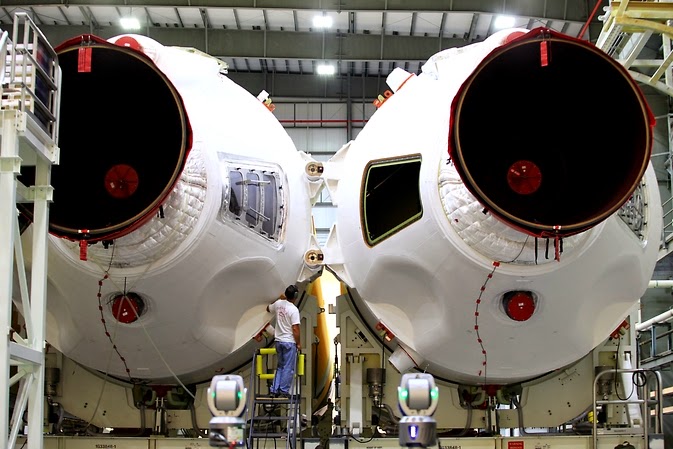
A United Launch Alliance technician monitors progress as core booster elements of a Delta IV Heavy rocket are being integrated in preparation for Exploration Flight Test-1.

Image Credit: NASA/Ben Smegelsky

Engineers took another step forward in preparations for the first test flight of NASA’s new Orion spacecraft, in December.

The three primary core elements of the United Launch Alliance (ULA) Delta IV Heavy rocket recently were integrated, forming the first stage of the launch vehicle that will send Orion far from Earth to allow NASA to evaluate the spacecraft’s performance in space.

The three Delta IV Common Booster Cores were attached in ULA’s Horizontal Integration Facility (HIF), at Cape Canaveral Air Force Station in Florida. The HIF building is located at Space Launch Complex 37 where the mission will lift off.

The first booster was attached to the center rocket in June with the second one was attached in early August.

"The day-to-day processing is performed by ULA," said Merri Anne Stowe of NASA's Fleet Systems Integration Branch of the Launch Services Program (LSP).

"NASA’s role is to keep a watchful eye on everything and be there to help if any issues come up."

Stowe explained that during major testing experts from NASA’s Launch Services Program monitor the work on consoles in Hanger AE at Cape Canaveral Air Force Station.

Hangar AE is home to the Kennedy Space Center’s upgraded Launch Vehicle Data Center. The facility allows engineers to monitor voice, data, telemetry and video systems that support expendable launch vehicle missions.

NASA’s Florida spaceport is also where Orion was built and is being processed.

In the Horizontal Integration Facility at Cape Canaveral Air Force Station, two core elements of a Delta IV Heavy rocket are brought together in preparation for Exploration Flight Test-1. 

Image Credit: NASA/Ben Smegelsky

The Delta IV rocket stages were assembled at the ULA plant in Decatur, Alabama, about 20 miles west of Huntsville.

After completion, the rocket components were shipped down the Tennessee River and Tombigbee Waterway, a canal, to the Gulf of Mexico. From there they traveled to Cape Canaveral, arriving on May 6.

The elements of the rocket's first stage were then transported to the HIF for preflight processing.

"After the three core stages went through their initial inspections and processing, the struts were attached, connecting the booster stages with the center core," Stowe said. "All of this takes place horizontally."

Inside the Horizontal Integration Facility at Space Launch Complex 37 at Cape Canaveral Air Force Station, United Launch Alliance technicians prepare the second stage of a Delta IV Heavy rocket for mating to the central core booster of the three booster stages for the unpiloted Exploration Flight Test-1. 

Image Credit: NASA/Daniel Casper

The three common booster cores are 134 feet in length and 17 feet in diameter.

Each has an RS-68 engine that uses liquid hydrogen and liquid oxygen propellant producing 656,000 pounds of thrust.

All totaled, the three Delta IV boosters collectively generate 1.96 million pounds of thrust.

The second stage of the Delta IV rocket is 45 feet in length and 17 feet in diameter. It uses one RL10-B-2 engine, also burning liquid hydrogen and liquid oxygen propellant creating 25,000 pounds of thrust.

"The second stage was taken to the Delta Operations Center for processing after it arrived," said Stowe. "The second stage was moved to the HIF on Aug. 29 and is scheduled to be horizontally mated to the first stage on Sept. 12."

The same upper stage will be used on the block 1 version of NASA's new heavy-lift rocket, the Space Launch System (SLS). More powerful than any rocket ever built, SLS will be capable of sending humans aboard Orion to deep-space destinations such as an asteroid and Mars.

"The hardware for Exploration Flight Test-1 is coming together well," Stowe said. "We haven't had to deal with any serious problems. All of the advance planning appears to be paying off."

Once all the launch vehicle stages are mated and thoroughly checked out, the next step is the Test Readiness Review.

Wednesday, July 30, 2014

ESA BepiColombo Mercury Planetary Orbiter (MPO) Integration Testing Completed

ProtoFlight Models (PFM) of the BepiColombo Mercury Planetary Orbiter (MPO) [foreground] and the Mercury Transfer Module (MTM) [background], during the press event at Thales Alenia Space Turin, 4 July 2014.

Integration and functional testing activities for the protoflight models of the BepiColombo Mercury Planetary OrbiterMercury Transfer Module, and Magnetospheric Orbiter Sunshield and Interface Structure have now been completed at the Thales Alenia Space facility in Turin, Italy.

All the mission components have been, or will soon be, delivered to ESA's European Space Research and Technology Centre in Noordwijk, the Netherlands, where additional integration tasks and an environmental testing campaign will be performed.

On 4 July 2014, a press event was held at the Turin facility of Thales Alenia Space (TAS-I) to mark the completion of a shipment readiness review held before the ProtoFlight Models (PFMs) of the BepiColombo Mercury Planetary Orbiter (MPO)Mercury Transfer Module (MTM), and Magnetospheric Orbiter Sunshield and Interface Structure (MOSIF) were prepared for transport to ESA's European Space Research and Technology Centre (ESTEC) in Noordwijk, the Netherlands.

At ESTEC, final integration tasks and then environmental testing will be performed.

The MTM and MOSIF left Turin on the evening of 7 July and arrived at ESTEC during the night of 10/11 July. The MPO is scheduled to leave on 4 August and arrive on 7/8 August.

Mercury Transfer Module (MTM)
Mercury Transfer Module
The MTM was delivered to TAS-I by Astrium UK (now EADS Airbus Defence and Space).

As supplied, it consisted of the mechanical spacecraft bus and the chemical propulsion system.

The MTM radiator panels were removed from the central structure and the module has been equipped with the rest of its subsystems while in Turin.

However, for the electrical propulsion subsystem, the relevant high voltage harness and electronic units are still representative dummy models, used to confirm the routing of the harness.

While the spacecraft is at ESTEC, these will be replaced with the flight units and the four electric thrusters will be installed on the thruster pointing mechanisms already integrated on the MTM thruster floor.

Once this has been completed, the thermal blankets will be fitted, prior to a Thermal Balance/Thermal Vacuum (TB/TV) test in ESTEC's Large Space Simulator (LSS) during the first half of 2015.

Magnetospheric Orbiter Sunshield and Interface Structure
Magnetospheric Orbiter Sunshield And Interface Structure
Integration of the MOSIF structure and harness has been completed in Turin.

The thermal protection will be integrated while it is at ESTEC, in readiness for testing as part of the complete spacecraft stack.

Mercury Planetary Orbiter (MPO)
Mercury Planetary Orbiter
Last year, the MPO was transported to TAS-I from ESTEC, where it had been baked out to remove potential contaminants after having been assembled by Astrium UK.

As delivered, it consisted of the spacecraft mechanical bus with the heat pipes and chemical propulsion system installed.

Nearly all of its other subsystems and payload components have been integrated and tested while it has been in Turin.

Once it arrives back at ESTEC next month, some final integration tasks will be completed and installation of the thermal blankets will be finalised. Later this year, it will undergo TB/TV testing in the LSS.

Tuesday, July 8, 2014

ESA ATV-5 Georges Lemaitre loaded with cargo after integration with Ariane 5 launcher

All ATVs have been orbited by Ariane 5 launchers, beginning with "Jules Verne" in March 2008, which was followed by "Johannes Kepler" in February 2011, "Edoardo Amaldi" in March 2012, and last June's flight with "Albert Einstein."

Europe's fifth, and final, Automated Transfer Vehicle (ATV) is now integrated with its Ariane 5 launcher, enabling final cargo loading in preparation for Arianespace's July 24 mission from French Guiana.

The ATV is named after Belgian physicist and father of the Big Bang theory, Georges Lemaitre, and it will deliver fuel, air and more than 2,600 kg. of dry cargo to the International Space Station.

ESA ATV-5 cargo racks filled with cargo for ISS.

In addition, this ATV resupply spacecraft will perform maneuvers to maintain the facility's nominal orbit, as well as test new rendezvous sensors in space.

Using a hoist system set-up in Ariane 5's Final Assembly Building at the Spaceport, the remaining cargo is being loaded through the ATV's top hatch, carefully securing these bags supplied by the European, U.S. and Japanese space agencies.

The ATV program, managed by the European Space Agency (ESA), is part of Europe's contribution to the International Space Station's operation. Prime contractor is Airbus Defence and Space, which also is the industrial architect for Ariane 5.

All ATVs have been orbited by Ariane 5 launchers, beginning with "Jules Verne" in March 2008, which was followed by "Johannes Kepler" in February 2011, "Edoardo Amaldi" in March 2012, and last June's flight with "Albert Einstein."

Arianespace's latest ATV mission in support of International Space Station operations is designated Flight VA219 in the company's numbering system, and will utilize an Ariane 5 ES version of the heavy-lift workhorse.

Sunday, March 9, 2014

ESA IXV during integration at Thales Alenia Space

The Intermediate eXperimental Vehicle (IXV) flight model during integration at Thales Alenia Space, Torino, Italy, on 12 February 2014.

It will be launched by ESA in 2014 on Vega, Europe’s new small launcher, into a suborbital path. 

It will reenter the atmosphere as if from a low-orbit mission, testing new European reentry technologies during its hypersonic and supersonic flight phases. 

Credits: ESA–S. Corvaja, 2014

Monday, June 24, 2013

Four O3b Network satellites integrated to Arianespace Soyuz launcher

The fifth Soyuz to be launched from French Guiana is now complete following the integration of its upper composite consisting of four O3b Networks satellites, their protective payload fairing and the Fregat upper stage.

This activity was performed at the Spaceport's ELS launch complex near the town of Sinnamary, beginning with the composite's transfer on a special transporter, followed by hoisting to the upper level of a purpose-built mobile gantry.

Final checkout of the Soyuz is now underway, leading to the Arianespace liftoff planned on Monday, June 24 at precisely 3:53:51 p.m., local time in French Guiana.

The cluster of four O3b Networks satellites to be orbited on Arianespace's upcoming flight will initiate the creation of a next-generation satellite network for telecommunications operators, Internet service providers, enterprise and government customers in emerging markets.

A total of 12 O3b Networks satellites are to be orbited by Arianespace in groups of four, with the next mission planned for later this year, and another in 2014.

These Ka-band relay platforms are produced by Thales Alenia Space, and have a liftoff mass of 700 kg. each.

Tuesday, July 27, 2010

Ariane 5 Is Ready: Thales Alenia Space-produced spacecraft: NILESAT 201 and RASCOM-QAF1R


The Ariane 5 for Arianespace's third mission in 2010 is ready to enter the final launch preparation phase, during which this heavy-lift vehicle will receive its dual-satellite payload.

Scheduled for liftoff from the Spaceport on August 4, this Ariane 5 ECA will carry a pair of Thales Alenia Space-produced spacecraft: NILESAT 201 and RASCOM-QAF1R.
Both satellites have been undergoing processing following their June arrival in French Guiana.

The upcoming mission is designated V196, signifying the 196th launch of an Ariane family vehicle. The Ariane 5 for this flight was delivered to Arianespace earlier this month by EADS Astrium, which is the heavy-lift vehicle's industrial prime contractor.

Astrium performed the Ariane 5's build-up in the Spaceport's Launcher Integration Building, and then transferred it to the Final Assembly Building, where it was received by Arianespace.

Riding as the flight's upper passenger for the August 4 mission, NILESAT 201 will be deployed first in the launch sequence - to ultimately be positioned at an orbital slot of 7 degrees West longitude.

The satellite will deliver digital Direct-to-Home (DTH) TV and radio broadcasting - along with high-speed data transmission services - to North Africa and the Middle East at the service of Egyptian satellite operator Nilesat. Utilizing a Spacebus 4000B2 platform, this relay platform is equipped with 24 Ku-band and 4 Ka-band transponders. NILESAT 201 will weigh nearly 3,200 kg. at launch.

NILESAT 201 is to be installed atop the Ariane 5 SYLDA dual-payload dispenser system, positioning it over this mission's lower passenger, RASCOM-QAF1R.