Showing posts with label flight. Show all posts

Friday, September 26, 2014

Delta IV Booster Integration Another Step Toward First Orion Flight

A transporter for oversize loads delivers the port, or left, booster for the United Launch Alliance Delta IV Heavy for Exploration Flight Test-1 into the Horizontal Integration Facility, or HIF, on May 7. 

The port booster joins the other two boosters of the Delta IV Heavy already in the HIF.

Image Credit: NASA/Kim Shiflett
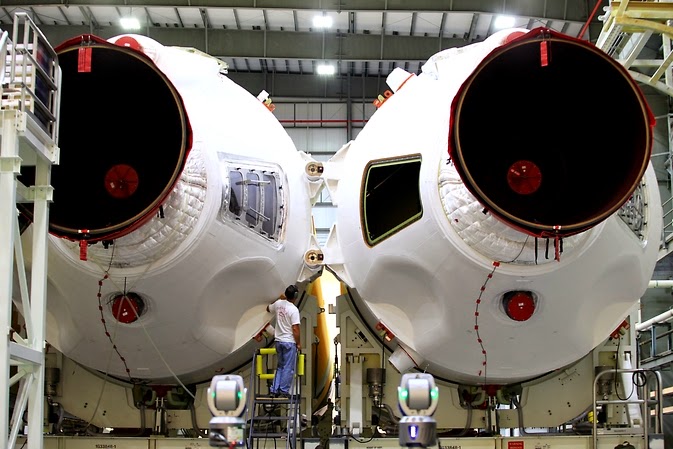
A United Launch Alliance technician monitors progress as core booster elements of a Delta IV Heavy rocket are being integrated in preparation for Exploration Flight Test-1.

Image Credit: NASA/Ben Smegelsky

Engineers took another step forward in preparations for the first test flight of NASA’s new Orion spacecraft, in December.

The three primary core elements of the United Launch Alliance (ULA) Delta IV Heavy rocket recently were integrated, forming the first stage of the launch vehicle that will send Orion far from Earth to allow NASA to evaluate the spacecraft’s performance in space.

The three Delta IV Common Booster Cores were attached in ULA’s Horizontal Integration Facility (HIF), at Cape Canaveral Air Force Station in Florida. The HIF building is located at Space Launch Complex 37 where the mission will lift off.

The first booster was attached to the center rocket in June with the second one was attached in early August.

"The day-to-day processing is performed by ULA," said Merri Anne Stowe of NASA's Fleet Systems Integration Branch of the Launch Services Program (LSP).

"NASA’s role is to keep a watchful eye on everything and be there to help if any issues come up."

Stowe explained that during major testing experts from NASA’s Launch Services Program monitor the work on consoles in Hanger AE at Cape Canaveral Air Force Station.

Hangar AE is home to the Kennedy Space Center’s upgraded Launch Vehicle Data Center. The facility allows engineers to monitor voice, data, telemetry and video systems that support expendable launch vehicle missions.

NASA’s Florida spaceport is also where Orion was built and is being processed.

In the Horizontal Integration Facility at Cape Canaveral Air Force Station, two core elements of a Delta IV Heavy rocket are brought together in preparation for Exploration Flight Test-1. 

Image Credit: NASA/Ben Smegelsky

The Delta IV rocket stages were assembled at the ULA plant in Decatur, Alabama, about 20 miles west of Huntsville.

After completion, the rocket components were shipped down the Tennessee River and Tombigbee Waterway, a canal, to the Gulf of Mexico. From there they traveled to Cape Canaveral, arriving on May 6.

The elements of the rocket's first stage were then transported to the HIF for preflight processing.

"After the three core stages went through their initial inspections and processing, the struts were attached, connecting the booster stages with the center core," Stowe said. "All of this takes place horizontally."

Inside the Horizontal Integration Facility at Space Launch Complex 37 at Cape Canaveral Air Force Station, United Launch Alliance technicians prepare the second stage of a Delta IV Heavy rocket for mating to the central core booster of the three booster stages for the unpiloted Exploration Flight Test-1. 

Image Credit: NASA/Daniel Casper

The three common booster cores are 134 feet in length and 17 feet in diameter.

Each has an RS-68 engine that uses liquid hydrogen and liquid oxygen propellant producing 656,000 pounds of thrust.

All totaled, the three Delta IV boosters collectively generate 1.96 million pounds of thrust.

The second stage of the Delta IV rocket is 45 feet in length and 17 feet in diameter. It uses one RL10-B-2 engine, also burning liquid hydrogen and liquid oxygen propellant creating 25,000 pounds of thrust.

"The second stage was taken to the Delta Operations Center for processing after it arrived," said Stowe. "The second stage was moved to the HIF on Aug. 29 and is scheduled to be horizontally mated to the first stage on Sept. 12."

The same upper stage will be used on the block 1 version of NASA's new heavy-lift rocket, the Space Launch System (SLS). More powerful than any rocket ever built, SLS will be capable of sending humans aboard Orion to deep-space destinations such as an asteroid and Mars.

"The hardware for Exploration Flight Test-1 is coming together well," Stowe said. "We haven't had to deal with any serious problems. All of the advance planning appears to be paying off."

Once all the launch vehicle stages are mated and thoroughly checked out, the next step is the Test Readiness Review.

Monday, September 22, 2014

PIBOT: Robotic Pilot system manages flight controls - video

The PIBOT Flight Simulation System 

Credit: IEEE

How close are we to a day when robots will fly airplanes?

A presentation of a takeoff and landing simulation at the IROS (International Conference on Intelligent Robots and Systems) in Chicago this month, "A Robot-Machine Interface for Full-functionality Automation using a Humanoid," by Heejin Jeong, David Hyunchul Shim and Sungwook Cho, may help you to come up with answers.


A small robot worked the controls of a simulated cockpit. PIBOT, as the robot was called, was able to work the controls, to the extent that it was able to identify and use the buttons and switches found in a real cockpit of a normal light aircraft designed for humans, reported Evan Ackerman in IEEE Spectrum.

PIBOT as shown in the video prepares for flight by turning on the switches in the order of power, battery, altimeter etc.

The engine starts and PIBOT accelerates on the runway while following the center line of the runway.

After climbing it takes turns, approaches the runway, aligns with the runway and makes a safe landing on the ground.

Kelsey Atherton in PopSci highlighted the significance of their work, in light of all the attention otherwise focused on drones.

"Most drones are actually human-piloted, with the controls elsewhere and the pilot steering remotely."

"In this video, the pilot is itself a humanoid robot, learning how to fly an airplane in a flight simulator."

"With a panel of controls in its mechanical fingers, the PIBOT uses visual information, presented on a computer monitor, to inform its flying. Right now, the concept is limited to piloting simulators, but the researchers hope to have PIBOT actually steer a plane some day."

The team is from the Korea Advanced Institute of Science and Technology (KAIST) in South Korea.

The Unmanned System Research Group (FDCL) at KAIST has its own home page where it describes its interest as in research and development of highly advanced autonomous aerial robots.

They combine various principles of control theory, aerospace engineering, and computer science.

Ackerman, meanwhile, summarized the KAIST team's progress thus far. He wrote, "It can do takeoffs, follow waypoints, maneuver, and make a final approach to landing, although at this point, it still needs some human help for the final touchdown."

He also said there are still some perception challenges to solve, "but they're getting very, very close."

Sunday, July 20, 2014

ESA IXV spaceplane set for test flight

ESA IXV Spaceplane weighs almost two tonnes, close to Vega's lifting capacity, and will be a tight fit inside the vehicle's fairing.

Credit: ESA

All eyes are on ESA's IXV spaceplane to showcase reentry technologies after its unconventional launch on a Vega rocket this November.

Instead of heading north into a polar orbit, as on previous flights, Vega will head eastwards to release the spaceplane into a suborbital path reaching all the way to the Pacific Ocean.

ESA's IXV spaceplane being unboxed.

Credit: ESA

Engineers are forging ahead with the final tests on ESA's Intermediate eXperimental Vehicle, IXV, to check that it can withstand the demanding conditions from liftoff to separation from Vega.

Launched in early November, IXV will flight test the technologies and critical systems for Europe's future automated reentry vehicles returning from low orbit.

This is a first for Europe and those working in the field are keeping a close watch.

ESA's IXV spaceplane undergoing re-entry recovery test.

Credit: ESA

The research and industrial community have the chance to use this information for progress in atmospheric reentry, oriented towards transportation systems with applications in exploration, science, Earth observation, microgravity and clean space.

Jose Longo, ESA's head of aerothermodynamics, said, "The technical advancements that have been made since the first experiments with our Atmospheric Reentry Demonstrator in 1996 are huge."


"This is the first flight demonstration of features such as highly advanced thermal structures: thrusters and flaps that are part of the control system, and the 300 sensors and infrared camera to map the heating all along the spacecraft from the nose to the flaps. These things just cannot be tested in the same way in laboratories."

"The fact that ESA's IXV will be launched on Vega makes this a fully European mission," noted Stefano Bianchi, ESA's head of launchers development.

IXV weighs almost two tonnes, close to Vega's lifting capacity, and will be a tight fit inside the vehicle's fairing.

"In this mission we are not only monitoring the spacecraft all along its autonomous flight, but also tracking its progress back to Earth to a particular spot, this is different to what we are used to," said Giorgio Tumino, ESA's IXV project manager.

When IXV splashes down in the Pacific at the end of its mission it will be recovered by ship and returned to Europe for detailed analysis to assess the performance and condition of the internal and external structures.

The actual performance will be compared with predictions to improve computer modelling of the materials used and the spaceplane's design.

Such is the enthusiasm and interest of industry in the opportunities associated with reentry technologies that the third IXV workshop in ESA's Technical Centre, ESTEC, in Noordwijk, the Netherlands was packed out last week.

"It is very encouraging to see such interest in this programme," added Giorgio. "Follow-up activities to this mission will build on the current industrial organisation and associated technologies will provide opportunities to newcomers."

SBIRS Military Defense Satellites Observed Missile Strike on Malaysian Airlines MH17

An artist's rendering shows one of the Space Based Infrared System's missile-spotting GEO spacecraft perched high above Earth.

Credit: Lockheed Martin

U.S. President Barack Obama addressed the nation today (July 18) to share what his administration knows so far about the attack on Malaysian Airlines flight MH17, an "outrage of unspeakable proportions," he said, that killed nearly 300 innocent people.

All evidence so far indicates that the commercial jet, a Boeing 777, was shot down in eastern Ukraine by a surface-to-air missile launched from an area in controlled by Russian-backed separatists, Obama said.

The president offered scant technical details to explain how the government arrived that conclusion but it's likely that heat from the explosion was detected from space by a network of military satellites.

Since the Cold War, the U.S. Department of Defense has had a multibillion-dollar space-based system to provide early warning for intercontinental ballistic missiles.

"It is a very, very precise system that has constant coverage, especially over Russia and Ukraine," said Riki Ellison, founder of the Missile Defense Advocacy Alliance.

Starting in the 1970s, the Pentagon has launched a series of high-altitude satellites with Earth-facing infrared telescopes as part of its Defense Support Program (DSP).

That constellation has kept a continuous watch on the planet for the hot plumes of exhaust from missiles to warn the military and intelligence communities about possible strikes and battlefield threats.

In the past few years, DSP has undergone a major upgrade, becoming the Space Based Infrared System (SBIRS), with the launch of better satellites that can detect faint missiles faster.

SBIRS now includes two geosynchronous Earth orbit (GEO) satellites, built by Lockheed Martin, that are each hover above an unchanging spot on planet, more than 22,000 miles (35,400 kilometers) high.

For comparison, the International Space Station orbits at an average altitude of about 248 miles, or 400 km.

The first of those satellites, dubbed GEO-1, launched from Cape Canaveral in May 2011. Lockheed Martin recently announced that it won a $1.86 billion Air Force contract to complete the fifth and sixth GEO satellites as part of SBIRS.

It's likely that the strike on MH17 showed up as an alarming blip on screens at Buckley Air Force Base in Colorado where those data from the SBIRS is processed.

The detection is precise enough to detect where a missile was fired from and what kind of missile it was.

"Each missile has a different signature plume," Ellison said.

Ellison told reporters that other military satellites in the region probably would have been alerted to gather further information to be provided to the U.S. European Command (EUCOM).

Tuesday, June 4, 2013

Solar Impulse: Solar Plane lands in US Midwest after 21 hour flight

The Solar Impulse is pictured after landing at Brussels Airport, in Zaventem, May 13, 2011. 

The single-person solar-powered aircraft piloted by a Swiss adventurer, has landed in St. Louis, Missouri on the third leg of a transcontinental flight after over 21 hours in the air.

The organizer's ground crew rushed out on the tarmac of the Lambert-St. Louis International Airport when the aircraft, which has four electric engines and a 63 meter wingspan, landed at 0627 GMT.

"I feel (like) I was coming back from another world," said pilot Bertrand Piccard upon landing. "It's almost a shock" to return to normal life.

Despite the long hours "I didn't really feel the fatigue. I felt very fortunate to be up there."

The landing was broadcast live on the organizer's website, live.solarimpulse.com.

Piccard departed the Dallas-Fort Worth airport in Texas aboard the Solar Impulse at 0906 GMT Monday on the third of a five-stop journey across the United States aimed at showcasing the potential of renewable energy technologies.

St. Louis was chosen as the Midwest stopover to pay homage to aviation pioneer Charles Lindbergh and his "Spirit of St. Louis," the first plane to fly from New York to Paris non-stop.

The Texas-Missouri leg was Piccard's longest flight in the single-seat cockpit to date.

Powerful storms that hit the St. Louis, Missouri area late Friday rendered Solar Impulse's airport hangar unusable, so organizers deployed what they described as a "revolutionary" inflatable mobile hangar.

Sunday, April 7, 2013

British Airway (BA) Takes possession of new EADS Airbus A380 luxury jetliner


The EADS Airbus A380 is arguably the most innovative commercial airliner currently on the market.

It offers a spacious, quiet cabin, less noise on take off and landing and greater fuel efficiency, BA are proud to be welcoming them to their fleet in 2013.

Book your British Airways flights on the new A380 to Los Angeles & Hong Kong.

BA flights to Los Angeles by the A380 will be available to book now, for travel from 15 October 2013.

BA is offering five services a week from London Heathrow. Selected services to Hong Kong will also be operated by an A380 and are available to book now for travel from 15 November 2013.

Book your seats here British Airways


Friday, October 5, 2012

SpaceX Dragon Capsule Readies for Flight

Technicians attach the Dragon capsule to a Falcon 9 rocket at the SpaceX facility at Cape Canaveral Air Force Station, Fla., during preparations for the CRS-1 mission.

SpaceX is set to launch the first of a dozen operational missions for NASA to deliver more than 1,000 pounds of supplies to the International Space Station on Oct. 7.

Launch time is 8:35 p.m. EDT from Space Launch Complex 40 at Cape Canaveral Air Force Station in Florida, just a few miles south of the space shuttle launch pads.

The spacecraft will be joined to the station three days later.

Image Credit: NASA/Kim Shiflett

Tuesday, September 25, 2012

DSTO conduct test flight of experimental hypersonic vehicle

The Defence Science and Technology Organisation (DSTO) scientists have successfully conducted a test flight of an experimental hypersonic vehicle at the Andoya Rocket Range in Norway.

The test vehicle reached an apogee of 350 km and then achieved speeds of up to Mach 8 on descent in the experimental band which was from 20.5 km to 32 km in altitude. All sensor and telemetry systems worked perfectly.

Scientists believe the launch could be a major step forward in the quest for hypersonic flight.

The experimental flight was undertaken as part of a joint research program, Hypersonic International Flight Research Experimentation (HIFiRE), being conducted by DSTO and the US Air Force Research Laboratory.

The program is aimed at exploring the fundamental technologies critical to the realisation of sustained hypersonic flight.

This latest launch was the fifth in a series of up to nine planned experimental flights being conducted as part of the HIFiRE program.

Next week, the HIFiRE team will be presented with the prestigious von Karman Award for International Co-operation in Aeronautics at the ICAS Congress in Brisbane.

The Defence Science and Technology Organisation (DSTO) is part of Australia's Department of Defence. DSTO's role is to ensure the expert, impartial and innovative application of science and technology to the defence of Australia and its national interests.

Sunday, June 24, 2012

Fast and Accurate Knife-Edge Manoeuvres for Autonomous Aircraft - YouTube


Robot Locomotion Group at MIT have built a computer-controlled aircraft that flies accurately enough to navigate safely through a gap that is smaller than its wingspan.

Here they demonstrate multiple flights of this vehicle with on-board camera footage and high-speed video.

Many small flying robots still have all the grace and awareness of a drunken pigeon, except that comparison probably disrespects the pigeon.

MIT robotics engineers took inspiration from our fine feathered friends to make a flying robot with the lightning-fast reflexes to dodge through gaps smaller than its wingspan.

That does not quite rival the impressiveness of a bird in flight or a "Star Wars" Jedi tearing through the forest of Endor on a speeder bike, but it's pretty good for a mechanical creation.

Thursday, February 2, 2012

Flying People in New York City - YouTube


Three people were spotted flying around the skies of lower Manhattan last Friday, causing dropped jaws from onlookers.

But while it appeared to be flying "death eaters" of  the "Harry Potter" series, it actually turned out to be a clever piece of viral marketing for this week's upcoming film "Chronicle."

In an interview to yahoo! James Percelay, the co-founder of Thinkmodo said he and his partner Michael Krivicka were approached by 20th Century Fox, the studio behind "Chronicle," and they came out with a plan for the viral video.

Those aren't people in the air, but some very intricately designed radio-controlled airplanes. Percelay has not disclosed who exactly was piloting the planes in the video. He only said: "They are expert AMA (Academy of Model Aeronautics) members with amazing skills."

Sunday, November 27, 2011

USAF Shuttle X-37B: Homecoming

At the end of November, the mysterious X-37B robot spaceplane will reach a critical point in its mission.

This time will mark the end of the official 270-day endurance limit of the semi-secret military shuttle. The X-37B could be getting ready to come home. But will it?

The X-37B is a small, experimental, automated winged spacecraft operated by the US Air Force.

It's roughly the size of a car, and has wings and a small cargo bay with clamshell doors that open up in orbit.

There's no cockpit and no crew. The cargo bay contains a boom that unfurls a solar panel while the vehicle is in orbit.

The first flight of an X-37B vehicle was launched on April 22, 2010, and flew a lengthy classified mission throughout the year. On December 3, 2010, the spacecraft returned to a runway landing, following a mission that lasted roughly 224 days.

We know for sure that the spacecraft itself was testing components and procedures that could be useful in future reusable spacecraft.

The "X" designates that this is an experimental vehicle. Prior to its adoption by the US Air Force, the X-37B was actually a civilian project connected to NASA, and these goals for the spacecraft were clearly stated in open channels.

The US Air Force has also reiterated these points in official statements. This part of the mission is beyond debate.

We also suspect that something else was carried in the cargo bay, but we don't know the details. The secrecy surrounding the X-37B's mission generated much curiosity and fear.

Some pundits suspected there was a spy camera on board, to investigate objects on Earth or in space. Some suggested the small shuttle was a robot satellite mechanic, ready to refuel or repair other spacecraft.

The wildest suggestion of all was that weapons were aboard, ready to destroy other spacecraft or targets on the ground. The spy camera theory is plausible, but not exactly proven. The other two theories are dubious.

It is our opinion that the cargo bay contained mechanical parts and other components to be used on military satellites. The parts would be exposed to space and operated for a long period.

Afterwards, they would be returned to Earth for analysis. This isn't very sexy, but it's absolutely vital. The US military and the shadowy intelligence community have lost too many satellites in recent years.

Problems with their components must surely be a cause of these losses. Fixing these bugs will ensure that these large, complex and highly expensive spacecraft will be more reliable in the future.

The first flight of the X-37B seems to have been highly successful, judging from the limited evidence we have. Photographs and video of the spacecraft were released soon after it landed, showing it intact.

Second Flight
There was a gap of only a few months between the landing of the first X-37B and the launch of the second vehicle. Evidently, there was no need for a major overhaul or redesign.

So we return to the second flight of the X-37B. Everything we know suggests that it's identical to the first vehicle. There has been even less discussion of this second mission than the first.

We don't know if is carrying or doing anything different to the first mission but it has clearly done something new. It's already been in space for much longer than its predecessor.

It is unlikely to come down before its 270 days are up. We believe that the second X-37B will try to push the endurance of this spacecraft further.

We don't really know how long this vehicle can survive in space. The official endurance figure could be a conservative estimate, or possibly tinged with a little strategic deception.

Sunday, July 31, 2011

‪Rockwell Collins Pro Line Fusion Touch Screen‬‏ - YouTube


For the first 50 years of computing, the input and output of a computer have been to different places. Mobile computing and the touch screen are quickly changing things though and the changes extend to the aircraft industry.

At the 59th Annual Experimental Aircraft Association (EAA) Airventure in Oshkosh, Wisconsin, Rockwell Collins has unveiled the first touch-control primary flight displays (PFD) for business jets and turboprop aircraft, which will be available on future applications of the company's Pro Line Fusion avionics system.

The icon-based, touch-controlled interface is designed to make the cockpit more user friendly and keep the pilot's eyes focused up and forward instead of down at the center console.

A tap of the display brings up a context-sensitive menu that lets pilots change things such as the speed, altitude and heading of the aircraft with just a couple of taps.

Through the icon-based graphical user interface, the pilot can also manage aircraft systems, complete checklists, and review the flightplan on a scrollable map, all without taking their eyes off the PFD.

Through gesture controls, pilots can also redirect the aircraft to a graphically displayed waypoint or destination with a swipe of a finger instead of entering information on a console-mounted keypad.

Other gestures control panning and zoom features, while a physical keyboard is retained for alphanumeric input rather than an onscreen virtual keyboard that was decided would cover up too much important information.

With a couple of taps, the screen layout can also be split into two, three or four windows and the elements of the individual windows customized by dragging and dropping icons to provide a wealth of relevant flight information at a glance.

Rockwell Collins says the user-friendly, icon-based graphical user interface also cuts the learning curve for pilots transitioning to a new aircraft type.

"These displays demonstrate our focus on empowering pilots with natural head-up, eyes-forward interfaces," said Colin Mahoney, vice president of Sales and Marketing for Rockwell Collins.

"Touch-controlled, icon-based controls on the main displays help keep pilots' attention focused up and forward for safer and more efficient flying."

Rockwell Collins expects to receive certification for the touchscreen interface in 2013, after which it is slated to appear in cockpits featuring its Pro Line Fusion avionics suite.

Tuesday, July 26, 2011

TED: A robot that flies like a bird


Plenty of robots can fly -- but none can fly like a real bird. That is, until Markus Fischer and his team at Festo built SmartBird, a large, lightweight robot, modeled on a seagull, that flies by flapping its wings. A soaring demo fresh from TEDGlobal 2011.

Monday, July 11, 2011

NASA Shuttle Discovery: Virtual Tour of Flight deck

To see a 360 deg virtual tour of the NASA Shuttle Discovery flight deck, click on the picture.

This view shows Space Shuttle Discovery's flight deck during decommissioning in the Orbiter Processing Facility

Investigating Space Planes

Click on the picture to see the complete picture

Friday, June 24, 2011

D-Dalus: Radical new flying machine may replace helicopters?

It can take off vertically, hover, rotate on a dime, fly in reverse and thrust down to nail a landing a moving target and, it can do all of this at jet-like speed and without any loud chopping noise.

What’s surprising is that the D-Dalus doesn’t have fixed wings or a standard rotor engine and more closely resembles a lawn mower than an aircraft.

It hovers using an innovative flight technology that may someday allow it supplant helicopters as the ultimate in aerial maneuverability.

Helicopters have long been deployed in a wide range of military and police operations. Yet, for just as long, they’ve been beset with a fair number of drawbacks. The same design principles that allows them to hover also limits their forward flying speed. The loud rotor engines also makes them impractical for reconnaissance missions.

IAT21, the Austrian Innovative Aeronautical Technology research company which developed the D-Dalus, claims their invention is a potential game-changer because it’s designed to rectify all these concerns. It’s ultra-quiet, works swimmingly in harsh weather conditions and requires much less maintenance.

The aircraft can enter buildings through windows and comes equipped with a sense-and-avoid system, which means it can navigate within tight spots and close to walls. Such versatility makes it ideal for search-and-rescue operations or as a surveillance drone.

The aircraft’s differs in that it generates propulsion using four contra-rotating turbines spinning at speeds upwards of 2,200 rpm. But the key to its incredibly nimble maneuvering is the turbines ability to be adjusted to generate thrust at different angles around the three axes.

A series of built-in computer algorithms take the guesswork out of how to reposition the blades so that in-air tricks, like glue-down landings, can be easily executed using a joystick.

Currently, the D-Dalus is marketed as a spy-drone. But the company plans to scale up the technology so that it can handle heavier payloads and so that it can someday be commissioned as a passenger vehicle.

According to the company website: “In trials to date D-DALUS has met the performance criteria placed upon it and appears to be scalable, becoming more efficient and less complex as it increases in size.”

Right now, the biggest version can only lift a payload of 70kg, although IAT21 is now working with the UK's Cranfield University on a larger, more powerful version.

Photo: IAT21

Thursday, June 23, 2011

EADS Eurocopter X3 Hybrid Helicopter demo Video at Paris Air show


The speedy new X3 helicopter made its public debut this week at the Paris Air Show, flying a demonstration routine in front of the aerospace industry crowd.

Developed by EADS Eurocopter, the X3 (pronounced ‘x-cubed’) has already flown more than 260 miles per hour, though the company says extreme top speed is not the only goal.

Unlike Sikorsky’s X2 helicopter, which is an entirely new design, the X3 is built around an existing airframe.

Starting with its Dauphin helicopter, Eurocopter removed the tail rotor and added a pair of propellers mounted on short wings. These propellers are used to counter the torque of the main rotor like a tail rotor, and are also used to provide thrust to push the X3 beyond typical helicopter speeds.

The new helicopter uses twin engines like the standard Dauphin, but the engines are much more powerful and are used to power both the side propellers and main rotor.

Eurocopter CEO Lutz Bertling said in a statement the hybrid design will not only be fast, but it will also be affordable to customers.

“Future helicopters incorporating the X3 configuration will offer our customers about 50 percent more cruise speed and range at very affordable costs.”

During the week in Paris, Eurocopter has been reinforcing this message saying the other helicopters may be faster, but the X3 is aimed at developing a technology that is easily adaptable. The company says the speedy technology will add less than 25 percent to the cost of a comparable traditional helicopter.

Sikorsky’s X2 helicopter is a technology demonstrator developed over the past several years.

The company has already begun development of its S-97 helicopter, which will be a larger aircraft aimed at military customers using the pusher propeller and co-axial rotor design of the X2. At the Paris Air Show Sikorsky said the S-97 will make its first flight within the next three and a half years, according to Rotor&Wing magazine.

Both companies see a wide-ranging market for the faster helicopters. In addition to military applications, the extra speed and range is attractive for search-and-rescue operations, law enforcement, offshore oil rig transportation and as private transportation.

In other words, just about any application where helicopters are currently used as transportation would likely opt for more speed and range.

Wednesday, May 18, 2011

Eurocopter X3 hybrid helicopter hits 232 knots

After undergoing a planned upgrade to its gearbox that enabled it to operate at full engine power, Eurocopter's X3 hybrid helicopter demonstrator has surpassed its original speed target of 220 knots (407 km/h or 253 mph).

In a flight on May 12, the X3 maintained a true airspeed of 232 knots (430 km/h or 267 mph) for several minutes during stable, level flight.

Equipped with two turboshaft engines powering a five-blade main rotor system and two propellers on short-span fixed wings, the X3 demonstrator combines the vertical takeoff and landing (VTOL) and hover capabilities of a helicopter with the fast cruise speeds of a turboprop-powered aircraft.

Flight testing of the X3 demonstrator began in September 2010, with the aircraft achieving its initial true airspeed goal of 180 knots (333 km/h or 207 mph) in November when operating at a reduced level of engine power.

After an upgrade that integrated its definitive gearboxes to enable it to operate at full power, the aircraft returned to flight testing last week at the DGA Flight Test Center in Istres, France, and achieved the 232 knot milestone on only its third mission.

"We were impressed by the ease at which this speed objective was attained," said flight test engineer Daniel Semioli and test pilot Hervé Jammayrac, who were aboard the aircraft for the May 12 flight. "The X3 handles extremely well, demonstrating remarkable stability at high speed - even with the autopilot off."

In the latest flight tests conducted at full engine power, Eurocopter says the X3 demonstrated "impressive climb and descent rates, as well as excellent maneuverability, while also confirming the hybrid propulsion system's outstanding capabilities for acceleration and deceleration."

Eurocopter X3 hybrid helicopter hits 232 knots

Tuesday, April 19, 2011

F-35 Lightning full mission simulator

The F-35 Lightning II Full Mission Simulator includes a high-fidelity 360-degree visual display system and a reconfigurable cockpit. Now that's what I call a games console!


Eglin Air Force Base has just taken delivery of a piece of hardware that would surely be the ultimate toy for flight sim gaming fans.

The F-35 Lightning II Full Mission Simulator (FMS) system includes a high-fidelity 360-degree visual display system and a reconfigurable cockpit that can simulate all three variants of the F-35 Lightning II for U.S. and international partner services – the conventional takeoff and landing (CTOL) F-35A, the short takeoff and vertical landing (STOVL) F-35B, and the F-35C carrier variant.

Cavalon gyrocopter

The newest addition to the gyrocopter genre arrived at Aero Friedrichshafen this week in the form of a side-by-side, fully-enclosed, composite construction Cavalon gyrocopter.

The gyrocopter is to the helicopter what the microlight is to traditional small aircraft.

Invented in 1923 by Spaniard Juan de la Cierva, the gyrocopter uses quite a different layout to the helicopter to give it stability at low speed.

It is cheap to run, takes off and lands on a ridiculously small footprint, and has a powered pusher propeller in addition to an unpowered main rotor.

Certification for the EUR65,000 Cavalon is almost complete in Germany and France, and AutoGyro will assist with certification documentation for other countries. Additionally, there are still ten units up for grabs in this year's production run.

The closest competitor to the Cavalon is the Xenon gyrocopter built in Poland, though the Xenon has the one-axle cyclic control while the Cavalon has a two-stick arrangement and the Cavalon stores its fuel outside the cabin.