Showing posts with label empty space. Show all posts

Monday, March 10, 2014

Astronomers find faint strings of galaxies inside empty space

A simulation of the ‘Cosmic Web’ showing clusters of galaxies and a void in the middle of the image, where Dr Alpaslan and team discovered tendrils of galaxies. 

Credit: Cunnama, Power, Newton and Cui (ICRAR).

Australian astronomers have shown galaxies in the vast empty regions of the Universe are actually aligned into delicate strings in research published today in the Monthly Notices of the Royal Astronomical Society.

A team of astronomers based at The University of Western Australia node of the International Centre for Radio Astronomy Research (ICRAR) has found short strings of faint galaxies in what were previously thought to be extremely empty parts of space.

The Universe is full of vast collections of galaxies that are arranged into an intricate web of clusters and nodes connected by long strings.

This remarkably organized structure is often called the 'cosmic web', with busy intersections of galaxies surrounding vast spaces, empty of anything visible to us on Earth.

"The spaces in the cosmic web are thought to be staggeringly empty," said Dr Mehmet Alpaslan, who led the research.

"They might contain just one or two galaxies, as opposed to the hundreds that are found in big clusters."

These huge, empty regions are called voids, and for years, astronomers have been trying to understand the small population of galaxies that inhabit them.

Using data from the Galaxy and Mass Assembly (GAMA) survey, Alpaslan and his colleagues found that the small number of galaxies inside these voids are arranged in a new way never seen before.


"We found small strings composed of just a few galaxies penetrating into the voids, a completely new type of structure that we've called 'tendrils'," said Alpaslan.

To discover tendrils, the GAMA team created the largest ever galaxy census of the southern skies using observations from the Anglo-Australian Telescope in NSW, Australia.

"Our new catalogue has looked deeper into space and mapped each patch of sky up to ten times to make sure it's as thorough as possible," said Dr Aaron Robotham from The University of Western Australia node of ICRAR.

"We weren't sure what we'd find when we looked at voids in detail, but it was amazing to find so many of these tendrils lurking in regions that have previously been classified as empty," said Robotham.

"This means that voids might be much smaller than we previously thought, and that galaxies that were previously thought to be in a void might just be part of a tendril," said Alpaslan.

The GAMA team plan to catalogue more tendrils for further study as their detailed map of the Universe expands.  

More Information: 'Galaxy and Mass Assembly (GAMA): Fine laments of galaxies detected within voids' arxiv.org/pdf/1401.7331.pdf

Friday, October 28, 2011

UFO Pod: Theme room

Make your childhood fantasies come true by staying in a UFO for a night. 

The flying-saucer-shaped pod hovers above the ground in a forest at Treehotel near the Lule River in Harads, Sweden. 

The UFO room is one of five free-standing treehouse rooms, which also include the Bird's Nest, Mirrorcube and the Blue Cone.
 
Picture: Peter Lundstrom WDO/www.treehotel.se/Rex Features

Saturday, October 22, 2011

NASA Considering Fuel Depots in the Space - latest

ROSAT - latest news

Last update: 23 October 2011, 02:45 UTC (04:45 CEST)
On Sunday, 23 October 2011, between 1:45 UTC (3:45 CEST) and 2:15 UTC (4:15 CEST) the german ROentgen SATellite ROSAT has re-entered Earth's atmosphere. There is currently no confirmation if pieces of debris have reached Earth's surface.

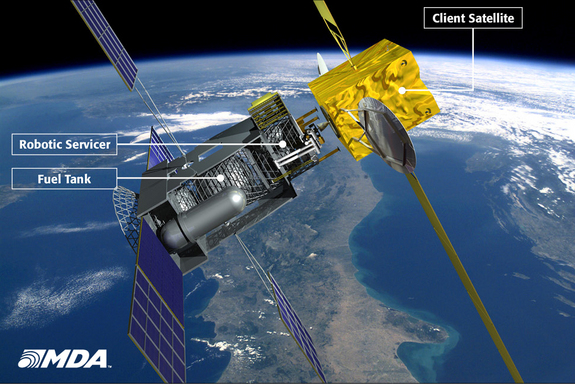
By considering a proposal to put filling stations in the sky, NASA is looking to accelerate plans to send astronauts to distant destinations.

The filling stations, NASA calls them propellant depots, would refuel a spacecraft in orbit before it headed out to the moon, an asteroid or eventually Mars.

Currently, all of the fuel needed for a mission is carried up with the rocket, and the weight of the fuel limits the size of the spacecraft.

Next month, engineers will meet at NASA headquarters in Washington to discuss how propellant depots could be used to reach farther into space and make possible more ambitious missions using the heavy-lift rocket that NASA is planning to build.

The discussions grow out of a six-month NASA study of propellant depots, completed in July.

However, the space agency has rejected the study’s most radical conclusion: that NASA could forgo the heavy-lift and use existing smaller rockets, combined with fuel depots, to reach its targets more quickly and less expensively.

Those targets, for the next two decades at least, include a return to the moon or a visit to an asteroid. (A trip to Mars is unlikely until at least the 2030s.)

“This study highlights some interesting benefits of depots, but it is too singularly focused,” William H. Gerstenmaier, the associate administrator for NASA’s human exploration and operations directorate, said in a statement.

“NASA is actively studying depots and how they can be used with other proposed elements to provide the lowest cost, sustainable exploration plan.”

Under the plan outlined in the document, the propellant depot would be launched first, and then other rockets would carry fuel to the depot before a spacecraft arrived to fill up.


That would increase the complexity for an asteroid mission, 11 to 17 launchings instead of four, but could get NASA astronauts to an asteroid by 2024, the study said.

The total budget needed for the project from 2012 through 2030 would be $60 billion to $86 billion, the study said.

Thursday, September 8, 2011

UK Space Attempt to revive silent satellite planned

British scientists say they will try to revive a satellite launched almost 40 years ago that has been silent since 1996.

The Prospero spacecraft, launched Oct. 28, 1871, atop a Black Arrow rocket, was the first -- and last -- British satellite to be put into orbit by a British launch vehicle, the BBC reported Tuesday.

The British government had canceled the satellite/rocket project before its scheduled launch but the team responsible decided to proceed anyway and launched Prospero into orbit from a remote Australian launch site.

Intended to investigate the effects of space environment, the satellite operated until 1973 and was contacted annually until 1996. Researchers at University College say they want to re-establish communication in time for the satellite's 40th anniversary.

It won't be easy, since most of the information from the original operation has been lost.

"First, we have to re-engineer the ground segment from knowledge lost, then test the communications to see if it's still alive," Roger Duthie of the University's Mullard Space Science Laboratory said.

If the satellite is still alive, he said, some of its on-board experiments might even be working.

"It's an artifact of British engineering; we should find out how it's performing," Duthie said.

Wednesday, August 31, 2011

The first nuclear power plants for settlements on the moon and Mars

"The biggest difference between solar and nuclear reactors is that nuclear reactors can produce power in any environment," Werner explained.

"Fission power technology doesn't rely on sunlight, making it able to produce large, steady amounts of power at night or in harsh environments like those found on the Moon or Mars.

A fission power system on the Moon could generate 40 kilowatts or more of electric power, approximately the same amount of energy needed to power eight houses on Earth."

Friday, March 18, 2011

Graphene, Space, Chess boards and Electron Spin

Physicists at UCLA set out to design a better transistor and ended up discovering a new way to think about the structure of space.
 
Space is usually considered infinitely divisible — given any two positions, there is always a position halfway between.
 
But in a recent study aimed at developing ultra-fast transistors using graphene, researchers from the UCLA Department of Physics and Astronomy and the California NanoSystems Institute show that dividing space into discrete locations, like a chessboard, may explain how point-like electrons, which have no finite radius, manage to carry their intrinsic angular momentum, or “spin.”
 
While studying graphene’s electronic properties, professor Chris Regan and graduate student Matthew Mecklenburg found that a particle can acquire spin by living in a space with two types of positions — dark tiles and light tiles. The particle seems to spin if the tiles are so close together that their separation cannot be detected.
 
“An electron’s spin might arise because space at very small distances is not smooth, but rather segmented, like a chessboard,” Regan said.
 
Their findings are published in the March 18 edition of the journal Physical Review Letters.
 
In quantum mechanics, “spin up” and “spin down” refer to the two types of states that can be assigned to an electron. That the electron’s spin can have only two values — not one, three or an infinite number — helps explain the stability of matter, the nature of the chemical bond and many other fundamental phenomena.
 
However, it is not clear how the electron manages the rotational motion implied by its spin. If the electron had a radius, the implied surface would have to be moving faster than the speed of light, violating the theory of relativity. And experiments show that the electron does not have a radius; it is thought to be a pure point particle with no surface or substructure that could possibly spin.
 
In 1928, British physicist Paul Dirac showed that the spin of the electron is intimately related to the structure of space-time. His elegant argument combined quantum mechanics with special relativity, Einstein’s theory of space-time (famously represented by the equation E=mc2).
 
Dirac’s equation, far from merely accommodating spin, actually demands it. But while showing that relativistic quantum mechanics requires spin, the equation does not give a mechanical picture explaining how a point particle manages to carry angular momentum, nor why this spin is two-valued.
 
Unveiling a concept that is at once novel and deceptively simple, Regan and Mecklenburg found that electrons’ two-valued spin can arise from having two types of tiles — light and dark — in a chessboard-like space. And they developed this quantum mechanical model while working on the surprisingly practical problem of how to make better transistors out of a new material called graphene.
 
Graphene, a single sheet of graphite, is an atomically-thin layer of carbon atoms arranged in a honeycomb structure. First isolated in 2004 by Andre Geim and Kostya Novoselov, graphene has a wealth of extraordinary electronic properties, such as high electron mobility and current capacity.
 
In fact, these properties hold such promise for revolutionary advances that Geim and Novoselov were awarded the 2010 Nobel Prize a mere six years after their achievement.
 
Regan and Mecklenburg are part of a UCLA effort to develop extremely fast transistors using this new material.
 
“We wanted to calculate the amplification of a graphene transistor,” Mecklenburg said. “Our collaboration was building them and needed to know how well they were going to work.”
 
This calculation involved understanding how light interacts with the electrons in graphene.
 
The electrons in graphene move by hopping from carbon atom to carbon atom, as if hopping on a chessboard. The graphene chessboard tiles are triangular, with the dark tiles pointing “up” and light ones pointing “down.”  When an electron in graphene absorbs a photon, it hops from light tiles to dark ones. 
 
Mecklenburg and Regan showed that this transition is equivalent to flipping a spin from “up” to “down.”
In other words, confining the electrons in graphene to specific, discrete positions in space gives them spin. 
 
This spin, which derives from the special geometry of graphene’s honeycomb lattice, is in addition to and distinct from the usual spin carried by the electron. In graphene the additional spin reflects the unresolved chessboard-like structure to the space that the electron occupies.
 
“My adviser [Regan] spent his Ph.D. studying the structure of the electron,” Mecklenburg said. “So he was very excited to see that spin can emerge from a lattice. It makes you wonder if the usual electron spin could be generated in the same way.”
 
“It’s not yet clear if this work will be more useful in particle or condensed matter physics,” Regan said, “but it would be odd if graphene’s honeycomb structure was the only lattice capable of generating spin.”
 
The California NanoSystems Institute at UCLA is an integrated research facility located at UCLA and UC Santa Barbara.

Wednesday, December 22, 2010

Monday, May 17, 2010

Quantum space monster leaps from a gravity well

Quantum space monster leaps from a gravity well

GRAVITY may have the power to create quantum monsters. A strong gravitational field can induce a runaway effect in quantum fluctuations in apparently empty space, resulting in a burgeoning concentration of energy that may explode stars or create black holes. So say Daniel Vanzella and William Lima at the University of São Paulo in Brazil.

Quantum phenomena are not thought to have any significant influence over processes on the astrophysical scale, such as the compression of gas clouds into stars. That's the domain of gravity, which in turn is not supposed to be much affected by quantum events, like an elephant unaware of the microbes on its skin. In only a few exotic cases, such as singularities inside black holes, do gravity and quantum-level forces influence the same processes.

Now calculations by Vanzella and Lima suggest gravity can trigger a powerful reaction in the fluctuating quantum fields of forces in apparently empty space, and that this reaction may be enough to influence the evolution of large objects like stars.

According to the uncertainty principle, virtual particles quickly pop in and out of existence throughout the vacuum of space. The pair calculate that a sufficiently powerful gravitational field, such as that created by a dense object like a neutron star, could create a region near the star where these virtual particles become densely packed. Their calculations suggest that the overall energy density of this region will grow exponentially until it dwarfs the energy of the object that generated the gravitational field - a monster of virtual particles that exceeds the strength of its creator.

What that monster could do is still unknown, but Vanzella and Lima speculate that the amassed energy could conceivably explode a neutron star, collapse it into a black hole, or some combination of the two.

However, none of the quantum fields based on known forces, such as electromagnetism, would be capable of causing a neutron star to collapse. Only an as-yet undiscovered quantum field would react to the gravity of a neutron star.

Nevertheless, the pair say that known quantum fields may have an influence on astrophysical processes if they were triggered by gravitational effects on much larger scales - across clusters of galaxies or in superclusters, for example (Physical Review Letters, vol 104, p 161102).