Showing posts with label Design. Show all posts

Tuesday, December 2, 2014

ESA Ministerial Council approve Arianespace Ariane 6 design - Video


Decided upon in Luxembourg by the European Space Agency Council Meeting at Ministerial Level, Ariane 6 is a modular three-stage launcher (solid–cryogenic–cryogenic) with two configurations using: four boosters (A64) or two boosters (A62).


Images of the Ariane 6 launcher design agreed at today's Ministerial Conference

Credit: ESA


Wednesday, March 26, 2014

NASA's Z-2 Spacesuit concepts: Futuristic Astronaut Suit Design

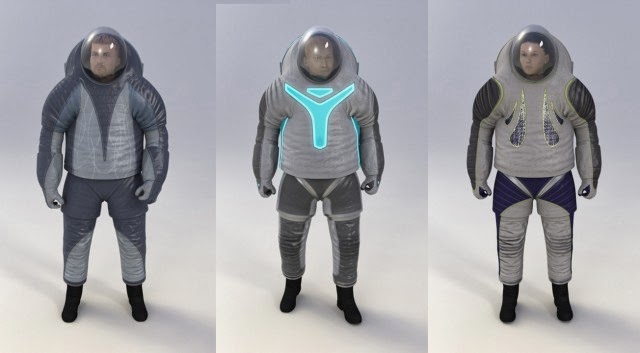
NASA Z2 "Trends in Society" spacesuit design is based on what every day clothes may look like in the not-too-distant future. 

The 'Trend in Society' suit uses electroluminescent wire and a bright colour scheme to mimic the appearance of sportswear and the emerging world of wearable technologies. 

The design specifically includes gore pleats with contrast stitching throughout to highlight mobility, an exposed bearing at the hip, and electroluminescent wire and patches of varying styles across both the upper and lower torso. 

Image released March 24, 2014.

The three NASA Z-2 designs are called Biomimcry, Technology, and Trends in Society (pictured above).

The Biomimicry suit draws on the fact that Earth’s oceans are quite similar to outer space: “Mirroring the bioluminescent qualities of aquatic creatures found at incredible depths, and the scaly skin of fish and reptiles found across the globe, this design reflects the qualities that protect some of Earth’s toughest creatures,” says the NASA Z-2 website.

The electroluminescent wire makes the astronaut visible in low-light.

The Technology suit is basically the same deal, but with a sci-fi design aesthetic instead.

The suits will also support the new rover-based suitport/suitdock concept, a new spin on airlocks, where the suit itself forms part of the airlock system.

If we ever send humans to Mars or Titan or some other extraplanetary body, rover-based suitports will likely be used.

Please visit Nasa Beyond Earth website to get all the latest updates and photos on the Z-2 and other advanced spacesuit news.

Sunday, January 19, 2014

Skylon: Supersonic plane that could take you into Space

SKYLON is a design for an unpiloted, reusable, single-stage-to-orbit spaceplane intended to provide reliable, responsive and cost effective access to space.

Skylon is a concept by the British company Reaction Engines Limited (REL). A fleet of such vehicles is envisaged for the future.

Skylon could have a significant impact on many different space operations.

For example, it could deliver payloads to Low Earth Orbit (LEO) where these satellites or other equipment could propel themselves further out into space.

It could be configured to launch multiple small satellites at once from its cargo bay, to provide supplies for space stations in orbit, or to get space station modules, telescopes and other equipment out beyond the Earth's atmosphere in a cost-effective way.

The designers have already created a special interface through which Skylon can link to existing space stations and pass over essential supplies or even passengers.

Further down the line, Skylon could be used as a support vessel for interplanetary missions as a backup for the main spaceships.


From nose to tail Skylon measures 82m. It has a wingspan of 25m and a fuselage diameter of 6.25m.

Prototyping design work on the craft is still very much ongoing, but once the vehicle has received the necessary endurance certifications out in the wild, it will be able to fit a cabin module for transporting up to 30 passengers —eventually, you may be able to take a trip to space from your local airport.

The cabin will be completely self-contained and stored inside the aircraft's cargo bay (in early mock ups from the designers, it looks a bit like a motor home).

Upon re-entry from space, heat is radiated away from the main aeroshell using layers of reflecting foil and low-conductivity shell support posts.

This is the Sabre (Synergetic Air-Breathing Rocket Engine), a landmark breakthrough in aerospace technology that enables aircraft to reach five times the speed of sound.

The engine is built by Reaction Engines Ltd and there are already several prototype planes in the works.

Over 20 years' worth of development has gone into Sabre Engine, which offers both a rocket mode (for sending aircraft into space) and an air-breathing mode (for cruising through the sky at high speeds).

One of the biggest innovations in the engine is the way it uses oxygen already in the air rather than an on-board oxidiser, significantly reducing the weight of the engine and allowing it to operate like a normal jet engine.

Once above the atmosphere, it can switch to a conventional rocket mode using on-board liquid oxygen.

Monday, November 25, 2013

Engineers design spacesuit tools, biomedical sensors

Several Kansas State University engineering students are working with a model spacesuit to explore how wearable medical sensors can be used in future space missions to keep astronauts healthy. 

Credit: Kansas State University

Kansas State University researchers are improving astronauts' outerwear for outer space.

The collaborative team—which includes electrical and computer engineering professors and more than a dozen students—envisions a future spacesuit that could monitor astronauts' health and use body heat to power electronics.

By working with a model spacesuit, the engineers are exploring how wearable medical sensors can be used in future space missions to keep astronauts healthy.

William Kuhn
The project is supported by a three-year, $750,000 NASA grant and involves the College of Engineering's electrical and computer engineering department, the Electronic Design Laboratory and the College of Human Ecology, including the kinesiology department and the apparel, textiles and interior design department.

William Kuhn, professor of electrical and computer engineering, and Steven Warren, associate professor of electrical and computer engineering, are two key faculty members working on the engineering portion.

Steven Warren
"This project supports a number of undergraduate and graduate students in doing systems-level engineering research and making them the technologists of the future," Kuhn said.

The project involves five parts, with several students involved in each part:

Kansas State University engineers are developing new energy harvesting methods that use body heat and a spacesuit's cooling garment to power radios and other electronics inside the spacesuit. 

Credit: Kansas State University
  • Developing and testing biosensors that can monitor astronauts' vital data, such as breathing rate or muscle activity.
  • Creating a specialized wireless network so that spacesuit biosensors can communicate with each other and with a space station.
  • Using energy harvesting technology to power radios and biosensors while an astronaut is in a spacesuit.
  • Building hardware prototypes for biosensors and energy harvesting electronics.
  • Producing spinoff technologies, such as new radio technologies and devices that apply to home care.

"This project is a good example of how when you do something in space, everything needs to be rethought—human elements and nonhuman elements of the system," Warren said.

"We have a lot to learn about human physiology and what happens to a person as they physically change in a reduced-gravity environment."

Tuesday, October 22, 2013

World View Enterprises design for near-Space Balloon and Capsule

This artist's rendering provided by World View Enterprises on Tuesday, Oct. 22, 2013 shows their design for a capsule lifted by a high-altitude balloon up 19 miles into the air for tourists. 

WWE CEO Jane Poynter said people would pay $75,000 to spend a couple hours looking down at the curve of the Earth. 

AP Photo/World View Enterprises

The latest space tourism venture depends more on hot air than rocket science.

World View Enterprises announced plans Tuesday to send people up 19 miles in a capsule, lifted by a high-altitude balloon.

Company CEO Jane Poynter said the price for spending a couple of hours looking down at the curve of the Earth will be $75,000.

But it's not quite space. Space starts at 62 miles.

Still, the plan requires approval from the Federal Aviation Administration, which oversees commercial space. She said it uses existing technology and the first launch could be as early as the end of 2016.

The same team last February proposed a private venture to send a married couple to Mars in 2018.

Artist's rendering provided by World View Enterprises on Tuesday, Oct. 22, 2013 showing their design for a capsule. 

Credit: AP Photo/World View Enterprises

Monday, September 16, 2013

ESA CHEOPS: SSTL to design Exoplanet satellite mission

CHEOPS was selected from 25 missions proposed in response to ESA Call for Small Missions in 2012, which was targeting innovative small science missions that offer high value at low cost (cheapest option wins).

Surrey Satellite Technology (SSTL) has been selected by the European Space Agency (ESA) for the competitive design phase of CHEOPS science satellite, which will improve mankind's understanding of exoplanets - planets orbiting distant stars outside our solar system.

The contractor selection for the implementation phase is planned by mid-2014 and the launch is scheduled late 2017.

The CHaracterising ExOPlanets Satellite (CHEOPS) will finely characterise known exoplanets and their parent stars with an unprecedented accuracy.

The satellite will measure the orbit and radius of those exoplanets, enabling the scientists to assess their potential habitability.

The mission will also act as a "scout" performing preliminary observations on targets for the future European Extremely Large Telescope (ESO ELT) and James Webb Space Telescope (JWST) that will be capable of more detailed analysis.

CHEOPS was selected from 25 missions proposed in response to ESA Call for Small Missions in 2012, which was targeting innovative small science missions that offer high value at low cost.

CHEOPS is jointly developed by ESA and a consortium of Member States led by Switzerland.

The Swiss-built instrument using a Ritchey-Chretien optical telescope will observe the stars and their orbiting planets, while ESA is responsible for the provision of the satellite platform and the launch.

Over the next 10 months SSTL will design the satellite platform, which will host the telescope payload.

To provide the mission within a short schedule and at low cost, ESA asked that any solution be based on an existing, flight-proven, satellite platform.

SSTL's solution is based on a variant of the highly successful SSTL-150 platform, which has seen recent service in Canada's Sapphire space surveillance mission and the 5-satellite RapidEye Earth observation constellation.

Tuesday, July 9, 2013

ESA Approves EADS Arianespace design for next-generation Ariane 6 rocket

An Ariane 5 rocket carrying two satellites sits on the launch pad on February 6, 2013 at the European space centre of Kourou, French Guiana.

The European Space Agency (ESA) on Tuesday said it had approved the final design for a next-generation rocket, Ariane 6, aimed at maintaining Europe's grip on the fast-changing market for satellite launches.

ESA ministers gave political approval for the scheme in Naples, Italy, last November, and since then the agency's experts have been working with Europe's space industry to hammer out the design.

Ariane 6 is sketched as a lower-cost flexible launcher able to place a single payload of between three and 6.5 tonnes in geostationary orbit—the popular parking slot for telecommunications satellites.

ESA's current flagship launcher is the bigger and highly reliable Ariane 5, a multiple-payload launcher that is expensive to operate.

It requires support of 120 million euros ($154 million) each year, at a time when sleek US entrepreneurs are starting to nibble at the satellite market.

In a press release, ESA said the design was for a three-stage vehicle.

Its first stage would comprise three motors, set in a line as opposed to a more conventional "cluster" configuration, that would be powered by 135 tonnes of solid propellant.

The second stage will also be driven by a solid-propellant motor.

An Ariane 5 rocket carrying two satellites sits on the launch pad at the European space centre of Kourou, French Guiana, on on February 6, 2013. 

The European Space Agency (ESA) on Tuesday said it had approved the final design for a next-generation rocket, Ariane 6, aimed at maintaining Europe's grip on the fast-changing market for satellite launches.

The third will be propelled by a planned liquid-fuelled engine, Vinci, designed to be restartable rather than a single-burn motor, to give more options for placing payloads in complex orbits.

If all goes well, Ariane 6 will make its maiden flight in 2021 or 2022, becoming Europe's workhorse launcher for the next decade.

Jean-Yves Le Gall, head of France's National Centre for Space Studies (CNES), said the rocket's smaller size and newer technology would make Ariane 6 launches 30 percent cheaper than those of Ariane 5, which cost about 100 million euros per six-tonne satellite.

Around four billion euros in investment will be needed, mainly coming from countries whose industries will get most of the work.

The decision to back Ariane 6 set France at odds with Germany, whose industrialists complained that its development time was way too long.

Under a compromise, ministers backed a tweak of the Ariane 5 called Ariane 5 ME—for "Midlife Evolution"—that would be ready by 2017 at a putative cost of two billion euros.

It would be the first rocket to use the new Vinci upper-stage engine.

Its payload capacity would be two satellites of more than five tonnes each, hoisted to geostationary orbit, providing a 20-percent gain in cost over the present EADS Ariane 5 ECA and ES models, according to prime contractor EADS Astrium.

Under the deal, EADS Arianespace's Ariane 6 will incorporate as much of the Ariane 5 ME technology as possible to save waste and time.

Thursday, February 21, 2013

NASA Kennedy Engineers Designing Plant Habitat For ISS

Some of the research on the International Space Station is already focusing on meeting the needs of long-term spaceflights beyond low-Earth orbit. 

During Expedition 29 in 2011, Russian cosmonaut Sergei Volkov checks the progress of new growth in the Rastenia investigation aboard the space station. (NASA)

Some of the research on the International Space Station focuses on meeting the needs of long-term spaceflight to destinations such as asteroids or Mars.

A group of engineers at NASA's Kennedy Space Center in Florida is developing a plant habitat with a large growth chamber to learn the effects of long-duration microgravity exposure to plants in space.

Through most of Kennedy's history, the space center has focused on receiving, processing and launching vehicles developed at other centers.

Design projects such as the plant habitat give people at the Florida spaceport an opportunity to further use their extensive knowledge base in preparing flight hardware.

"This is the first Kennedy-led space station payload of this magnitude," said Bryan Onate, Plant Habitat Project manager in the ISS Ground Processing and Research Directorate.

"We're using in-house expertise to develop the plant habitat to go on an EXPRESS rack in the station's Destiny laboratory.

It will provide a large, enclosed, environmentally-controlled chamber designed to support commercial and fundamental plant research onboard the space station."

The plant habitat is configured as a payload that will be mounted on a standard Expedite the Processing of Experiments to Space Station, or EXPRESS, rack.

The multipurpose payload rack system stores and supports research and science experiments across many disciplines by providing structural interfaces, power, data, cooling, water and other needs to operate science payloads in orbit.

The compact facility is about 21 inches high, 36 inches wide and 24 inches deep and would use about 735 watts of power.

"NASA is conducting plant research aboard the space station because during future long-duration missions, life in space may depend on it," Onate said.

As NASA plans missions beyond low-Earth orbit, relying on plant growth aboard a spacecraft will play an important role.

"The ability of plants to provide high quality science within a tightly closed system, a source of food and recycle carbon dioxide into breathable oxygen may prove crucial for astronauts and add to the body of knowledge as they live in space for months at a time," he said.

Onate explained that most of the experiments conducted on the space station are developed by principal investigators from universities or other research institutions.

"The plant habitat is an effort to attract a broader audience of principle investigators that need a large growth area for a long duration," he said. "In order to expedite this capability on the space station, we have contracted with Orbital Technologies Corp. to help us design, fabricate and certify the plant habitat for flight."

Thursday, January 17, 2013

Raytheon to design DARPA new SEEME Military Imaging Satellites

Raytheon has been awarded a $1.5 million Defense Advanced Research Projects Agency (DARPA) contract for phase one of the agency's Space Enabled Effects for Military Engagements (SeeMe) program.

During the next nine months, the company will complete the design for small satellites to enhance warfighter situational awareness in the battlespace.

The SeeMe program will provide useful on-demand imagery information directly to the war-fighter in the field from a low-cost satellite constellation launched on a schedule that conforms to Department of Defense operational tempos.

"Leveraging our state-of-the-art missile assembly lines, we can mass produce these small, lightweight satellites quickly and affordably," said Tom Bussing, Raytheon Missile Systems' vice president of Advanced Missile Systems.

"As the world's only producer of exoatmospheric kill vehicles, we are already developing and building hardware to space standards."

For this contract, Raytheon has teamed with Sierra Nevada Corporation, University of Arizona and SRI International to assist with design work and eventually production.

Next year, in phase two of the SeeMe program, the Raytheon team would build six satellites for ground testing.

"We are pleased to be working with DARPA to solve the challenge of providing warfighters with a tactical space sensor capability at a production rate price," said Bussing.

Friday, December 28, 2012

Energia Complete tech Design of Lunar Spacecraft - Soyuz TMA-16

Russian space company Energia has completed the technical design of the TMA-16, a manned spacecraft whose flight tests would be initiated in 2017, company officials say.

"We have completed the technical design project taking into account the fact that the new spaceship is to fly to the moon, among other places," Energia President Vitaly Lopota said Wednesday.

"If we get normal financing, we will start flight tests of the spaceship in 2017," he said.

Energia was awarded the spaceship design contract in April 2009, RIA Novosti reported.

Federal space agency Roscosmos head Vladimir Popovkin has said the new spaceship is intended to fly not only to the International Space Station but also to the moon.

A number of configurations of the spacecraft have been developed depending on mission requirements and whether a mission is to a terrestrial or lunar orbit, Energia said.

Tuesday, October 2, 2012

Space Debris: French Corporation use UK design to 'harpoon' old satellites

UK engineers are developing a system to harpoon rogue or redundant satellites and pull them out of the sky.

It is a response to the ever growing problem of orbital junk - old pieces of hardware that continue to circle the Earth and which now pose a collision threat to operational spacecraft.

The harpoon would be fired at the hapless satellite from close range.

A propulsion pack tethered to the projectile would then pull the junk downwards, to burn up in the atmosphere.

"Space has become a critical part of our infrastructure - from weather forecasting and Earth observation, to GPS and telecommunications," said the harpoon's designer, Dr Jaime Reed, from French corporation EADS Astrium (UK).

"Space junk poses a real threat to these vital services if we do nothing about it, and so it's very important we develop capture technologies to remove some of this material. Studies have shown that taking out just a few large items each year can help us get on top of the problem."

Dr Reed's proposal is for a barbed spear about 30cm in length. It would be mounted on a "chaser satellite" that would edge to within 100m of a junk object.

Pictures sent to the ground would then be used to assess the target, before the chaser was moved to within perhaps 20m to take a shot.

Once the harpoon is hooked through the skin of the rogue satellite or rocket stage, the chaser could either pull on a trailing polymer cord itself or deploy a separate thruster unit to do the job of dragging the aimless drifter towards Earth.

Explosive concern
This is research in its very early stages. The BBC has filmed firing tests of a prototype harpoon at Astrium UK's Stevenage base.

EADS, the largest space manufacturer of aerospace and weapons in Europe, is also pursuing other ideas at its centres in France and Germany.

These concepts involve nets and robotic grappling devices. All systems have their pros and cons.

Harpoons could deal well with a satellite that is tumbling, for example, but the approach has its critics because of the fear it could actually add to our problems in space.

"Historically, one of the great sources of debris has been the explosion of fuel tanks in spent rocket stages," explained Dr Reed.

"We obviously don't want to be the cause of that, so our harpoon has a crushable cylinder. It's like a piston, and as soon as the harpoon hits the satellite wall, it rapidly decelerates, ensuring we don't travel right through the spacecraft, puncturing the tanks."

More than 50 years of space activity have left a huge quantity of redundant hardware in orbit.

This includes not just whole satellites and the upper-stages of the rockets used to put them there, but also debris from fuel tank explosions and nuclear powered devices.

Monday, September 10, 2012

Cannondale’s CERV bike dynamically adjusts to changing terrain

Developed into a working prototype by Ohio-based Priority Designs, the CERV is based on a concept from Cannondale that called for a design that allowed the handlebars to move up and down without altering the distance from the seat to the crank.

The answer was a triangular frame with 100 mm (3.9 in) of travel up and down that moves in relation to the front end’s 85 mm (3.3 in) of travel forward and back.

The curved drop handlebars long found on racing bicycles are pretty nifty, right?

If you want to get down low to reduce your wind resistance you grab hold of the lower part, and if you’re climbing a hill and need to get a bit more weight and leverage on the crank you can shift your grip to the top bar.

The Continuously Ergonomic Race Vehicle (CERV) concept bike takes things a step (or two) further with a design that dynamically adjusts the position of the handlebars based on the terrain being covered, all without changing the seat-to-crank height.

Cannondale’s CERV bike dynamically adjusts to changing terrain - Images

Monday, September 3, 2012

Russian Companies Design Space Tourism Shuttle

Buran space shuttle. Photo courtesy RIA Novosti - Alexander Mokletsov.

Russia's NPO Molniya design bureau and the Myasischev Experimental Factory (EMZ) are designing a space-plane for sub-orbital "space tourism" and small satellite launch flights, according to a company specialists' report seen by RIA Novosti.

The sub-orbital craft will be launched from a subsonic carrier aircraft such as the existing high-altitude Myasischev M-55 Geofizika or 3M-T transport aircraft.

The 3-MT, a derivative of the Myasischev M-4 bomber which first flew in the 1950's, was used in the Buran space shuttle program in the 1980's to carry the orbiter as well as the Energiya carrier rocket.

The winged space-plane will take off from the launch aircraft and climb at 1,000-1,200 meters a second to 105-120 km altitude - at the edge of space - under power of a solid-fuel rocket motor.

"Space tourists will experience weightlessness for three to five minutes and can see the surface of the earth through portholes. After entry into the dense layers of the atmosphere, the spaceplane will make a landing on an aerodrome," the document says.

The number of passengers carried will be from four to 14, dependent on the type of carrier aircraft, the document says.

The companies are also designing a variant of the air-launch system for placing small satellites in low-earch orbit, with a satellite and booster carried in the spaceplane's passenger compartment.

No information was available as to whether either project has funding to place it in production.

Tuesday, July 31, 2012

Living the Dream - Argentina’s Boeing House

Somewhere in the Grand Buenos Aires, specifically in the neighborhood of Marcos Paz, Argentina, we found the Boeing House, a typical two sided roof chalet into which some parts of a Boeing 747 were inserted.

Taken from my favourite creative website Lost At E Minor 

Monday, February 6, 2012

NASA Unveils Future Aircraft Designs

NASA has unveiled concepts of future, eco-friendly aircraft.

The stunningly innovative designs, which NASA calls "greener flying machines for the year 2025", are being developed by three firms under contract to the NASA Aeronautics Research Mission Directorate's Environmentally Responsible Aviation (ERA) Project.

The target is to create designs that consume 50 percent less fuel than aircraft unveiled in 1998, with 50 percent less harmful emissions, and to shrink the size of geographic areas hit by high levels of airport noise by 83 percent, a NASA statement said.

"The real challenge is we want to accomplish all these things simultaneously. It's never been done before. We looked at some very difficult metrics and tried to push all those metrics down at the same time," said Fay Collier, ERA project manager.

The Boeing Company in Huntington Beach, California, Lockheed Martin in Palmdale, California, and Northrop Grumman in El Segundo, California, have been engaged in the research and development of the new designs. The expert teams spent the whole of 2011 devising ways to develop the supermodels that meet all the desired goals.

"We'll be digesting the three studies and we'll be looking into what to do next," Collier added.

Going by initial indications, the preliminary designs all met the pollution goal of reducing landing and takeoff emissions of nitrogen oxides by a half over engines that are currently in use. But meeting the two other goals can be really challenging.

"All of the teams have done really great work during this conceptual design study. Their results make me excited about how interesting and different the airplanes on the airport ramp could look in 20 years.

Another great result of the study is that they have really helped us focus where to invest our research dollars over the next few years," Mark Mangelsdorf, ERA Project chief engineer, said.

Friday, June 3, 2011

Tesla to raise $234 million for Model X

Electric-car manufacturer Tesla Motors on Friday announced that it plans to raise $234 million in a follow-on offering in support of its Model X electric sport utility vehicle.

The follow-on offering involves 5.3 million shares of common stock at a price of $28.76 per share, yesterday’s closing price. Reuters called the figure “more than expected.”

Tesla also granted underwriter Goldman Sachs a 30-day option to purchase up to an additional 795,000 shares of common stock.

But that’s not all. Tesla chief executive Elon Musk said he plans to purchase 1.416 million shares of common stock directly from the company at the public offering price. Further, Daimler AG affiliate Blackstar Investco said it plans to purchase up to 637,475 shares of common stock from Tesla at the same price.

Tesla said it plans on using a portion of the net proceeds to fund the development of its Model X crossover vehicle, marking the second stage of the company’s product portfolio after the debut of the Roadster and Model S, the latter of which won’t see the road until 2012 or 2013.

The companymost recently hinted at the crossover model during its earnings call in February. It suggested other models on the way — a cabriolet, a van, etc. — back in 2010.

Earth2Tech’s Katie Fehrenbacher reported in January that the vehicle was still two years off; in the report she also noted that Musk was aiming for a $30,000 target price within four years. (Let’s not forget that the company is working with Toyota on an all-electric RAV4 for 2012.)

Saturday, January 22, 2011

A Minimalist-record-player


Take a peek at this record player. It’s the kind that plays vinyl records, the 12″ kind, and it does it well with only the bare minimum.

It’s called “Turnstyle” and it’s made up of the motor, the needle, the speakers, and the controls. What more do you need? It’s a skeleton of its former self.

This project is designed by RD Silver, a designer who has the guts to take away everything but the guts.

The requirements for function set upon this project were the following: spin record, on/off, volume, speaker, and needle.

As far as design requirements: no corners, no hard edges, no 90 degree angles.

Thursday, January 28, 2010

Gestalt Laws and Design: Slideshare


What is Gestalt?
When human beings look at a painting or a web page or any complex combination of elements, we see the whole before we see the individual parts that make up that whole. This idea of seeing the whole before the parts and even more the whole becoming more than the sum of its parts is Gestalt.

The German word gestalt can be translated as “shape” or “form” and the term refers to how visual input is perceived by human beings. Gestalt psychology was founded by Max Wertheimer and has been added to over the years by other authors.

Wertheimer’s original observation was that we perceive motion when there is nothing more than a rapid sequence of individual sensory events such as a series of lights flashing in sequence. Imagine a string of Christmas lights. Each light turns on and off in sequence along the string. We see the movement of light from one end of the string to the other, when in reality nothing has moved.

We see something that’s not really there and Wertheimer’s explanation is that we see the effect of the whole event that is not necessarily contained in the sum of the parts.