Showing posts with label SSTL. Show all posts

Tuesday, September 30, 2014

Europe's SSTL new ocean winds and waves measuring method - video


The video shows in about 20 times real time speed the motion of the TechDemoSat-1 satellite over an orbit, indicated by a white cross on the world map. 

The specular reflections targeted by the SGR-ReSI are shown by yellow spots, and the measurement tracks are shown in yellow. 

The four Delay Doppler Map channels from the SGR-ReSI are shown at the top right. The spreading horseshoe shape is caused by reflections being received away from the specular point, and a rougher ocean causes more spreading. 

When reflections are received from over land and over ice, there is much less spreading. 

The red band on the map indicates the collection of “raw” unprocessed data, which takes a few minutes to transfer before the processed Delay Doppler Maps resume.

Credit: SSTL

Surrey Satellite Technology Ltd (SSTL) has successfully demonstrated an innovative method of measuring winds and waves from space, using GNSS Reflectometry.

This paves the way for a cost effective satellite system supporting the maritime sector and the organisations that rely on this information and it also offers improvements to weather services and climate research.

The measurements were taken from an instrument developed by SSTL, the SGR-ReSI, (Space GNSS Receiver Remote Sensing Instrument) which is flying on-board TechDemoSat-1, a technology demonstration satellite which was launched in July 2014.

TechDemoSat-1
SSTL's SGR-ReSI collects the signals from GPS and other navigation satellites after they have been reflected off the ocean surface and processes them into images called Delay Doppler Maps, from which ocean roughness and wind speed measurements at the sea surface can be interpreted.

The technique works in a similar way to existing scatterometric radar from satellites, however it eliminates the need for a transmitter and can process up to four reflections from different GPS satellites simultaneously, presenting an opportunity for collecting data more regularly and in a denser grid across the globe.

By flying the receivers on a constellation of small satellites GNSS Reflectometry data could be used to map all of the Earth's ocean surface with refreshed data every couple of hours.

This would be of enormous benefit to the maritime industry who depend on wave height and wind speed predictions for optimum ship routing, insurance claims, oil and gas rig operations, undersea cable laying and fishing conditions.

Such wind speed and wave height measurements are currently very difficult to make over the open ocean in timely manner and in a dense enough grid to be useful.

Luis Gomes, Director of Earth Observation and Science at SSTL, commented: "We are very excited about the future application of this development which extends the applications of small satellites.

"For instance, a constellation of 18 SGR-ReSIs could cover most of the world's oceans every few hours providing a real time wind and wave height service."

"These do not need to be dedicated satellites as the SGR-ReSI can be easily accommodated as a hosted payload on small satellites with a different primary mission. Our aim is to deploy such a constellation in the next two years."

The SGR-ReSI can pick up GPS reflections not only off the ocean, but also off land, snow and ice, opening up other potential new opportunities for remote sensing - for example, measuring the thickness of sea ice, snow depth, soil moisture levels and the classification of vegetative foliage.

SSTL, supported by the European Space Agency, is now working on preparing the ground processing and web interface that will allow users access to the measurements over the internet with a short delay.

Tuesday, May 27, 2014

SSTL TechDemoSat-1 on Fregat upper stage of Soyuz-2: Launch date 28th June

Surrey Satellite Technology Ltd (SSTL) is announcing the launch of TechDemoSat-1, an in-orbit technology demonstration mission for innovative UK spacecraft equipment and software, planned for 28th June 2014 by a Soyuz-2 launch vehicle with a Fregat upper stage from the Baikonur Cosmodrome in Kazakhstan.

TechDemoSat-1 is based on the SSTL-150 platform and is part-funded by a small grant from the UK's Technology Strategy Board, and SEEDA (South East England Development Agency).

The spacecraft will carry eight separate payloads from UK academia and industry, providing valuable in-orbit validation for new technologies.

Iain Gray, the Chief Executive of the Technology Strategy Board, said: "The UK is home to an expert space community and the Technology Strategy Board supports businesses with potential to be world leaders in this growing sector."

"Technology and data from space can help solve problems on the ground, in agriculture, healthcare, transport and many other areas of life."

"This mission is an exciting opportunity to flight test innovative technology in extreme conditions."

The payloads flying on TechDemoSat-1 are:

  • MuREM, a flexible miniature radiation and effects monitor from Surrey Space Centre
  • ChaPS, a prototype compact instrument to detect electrons and ions from the Mullard Space Science Laboratory
  • HMRM, a lightweight, ultra-compact radiation monitor designed to measure total radiation dose, particle flux rate and identify electrons, protons and ions from Rutherford Appleton Laboratory and Imperial College
  • LUCID, a device to measure characterisation of the energy, type, intensity and directionality of high energy particles from the Langton Star Centre
  • Compact Modular Sounder system, a modular infrared remote sensing radiometer unit from Oxford University's Planetary Group and Rutherford Appleton Laboratory
  • De-orbit sail from Cranfield University
  • Cubesat ADCS, a 3-axes attitude determination and control subsystem from SSBV
  • Sea State Payload, a device using an enhanced GPS receiver from SSTL and components from a Synthetic Aperture Radar from Airbus Defence and Space to monitor reflected signals to determine ocean roughness

Dr Matt Perkins, SSTL's CEO, commented "We are delighted to provide the platform that will carry innovative new British technologies into space, along with over 20 product developments for SSTL."

"We have worked closely with the payload providers for this mission and nothing would please us better than seeing these new technologies developed for the market as a result of the in-orbit demonstration opportunity they are being given on TechDemoSat-1."

The Launch and Early Operations phase (LEOP) and platform commissioning will be performed by SSTL from the Satellite Applications Catapult Operations Centre at Harwell.

Subsequently, the commissioning of the payloads will be performed by SSTL via its own Mission Control Centre in Guildford before handing over day-to-day operation of the payloads back to the Catapult. SSTL will continue to manage spacecraft level monitoring and operations for TechDemoSat-1 in Guildford.

Tuesday, January 21, 2014

SSTL's First Mission: New X50 platform will be for Kazakh customer

SSTL-X50 Earthmapper variant

Surrey Satellite Technology Ltd (SSTL) and Ghalam LLP (Kazakhstan) have agreed that SSTL's new X50 platform design will deliver KazSTSAT, a small satellite mission announced under a contract signed last year.

KazSTSAT will be based on the SSTL-X50 Earthmapper variant and will carry an SSTL SLIM-6 imager, providing 22m resolution multispectral imagery with a swath width of more than 600km for global wide-area imaging.

The new SSTL-X50 Earthmapper variant combines a large volume of data storage, enhanced power generation capacity and high downlink availability to continuously image the sunlit land mass making it particularly suited to applications requiring a high temporal revisit rate, such as agricultural and flood monitoring, water quality assessment, forest monitoring and disaster management.

Luis Gomes
Luis Gomes, SSTL's Director of Earth Observation and Science, commented: "It is very gratifying that less than 3 months after the public introduction of the X50 Earthmapper, one of our longstanding customers has decided to base its new satellite on this platform.

It demonstrates the appeal of our new family of advanced platforms which have been designed using our unrivalled experience and the know-how unique to SSTL, combined with cutting-edge technology, manufacturing and testing processes."

Under a joint development programme 14 Kazakh engineers will work alongside SSTL engineers to design and build the KazSTSAT spacecraft.

In addition to the SLIM-6 imager, KazSTSAT will fly a number of Ghalam LLP developed payloads, and will join the Disaster Monitoring Constellation, which provides daily images for applications including global disaster monitoring.

Environmental testing will take place at a new Ghalam LLP test facility being established in Astana, Kazakhstan.

SSTL has developed the new X50 satellite platform to provide a smaller, lighter, flexible spacecraft with enhanced systems capabilities and quality.

With a mass of 50kg, the compact, highly integrated design baselines flight-proven heritage with next-generation avionics to incorporate fully dual redundant subsystems and scaled core platform services such as power, structure, data processing, communications and high-precision attitude control.

The new platform design allows SSTL to take advantage of automated batch avionics manufacturing and test processes, and aids rapid assembly and integration of the spacecraft, bringing customers the benefit of shorter order to orbit timescales and reduced fixed-price costs.

Monday, December 16, 2013

Mars One Mission: Private Enterprise cite 2018 as launch date

Plans for a permanent human colony on Mars will be preceded by a robotic mission that will take off in 2018, it's been confirmed. 

The initial phase of the private Mars One project – whose (now closed) public appeal for volunteer colonists attracted a stunning 202,586 applicants – has been put back to 2018, though the final goal remains the same: to send four astronauts on a one-way mission to Mars every two years.

The proof-of-concept robotic mission will require a communications satellite to orbit the Sun and a rover to land on the surface of Mars to identify a landing position for later missions. 

The robotic lander, which will also install a communications system ahead of the first manned mission planned for the 2020s, will be built by Mars specialists at Lockheed Martin, with the communications satellite constructed by the UK space company Surrey Satellite Technology (SSTL).

Monday, September 16, 2013

ESA CHEOPS: SSTL to design Exoplanet satellite mission

CHEOPS was selected from 25 missions proposed in response to ESA Call for Small Missions in 2012, which was targeting innovative small science missions that offer high value at low cost (cheapest option wins).

Surrey Satellite Technology (SSTL) has been selected by the European Space Agency (ESA) for the competitive design phase of CHEOPS science satellite, which will improve mankind's understanding of exoplanets - planets orbiting distant stars outside our solar system.

The contractor selection for the implementation phase is planned by mid-2014 and the launch is scheduled late 2017.

The CHaracterising ExOPlanets Satellite (CHEOPS) will finely characterise known exoplanets and their parent stars with an unprecedented accuracy.

The satellite will measure the orbit and radius of those exoplanets, enabling the scientists to assess their potential habitability.

The mission will also act as a "scout" performing preliminary observations on targets for the future European Extremely Large Telescope (ESO ELT) and James Webb Space Telescope (JWST) that will be capable of more detailed analysis.

CHEOPS was selected from 25 missions proposed in response to ESA Call for Small Missions in 2012, which was targeting innovative small science missions that offer high value at low cost.

CHEOPS is jointly developed by ESA and a consortium of Member States led by Switzerland.

The Swiss-built instrument using a Ritchey-Chretien optical telescope will observe the stars and their orbiting planets, while ESA is responsible for the provision of the satellite platform and the launch.

Over the next 10 months SSTL will design the satellite platform, which will host the telescope payload.

To provide the mission within a short schedule and at low cost, ESA asked that any solution be based on an existing, flight-proven, satellite platform.

SSTL's solution is based on a variant of the highly successful SSTL-150 platform, which has seen recent service in Canada's Sapphire space surveillance mission and the 5-satellite RapidEye Earth observation constellation.

Tuesday, February 26, 2013

UK University of Surrey STRaND: Launch Smartphone satellite


A smartphone has been blasted into orbit from India by a team of researchers from the University of Surrey.

They hope to use a purpose-built app to test the theory, immortalised in the film Alien, that "in space no-one can hear you scream".

The phone will play out several of the screams submitted by people online.

The test will monitor the durability of standard commercial components in space.

It will also test two new innovative propulsion systems.

STRaND-1 being assembledThe first - named Warp Drive (Water Alcohol Resisto-jet Propulsion De-orbit Re-entry Velocity Experiment) - uses the ejection of a water-alcohol mixture to provide thrust.

The second technology is pulsed plasma thrusters. These use an electric current to heat and evaporate a material, producing a charged gas that can then be accelerated in one direction in a magnetic field to push the satellite in the other direction.

'Fantastic achievement'
The mission will see the so-called "smartphone-sat" - a world first - orbit the Earth for six months.

Weighing 4.3 kg (9.5lbs) and measuring 10cm by 30cm (4in by 12in), the satellite has been developed by the University of Surrey's Space Centre (SSC) and Surrey Satellite Technology (SSTL).

Strand-1 being worked on by engineers"This mission is a fantastic achievement and a great tribute to the hard work of the engineers involved," said Sir Martin Sweeting, director of SSC, and also executive chairman of SSTL.

At first, the Strand-1 satellite will be controlled by a standard onboard computer, but in phase two of the mission, a Google Nexus phone will take the reins - equipped with a number of special apps.

One of them, iTesa, is to record the magnitude of the magnetic field around the phone during orbit.

The 360 app will take pictures using the phone's built-in five megapixel camera, and will act as a method of establishing the satellite's position.

Images captured by the app will be posted on Facebook.

Sunday, July 8, 2012

Europe's Satellites: Galileo pathfinder GIOVE-A retires

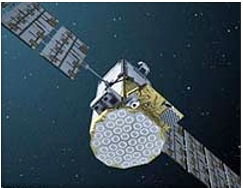
Galileo's Giove-A satellite. It remains operational and will still be maintained from SSTL's Mission Control Centre in Guildford, during which time SSTL will continue to collect data on the radiation environment in MEO

Surrey Satellite Technology Ltd (SSTL) has put the GIOVE-A satellite into retirement, ending a successful extended mission for the European Commission's Galileo satellite navigation programme under the supervision of the European Space Agency (ESA).

The first 'Galileo In-Orbit Validation Element', GIOVE-A, was launched on 28th December 2005 by Soyuz rocket from Baikonur in Kazakhstan, securing vital frequency filings with the International Telecommunications Union (ITU) on the 12th January 2006 that enabled the satellite navigation programme to proceed.

GIOVE-A was completed by SSTL within a record 29-month schedule from contract to launch for a budget of Euro 28m. Its original mission was extended, having already outlived its 27 month design life and been declared a full mission success by ESA in 2008.

The main objectives of the GIOVE-A mission were the on-board characterisation of a highly accurate prototype rubidium atomic clock, modeling the Medium Earth Orbit (MEO) radiation environment and the possible effects of radiation on future Galileo spacecraft, and of course the generation of the first Galileo navigation signals in space.

Those Galileo test signals from GIOVE-A have proved a very useful resource for manufacturers of Galileo receivers worldwide, allowing them to easily test their designs against a realistic version of the final Galileo navigation signal.

Now more than six years after launch, SSTL's operations team finally switched off the Galileo payload on 30th June.

The spacecraft has been manoeuvred about 100 kilometers higher than its operating orbit of 23,222 kilometers to make way for the first 22 Fully Operational Capability (FOC) satellites that are now being completed by OHB Technology and SSTL.

The satellite remains operational and will still be maintained from SSTL's Mission Control Centre in Guildford, during which time SSTL will continue to collect data on the radiation environment in MEO.

This document has been produced under funding of the European Union. The views expressed herein can in no way be taken to reflect the official opinion of the European Union and/or ESA.

The Full Operational Capability phase of the Galileo programme is managed and fully funded by the European Commission.

The Commission and ESA have signed a delegation agreement by which ESA acts as design and procurement agent on behalf of the Commission. "Galileo" is a trademark subject to OHIM application number 002742237 by EU and ESA.

Read more about GPS and satellite technology here