Showing posts with label Deimos. Show all posts

Tuesday, July 1, 2014

Merging galaxies illuminate the cosmic food chain

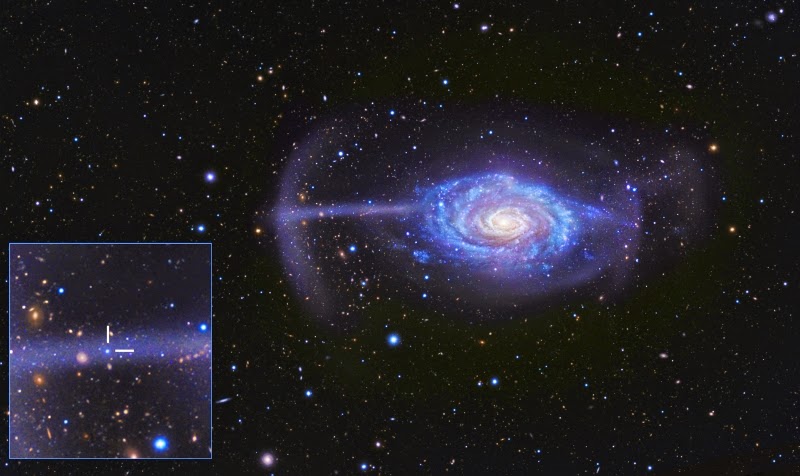
The Umbrella Galaxy (NGC 4651) takes its name from a mysterious feature seen on the left here, that is now found to be debris from a tiny galaxy, only a 50th its size, shredded apart by gravity. 

The image is a combination of data from the 0.5-meter BlackBird Remote Observatory Telescope and Suprime-Cam on the 8-meter Subaru Telescope. 

The inset shows a small cluster of stars embedded in the stream, which marks the center of the disrupted galaxy. 

Credit: R. JAY GABANY

Scientists studying a 'twin' of the Milky Way have used the W. M. Keck Observatory and Subaru Observatory to accurately model how it is swallowing another, smaller galaxy.

Their findings have opened the way to a better understanding of how structure forms in the universe and are being published in the Monthly Notices of the Royal Astronomical Society this week.

The work, led by Caroline Foster of the Australian Astronomical Observatory, has used the Umbrella Galaxy (NGC 4651) to reveal insights in galactic behaviour.

The Umbrella lies 62 million light-years away, in the northern constellation of Coma Berenices. Its faint parasol is composed of a stellar stream, thought to be the remnants of a smaller galaxy being pulled apart by the large galaxy's intense gravitational field. The Umbrella will eventually absorb this small galaxy completely.

The merging of small galaxies into larger ones is common throughout the universe, but because the shredded galaxies are so faint it has been hard to extract details in three-dimensions about how such mergers proceed.

Using the most powerful optical facilities in the world, the twin, 10-meter Keck Observatory and the 8-meter Subaru Observatory, near the summit of Mauna Kea, Foster and her collaborators have determined enough about the character of the merger to provide a detailed model of how and when it occurred.

In this three-dimensional, rotating computer model of the Umbrella Galaxy (NGC 4651), the disk of the main galaxy is shown by blue circles. 

The path of the dwarf galaxy through space is shown by a green curve. 

The white dots show stars that once belonged to the dwarf galaxy but have now been ripped off by tidal forces into a long stream of stars. 

Credit: N. SINGH/UCSC

After taking panoramic images of the Umbrella with Suprime-Cam on Subaru, the scientists used the DEIMOS instrument, installed on the Keck II telescope, to map out the motions of the stream and hence determine how the galaxy is being shredded.

The stars in the stream are incredibly faint, so it was necessary to use a proxy technique to measure the speeds of brighter tracer objects moving along with the stream stars.

These bright tracers include globular star clusters, planetary nebulae (dying stars that glow like neon lights), and patches of glowing hydrogen gas.

"This is important because our whole concept about what galaxies are and how they grow has not been fully verified," said co-author Aaron Romanowsky, an astronomer at both San José State University and University of California Observatories.

"We think they are constantly consuming smaller galaxies as part of a cosmic food chain, all pulled together by a mysterious form of invisible 'dark matter'.

When a galaxy is torn apart, we sometimes get a glimpse of the hidden vista because the stripping process lights it up. That's what occurred here."

"Through new techniques we have been able to measure the movements of the stars in the very distant, very faint, stellar stream in the Umbrella," Foster said.

"This allows us, for the first time, to reconstruct the history of the system."

"Being able to study streams this far away means that we can reconstruct the assembly histories of many more galaxies," Romanowsky said.

"In turn that means we can get a handle on how often these 'minor mergers,' thought to be an important way that galaxies grow, actually occur.

We can also map out the orbits of the stellar streams to test the pull of gravity for exotic effects, much like the Moon going around the Earth but without having to wait 300 million years for the orbit to complete."

The present work is a follow-up to a 2010 study, led by Dr. David Martínez-Delgado (University of Heidelberg), which used small robotic telescopes to image eight isolated spiral galaxies, and found the signs of mergers, shells, clouds and arcs of tidal debris, in six of them.

The W. M. Keck Observatory operates the largest, most scientifically productive telescopes on Earth.

The two, 10-meter optical/infrared telescopes on the summit of Mauna Kea on the Island of Hawaii feature a suite of advanced instruments including imagers, multi-object spectrographs, high-resolution spectrographs, integral-field spectroscopy and world-leading laser guide star adaptive optics systems.

DEIMOS (the DEep Imaging and Multi-Object Spectrograph) boasts the largest field of view (16.7 arcmin by 5 arcmin) of any of the Keck instruments, and the largest number of pixels (64 Mpix).

It is used primarily in its multi-object mode, obtaining simultaneous spectra of up to 130 galaxies or stars.

Astronomers study fields of distant galaxies with DEIMOS, efficiently probing the most distant corners of the universe with high sensitivity.

Wednesday, April 30, 2014

ESA: Phobos Occults

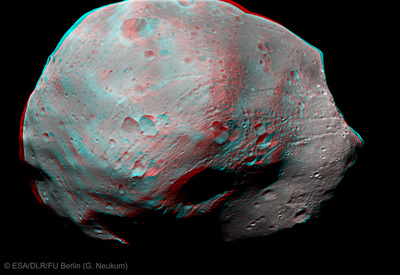
Credit: ESA/DLR/FU Berlin (G. Neukum)

Mars' moon Phobos has already been extensively observed – this image is just one example, taken in 2009 – so its occultation of ESA Mars Express on 28 April 2014 is not expected to yield dramatic discoveries.

But science lies in the smallest things – like obtaining a 'snapshot in time' of continuous change.

The occultation meant that, for a brief time, Phobos passed between ESA Mars Express and Earth, blocking the spacecraft's radio signal.

The break in the signal was small – about nine seconds – but the precise start and end times are valuable information.

These will allow scientists to calculate the orbit of Phobos with great precision – specifically the mean distance from Mars, which is notoriously difficult to pin down because Phobos' natural motion around the planet changes over time.

Phobos and sister moon Deimos are formidable scientific enigmas.

There is no confirmed theory of their origin that offers a satisfactory explanation for their current orbits and appearances.

They could be excellent targets for future robotic landings.

ESA experts analysed yesterday's data from the tracking station and found the occultation to have started just before 01:08:24 GMT, lasting until shortly before 01:08:33 GMT.

Now, we'll know the orbit of Phobos with just a little more precision, at least for a while.

Wednesday, April 23, 2014

How many moons does Venus have?

A radar view of Venus taken by the Magellan spacecraft, with some gaps filled in by the Pioneer Venus orbiter. 

Credit: NASA/JPL

There are dozens upon dozens of moons in the Solar System, ranging from airless worlds like Earth's Moon to those with an atmosphere (most notably, Saturn's Titan).

Jupiter and Saturn have many moons each, and even Mars has a couple of small asteroid-like ones.

But what about Venus, the planet that for a while, astronomers thought about as Earth's twin?

The answer is no moons at all. That's right, Venus (and the planet Mercury) are the only two planets that don't have a single natural moon orbiting them.

Figuring out why is one question keeping astronomers busy as they study the Solar System.

Phobos
Astronomers have three explanations about how planets get a moon or moons. Perhaps the moon was "captured" as it drifted by the planet, which is what some scientists think happened to Phobos and Deimos (near Mars).

Deimos
Maybe an object smashed into the planet and the fragments eventually coalesced into a moon, which is the leading theory for how Earth's Moon came together.

Or maybe moons arose from general accretion of matter as the solar system was formed, similar to how planets came together.

Considering the amount of stuff flying around the Solar System early in its history, it's quite surprising to some astronomers that Venus does not have a moon today. Perhaps, though, it had one in the distant past.

David Stevenson
In 2006, California Institute of Technology (CalTech) researchers Alex Alemi and David Stevenson presented at the American Astronomical Society's division of planetary sciences meeting and said Venus could have been smacked by a large rock at least twice.

"Most likely, Venus was slammed early on and gained a moon from the resulting debris."

"The satellite slowly spiraled away from the planet, due to tidal interactions, much the way our Moon is still slowly creeping away from Earth," Sky and Telescope wrote of the research.

"However, after only about 10 million years Venus suffered another tremendous blow, according to the models. The second impact was opposite from the first in that it 'reversed the planet's spin,' says Alemi."

"Venus's new direction of rotation caused the body of the planet to absorb the moon's orbital energy via tides, rather than adding to the moon's orbital energy as before."

"So the moon spiraled inward until it collided and merged with Venus in a dramatic, fatal encounter."

Venus as photographed by the Pioneer spacecraft in 1978. 

Some exoplanets may suffer the same fate as this scorched world. 

Credit: NASA/JPL/Caltech

There could be other explanations as well, however, which is part of why astronomers are so interested in revisiting this world.

Figuring out the answer could teach us more about the solar system's formation.

Thursday, August 15, 2013

Mars Curiosity Rover Captures 2 Mars Moons Together - NASA Video


A spectacular new video from NASA's Mars rover Curiosity shows the Red Planet's two tiny moons eclipsing each other in an otherworldly skywatching first.

Curiosity snapped 41 images of the Mars moons in the night sky on Aug. 1, with rover scientists then stitching them together to make the final 30-second video. It is the first time a view of the two Martian satellites — called Phobos and Deimos — eclipsing each other has been captured from the vantage point of the planet's surface, NASA officials said.

The new Curiosity video has plenty of scientific value in addition to its gee-whiz appeal, officials said. For example, researchers are studying the images to refine their knowledge of the orbits of Phobos and Deimos, both of which appear to be captured asteroids.

Mark Lemmon
"The ultimate goal is to improve orbit knowledge enough that we can improve the measurement of the tides Phobos raises on the Martian solid surface, giving knowledge of the Martian interior," Mark Lemmon of Texas A&M University said in a statement.

"We may also get data good enough to detect density variations within Phobos and to determine if Deimos' orbit is systematically changing," added Lemmon, who is a co-investigator for Curiosity's Mastcam instrument, which took the pictures using its telephoto lens.

Phobos' orbit is taking it closer to the surface of Mars very slowly, researchers said, while Deimos may gradually be getting farther and farther away from the planet.

Phobos is just 14 miles (22 kilometers) wide on average, while Deimos is even smaller. But Curiosity was able to spot both of them because they orbit quite close to the Red Planet's surface — 3,700 miles (6,000 km) in Phobos' case and 12,470 miles (20,070 km) for Deimos.

Earth's moon is gigantic compared to Phobos and Deimos, with a diameter of about 2,160 miles (3,475 km). But our planet's natural satellite orbits much farther away — its average distance is 239,000 miles (384,600 km) — so Phobos appears half as big in the sky to Curiosity as Earth's moon does to human skywatchers, NASA officials said.

This illustration provides a comparison for how big the moons of Mars appear to be, as seen from the surface of Mars, in relation to the size that Earth's moon appears to be when seen from the surface of Earth. 

Deimos, at far left, and Phobos, beside it, are shown together as they actually were photographed by the Mast Camera (Mastcam) NASA's Mars rover Curiosity on Aug. 1, 2013.

Credit: NASA/JPL-Caltech/Malin Space Science Systems/Texas A&M Univ.

Sunday, May 19, 2013

Field tests in Mojave Desert pave way for human exploration of Asteroids and Small Moons

Top Image: 538 meter-long Near Earth Asteroid (25143) Itokawa imaged by Japan’s Hayabusa spacecraft

The asteroid is likely a loosely consolidated rubble pile 

Credit: JAXA

Bottom Image: Similar scaled Asteroid Hill at the National Training Center, Fort Irwin, California, the site of the April 2013 NASA Mojave Field Test

Note the graduation of large blocks of rock, down to a small gravel surface. The rocks and debris here is primarily made of granite tors and debris. 

Credit: NASA

A team of researchers from the SETI Institute, the Mars Institute, NASA Ames Research Center, and the space robotics company Honeybee Robotics, has successfully completed a first series of field tests aimed at investigating how humans will explore and work on Near-Earth Asteroids (NEAs) and eventually the two moons of Mars, Phobos and Deimos.

From 13 to 15 April 2013, field experiments were conducted at the U.S. Army's National Training Center (NTC) at Fort Irwin, California, to evaluate geotechnical methods and systems that will enable humans to be productive explorers in the low gravity environment of small rocky bodies.

Sub-kilometer sized NEAs, Phobos, and Deimos are among destinations currently considered by NASA for future human missions into Deep Space.

Pascal Lee
"Human missions to Near-Earth Asteroids and to the moons of Mars present us with the exciting challenge of exploring planetary bodies with extremely low gravity" says Pascal Lee, planetary scientist at the SETI Institute and leader of the field test.

"The goal of our field test was to learn how to characterize the physical properties of small body surfaces, and to test ideas that might enable humans to more productively explore these low-gravity worlds."

Pascal Lee (SETI Institute and Mars Institute) (left) measures the bearing capacity of gravelly soil at Asteroid Hill, National Training Center, Fort Irwin, California, using a static cone penetrometer, while Kris Zacny (Honeybee Robotics) drives an anchor into the same material to evaluate the system’s design and performance.

These field tests will help design surface exploration systems optimized for the exploration of Near-Earth Asteroids, Phobos, and Deimos. 

Credit: First Canyon Media

Kris Zacny
The Mojave field test included three investigations:

  1. a study of whether conventional field tools commonly used to characterize the mechanical properties of soils on Earth are suitable for small bodies; 
  2. an evaluation of how different anchoring systems might allow robotic spacecraft and astronauts to remain bound to a low gravity body; 
  3. a study of how astronauts might conduct geological sampling on a small body while using anchors and tethers.

"It's important to analyze and understand how conventional civil engineering methods and systems perform in natural settings on Earth before adapting them to the exploration of small bodies" explains Kris Zacny, Director of planetary exploration robotics at Honeybee Robotics in Pasadena, California.

Honeybee Robotics is the company that developed the Rock Abrasion Tool (RAT) on NASA's Mars Exploration Rovers, Spirit and Opportunity, and the Sample Manipulation System (SMS) and Dust Removal Tool (DRT) on NASA's Mars Science Laboratory (MSL) rover, Curiosity.

Pascal Lee (SETI Institute and Mars Institute) (right) and Sgt Andre Pearson (U.S. Army, NTC) conduct “small body” geological sampling in simulated spacesuits while anchored and tethered on a steep boulder slope at Asteroid Hill, National Training Center, Fort Irwin, California. 

Credit: NASA

The Mojave field test was carried out on a small rocky hill at the NTC with many exposed blocks of weathered granite called tors. The site, now named "Asteroid Hill", is reminiscent of the blocky rock surface of Near-Earth Asteroid (25143) Itokawa, which was explored in 2005 by Japan's Hayabusa robotic spacecraft.

"While neither the composition of the rocks nor the gravity at Asteroid Hill are similar to what they are on NEAs, the relevance of the site resides in the similarity in terrain texture (gravel and block abundance and sizes), topography, and scale between Asteroid Hill and Itokawa" notes Lee.

Terry Fong
"This is an interesting analogue site for planning future NASA robotic and human asteroid exploration, as it not only resembles the surface of the only sub-kilometer NEA explored by spacecraft to date, Itokawa, but it is well supported logistically by the U.S. Army's National Training Center" said Terry Fong, Director of the Intelligent Robotics Group at NASA Ames Research Center.

Monday, August 20, 2012

ESA Mars Express Image: 3D Pictures of Phobos

Credit: ESA/DLR/FU
Some 135 years after its discovery, Mars’ largest moon Phobos is seen in fantastic detail – and in 3D – in an image taken by ESA’s Mars Express spacecraft as it passed just 100 km by.

This view is much different to the faint object that astronomer Asaph Hall would have just been able to make out as he observed the Red Planet through the United States Naval Observatory’s 66 cm telescope in 1877.

Through this telescope he discovered Mars’ smaller, outermost moon Deimos on 12 August and the larger, innermost moon Phobos on 18 August.

More than a century later later, spacecraft in orbit around Mars are studying Phobos in unprecedented detail.

In this image, a bite-sized chunk appears to be missing from the right edge of the irregular shaped moon – this is a side-on view of the rim of large impact crater Stickney, so-called after the maiden name of the discoverer’s wife.

Families of grooves appear to emanate from Stickney, carving channels across the approximately 27 km length of the moon.

Initially thought to be associated with the Stickney impact crater, one recent theory suggests that they were instead formed when Phobos passed through debris clouds thrown up from the surface of Mars by asteroid impacts onto the planet’s surface.

Orbiting Mars at just 6000 km from the planet’s surface, it is closer to its parent planet than any other known moon in our Solar System.

The moon’s proximity means that it hurtles around Mars faster than the planet rotates: for an observer on the surface of Mars, Phobos would appear to rise and set twice a day.

The moon’s orbit is decreasing and in some 50 million years time it will likely break up to form a debris ring around Mars, before colliding with the planet’s surface.

Monday, September 13, 2010

Don't Forget Deimos


Next year, Russia plans to launch a mission to Phobos, the largest moon of Mars. This spacecraft, called Phobos-Grunt, will be the first spacecraft to land on this moon, and also the first mission to return samples of Phobos to Earth.

Phobos is an interesting object, and it's been studied a lot by orbiting spacecraft. The moon is in a fairly low orbit around Mars, which makes it easy to see from spacecraft placed in orbit around Mars. Earlier this year, the Mars Express orbiter got close enough to feel its gravitational tug, allowing us to explore the mass and density of this world without even landing.

This upcoming mission to Phobos is the culmination of decades of close study of this strange, irregular moon, which could be a captured asteroid or an aggregation of rock that formed in Martian orbit.

But Phobos has a twin. It's the small moon of Deimos, which lurks in a much higher orbit. Deimos has also been photographed regularly, but it's still relatively unknown.

Let's size up the two moons for comparison. Phobos is roughly 28 kilometres long and 23 kilometres wide, extremely small for a planetary moon. Deimos comes in at 16 by 12 kilometres.

The size and shape of both moons are similar, which could suggest a common origin. But this is not necessarily the case.

Deimos is harder to explore because of its small size and its distant orbit, which places it a long way from most spacecraft that lurk around Mars. A Viking orbiter made a close approach in the 1970s, but the current orbiters around Mars can only observe from a fairly discreet distance.

Monday, December 14, 2009

ESA: Phobos and Deimos, Martian Moon Duo, in alignment

Phobos and Deimos raw (left panel) and processed images (right panel). Phobos rests in the foreground of the image with Deimos behind. Deimos was more than twice as far from the camera.
Credit: ESA/DLR/FU Berlin (G. Neukum).

For the very first time, the Martian moons Phobos and Deimos have been caught on camera together. ESA's Mars Express orbiter took these pioneering images last month. Apart from their 'wow' factor, these unique images will help the HRSC team validate and refine existing orbit models of the two moons.
The images were acquired with the Super Resolution Channel (SRC) of the High Resolution Stereo Camera (HRSC). The camera took 130 images of the moons on 5 November at 9:14 CET over period of 1.5 minutes at intervals of 1s, speeding up to 0.5-s intervals toward the end. The image resolution is 110 m/pixel for Phobos and 240 m/pixel for Deimos - Deimos was more than twice as far from the camera.

The Super Resolution Channel of the HRSC uses an additional lens, which has a very narrow field of view of just 0.5 degree, providing four times the resolution of the HRSC color stereo channel.

Phobos, the larger of the two moons, orbits closer to the Red Planet, circling it every 7 hours and 39 minutes. It travels faster relative to Mars than the Moon relative to Earth. It was 11,800 km from Mars Express when the images were taken. Deimos was 26,200 km away.

It is not often that both Martian moons are located directly in front of the camera, lined up one behind the other. The chance to image both moons together came on 5 November 2009 when the viewing geometry was especially favorable.

The plan to image both moons at once was years in the making and was made possible by the unique elliptical orbit of Mars Express, precise knowledge of the orbits of the planet, the moons and the spacecraft, as well as fortuitous viewing geometry, and perfect planning by the ESA and HRSC teams.

Exploration of Phobos: A Scientific Priority for Mars Express
In addition to producing high-resolution maps of the surface of Mars in color and in 3D, the exploration of Phobos is a scientific priority for the HRSC team. The potato-shaped, 27 × 22 × 18 km moon has already been photographed 127 times by the HRSC, improving our knowledge of the topography of the moon, and providing insight into its origins and development.

The moons of Mars still hold many mysteries. Phobos is made of dark material that does not reflect much light, and some scientists suspect it has a chemical composition similar to that of carbonaceous chondrite asteroids.

Phobos may also contain water ice, which could be an important resource for future Mars explorers. As missions like Mars Express continue to observe Phobos and Deimos, scientists hope to reveal more information about these unique satellites of Mars.