Showing posts with label W.M. Keck telescope. Show all posts

Tuesday, July 1, 2014

Merging galaxies illuminate the cosmic food chain

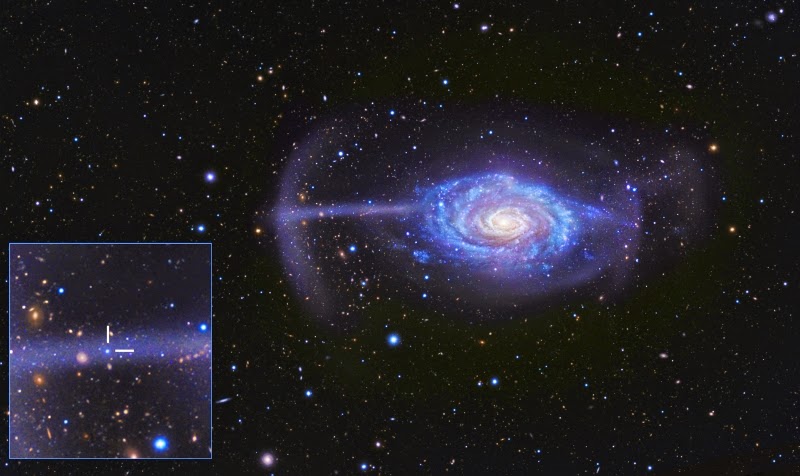
The Umbrella Galaxy (NGC 4651) takes its name from a mysterious feature seen on the left here, that is now found to be debris from a tiny galaxy, only a 50th its size, shredded apart by gravity. 

The image is a combination of data from the 0.5-meter BlackBird Remote Observatory Telescope and Suprime-Cam on the 8-meter Subaru Telescope. 

The inset shows a small cluster of stars embedded in the stream, which marks the center of the disrupted galaxy. 

Credit: R. JAY GABANY

Scientists studying a 'twin' of the Milky Way have used the W. M. Keck Observatory and Subaru Observatory to accurately model how it is swallowing another, smaller galaxy.

Their findings have opened the way to a better understanding of how structure forms in the universe and are being published in the Monthly Notices of the Royal Astronomical Society this week.

The work, led by Caroline Foster of the Australian Astronomical Observatory, has used the Umbrella Galaxy (NGC 4651) to reveal insights in galactic behaviour.

The Umbrella lies 62 million light-years away, in the northern constellation of Coma Berenices. Its faint parasol is composed of a stellar stream, thought to be the remnants of a smaller galaxy being pulled apart by the large galaxy's intense gravitational field. The Umbrella will eventually absorb this small galaxy completely.

The merging of small galaxies into larger ones is common throughout the universe, but because the shredded galaxies are so faint it has been hard to extract details in three-dimensions about how such mergers proceed.

Using the most powerful optical facilities in the world, the twin, 10-meter Keck Observatory and the 8-meter Subaru Observatory, near the summit of Mauna Kea, Foster and her collaborators have determined enough about the character of the merger to provide a detailed model of how and when it occurred.

In this three-dimensional, rotating computer model of the Umbrella Galaxy (NGC 4651), the disk of the main galaxy is shown by blue circles. 

The path of the dwarf galaxy through space is shown by a green curve. 

The white dots show stars that once belonged to the dwarf galaxy but have now been ripped off by tidal forces into a long stream of stars. 

Credit: N. SINGH/UCSC

After taking panoramic images of the Umbrella with Suprime-Cam on Subaru, the scientists used the DEIMOS instrument, installed on the Keck II telescope, to map out the motions of the stream and hence determine how the galaxy is being shredded.

The stars in the stream are incredibly faint, so it was necessary to use a proxy technique to measure the speeds of brighter tracer objects moving along with the stream stars.

These bright tracers include globular star clusters, planetary nebulae (dying stars that glow like neon lights), and patches of glowing hydrogen gas.

"This is important because our whole concept about what galaxies are and how they grow has not been fully verified," said co-author Aaron Romanowsky, an astronomer at both San José State University and University of California Observatories.

"We think they are constantly consuming smaller galaxies as part of a cosmic food chain, all pulled together by a mysterious form of invisible 'dark matter'.

When a galaxy is torn apart, we sometimes get a glimpse of the hidden vista because the stripping process lights it up. That's what occurred here."

"Through new techniques we have been able to measure the movements of the stars in the very distant, very faint, stellar stream in the Umbrella," Foster said.

"This allows us, for the first time, to reconstruct the history of the system."

"Being able to study streams this far away means that we can reconstruct the assembly histories of many more galaxies," Romanowsky said.

"In turn that means we can get a handle on how often these 'minor mergers,' thought to be an important way that galaxies grow, actually occur.

We can also map out the orbits of the stellar streams to test the pull of gravity for exotic effects, much like the Moon going around the Earth but without having to wait 300 million years for the orbit to complete."

The present work is a follow-up to a 2010 study, led by Dr. David Martínez-Delgado (University of Heidelberg), which used small robotic telescopes to image eight isolated spiral galaxies, and found the signs of mergers, shells, clouds and arcs of tidal debris, in six of them.

The W. M. Keck Observatory operates the largest, most scientifically productive telescopes on Earth.

The two, 10-meter optical/infrared telescopes on the summit of Mauna Kea on the Island of Hawaii feature a suite of advanced instruments including imagers, multi-object spectrographs, high-resolution spectrographs, integral-field spectroscopy and world-leading laser guide star adaptive optics systems.

DEIMOS (the DEep Imaging and Multi-Object Spectrograph) boasts the largest field of view (16.7 arcmin by 5 arcmin) of any of the Keck instruments, and the largest number of pixels (64 Mpix).

It is used primarily in its multi-object mode, obtaining simultaneous spectra of up to 130 galaxies or stars.

Astronomers study fields of distant galaxies with DEIMOS, efficiently probing the most distant corners of the universe with high sensitivity.

Tuesday, April 1, 2014

Young Star Clusters In the Circumnuclear Region of Black Hole

In this false-colour image combining several sets of observations, the visible light is in blues (Hubble Space telescope) showing swirls of stars; the observations from NRAO's Very Large Array (VLA) radio telescope are in green and aqua displaying a central emission with two jets, and the newly discovered clusters are in red in the middle. 

The black hole is represented by a dot to show the location – the black hole itself can't be seen.

Huge young star clusters resembling a string of pearls around a black hole in the centre of a galaxy 120 million light-years away have been discovered by researchers at Swinburne University of Technology.

The galaxy, called NGC2110, is in the constellation of Orion.

Using the giant Keck telescopes in Hawaii, the researchers, Professor Jeremy Mould and PhD student Mark Durré from Swinburne's Centre for Astrophysics and Supercomputing, found four star clusters, very close (in astronomical terms) to a black hole.

"These star clusters hadn't been seen before because they are hidden by dust clouds around the black hole and because they appear very tiny, but they can be observed in infrared radiation that penetrates the clouds," Mr Durré said.

"The Keck telescopes also uses 'adaptive optics', which removes the atmospheric shimmer that blurs images."

Supermassive black holes – condensations of matter so dense that not even light can escape from its gravity – are thought to be at the centre of all large galaxies.

"Our own galaxy, the Milky Way, has a black hole that is almost four million times the mass of our Sun," Mr Durré said. "NGC2110 has a black hole about 100 times bigger."

Mark Durré
The black hole produces huge amounts of energy that comes from gas and dust falling into it.

As the material streams in, it hits an accretion disk – a spinning ring of superheated gas around the black hole's equator.

Enormous quantities of radiation shine out and some of the matter also gets spewed out in jets, which are most clearly observed by radio telescopes.

Tides from the black hole and other features of the galaxy can help form star clusters – collections of thousands of stars which are all formed together from a gas and dust cloud.

In turn, gas out-streaming from the young stars in the clusters can feed and energise the black hole.

"The jets can compress gas around them to start this star cluster formation, but they can also stop the process by blowing the gas completely out of the galaxy."

"The fine details of how the matter is funnelled in and how the black hole affects the galaxy around it remain fascinating questions for astronomers as they try to work out how galaxies form."

Mr Durré said that according to computer simulations, star clusters should form like beads or pearls on a string in a ring around the black hole – and this is just what the researchers have observed.

"After many millions of years, these clusters will be torn apart, again by tidal forces, and gradually settle into a central collection closer around the black hole." Mr Durré said.

This research has been published in the Astrophysical Journal.

More information: "Young Star Clusters In The Circumnuclear Region Of NGC 2110." Mark Durré, Jeremy Mould. arXiv:1402.3339 [astro-ph.GA]

Wednesday, March 19, 2014

NRL Scientists detect water around a hot Jupiter

This is an artist's conception of a hot Jupiter extrasolar planet orbiting a star similar to tau Boötis. 

Credit: David Aguilar, CfA, Harvard-Smithsonian Center for Astrophysics

Scientists at the Naval Research Laboratory (NRL) are part of a research team that has detected water vapour in the atmosphere of a planet outside our solar system.

The team, including scientists from California Institute of Technology (CalTech)Harvard-Smithsonian Center for Astrophysics, Pennsylvania State University, and University of Arizona, applied a sophisticated Doppler technique to the infrared to directly detect the planet and demonstrate the presence of water in its atmosphere.

The discovery is described in the March 10, 2014 issue of The Astrophysical Journal Letters.

The planet, named tau Boo b, orbits the nearby star tau Boötis and belongs to a class of exotic planets called "hot Jupiters" that are not found in our solar system.

A hot Jupiter is a massive extrasolar planet that orbits very close to its parent star. Unlike our Jupiter, which is fairly cold and has an orbital period of about 12 years, tau Boo b orbits its star every 3.3 days and is heated to extreme temperatures by its proximity to the star.

Under these conditions, water will exist as a high temperature steam.

While hot Jupiters are found to be relatively common in the Galaxy, the origin and nature of these planets remain the subject of intense research.

The research team studied data collected at the W.M. Keck Observatory in Hawaii, using the Near Infrared Echelle Spectrograph instrument.

Because a hot Jupiter is too close to its star to separate the planet's light from that of the star, the researchers adapted a Doppler technique previously used to detect low mass-ratio spectroscopic binary stars.

Application of this method to tau Boo b, however, posed a huge challenge, because the infrared radiation from the star is more than 10,000 times greater than that of the planet.

The analysis software to extract this minute planetary signal was developed by Chad Bender, a Penn State member of the team, while he was a National Research Council Associate at NRL.

By comparing the molecular signature of water to the combined light spectrum of the planet and star, the scientists were able to measure the motion of the planet as it orbits the star and establish the presence of water vapour in the planet's atmosphere.

The team also determined that the planet is six times more massive than Jupiter.

This work is ongoing, with plans to further examine the physical properties and composition of this hot Jupiter's atmosphere.

The research team is also applying this technique to search for water and other molecules in several other hot Jupiter exoplanets.

More Information: The Astrophysical Journal Letters "Near-IR Direct Detection of Water Vapor in tau Boötis b."

Thursday, March 6, 2014

Astronomers witness mysterious and unique disintegration of asteroid

This series of Hubble Space Telescope images reveals the breakup of an asteroid over a period of several months in late 2013. 

The largest fragments are up to 200 yards in radius, each with "tails" caused by dust lifted from their surfaces and pushed back by the pressure of sunlight. 

The 10 pieces of the asteroid drift apart slowly and show a range of breakup times, suggesting that the disintegration cannot be explained by a collision with another asteroid. 

One idea for the breakup is that the asteroid was accelerated by sunlight to spin at a fast enough rate to fly apart by centrifugal force. 

The images were taken in visible light with Hubble's Wide-Field Camera 3

Credit: NASA, ESA, D. Jewitt/UCLA

Astronomers have witnessed for the first time the breakup of an asteroid into as many as 10 smaller pieces.

The discovery is published online March 6 in Astrophysical Journal Letters.

Though fragile comet nuclei have been seen falling apart as they near the sun, nothing resembling this type of breakup has been observed before in the asteroid belt. NASA's Hubble Space Telescope photographed the demolition.

"Seeing this rock fall apart before our eyes is pretty amazing," said David Jewitt, a professor in the UCLA Department of Earth, Planetary and Space Sciences and the UCLA Department of Physics and Astronomy, who led the astronomical forensics investigation.

The crumbling asteroid, designated P/2013 R3, was first noticed as an anomalous, fuzzy-looking object on Sept. 15, 2013, by the Catalina and Pan-STARRS sky-survey telescopes.

Pan-STARRS sky-survey telescope
A follow-up observation on Oct. 1 with the W.M. Keck telescope on Hawaii's Mauna Kea revealed three co-moving bodies embedded in a dusty envelope that is nearly the diameter of Earth.

"The Keck telescope showed us that this asteroid was worth looking at with Hubble," Jewitt said.

With its superior resolution, the Hubble telescope revealed that there were really 10 embedded objects, each with comet-like dust tails.

The four largest rocky fragments are up to 200 yards in radius, about twice the length of a football field.

The Hubble data showed that the fragments are drifting away from each other at a leisurely pace of one mile per hour—slower than a strolling human.

The asteroid began coming apart early last year, but new pieces continue to emerge in the most recent images.

This makes it unlikely that the asteroid is disintegrating because of a collision with another asteroid, which would be instantaneous and violent.

Some of the debris from such a high-velocity smash-up would also be expected to travel much faster than observed.