Showing posts with label Subaru Observatory. Show all posts

Tuesday, July 1, 2014

Merging galaxies illuminate the cosmic food chain

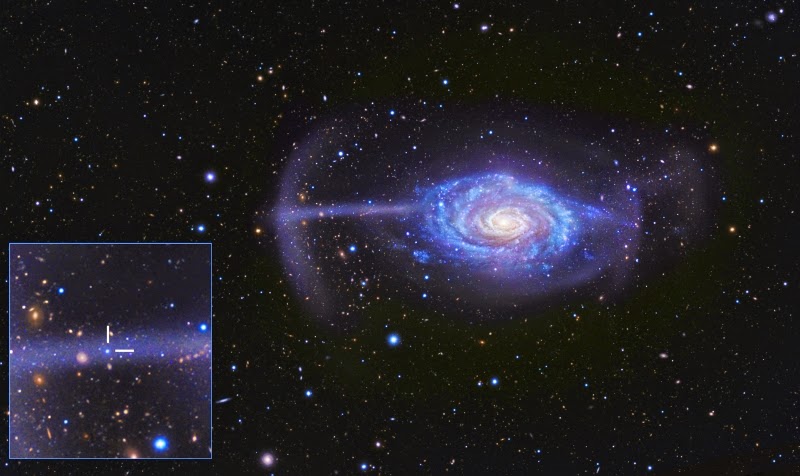
The Umbrella Galaxy (NGC 4651) takes its name from a mysterious feature seen on the left here, that is now found to be debris from a tiny galaxy, only a 50th its size, shredded apart by gravity. 

The image is a combination of data from the 0.5-meter BlackBird Remote Observatory Telescope and Suprime-Cam on the 8-meter Subaru Telescope. 

The inset shows a small cluster of stars embedded in the stream, which marks the center of the disrupted galaxy. 

Credit: R. JAY GABANY

Scientists studying a 'twin' of the Milky Way have used the W. M. Keck Observatory and Subaru Observatory to accurately model how it is swallowing another, smaller galaxy.

Their findings have opened the way to a better understanding of how structure forms in the universe and are being published in the Monthly Notices of the Royal Astronomical Society this week.

The work, led by Caroline Foster of the Australian Astronomical Observatory, has used the Umbrella Galaxy (NGC 4651) to reveal insights in galactic behaviour.

The Umbrella lies 62 million light-years away, in the northern constellation of Coma Berenices. Its faint parasol is composed of a stellar stream, thought to be the remnants of a smaller galaxy being pulled apart by the large galaxy's intense gravitational field. The Umbrella will eventually absorb this small galaxy completely.

The merging of small galaxies into larger ones is common throughout the universe, but because the shredded galaxies are so faint it has been hard to extract details in three-dimensions about how such mergers proceed.

Using the most powerful optical facilities in the world, the twin, 10-meter Keck Observatory and the 8-meter Subaru Observatory, near the summit of Mauna Kea, Foster and her collaborators have determined enough about the character of the merger to provide a detailed model of how and when it occurred.

In this three-dimensional, rotating computer model of the Umbrella Galaxy (NGC 4651), the disk of the main galaxy is shown by blue circles. 

The path of the dwarf galaxy through space is shown by a green curve. 

The white dots show stars that once belonged to the dwarf galaxy but have now been ripped off by tidal forces into a long stream of stars. 

Credit: N. SINGH/UCSC

After taking panoramic images of the Umbrella with Suprime-Cam on Subaru, the scientists used the DEIMOS instrument, installed on the Keck II telescope, to map out the motions of the stream and hence determine how the galaxy is being shredded.

The stars in the stream are incredibly faint, so it was necessary to use a proxy technique to measure the speeds of brighter tracer objects moving along with the stream stars.

These bright tracers include globular star clusters, planetary nebulae (dying stars that glow like neon lights), and patches of glowing hydrogen gas.

"This is important because our whole concept about what galaxies are and how they grow has not been fully verified," said co-author Aaron Romanowsky, an astronomer at both San José State University and University of California Observatories.

"We think they are constantly consuming smaller galaxies as part of a cosmic food chain, all pulled together by a mysterious form of invisible 'dark matter'.

When a galaxy is torn apart, we sometimes get a glimpse of the hidden vista because the stripping process lights it up. That's what occurred here."

"Through new techniques we have been able to measure the movements of the stars in the very distant, very faint, stellar stream in the Umbrella," Foster said.

"This allows us, for the first time, to reconstruct the history of the system."

"Being able to study streams this far away means that we can reconstruct the assembly histories of many more galaxies," Romanowsky said.

"In turn that means we can get a handle on how often these 'minor mergers,' thought to be an important way that galaxies grow, actually occur.

We can also map out the orbits of the stellar streams to test the pull of gravity for exotic effects, much like the Moon going around the Earth but without having to wait 300 million years for the orbit to complete."

The present work is a follow-up to a 2010 study, led by Dr. David Martínez-Delgado (University of Heidelberg), which used small robotic telescopes to image eight isolated spiral galaxies, and found the signs of mergers, shells, clouds and arcs of tidal debris, in six of them.

The W. M. Keck Observatory operates the largest, most scientifically productive telescopes on Earth.

The two, 10-meter optical/infrared telescopes on the summit of Mauna Kea on the Island of Hawaii feature a suite of advanced instruments including imagers, multi-object spectrographs, high-resolution spectrographs, integral-field spectroscopy and world-leading laser guide star adaptive optics systems.

DEIMOS (the DEep Imaging and Multi-Object Spectrograph) boasts the largest field of view (16.7 arcmin by 5 arcmin) of any of the Keck instruments, and the largest number of pixels (64 Mpix).

It is used primarily in its multi-object mode, obtaining simultaneous spectra of up to 130 galaxies or stars.

Astronomers study fields of distant galaxies with DEIMOS, efficiently probing the most distant corners of the universe with high sensitivity.

Thursday, May 8, 2014

NASA seeks Kuiper Belt Objects for New Horizon's post-Pluto mission

An artist’s conception of a KBO encounter by New Horizons. 

Credit: JHUAPL/SwRI.

Are you ready for the summer of 2015? A showdown of epic proportions is in the making, as NASA's New Horizons spacecraft is set to pass within 12,500 kilometres of Pluto, roughly a third of the distance of the ring of geosynchronous satellites orbiting the Earth, a little over a year from now on July 14th, 2015.

But another question is already being raised, one that's assuming center stage even before we explore Pluto and its retinue of moons: will New Horizons have another target available to study for its post-Pluto encounter out in the Kuiper Belt?

Researchers say time is of the essence to find it.

To be sure, it's a big solar system out there, and it's not that researchers haven't been looking.

New Horizons was launched from Cape Canaveral Air Force Station on January 19th, 2006 atop an Atlas V rocket flying in a 551 configuration in one of the fastest departures from Earth ever: it took New Horizons just nine hours to pass Earth's moon after launch.

The idea has always been out there to send New Horizons onward to explore and object beyond Pluto in the Kuiper Belt, but thus far, searches for a potential target have turned up naught.

A recent joint statement from NASA's Small Bodies and Outer Planets Assessment Groups (SBAG and OPAG) has emphasized the scientific priority needed for identifying a possible Kuiper Belt Object (KBO) for the New Horizons mission post-Pluto encounter.

The assessment notes that such a chance to check out a KBO up close may only come once in our lifetimes: even though it's currently moving at a heliocentric velocity of just under 15 kilometres a second, it will have taken New Horizons almost a decade to traverse the 32 A.U. distance to Pluto.

The report also highlights the fact that KBOs are expected to dynamically different from Pluto as well and worthy of study.

The statement also notes that the window may be closing to find such a favourable target after 2014, as the upcoming observational apparition of Pluto as seen from Earth, and the direction New Horizons is headed afterwards, reaches opposition this summer on July 4th.

But time is of the essence, as it will allow researchers to plan for a burn and trajectory change for New Horizons shortly after its encounter with Pluto and Charon using what little fuel it has left.

Then there's the issue of debris in the Pluto system that may require fine-tuning its trajectory pre-encounter as well.

New Horizons will begin long range operations later this year in November, switching on permanently for two years of operations pre-, during and post- encounter with Pluto.

New Horizons spends its last days on Earth pre-encapsulation. Credit: NASA/KSC

And there currently isn't a short-list of "next best thing" targets for New Horizons post-Pluto encounter.

One object, dubbed VNH0004, may be available for distant observations in January of next year, but even this object will only pass 75 million kilometres, about 0.5 A.U. from New Horizons at its closest.

Ground based assets such as the Keck, Subaru and Gemini observatories have been repeatedly employed in the search over the past three years.

The best hopes lie with the Hubble Space Telescope, which can go deeper and spy fainter targets.

Nor could New Horizons carry out a search for new targets on its own. Its eight inch (20 cm in diameter) LORRI instrument has a limiting magnitude of about +18, which is not even close to what would be required for such a discovery.

New Horizons currently has 130 metres/sec of hydrazine fuel available to send it onwards to a possible KBO encounter, limiting its range and maneuverability into a narrow cone straight ahead of the spacecraft.

This restricts the parameters for a potential encounter to 0.35 A.U. off of its nominal path for a target candidate be to still be viable objective.

New Horizons will exit the Kuiper Belt at around 55 A.U. from the Sun, and will probably end its days joining the Voyager missions probing the outer solar system environment.

Like Pioneers 10 and 11, Voyagers 1 and 2 and the upper stage boosters that deployed them, New Horizons will escape our solar system and orbit the Milky Way galaxy for millions of years.

We recently proposed a fun thought experiment concerning just how much extraterrestrial "space junk" might be out there, littering the galactic disk.