Showing posts with label InSIGHT. Show all posts

Friday, October 17, 2014

Geochemist: Helium and Lead isotopes provide insight into Earth's core

This map of the Samoan hotspot shows its division into three parallel volcanic lineaments. 

Credit: UCSB

A UC Santa Barbara geochemist studying Samoan volcanoes has found evidence of the planet's early formation still trapped inside the Earth.

Known as hotspots, volcanic island chains such as Samoa can ancient primordial signatures from the early solar system that have somehow survived billions of years.

Matthew Jackson, an associate professor in UCSB's Department of Earth Science, and colleagues utilized high-precision lead and helium isotope measurements to unravel the chemical composition and geometry of the deep mantle plume feeding Samoa's volcanoes.

Their findings appear today in the journal Nature.

In most cases, volcanoes are located at the point where two tectonic plates meet, and are created when those plates collide or diverge.

Hotspot volcanoes, however, are not located at plate boundaries but rather represent the anomalous melting in the interior of the plates.

Such intraplate volcanoes form above a plume-fed hotspot where the Earth's mantle is melting.

The plate moves over time, at approximately the rate human fingernails grow (3 inches a year), and eventually the volcano moves off the hotspot and becomes extinct.

Another volcano forms in its place over the hotspot and the process repeats itself until a string of volcanoes evolves.

"So you end up with this linear trend of age-progressive volcanoes," Jackson said. "On the Pacific plate, the youngest is in the east and as you go to the west, the volcanoes are older and more deeply eroded."

"Hawaii has two linear trends of volcanoes, most underwater, which are parallel to each other. There's a southern trend and a northern trend."

Because the volcanic composition of parallel Hawaiian trends is fundamentally different, Jackson and his team decided to look for evidence of this in other hotspots.

In Samoa, they found three volcanic trends exhibiting three different chemical configurations as well as a fourth group of a late-stage eruption on top of the third trend of volcanoes. These different groups exhibit distinct compositions.

"Our goal was to figure out how we could use this distribution of volcano compositions at the surface to reverse-engineer how these components are distributed inside this upwelling mantle plume at depth," Jackson said.

Each of the four distinct geochemical compositions, or endmembers, that the scientists identified in Samoan lavas contained low Helium-3 (He-3) and Helium-4 (He-4) ratios.

The surprising discovery was that they all exhibited evidence for mixing with a fifth, rare primordial component consisting of high levels of He-3 and He-4.

"We have really strong evidence that the bulk of the plume is made of the high Helium-3, -4 component," Jackson said.

"That tells us that most of this plume is primordial material and there are other materials hosted inside of this plume with low Helium-3, -4, and these are likely crustal materials sent into the mantle at ancient subduction zones."

The unique isotopic topology revealed by the researchers' analysis showed that the four low-helium endmembers do not mix efficiently with one another. However, each of them mixes with the high He-3 and He-4 component.

"This unique set of mixing relationships requires a specific geometry for the four geochemical flavors within the upwelling plume: They must be hosted within a matrix that is composed of the rare fifth component with high He-3," Jackson explained.

"This new constraint on plume structure has important implications for how deep mantle material is entrained in plumes, and it gives us the clearest picture yet for the chemical structure of an upwelling mantle plume."

More Information
Helium and lead isotopes reveal the geochemical geometry of the Samoan plume - M. G. Jackson, S. R. Hart, J. G. Konter, M. D. Kurz, J. Blusztajn & K. A. Farley Corresponding Author: Nature 514, 355–358 (16 October 2014) doi:10.1038/nature13794

Tuesday, May 20, 2014

NASA Mars lander InSight: Construction to begin on 2016

Credit: NASA

NASA and its international partners now have the go-ahead to begin construction on a new Mars lander, after it completed a successful Mission Critical Design Review on Friday.

NASA's Interior Exploration Using Seismic Investigations, Geodesy and Heat Transport (InSight) mission will pierce beneath the Martian surface to study its interior.

The mission will investigate how Earth-like planets formed and developed their layered inner structure of core, mantle and crust, and will collect information about those interior zones using instruments never before used on Mars.

InSight will launch from Vandenberg Air Force Base, on the central California coast near Lompoc, in March 2016. This will be the first interplanetary mission ever to launch from California.

The mission will help inform the agency's goal of sending a human mission to Mars in the 2030s.

InSight team leaders presented mission design results last week to a NASA review board, which then gave approval for advancing to the next stage of preparation.

"Our partners across the globe have made significant progress in getting to this point and are fully prepared to deliver their hardware to system integration starting this November, which is the next major milestone for the project," said Tom Hoffman, InSight project manager of NASA's Jet Propulsion Laboratory, Pasadena, California.

"We now move from doing the design and analysis to building and testing the hardware and software that will get us to Mars and collect the science that we need to achieve mission success."

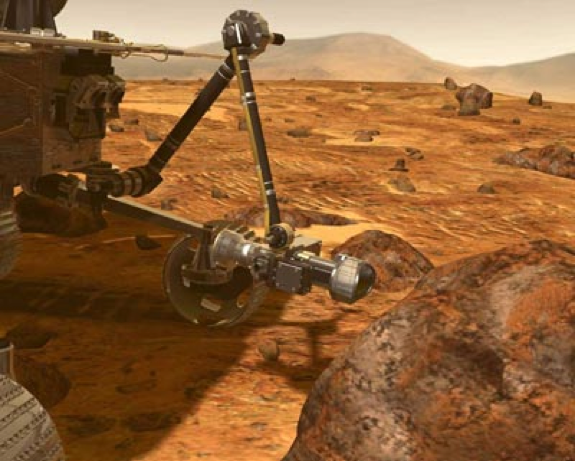
To investigate the planet's interior, the stationary lander will carry a robotic arm that will deploy surface and burrowing instruments contributed by France and Germany.

The national space agencies of France and Germany, Centre National d'Etudes Spatiales (CNES) and Deutsches Zentrum für Luft- und Raumfahrt (DLR), are partnering with NASA by providing InSight's two main science instruments.

The Seismic Experiment for Interior Structure (SEIS) will be built by CNES in partnership with DLR and the space agencies of Switzerland and the United Kingdom.

It will measure waves of ground motion carried through the interior of the planet, from "marsquakes" and meteor impacts.

The Heat Flow and Physical Properties Package, from DLR, will measure heat coming toward the surface from the planet's interior.

"Mars actually offers an advantage over Earth itself for understanding how habitable planetary surfaces can form," said Bruce Banerdt, InSight principal investigator from JPL.

"Both planets underwent the same early processes. But Mars, being smaller, cooled faster and became less active while Earth kept churning."

"So Mars better preserves the evidence about the early stages of rocky planets' development."

The three-legged lander will go to a site near the Martian equator and provide information for a planned mission length of 720 days, about two years.

InSight adapts a design from the successful NASA Phoenix Mars Lander, which examined ice and soil on far-northern Mars in 2008.

InSight will deploy two instruments to the ground using a robotic arm: 
  • a seismometer (contributed by the French space agency Centre National d'Etudes Spatiales, or CNES) to measure the microscopic ground motions from distant marsquakes, providing detailed information about the interior structure of Mars; and 
  • a heat-flow probe (contributed by the German Aerospace Center, or DLR) designed to hammer itself 3 to 5 meters (about 16 feet) deep and monitor heat coming from the planet's interior.

The mission will also track the lander's radio to measure wobbles in the planet's rotation that relate to the size of its core and will include a camera and a suite of environmental sensors to monitor the weather and variations in the magnetic field.

Lockheed Martin Space Systems, Denver, is building the spacecraft.

The following are shown in the annotated image:
  • Grapple – Mechanism at the end of the IDA that grips the instruments during deployment
  • Heat Flow Probe – Hammering mechanism that pulls the temperature sensors down into the regolith
  • HP3 – Heat Flow and Physical Properties Package, the heat flow experiment
  • IDC – Instrument Deployment Camera, pointable medium-resolution camera
  • IDA – Instrument Deployment Arm
  • ICC – Instrument Context Camera, fixed wide-angle camera
  • Pressure Inlet – Wind-shielded opening for pressure sensor
  • RISE Antenna – X-band radio antenna for the Rotation and Interior Structure Experiment
  • SEIS – Seismic Experiment for Interior Structure, the seismometer
  • Tethers – Cables carrying electrical power, commands and data between the lander and instruments
  • TWINS – Temperature and Winds for InSight, environmental sensors
  • UHF Antenna – Antenna used for communication with orbital relay spacecraft
  • WTS – Wind and Thermal Shield protecting the seismometer from the environment

Monday, April 29, 2013

Mars Mission May Carry Asteroid-Smashing Probe ISIS and Insight in 2016


Impactor for Surface and Interior Science (ISIS) nears asteroid target: 1999 RQ36.

CREDIT: Steve Chesley

When a NASA mission to study Mars' deep interior blasts off in 2016, it may also carry a tag-along experiment that will slam an impactor into a potentially hazardous asteroid.

Scientists are studying the possibility of adding the asteroid-deflection effort — dubbed Impactor for Surface and Interior Science (ISIS) — to NASA's InSight Mars mission, which is slated to launch a lander toward the Red Planet in March 2016.

Once set loose in space, ISIS is designed to slam into the asteroid target of the already-on-the-books NASA mission Osiris-Rex, which aims to launch a robotic probe toward potentially dangerous asteroid 1999 RQ36 in September 2016.

Hardware alignment
"This opportunity with a free launch and the observer spacecraft already at the asteroid is like a planetary alignment. It almost never happens," said Steven Chesley of the solar system dynamics group at NASA's Jet Propulsion Laboratory in Pasadena, Calif. who is leading the potential ISIS mission.

Chesley discussed ISIS here during the 2013 International Academy of Astronautics' Planetary Defense Conference, which ran from April 15 to 18.

SIS would take advantage of a boost into space from the InSight Mars lander mission in 2016.

CREDIT: Steve Chesley

NASA's Osiris-Rex mission has an amalgam of asteroid-studying duties, as the name suggests: Origins, Spectral Interpretation, Resource Identification, Security, Regolith Explorer.

The Osiris-Rex mission is a partnership involving the University of Arizona, NASA’s Goddard Space Flight Center and Lockheed Martin, with collaborators worldwide.

The Osiris-Rex spacecraft is scripted for travel to 1999 RQ36, a near-Earth carbonaceous asteroid.

The probe will rendezvous with that space rock in 2019-2021, gathering and returning specimens of the object for delivery to Earth in 2023.

The new plan being devised has ISIS arriving after Osiris-Rex has done its science work at the asteroid. ISIS would smack at high velocity into the near-Earth asteroid, creating a crater tens of meters in diameter.

Celestial wallop
From a safe vantage point, Osiris-Rex would observe the celestial wallop.

After debris clears, the probe would then approach the asteroid and image the crater for comparative analysis of previously mapped terrain. In addition, spectra of the pristine material exposed by the impact could be obtained.

The purposeful crash of ISIS into the asteroid is viewed, in part, as a seismic experiment. Global alterations (toppled rocks, landslides) due to shock waves and reverberations are anticipated, as is lofting of material far from the impact site. Just how much the asteroid is deflected from its course will also be measured.

The outcome of the ISIS impact, and the data it generates, are meant to showcase planetary defense aspects of an asteroid deflection experiment, like demonstrating terminal guidance capability.

ISIS also spotlights important science return per dollar, advocates say.

On the exploration side, ISIS squarely addresses numerous critical and strategic knowledge gaps for human exploration of near-Earth asteroids, Chesley told conference attendees.

Wednesday, August 22, 2012

DLR Mars InSight: HP3-Experiment uses German Drill technology - YouTube

After the successful landing of the Mars Science Laboratory rover Curiosity by NASA has approved a further landing mission on Mars.

The InSight mission will be ready in 2016 and will arrive after a six-month flight to Mars. With InSight there should be a number of geophysical experiments to take a look at the interior of the Red Planet, including the German Aerospace Center (DLR) developed experiment HP3, which will penetrate several meters into the Martian soil.

This experiment make heat flow measurements make and investigate the thermo-mechanical properties of the Martian soil. InSight is a mnemonic for 'Interior Exploration using Seismic investigations, geodesy and heat transport'.

The mission name shows that this mission is primarily focussed on geophysical experiments which are conducted on and under the surface of Mars, for example, by measuring the velocity of seismic waves or the flow of heat.

The aim of the mission is to understand the structure and condition of the core and cladding, and the thermal evolution of Mars.

The InSight HP3 experiment was developed at DLR. HP3 "Heat Flow and Physical Property Package".

For more information: s.dlr.de/vmu5

Monday, August 20, 2012

NASA InSIGHT: Second Robotic Rover drill to land on Mars in 2016

In the wake of successfully dropping the SUV-sized Curiosity rover on Mars this month, NASA will send another robot to the Red Planet in 2016 to drill into the planet’s crust and, for the first time, piece together a picture of the Martian interior.

The $425 million robotic lander, named InSIGHT, will be built and operated by the Jet Propulsion Laboratory at the California Institute of Technology, the high-flying hotbed of now-famous engineers and scientists who designed and assembled the $2.5 billion Curiosity rover and its heart-stopping “sky crane,” which lowered the Curiosity rover to the Martian surface.

Mars Atmosphere and Volatile Evolution Mission (MAVEN)

Credit: NASA/Goddard Space Flight Center artist's concept

On Monday morning, NASA officials informed JPL staff that InSIGHT had won funding over two other proposed missions.

“This is another big day for us out at JPL,” said Gregg Vane, the lab’s head of planning for solar system exploration.

Whereas Curiosity can roam the surface on six-wheels, InSIGHT will be planted in one spot after dropping onto the Martian surface — minus the sky crane — in September 2016.

A German-built drill nick-named “the mole” will pound 30 feet into the Martian crust to take the temperature of the planet, while a sensitive French-built seismometer will detect any Marsquakes.

Together, the instruments will provide vital clues to how Mars formed.

“We’ll be able to deduce the deep structure of Mars, which now is a total mystery,” said Vane. “That means all the way down to the core.”

To date, scientists have determined the deep structure of only one planet — Earth.

They know the interior of Mars must be different, because Mars has no magnetic field to shield its surface from radiation. Earth, by contrast, has a strong magnetic field generated by a spinning molten iron core.

Except for the drill and seismometer, which are new, InSIGHT will be a near-copy of the Phoenix lander NASA dropped onto Mars in 2008, which found water ice near the Martian north pole.

In choosing InSIGHT, NASA rejected two riskier missions: a robotic boat that would have floated on a methane lake on Saturn’s moon Titan, and a mission to examine a comet.

Meanwhile, Curiosity has begun shooting its laser “ChemCam” on Mars, blasting a rock Sunday in a successful test of the instrument, which can determine the composition of surface minerals by examining flashes of vaporized gas.