Showing posts with label Risk. Show all posts

Wednesday, October 22, 2014

Researchers construct a model of impact for El Nino / La Nina events

The 1997 El Nino seen by TOPEX/Poseidon

Credit: NASA

A small team made up of researchers from the U.S. and Europe has constructed a model that helps map parts of the world that are most at risk of flooding due to El Niño/La Niña events.

In their paper published in Proceedings of the National Academy of Sciences, the team describes how they compared weather data over the past half century with economic impacts of actual floods to create a model that may soon be used to help predict flooding events in the future.

By now, most everyone has heard about El Niño/La Niña weather events, El Niño is where warm water west of South America causes more rain to fall in some places.

La Niña is where the same waters are cooler than normal resulting in different changes to rain patterns.

Perhaps less well known is that such events have a worldwide impact, causing more flooding than normal in some parts of the world and less in others.

Ofen the flooding results in damage to property and loss of life, thus it would be a good thing if forecasts could be made, warning people in areas most at risk.

Unfortunately, up till now, such forecasts have not been available because such events don't always cause the same types of flooding in the same places.

In this new effort, the researchers sought to provide a model for building such a forecasting ability by using data over a long period of time.

"El Niño Southern Oscillation (ENSO) is the most dominant interannual signal of climate variability and has a strong influence on climate over large parts of the world."

"In turn, it strongly influences many natural hazards (such as hurricanes and droughts) and their resulting socioeconomic impacts, including economic damage and loss of life."

"However, although ENSO is known to influence hydrology in many regions of the world, little is known about its influence on the socioeconomic impacts of floods (i.e., flood risk)."

The research team obtained weather data for the years 1959 to 2000, pulling out periods of El Niño/La Niña weather events which they then compared with reports of damage due to flooding.

Next they compared those results with flood reports during normal times and used what they found to create a model.

The model showed that during El Niño events, 34 percent of the Earth's surface had higher or lower than normal amounts of flooding, that number jumped to 38 percent for La Niña weather events.

The model also showed which parts of the planet are more susceptible on average, to flooding due to such events.

The Southwest in the U.S. for example and parts of South America, both experience more flooding during El Niño events, while places like the Sahel in Africa, and most of Australia experience less.

The research team acknowledges that their model is still in its infancy but believe that over time, as more research is conducted, it will improve to the point that it will be useful in helping areas prepare for flooding during El Niño/La Niña weather events.

More information: Strong influence of El Niño Southern Oscillation on flood risk around the world, PNAS, Philip J. Ward, DOI: 10.1073/pnas.1409822111

Tuesday, May 6, 2014

Stephen Hawking: Threat to Humanity - Artificial Intelligence and Smart Weapon Systems

Stephen Hawking, in an article inspired by the new Johnny Depp flick Transcendence, said it would be the "worst mistake in history" to dismiss the threat of artificial intelligence.

In a paper he co-wrote with University at California, Berkeley computer-science professor Stuart Russell, and Massachusetts Institute of Technology physics professors Max Tegmark and Frank Wilczek, Hawking cited several achievements in the field of artificial intelligence, including self-driving cars, Siri and the computer that won the US game show Jeopardy!

"Such achievements will probably pale against what the coming decades will bring," the article in Britain's Independent said.

"Success in creating AI would be the biggest event in human history," the article continued. "Unfortunately, it might also be the last, unless we learn how to avoid the risks."

The professors wrote that in the future there may be nothing to prevent machines with superhuman intelligence from self-improving, triggering a so-called "singularity."

"One can imagine such technology outsmarting financial markets, out-inventing human researchers, out-manipulating human leaders, and developing weapons we cannot even understand."

"Whereas the short-term impact of AI depends on who controls it, the long-term impact depends on whether it can be controlled at all," the article said.

"Although we are facing potentially the best or worst thing to happen to humanity in history, little serious research is devoted to these issues outside non-profit institutes such as the Cambridge Centre for the Study of Existential Risk, the Future of Humanity Institute, the Machine Intelligence Research Institute, and the Future of Life Institute."

"All of us should ask ourselves what we can do now to improve the chances of reaping the benefits and avoiding the risks."

Tuesday, April 8, 2014

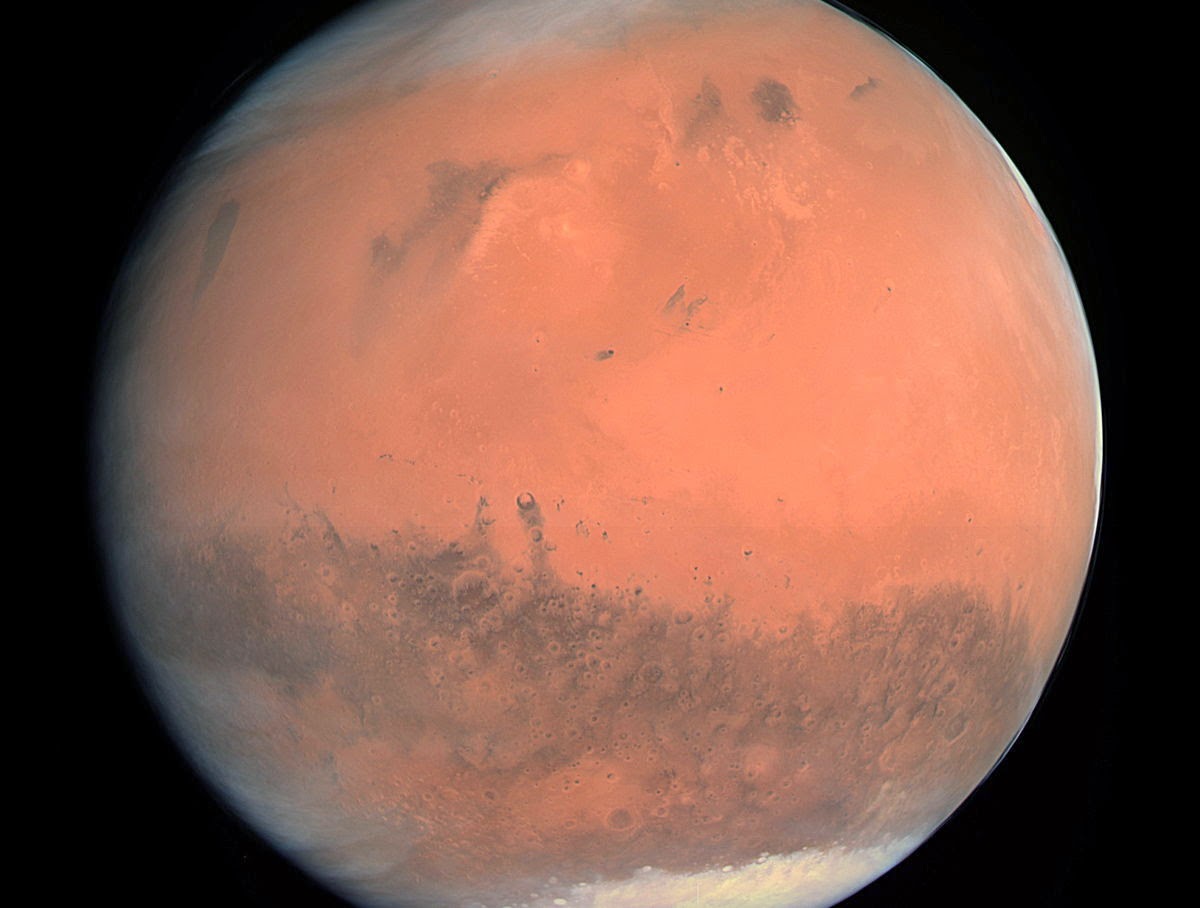
Mars Mission 'Risk': Astronauts may suffer Vision Damage

A manned mission to Mars could feasibly launch sometime in the 2030s, according to a panel of experts.

Credit: ESA

Mars may possess a stark and austere beauty, but a manned Red Planet mission will likely not be easy on the eyes.

Recently, scientists have begun realizing that spaceflight can cause serious and perhaps permanent vision problems in astronauts.

NASA researchers are working hard to understand the issue, which could present a major hurdle to mounting manned missions to Mars and other faraway destinations.

"This is one that we don't yet have a good handle on, and it can be a showstopper," Mark Shelhamer, chief scientist for the NASA Human Research Program at Johnson Space Center in Houston, said last week during a presentation with the agency's Future In-Space Operations (FISO) working group.


The human body suffers in the microgravity environment of space. For example, without effective countermeasures — i.e., vigorous weight-bearing exercise — astronauts' muscles atrophy and their bones shed calcium, becoming more and more brittle over time.

Spaceflight can also affect the eyes. Researchers have known this for decades, but they're just now beginning to appreciate the gravity of the situation.

"Over the last 40 years there have been reports of visual acuity impairments associated with spaceflight through testing and anecdotal reports," a 2012 NASA report about spaceflight-related vision problems states.

"Until recently, these changes were thought to be transient, but a comparison of pre- and postflight ocular measures have identified a potential risk of permanent visual changes as a result of microgravity exposure."

Monday, November 25, 2013

Are We Alone in the Universe - Paul Davies examines the risk or odds

Paul Davies
Recent research suggests that there may be as many as 40 billion habitable planets in our galaxy. 

A number that large has some scientists speculating that the universe might be teeming with life.

Before we eagerly set out to find our interstellar brethren, ASU cosmologist and author Paul Davies says we need to take a hard look at the odds of life elsewhere.

Thanks to Charles Darwin, we know a lot about how life evolved on Earth, but we know very little about how it first arose on this once sterile planet. 

Current thinking assumes there had to be the right chemicals and the right environmental conditions to set up a series of reactions that somehow led to the most basic of life forms.

According to Davies, the actual odds of the right chemical and environmental conditions coming together on a habitable planet at the right times to trigger an unlikely series of events are completely unknown because we don't know what those reactions and conditions were. 

The odds might indeed turn out to be favorable, as many scientists intuitively feel. But, on the other hand, they might equally well be very slim; indeed, less than, say, one in a trillion trillion. 

In our present state of ignorance, we simply cannot say, Davies adds.

"Set against a number that big – and once you decide a series of unlikely accidents is behind the creation of life, you get enormous odds very easily – it is irrelevant whether the Milky Way contains 40 billion habitable planets or just a handful," he writes in "Are we alone in the Universe?" in the Nov. 19 New York Times

"Forty billion makes hardly a dent in a trillion trillion."

Wednesday, April 3, 2013

European Space Agency (ESA) readies for solar storm risks

This January 23, 2012 image provided by NASA SDO shows a solar flare erupting on the Sun's northeastern hemisphere. 

Europe has launched its first space weather coordination centre to raise the alarm for possible satellite-sizzling solar storms that also threaten astronauts in orbit, plane passengers and electricity grids on Earth.

Though impossible to predict, a worst-case scenario mega-storm can happen at any time, leaving the world without Internet, telephones, television, electricity and air and rail transport for days on end.

Limited precautions can be taken, but early warning is key, say experts at the European Space Agency (ESA) which runs the centre from Brussels.

Juha-Pekka Luntama
"A pilot can always land a plane... because they have alternatives (to satellites) for navigation, but if they get the disturbance without warning, at the wrong time, that can be dangerous," Juha-Pekka Luntama, head of ESA's space weather division told AFP at the launch.

Even a slight satellite glitch can put navigation out by 100 metres (yards)—enough to miss a runway.

Earth's atmosphere and magnetosphere protect the planet from radiation released during solar flares and geomagnetic storms—some of the most severe forms of space weather.

Smaller eruptions usually have little noticeable effect—perhaps slight problems with car navigation systems or mobile phones but a major solar storm on the scale of an event in 1859 that crippled global telegraph systems could have severe impacts today.

A "coronal mass ejection"—which sends electromagnetic radiation flying towards Earth at a speed of some 2,500 kilometres (1,500 miles) per second and plays havoc with long transmission lines— caused surges on telegraph lines so strong in 1859 that offices caught fire and operators received electric shocks.

Such super storms happen "only very occasionally, perhaps once or twice a century," according to ESA's human spaceflight director Thomas Reiter.

Luntama added that the most severe storms statistically happen around the solar maximum—a period of greatest activity in the 11-year solar cycle—where we are now.

"In some ways you can say that the next two years is the time period that a solar event is more likely," he said.

An 1859-like storm today could claim about 50 to 100 satellites—10 percent of the total in orbit, at a cost of billions of euros, according to ESA but probably the biggest threat to Earth lies in electric power grid surges.

"In the worst case, what could happen is that the transformers in the power grid are damaged and in that case, replacement of the transformers can take weeks or months," said Luntama.

Even if only a small part of the grid is damaged, overloading in neighbouring systems can lead to more blackouts that spread domino-like, such as the nine-hour power blackout in Quebec in Canada in 1989.

Astronauts orbiting Earth on the International Space Station (ISS), closer to the source of the radiation, could be at high risk of a severe solar storm, as could plane crews and passengers flying over the polar regions.

Precautions would include turning off satellites to lessen the risk, reducing the load on power grids, astronauts taking cover in well-shielded part of the ISS, and planes being diverted or even grounded if communications become unreliable.

Once witnessed by space weather watchers, the fallout from a solar storm takes between 17 and 48 hours to reach Earth, depending on its severity.

The coordination centre, a central point for space weather enquiries, will draw on the expertise of dozens of European universities, research institutions and private companies.

A similar service already exists in the United States. For the moment, the ESA service—funded by 14 member states— is free.

The centre started operating six months ago and is expected to be fully operational by 2020—part of wider, multi-billion euro ESA system that also tracks objects in space that pose a collision threat.

Tuesday, September 20, 2011

Arctic Airships carry Cargo

Airships may soon soar in the cold skies of northern Canada and Alaska, bringing supplies to remote mining communities where planes can't always fly and roads are cost-prohibitive.

British airship manufacturer Hybrid Air Vehicles has announced a major contract with Canada's Discovery Air Innovations to build airships capable of lifting as much as 50 tons, delivering freight at one-quarter the cost of other alternatives.

Though various militaries have expressed interest in airships, this is HAV's first commercial contract. The first ship is expected by 2014.

While the word "airship" may conjure images of prewar zeppelins and Goodyear advertisements, the aircraft are quite useful for carrying cargo to remote locations, because they have greater payload flexibility than airplanes or trucks. They're often cheaper to operate, too.


"If you look at the mining operations in the North, the traditional way of opening a mine is to build a road to it.

That's very expensive and time consuming," said Barry Prentice, a professor of supply chain management at the University of Manitoba. He builds, tests and studies airships.

Prentice estimated the cost of a road to a gold mine in Baker Lake, Nunavut, at $110 million - an amount not easily recovered if the mine shuts down - and said obtaining the permits to build it can take as long as three years.

"The day after your mine is finished, the road has no value whatsoever," he said. "The idea of being able to use an airship to bring the product back out means you could start your operations sooner, and have the flexibility, if mineral prices turn, to cease operations temporarily."

Prentice is working on cold-weather testing of smaller airships, the kind that may be able to carry supplies to existing Arctic communities.

"For a mining operation, you need something that's really muscle-bound," he said. "But if you're taking goods into a remote community, that's actually too big," he said.


It's a renaissance for the airship, though today's craft bear little resemblance to the hydrogen-filled, metal-framed behemoths of the 1920s and '30s.

New ships have rigid envelopes that eliminate the need for a frame, and they are filled with nonflammable helium.

Hybrid aircraft can even be heavier than air, taking off like a conventional airplane and landing softly like a hovercraft.

"They're almost nothing like the ones that have been produced in the past," Prentice said.

Though modern airships are novel, the technology on board is hardly cutting-edge.

"What we are seeing today could've been done any time within the past 25 years," Prentice said. "The technology has been around that long. The problem has been a lack of business confidence."

Wary of the unusual technology, few businesses have wanted to take the risk of building hangars and training pilots. The public sector hasn't stepped up to the plate, either.

"Truck drivers don't build their own roads, and airlines don't build airports," Prentice said.

"This is a role where the public should come in - setting up mooring masts, locating zones for the airships to land in."

According to Prentice, military interest in using airships as unmanned surveillance drones and cargo-lifters has jump-started civilian curiosity. When military users prove airships' utility in difficult environments, he expects commercial demand to increase.

"Once airships are back in the skies again, there's going to be quite a stampede of people saying, ‘Me too,'" he said.

Friday, May 14, 2010

NASA Shuttle Atlantis Astronauts Risk Damage to Immune system

Astronauts are known to have a higher risk of getting sick compared to their Earth-bound peers.

The stresses that go with weightlessness, confined crew quarters, being away from family and friends and a busy work schedule - all the while not getting enough sleep - are known to wreak havoc on the immune system.

A research group led by immunobiologist Ty Lebsack at the University of Arizona has discovered that spaceflight changes the activity of genes controlling immune and stress response, perhaps leading to more sickness.

Between spaceflight affecting a crew's susceptibility to infections and previous observations of sickness-causing microbes thriving in a near-zero gravity environment, long journeys to far-away destinations such as Mars pose a big challenge to manned space missions.

"Taken together, our results hint at the possibility that an astronaut's immune system might be compromised in space," said Lebsack of the UA's department of immunobiology in the College of Medicine.

Lebsack and his colleagues focused their study on the thymus gland, the organ that serves as a "factory" and "training academy" for T-cells that are key players of the immune system.

They compared gene-expression patterns in thymuses from four healthy mice that had spent 13 days aboard NASA's STS-118 Endeavor Space Shuttle to those from an equal number of control mice on the ground.

Their finding: 970 individual genes in the thymus of space-flown mice were up or down-regulated by a 1.5 fold change or greater. When these changes were averaged, 12 genes in the thymus tissue of all four space-flown mice were significantly up or down-regulated.

"The altered genes we observed were found to primarily affect signaling molecules that play roles in programmed cell death and regulate how the body responds to stress," Lebsack said.

Programmed cell death plays an important role in a functioning body, for example in the disposal of cells that are no longer needed or damaged beyond repair. However, cell death must be tightly regulated in the immune system to ensure the process does not get out of hand.

"Many of the genes whose activity was down-regulated in the space-flown mice play important roles in maintaining that balance," Lebsack said. "Potentially, you could get more cell death aboard a spacecraft because of these differences."

The results fit in with experiments carried out on the ground to study how microgravity affects immune cells. In these experiments, scientists mimicked weightlessness using clinostats - apparatuses that slowly rotate the study object so the Earth's gravitational pull is never perceived as coming from one consistent direction.

"Previous studies with cell cultures in clinostats showed increased cell death in T-cells when you take away the gravity stimulus," said Lebsack, "so it was a logical step to test whether we find the same effects in animals exposed to an actual lack of gravity."

"We observed an overall pattern about the genes whose expression was changed by space flight: All of them are involved, in one way or another, in the development, control and programmed cell death of immune cells."

This study represents the first use of microarray technology to investigate gene expression in thymus tissue of space-flown mice, according to the authors. Complex research undertakings like this require specialists combining their different areas of expertise.

The research was funded by NASA, and will be published in the May 15 issue of the Journal of Cellular Biochemistry.

Link: http://uanews.org

Wednesday, May 5, 2010

Spouses of dementia sufferers have a 6-fold increased risk of dementia onset | ScienceBlog.com

Spouses of dementia sufferers have a 6-fold increased risk of dementia onset ScienceBlog.com

Older married adults whose spouse has dementia are at significantly higher risk for developing dementia themselves, compared to similar older married adults whose spouse never develops dementia. This is the key finding of a study published today in the Journal of the American Geriatrics Society.

Informal dementia caregiving for a spouse is a natural marital obligation, and spousal caregivers often report positive feelings toward caregiving, yet it is difficult, requiring time, energy and usually physical exertion.

Dementia caregivers have been shown to provide more assistance, and to report more personal sacrifices and stress, than those who care for physically-impaired elderly without dementia.

While there are many published studies showing that dementia caregivers are at higher risk for health problems and depression, none have examined risk for dementia in the caregiver.

2,442 subjects (1,221 married couples) aged 65 and older from Northern Utah, USA, without dementia at onset were studied for up to 12 years to monitor for onset of dementia in husbands, wives or both. During this time, 125 cases of dementia only in the husband were diagnosed, 70 only in the wife, and 30 where both spouses were diagnosed (60 people).

The researchers, led by Dr. Maria Norton of Utah State University, USA, adjusted for socioeconomic status, a significant predictor of many health-related outcomes including dementia to control for shared environmental exposures that might influence risk for dementia in both spouses.

The results showed that incident dementia was significantly associated with older age, and having a spouse with dementia. Participants with a spouse who developed dementia were at a six times increased risk of developing dementia, net of the effect of age, gender, APOE genotype, and socioeconomic status, with higher risk in men (11.9) than women (3.7).

"Future studies are needed to determine how much of this association is due to caregiver stress compared to a shared environment," said Norton. "On the positive side, the majority of these individuals, with spouses who develop dementia, did not themselves develop dementia, therefore more research is needed to explore which factors distinguish those who are more vulnerable."

"Given the significant public health concern of Alzheimer's disease and other dementias, and the upcoming shift in population age composition, continued research into the causes of dementia is urgent," concluded Norton.

Link: http://www.wiley.com/wiley-blackwell

Saturday, January 9, 2010

Podcast: Richard Bradley on Risk based behaviour and Decision making theory

Zoeken philosophybites UPC

Podcast by Richard Bradley on Risk based behaviour and Decision making theory - This discussion, hosted by Philosopy Bites, draws somewhat from the tragic figure of UK polymath Frank Ramsey

Thursday, October 8, 2009

Mediterranean Diet - Lowers Risk of Depression

People who eat a Mediterranean diet rich in fruit, vegetables and cereals may be less likely to develop depression, Spanish researchers have found.

The prevalence of mental disorders is lower in Mediterranean countries than in countries in Northern Europe. Dietary differences, such as use of olive oil, may be the reason, the researchers said.


To find out more, Almudena Sánchez-Villegas and colleagues at the clinic of the University of Navarra, in Pamplona, studied 10,094 healthy Spaniards who filled in questionnaires. Participants were followed for an average of 4½ years.

Those who followed the Mediterranean diet most closely had a more than 30 per cent reduction in risk of depression compared with those who ate diets with the fewest hallmarks of the Mediterranean diet, the team reported in the October issue of Archives of General Psychiatry.

Fruits, nuts, legumes linked
Other factors such as marital status, number of children and factors associated with a healthy diet, as well as personality traits such as anxiety were taken into account.

Over the study period, 480 new cases of depression were identified — 156 in men and 324 in women.

"The specific mechanisms by which a better adherence to the Mediterranean dietary pattern could help to prevent the occurrence of depression are not well known," the study's authors concluded.

They speculated that elements of the diet or the combination of foods may improve blood vessel function, fight inflammation and reduce oxygen-related cell damage to reduce the risk of developing depression.

The Mediterranean diet includes nine features, including:

•A high intake of monounsaturated fatty acids such as olive oil.
•A moderate intake of alcohol and dairy products.
•A low intake of meat.
•A high intake of legumes, fruit and nuts, cereals, vegetables and fish.
In particular, people who ate the most fruits, nuts and legumes showed the lowest risks for depression.

Participants who had a strong adherence to the diet tended to be more physically active, male, former smokers, married and older.

Last year, Dutch researchers suggested depression in older people may be linked to low levels of Vitamin D, which is obtained from sun exposure.

Cabriolet & Convertibles - Men Drivers at Risk of Hearing Loss

A study of more than 5,000 people in the United States aged 20 to 69 found that males were three times as likely to have noise-related hearing loss as women. The research was recently presented at the annual meeting of the American Academy of Otolaryngology -- Head and Neck Surgery in San Diego, California.
Occupational and recreational noise exposure, as well as service in the armed forces, are likely explanations for why men are at greater risk, said Dr. Hamid Djalilian of the University of California, Irvine, Medical Center, who collaborated on the research.

While the study did not focus on specific root causes, anecdotally Djalilian sees patients whose hearing problems most likely stem from music at concerts or night clubs, or outdoor activities with "powered instrumentation" such as chain saws and motorcycles. Listen to sounds at different levels »

Dr. Douglas Mattox, professor of otolaryngology at Emory University School of Medicine, who was not involved in the study, agreed. People who regularly use leaf-blowers, lawnmowers and other noisy machinery are at increased risk of noise-induced hearing loss, he said. Activities such as hunting and motorcycle-riding, which men typically do more than women, also create high levels of noise that may impair hearing.

Tuesday, May 5, 2009

Herschel & Planck: High Risk and High Stakes

Herschel & Planck sits ready in the cargo bay of the Ariane 5 launcher.

Separately, each is a major mission. Together, they constitute a landmark in astrophysics. The probes could revolutionise our understanding of the cosmos. If everything goes to plan, Herschel and Plank will dominate space science for at least five years. But if the launch goes wrong...

With science budgets shrinking, launching two such important missions on the same rocket smacks of madness, especially given that the launcher, an Ariane 5 rocket, has suffered a couple of high-profile and expensive failures. In 1996, a computer bug caused the loss of ESA's Cluster mission, which was rebuilt at a cost of €315 million. In 2002, a commercial launch exploded, forcing ESA to delay its Rosetta mission and costing it a further €100 million.

With the combined bill for Herschel and Planck coming in at more than €2 billion, it is near-inconceivable that they will be rebuilt if something goes wrong. Their loss would leave ESA reeling. The agency has other missions in the pipeline, including a mission to Mercury and a star-mapping project called Gaia. These have excellent scientific potential but they somehow seem small in comparison.

In short, if we lose Herschel and Planck, the heart of ESA's - and arguably the world's - space science programme would be ripped out. Let us all wish ESA the very best of luck.

Friday, January 23, 2009

Dirty old nuclear Rorsat leaking in orbit


Spinning around the Earth for more than two decades, an old Soviet satellite, with a dirty nuclear reactor, is leaking in orbit.

Launched by the former Soviet Union in February 1987, Cosmos 1818 was the first of two vehicles designed to evaluate an advanced nuclear power supply in low Earth orbit.

Apart from being a debris hazard, ground-watching surveillance has picked up dozens of small particles spewing into space from the 21-year-old satellite. What is this debris cloud? It's still an unexplained and worrying debris generation event.

Information on the event, first spotted in July 2008, has been highlighted in the January issue of the Orbital Debris Quarterly News - produced by the NASA Orbital Debris Program Office at the space agency's Johnson Space Center in Houston, Texas.

Interesting history
The newsletter notes that Cosmos 1818 and its sister spacecraft, Cosmos 1867 both carried into orbit a thermionic nuclear power supply. That nuclear power gear was more advanced than earlier thermoelectric nuclear devices that energized the well-known Radar Ocean Reconnaissance Satellites (RORSATs) during the 1970s and 1980s.

The most infamous RORSAT was Cosmos 954. It made an out-of-control nose dive in 1978, raining dangerous radioactive debris over Canada. Traces of this radiation now cover the whole planet.

Unlike their RORSAT cousins that operated in very low orbits, Cosmos 1818 and Cosmos 1867 were directly inserted into much higher orbits, thereby eliminating any threat of premature reentry, the Orbital Debris Quarterly News notes.

Russian space authorities have said in the past that the nuclear reactors onboard Cosmos 1818 and Cosmos 1867 functioned for roughly five and 11 months, respectively. For the next two decades, the two inactive spacecraft orbited the Earth with their dirty cargo but without significant incident.

Special observations
But on or about July 4, 2008, the dormant Cosmos 1818 satellite seemed to be breaking up, possibly following a collision with other orbiting debris. The U.S. Space Surveillance Network spotted debris of various sizes being shed from the spacecraft.

Closer observation of a few of the debris pieces revealed characteristics generally indicative of metallic spheres – perhaps bubbles of sodium potassium reactor coolant, according to the space debris newsletter.

Another idea being put forward is that a coolant tube on Cosmos 1818 became thermally stressed and breached after coasting between sunlight and dark temperatures over the two decades.

Alternatively, the hyper-velocity impact of a small particle might have generated sufficient heat to melt some of the NaK, which then would have formed spheres with metallic properties," the newsletter explained.

Trail of droplets
This is not the first case of former Soviet satellites casting off a trail of droplets in Earth orbit – dendrites of a dangerous kind to other spacecraft.

Back in March of 2004 I reported on the case of the leaking RORSATs – and whether or not the drips of NaK were, a hazard or still radioactive.

Meanwhile, according to the space debris newsletter, more analysis of the Cosmos 1818 debris is underway in hopes of pinning down the nature of the debris and the possible cause of their origin. "To date, no similar debris generation by Cosmos 1867 has been observed," the newsletter advised.

Collision space
"I can only guess for now what may be going on with RORSATs," said Don Kessler, a former NASA expert on orbital debris and now an orbital debris and meteoroid consultant in Asheville, North Carolina.

These RORSATs were placed at an altitude above 500 miles (800 kilometers), he added, in the hope that their orbit would not decay until after their radioactivity had decayed hundreds of years from now. However, this also placed the RORSATs in a region of space that has the highest collision probability with other debris.

"Most of the small debris in this region is NaK droplets, released from the RORSATs prior to 1990. Consequently, as a result of collisions with other debris, RORSATs are not likely to remain intact before they re-enter," Kessler told SPACE.com. The most frequent type of collision would be with the older NaK droplets, impacting with very high velocities, he said.

"These smaller impacts would penetrate the RORSAT radiators, and release some of the remaining NaK. Impacts with larger debris would cause the entire RORSAT satellite to fragment," Kessler advised.

As for the wandering droplets of reactor coolant being radioactive, Kessler said. "I have never resolved the issue of whether these droplets are radioactive or not....they were certainly exposed to the RORSAT radiation. A specialist in radioactive material would best answer the question, how long NaK would remain radioactive."

Sunday, January 11, 2009

Space for Phobos Grunt!

The crater on Phobos
Russia is pushing forward on a robotic mission to Mars dubbed Phobos-Grunt - now seemingly on a countdown clock that ticks away for an October launch. If the project is on track and off the ground by that time, Phobos-Grunt would arrive at the red planet in August of next year.

The project also includes deployment of a Chinese sub-satellite -Yinghuo-1 meaning "Firefly-1" - that will gauge the Martian past in terms of how surface water on the red planet did a disappearing act. Of course the lack of atmosphere to contain the liquid and any other, even in gaseous form, is the most probable.

Phobos-Grunt is intended also to cast an orbital eye on Mars too, but then plop down on Phobos - one of that planet's two moons, scrape up on-the-spot samples and then transport those extraterrestrial tidbits to Earth in July 2012. As it swoops by Earth, the spacecraft is to release a capsule containing all the samples gathered on Phobos, to land on Earth.

The most interesting and possibly sinister item is another payload on this heady mission. Russia is also dispatching on this flight the "world's hardiest" or "toughest" organisms found here on Earth, sealed up in a bio-container for the Earth-to-Mars/Mars to Earth three year trek. The bio-module will provide 30 small tubes for individual microbe samples.

That's LIFE
The Planetary Society is at the root of this "hardy boys go to Mars" saga - dubbed LIFE, short for Living Interplanetary Flight Experiment.

LIFE is intended to help better understand the nature of life, its robustness, and its ability - or not - to move between planets. The journey will be a test of one facet of the "transpermia" hypothesis. That is, the possibility that life can voyage from planet to planet inside rocks blasted off one planetary surface by impact, to land on another planetary surface.

What sets off alarms is the blatant depositing of organisms on Mars. This is in direct contrast to the efforts and money involved in preventing hitchhiking microbes from Earth making it to the red planet in the first place.

Forward contamination.
Under The Outer Space Treaty of 1967, planetary protection policies are in place to prevent cross contamination between planets - avoiding both forward contamination on outbound spacecraft, and back contamination of Earth upon return. For this mission, it's the possibility of forward contamination that raises concerns.

International protocols
Lou Friedman, the Executive Director of The Planetary Society, made an effort to allay concerns about forward contamination.

"......the most important thing I can say to 'allay concerns' is that...us and the Russians with whom we are working, are committed to observing the international protocols and agreements concerning planetary protection,"

"The main point is the product of probabilities of this experiment even entering Mars, let alone breaking up and then dispersing organisms in a way that they could survive on Mars is incredibly small. It is in the order of magnitude less than the minimum allowed in the international science protocols," Friedman advised.

As broached in The Planetary Society's Frequently Asked Questions about the mission: Is it likely that this experiment could contaminate Mars with life, thus confusing future searches for life on Mars?

"The short answer is that it is very unlikely, but we are doing a thorough analysis of the issue. We will fully comply with the COSPAR (Committee on Space Research of the International Council for Science) planetary protection guidelines aimed at preventing the contamination of Mars by introducing terrestrial life onto the surface of Mars."

Preliminary passenger list
On the other hand, there are some other aspects of this that still ring an alarm bell in some quarters. For example:
  • Since it's a Russian launch vehicle, and not going to the surface of Mars per se, the concerns about planetary protection are less stringent. However, if an out-of-control spacecraft impacts on the planet, that would be bad. How would NASA respond if it were a U.S. launch vehicle with the same experiment?
  • Okay, let's hope they are successful. Even so, if the experimental organisms make it back alive, it says that organisms are hardy (already known) and if they die, there's no way to interpret the data in a useful way.
  • The Phobos-Grunt mission intends to meet orbital lifetime requirements, so by COSPAR policy there is no official limit on the number of organisms the spacecraft may carry. However, I've been advised that neither the COSPAR nor NASA planetary protection officials think that sending organisms so close to Mars is a good idea, given the trouble the U.S. normally goes through to ensure that Mars spacecraft are very clean.
  • A critical question involves the specific organisms that will be transported. Both The Planetary Society and the Russian National Academy have been advised to send only "pure cultures of organisms" that could not possibly survive on Mars, selected so that they would pose a minimal contamination hazard. By the way, most organisms relevant to human exploration, such as well-studied human commensal microbes and food organisms, meet this criterion.
  • A preliminary passenger list on the LIFE experiment included a section of tundra taken from the Russian far north. Of all locations on Earth that could possibly contain organisms capable of adapting to Martian conditions, this is one of the most likely. However, The Planetary Society website indicates that the final passenger list is not yet in place. But the description still states that "a natural soil colony of microbes" will be included. This is very vague. What's up here, and what's really slated to be up and going?
  • At the end of the day, will the Russians comply with the spirit or letter of the COSPAR Planetary Protection Policy when analyzing the potential for harm? And in not doing this, would they undercut COSPAR policy?
Native tundra samples
Catharine Conley, the acting Planetary Protection Officer at NASA Headquarters said about this mission.

"The Phobos-Grunt mission intends to meet orbital lifetime requirements, so by COSPAR policy there is no official limit on the number of organisms the spacecraft may carry," Conley advised. Sending pure cultures of organisms that could not possibly survive on Mars, she added, would pose a minimal contamination hazard, and this includes most organisms relevant to human exploration.

"However, I am uncomfortable with sending native tundra samples so close to Mars, because this is a location on Earth that could possibly contain organisms capable of adapting to Martian conditions," and to do so "seems ill-advised," Conley said

John Rummel, Director of the Institute for Coastal Science & Policy at East Carolina University in Greenville, North Carolina was asked for his thoughts. He's also COSPAR Planetary Protection Panel Chair.

"The Planetary Society, as a public space advocacy group, is looking for a publicly noticeable way to demonstrate that live organisms can make the journey from Earth to Mars and return. Scientifically, however, I think that the hypothesis has already been sufficiently supported by previous work on Earth and in near-Earth space," Rummel said

"As the COSPAR Planetary Protection Panel Chair, I would judge that the threat of contaminating Mars is negligible - but I would emphasize that the Russian Academy of Sciences is the organization that should be making that determination for a Russian-launched payload, judging both the potential for contaminating Mars and the safety of returning samples of Phobos to Earth."

So space fans: Is the Phobos-Grunt mission something to groan about?

On 23 July 2008, the High Resolution Stereo Camera on board the ESA’s Mars Express took the highest-resolution full-disc image yet of the surface of the moon Phobos. Credit: ESA/DLR/FU Berlin (G. Neukum)

Full-scale mockup of Russia's Phobos-Grunt. Mission objectives are to collect samples of soil on Phobos, a satellite of Mars, and to bring the samples back to Earth to carry out comprehensive scientific research of the Martian system. Credit: CNES


The LIFE experiment to be carried onboard Russia's Phobos-Grunt mission. Credit: The Planetary Society

This diagram identifies critical systems for Russia's Phobos-Grunt sapcecraft, which is planned to return soil samples from the Martian moon Phobos. Credit: Babakin Science and Research Space Center