

In August of this year, LISA was given a high recommendation by the 2010 U.S. National Research Council decadal report on astronomy and astrophysics.
One of LISA's primary goals is to detect gravitational waves directly. Studies of these cosmic waves began in earnest decades ago when, in 1974, researchers discovered a pair of orbiting dead stars -- a type called pulsars -- that were spiraling closer and closer together due to an unexplainable loss of energy.
That energy was later shown to be in the form of gravitational waves. This was the first indirect proof of the waves, and ultimately earned the 1993 Nobel Prize in Physics.
LISA is expected to not only "hear" the waves, but also learn more about their sources -- massive objects such as black holes and dead stars, which sing the waves like melodies out to the universe as the objects accelerate through space and time.
The mission would be able to detect gravitational waves from massive objects in our Milky Way galaxy as well as distant galaxies, allowing scientists to tune into an entirely new language of our universe.
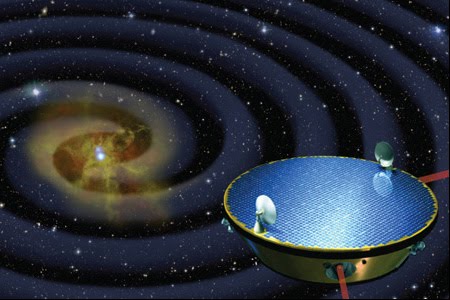
The proposed mission would amount to a giant triangle of three distinct spacecraft, each connected by laser beams. These spacecraft would fly in formation around the sun, about 20 degrees behind Earth. Each one would hold a cube made of platinum and gold that floats freely in space.
As gravitational waves pass by the spacecraft, they would cause the distance between the cubes, or test masses, to change by almost imperceptible amounts -- but enough for LISA's extremely sensitive instruments to be able to detect corresponding changes in the connecting laser beams.
"The gravitational waves will cause the 'corks' to bob around, but just by a tiny bit," said Glenn de Vine, a research scientist and co-author of the recent study at JPL. "My friend once said it's sort of like rubber duckies bouncing around in a bathtub."
The JPL team has spent the last six years working on aspects of this LISA technology, including instruments called phase meters, which are sophisticated laser beam detectors.
The latest research accomplishes one of their main goals -- to reduce the laser noise detected by the phase meters by one billion times, or enough to detect the signal of gravitational waves.



 Posts
Posts


